
What Attracts Western Conifer Seed Bugs to Your House?
At a glance
- Short answer: Western conifer seed bugs aren't coming in for food or warmth. They want winter shelter, and a nearby pine or spruce predicts which house gets them.
- The verdict: The belief is wrong
The attractant verdict
Four possible answers to why this species turned up. Three stay unlit — and that's the argument: the honest answer could have been any of them, and for this species it wasn't.
Western conifer seed bugs aren't coming in for food or warmth. They want winter shelter, and a nearby pine or spruce predicts which house gets them.
Our own previous page said this bug is "primarily attracted to your house because of its need for warmth and shelter, especially during colder months," language that's directionally accurate about shelter but leaves warmth doing more explanatory work than it should, and says nothing about the host-tree proximity that actually predicts the problem.
A nearby host conifer — pine, spruce, Douglas fir, or hemlock — where the bug fed and developed over summer, often planted directly next to the house. As the weather cools, adults search for a sheltered overwintering site, and a structure that close is the obvious option.
“It isn't warmth from the house. It's whichever pine or spruce is planted next to it — that's what predicts which house gets found.”
Proximity to a host conifer — pine, spruce, Douglas fir, or hemlock — where the bug feeds on developing cones and needles all summer. Extension entomology notes these host trees are often planted or growing directly near homes, and that when they are, the bugs seek out the nearby buildings as an overwintering site.
It shifts the explanation away from anything the house is doing (warmth, shelter as an abstract quality) and onto a concrete, checkable landscape fact: whether a host conifer is planted close by, which is the actual reason one house gets swarmed and a similar house down the street doesn't.
Calibrated from: University of Minnesota Extension — Western Conifer Seed Bug and Hackberry Psyllids, https://extension.umn.edu/nuisance-insects/western-conifer-seed-bug-and-hackberry-psyllids
Why it's here, in full
It can't reproduce indoors — the host tree is the whole story
Western conifer seed bugs feed on the developing seeds and needles of conifers — pine, spruce, Douglas fir, and hemlock among them — and that relationship is not optional or supplementary; it's the entire reproductive cycle. Iowa State University Extension is explicit that the bugs "cannot reproduce inside the house, as egg laying and development are restricted to the host plants during the summer months." That means a house can host overwintering adults, but it can never be the reason the population exists in the first place — that's entirely a function of a nearby conifer.
Our old page's "need for warmth and shelter" framing describes what the bug wants once it's moving toward a structure in fall, but skips the more useful, checkable fact: whether a host conifer is close enough to feed the population that later shows up at the door.
Why some houses get swarmed and others don't
University of Minnesota Extension notes these bugs search for sheltered places to spend the winter as the weather cools in fall, and it's common to see them indoors on mild winter or early spring days. Separately, extension sources describing the eastern range of this originally western species note that host conifers are "often planted or are growing near homes, and if that is the case, the bugs may seek the nearby buildings as an overwintering site." That's the real, actionable variable: a house next to an ornamental pine, spruce, or hemlock is far more likely to see this bug than a similar house without a host tree close by, regardless of anything about the house itself.
How to tell it's actually this species
Real signs only — a species with four honest tells gets four, and stops. Where a sign is weak on its own, we say so.
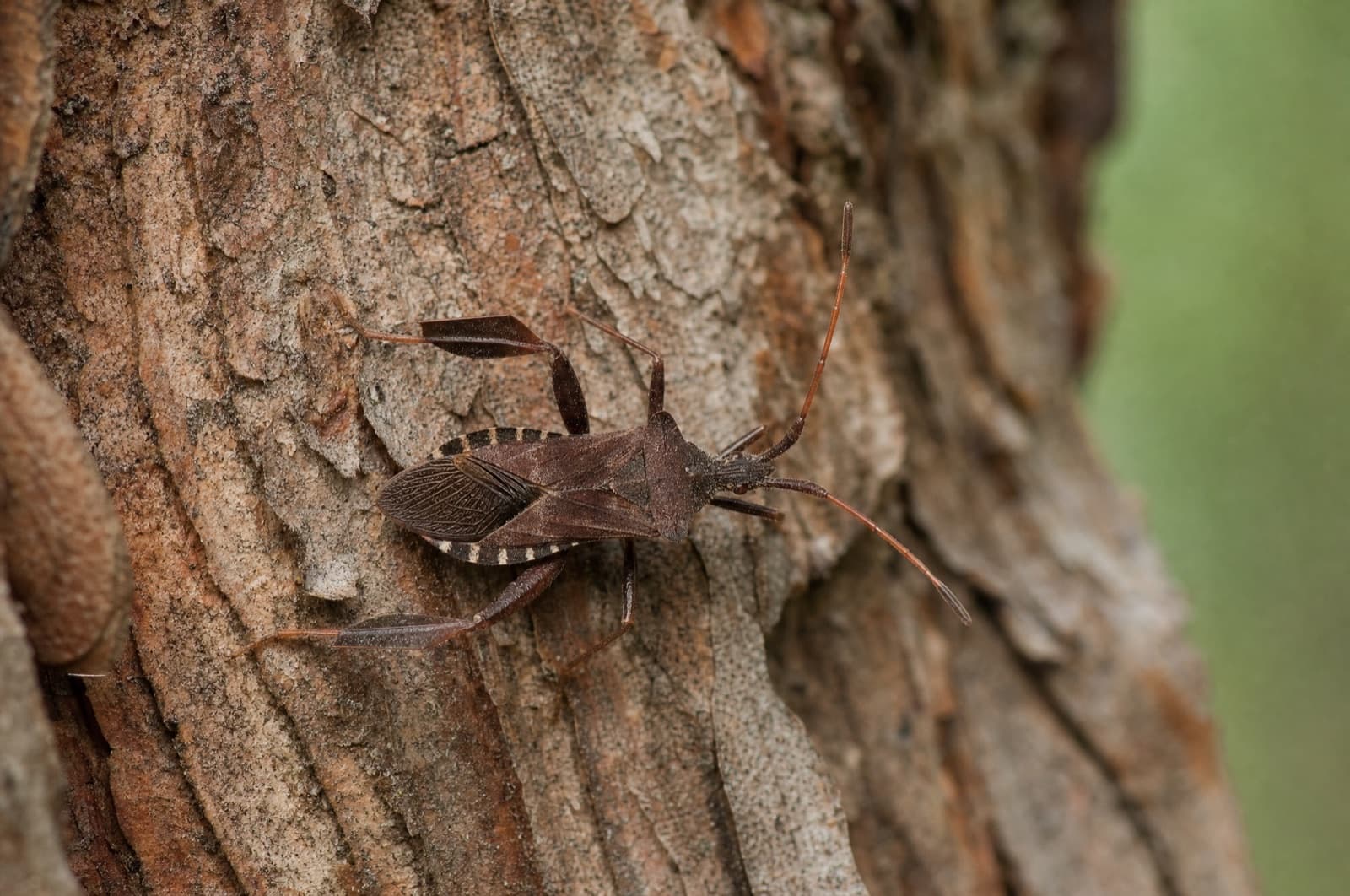
A large, reddish-brown, leaf-footed bug with a white zigzag line across its wings, found resting on a sunny wall in late summer or fall
Bugs found indoors on mild winter or early spring days, often near windows
Could be something else: This reflects an already-sheltering population being roused by warmth, not new arrivals or feeding activity.
A mature pine, spruce, fir, or hemlock tree growing on or near the property
A faint odor when a bug is handled or disturbed, though this species does not bite or sting
Want western conifer seed bugs gone?
This page only answers why it's here. Every removal step for this exact species — what to seal, what to set, what actually works — lives on its own dedicated guide.
Two questions, two pages
Here: why it turned up at all — the honest answer, blame removed.
There: the step-by-step removal guide for this exact species.
Key takeaways
- It isn't warmth from the house. It's whichever pine or spruce is planted next to it — that's what predicts which house gets found.
- It doesn't feed or breed indoors — it's only there for winter shelter.
- What actually matters: the outdoors nearby, shelter.
- If it's already inside, removal is a different question — see /top-diy-methods/western-conifer-seed-bug.
Finding these bugs on your walls or windows each fall?
This page is about why they showed up. Exclusion and removal options are covered at /top-diy-methods/western-conifer-seed-bug.
Frequently asked
Sources(2)
- [1]University of Minnesota Extension — Western Conifer Seed Bug and Hackberry Psyllids
Fall shelter-seeking behavior and indoor sightings on mild winter days
extensionverified 2026-07-17 - [2]University of Maine Cooperative Extension — Western Conifer Seed Bug
Host conifers planted near homes predicting which buildings the bugs seek out for overwintering
extensionverified 2026-07-17
Written & reviewed by
VerifiedDaniel Brady
NH-Licensed Pesticide Applicator · License #782664 (NHDAMF, RSA 430)
Daniel Brady is the New Hampshire–licensed applicator behind Anchor Pest Services, a family-owned pest control company serving the Manchester area since 2017.
Last updated Jul 2026
A nearby conifer explains it, not your house
Dealing with conifer seed bugs every fall?
Same-day inspections across southern and central New Hampshire — we'll help identify entry points and nearby host trees.
- Family-owned in Manchester since 2017
- NH commercial applicator #782664, category F1
- We will tell you when the answer is do nothing
NH License #782664 · No obligation · We answer in person