
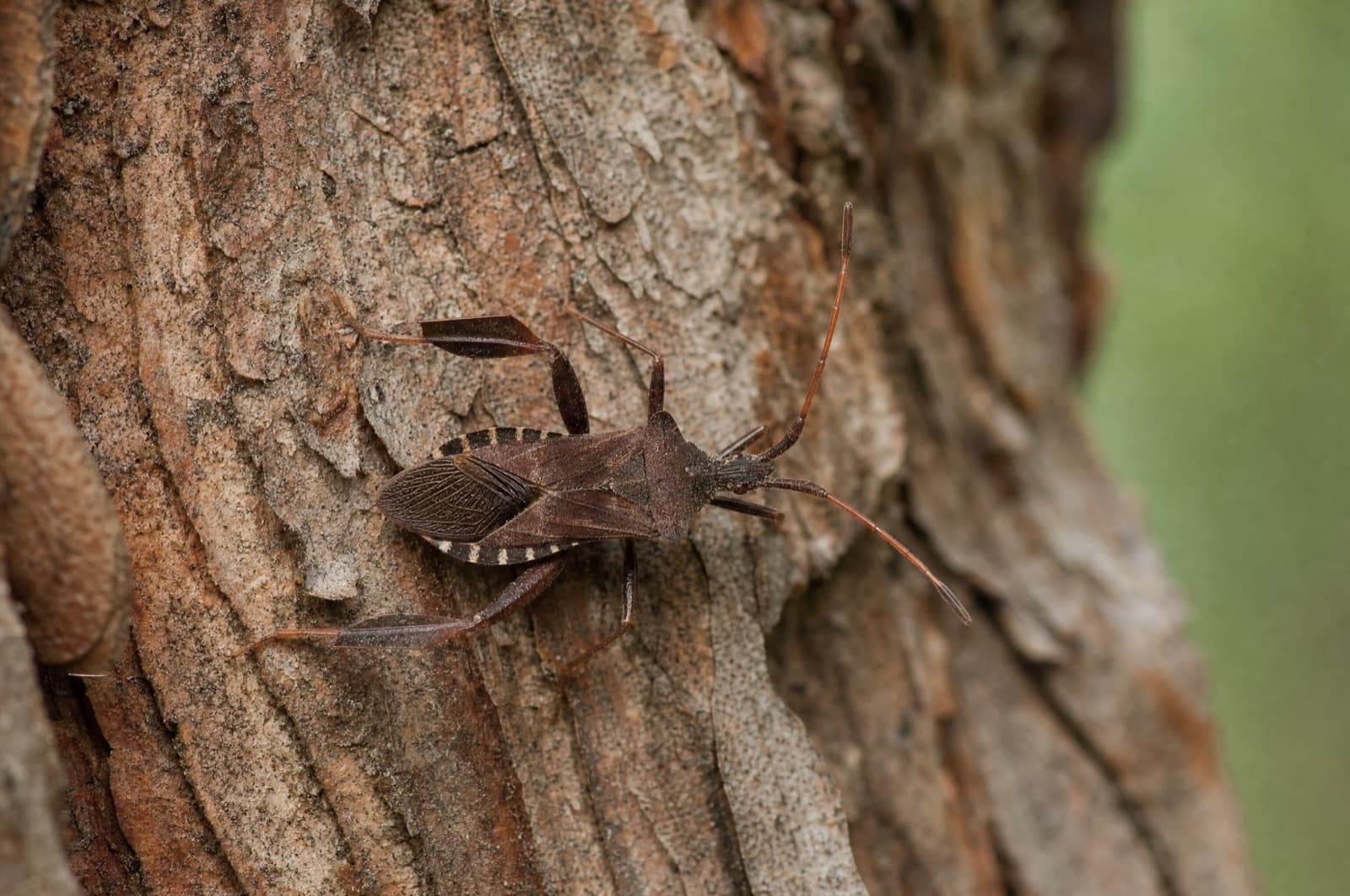
Western Conifer Seed Bug in New Hampshire — ID & Control
Also called WCSB · pine seed bug · leaf-footed bug · conifer seed bug
The western conifer seed bug is a large, harmless leaf-footed bug that feeds on pine and spruce cones and overwinters inside NH homes and buildings. It is frequently and alarming mistaken for a kissing bug or stink bug — it is neither. It does not bite, does not breed indoors, and does not damage your home. First confirmed in NH in 1997; now found statewide.
- Adult size
- ~¾ in (16–20 mm)
- Penn State Extension; USU Extension
- ID tell
- Leaf-shaped flares on the hind tibiae — unique among NH fall invaders
- UNH Cooperative Extension
- First NH record
- 1997, Cheshire and Sullivan counties; now statewide
- UNH Cooperative Extension
- Breeds indoors?
- No — one generation per year outdoors on conifers
- Penn State Extension
- Host plants
- Pine, spruce, hemlock, Douglas-fir, and other conifers
- MSU Extension
- Kissing bug?
- Not a kissing bug — completely harmless, does not bite people
- UNH Extension; UMaine IPM
The giant leaf-footed bug that scares people — but shouldn't
The western conifer seed bug (*Leptoglossus occidentalis*) triggers more alarm than any other NH fall invader — partly because of its size (it is the largest of the four common fall wall-clusterers at ~¾ inch), partly because of its bumblebee-loud buzzing flight when disturbed, and partly because alarmed internet searches often turn up the word 'kissing bug,' a genuinely dangerous triatomine from the South and Southwest.
The reassurance is categorical: the western conifer seed bug is not a kissing bug, not a stink bug, and not dangerous in any meaningful way. It does not bite or sting people, does not breed indoors, and does not damage your home or stored food. The leaf-shaped flares on its hind legs — the most distinctive feature of the family Coreidae — are the single best field ID, visible to the naked eye and seen on no other common NH home-entering insect.
UNH Cooperative Extension documents the first confirmed NH specimen in 1997 in Cheshire and Sullivan counties; it is now found statewide, aided by New Hampshire's abundant pine, spruce, and hemlock forests. Like the boxelder bug and brown marmorated stink bug, it masses on warm building exteriors in late summer and early fall before slipping through gaps to overwinter. The fix is identical: exclusion before mid-October. No spray needed.
How to identify the western conifer seed bug
Look for the leaf-shaped flares on the hind tibiae first — these expanded, flat, leaf-like plates on the rear legs are diagnostic for the family Coreidae and are visible to the naked eye. Add the ~¾ inch elongate body, reddish-brown color, faint white zigzag line across the back, and the bumblebee-loud buzzing flight when it takes off, and the ID is definitive.
Western conifer seed bug
- Scientific name
- Leptoglossus occidentalis
- Family
- Coreidae (leaf-footed bugs / squash bugs)
- Size
- 16–20 mm (~¾ in)
- Coloration
- Reddish-brown to dark brown; faint white zigzag line across the mid-back; yellow/orange and black abdomen revealed in flight; leaf-shaped hind-leg flares often banded
- Habitat
- Conifer forests (pine, spruce, hemlock, Douglas-fir) in summer; building wall voids and structural gaps for overwintering
- Active season
- Active on conifers spring through summer; enters buildings late August–October; overwinters indoors; emerges on warm winter/spring days
- Diet
- Sap of developing conifer cones and seeds (pine, spruce, hemlock, Douglas-fir); does not feed indoors
- Reproduction
- One generation per year in the US; eggs laid in chains on conifer needles (~2 mm); does not reproduce indoors
- Lifespan
- Adults overwinter and may live approximately one year
Native to the Pacific Northwest and western North America; spread east beginning in the 1950s; first NH record 1997 (Cheshire/Sullivan counties); now statewide across New England and into Europe
The tells — key ID features
- Leaf-shaped flares on the hind tibiae — flat, expanded plates visible to the naked eye; the single best field ID, seen on no other common NH home-entering insect.
- ~¾ inch, elongate body pointed at both ends — longer and narrower than a stink bug.
- Faint white zigzag line across the middle of the back.
- Bumblebee-loud buzzing flight when disturbed — often the first alert a homeowner has.
- Yellow/orange-and-black abdominal pattern visible in flight.
- Long antennae, about as long as the body, with no banding (unlike BMSB).
Size, to scale
16–20 mm (~¾ in)
About the length of the long side of a standard staple — longer and narrower than a stink bug (dime-sized); larger than a boxelder bug (aspirin-sized)
Kissing bug (Triatoma spp.) — the alarming misID
How to tell — Kissing bugs are a southern/southwestern species not established in NH. WCSB has distinctive leaf-shaped hind-leg flares that kissing bugs lack entirely. WCSB is reddish-brown overall; kissing bugs have a more orange-and-black banded abdomen. If you see leaf-feet, it is WCSB — not a kissing bug.
Brown marmorated stink bug
How to tell — BMSB is wider and shield-shaped, about the size of a dime, with banded antennae and no leaf-shaped legs. WCSB is longer, narrower, and has the unmistakable leaf-feet.
Squash bug (Anasa tristis)
How to tell — Squash bug is darker, flatter, found on squash plants in gardens, and lacks the leaf-shaped tibiae of WCSB. It does not typically enter homes in fall.
Wheel bug or assassin bug
How to tell — Assassin bugs have a distinctive curved beak held under the body and a cog-like crest on wheel bugs. No leaf-feet. WCSB has the leaf-foot tell that ends the confusion.
Signs of a problem
The WCSB's large size and loud flight make it one of the most noticed fall invaders in NH homes. Here is what each sign means.
Large brown bugs with leaf-shaped hind legs buzzing loudly into windows or walls in late summer and fall
What it means — Classic WCSB fall aggregation — seeking overwintering sites before frost, not establishing a breeding population.
Bugs on warm, sunny walls or near conifer trees in late August–September
What it means — Pre-overwintering aggregation; they are moving from nearby pines or spruce to the building as fall approaches.
A piney or pungent smell when a bug is handled or disturbed indoors
What it means — WCSB releases a defensive scent when threatened — it is not a true stink bug but has a similar chemical defense. Confirms WCSB identity.
Bugs emerging near windows on warm winter or spring days
What it means — They overwintered successfully in your wall voids and are trying to exit to the outdoors — they did not breed indoors.
Rare: tiny pinhole water leak appearing near PEX plumbing
What it means — An unusual but documented behavior — WCSB can probe PEX tubing with its piercing beak, occasionally causing a tiny puncture. Rare and not a structural concern.
The real risks, calibrated
The western conifer seed bug is one of the lowest-risk fall home invaders in New Hampshire. The kissing-bug confusion drives unwarranted fear — the honest verdict is genuinely reassuring.
Piney defensive odor
Low riskOnset: Immediately when handled or disturbed
WCSB releases a piney or pungent defensive scent — noticeable but not hazardous. Avoid handling barehanded; the scent dissipates quickly.
Bite or sting
Low riskOnset: Not applicable — does not bite people
The WCSB has a piercing beak used only for feeding on conifer sap and seeds. UNH Extension and UMaine IPM confirm it does not bite people. The kissing-bug fear is unfounded.
Rare PEX plumbing probe
Low riskOnset: Uncommon — documented in research literature
WCSB has been documented probing PEX plumbing tubing in homes, potentially causing a tiny pinhole leak. This is rare and not a routine concern for most NH homeowners.
Home or structural damage
Low riskOnset: Not applicable
WCSB does not feed on wood, stored food, fabric, or any household material. No structural or property damage documented.
DIY — what works, what backfires
WCSB control is an exclusion problem, not a spray problem. The goal is to prevent entry before mid-October. Once inside wall voids for winter, the bugs are inaccessible and harmless.
What actually works
- Seal all cracks and gaps before fall: caulk around windows, doors, siding laps, utility penetrations, soffit seams, and pipe entries — focusing on south- and west-facing walls near conifer trees.
- Screen soffit vents, gable vents, and chimney openings with fine mesh (1/16 inch or smaller) before late August.
- Replace worn door sweeps and repair window screens before September.
- Vacuum indoor bugs — they are harmless; dispose of the bag outdoors.
- Hand-remove or gently sweep outdoor wall clusters into soapy water rather than crushing them (to avoid odor).
What backfires
- Don't panic — it is not a kissing bug. WCSB is completely harmless to people.
- Don't crush it indoors — it releases a piney odor.
- Don't rely solely on caulk on vinyl-sided homes — MSU Extension notes that caulk cannot seal all the channels in vinyl siding; combine caulk with other exclusion methods.
- Don't assume insecticide spray will stop the fall influx — exclusion is the only durable solution.
Western conifer seed bug in New Hampshire
The WCSB arrived in New Hampshire in 1997 (first specimens in Cheshire and Sullivan counties, per UNH Extension) and is now confirmed statewide. Its spread across New England has been facilitated by the region's abundant conifers — pine, spruce, and hemlock are all host species — making NH particularly hospitable. Homes near pine or spruce stands, including much of the Lakes Region, Merrimack Valley, and Monadnock region, see significant fall entry. Peak entry in southern NH is late August through October, matching the Manchester first-frost window (~Oct 19 at 50%; Oct 29 at 80% per NOAA 1991–2020). Anchor's service area from Manchester to Derry and Bristol regularly encounters WCSB calls in September and October.
Peak season
Late summer through fall (August–October); overwinters in wall voids and structural gaps
You might actually have
- Brown marmorated stink bug (same fall clustering, wider, banded antennae)
- Boxelder bug (same fall clustering, smaller, black/red)
- Cluster fly (same fall overwintering, different cluster)
- Multicolored Asian lady beetle (same fall clustering, orange/spotted, different cluster)
We serve these communities
- NH-licensed applicator · #782664
- Same-day service
- Family-owned since 2017
Service Area Map
Southern New Hampshire
When to call Anchor Pest Services for western conifer seed bugs
WCSB entry is largely preventable with timely exclusion. Professional help is most valuable when large populations are entering despite DIY efforts, when complex or multi-story homes have entry points a homeowner cannot locate, or when homes are immediately adjacent to conifer stands that produce large annual populations.
When to call a pro
- Large fall populations entering living space despite caulking and screening attempts.
- You cannot locate or seal all entry points on a complex exterior, multi-story home, or older cedar-sided NH house.
- Home is immediately adjacent to pine or spruce forest with recurring large annual WCSB populations.
- You want a pre-fall exterior inspection before September to identify and seal all vulnerable points.
Complete exclusion by mid-August — earlier than the other fall invaders
WCSB begins moving from conifers to buildings as early as late August in NH, slightly earlier than BMSB or boxelder bugs. Complete caulking and screen repairs before August 20 to close the earliest entry window.
Screen all vents with 1/16-inch mesh
WCSB is large enough that coarser mesh can exclude it, but smaller insects may exploit the same vents. Consistent fine-mesh screening of soffit, gable, and ridge vents is the most effective year-over-year prevention step.
Trim conifer branches away from the building
WCSB moves from conifer trees to buildings directly when branches touch or overhang the structure. Maintaining a gap between conifers and the roofline reduces the bridge these insects use to reach the building.
Not sure it's a western conifer seed bug?
A licensed NH technician can confirm the species and tell you honestly whether it's a DIY fix or a job for a pro — free inspection, same-day service across Southern New Hampshire.
Frequently asked questions
Sources(6)
- [1]UNH Cooperative Extension — Seasonal Insect Invaders in NH Homes
First NH record 1997 (Cheshire/Sullivan counties); now statewide; leaf-tibiae ID; exclusion guidance
extensionverified 2026-06-30 - [2]Penn State Extension — Western Conifer Seed Bug
Adult size 16–20 mm; biology; one generation per year; no indoor reproduction; exclusion as primary management
extensionverified 2026-06-30 - [3]Utah State University Extension — Western Conifer Seed Bug
Size reference; western US native range; spread east from 1950s
extensionverified 2026-06-30 - [4]Michigan State University Extension — Western Conifer Seed Bug
Host conifers (pine, spruce, hemlock, Douglas-fir); vinyl siding caulk limitation; eggs ~2 mm laid in chains
extensionverified 2026-06-30 - [5]University of Maine Cooperative Extension — WCSB IPM
Does not bite people; rare PEX plumbing probing behavior; NH/NE presence
extensionverified 2026-06-30 - [6]Garden.org — NOAA Frost Date Calculator (Manchester, NH)
Manchester first hard frost ~Oct 19 (50%) / Oct 29 (80%), NOAA 1991–2020 normals
govverified 2026-06-30
Written & reviewed by
VerifiedDaniel Brady
NH-Licensed Pesticide Applicator · License #782664 (NHDAMF, RSA 430)
Daniel Brady is the New Hampshire–licensed applicator behind Anchor Pest Services, a family-owned pest control company serving the Manchester area since 2017.
Last updated 2026-06-30

New Hampshire pest control
Dealing with western conifer seed bugs in your home?
Anchor Pest Services identifies and handles western conifer seed bug problems across southern and central New Hampshire. Family-owned since 2017, NH license #782664.
- NH-licensed applicators (#782664)
- Same-day service · free inspection
- Family-owned since 2017
Your next step
- Fall guide
Fall Pest Control in New Hampshire
What matters before frost: the fall invader window, mice at the foundation, and what to seal first.
Read the answer - What to do next
How do I recognize a stink bug infestation?
Read the answer - What to do next
How to Get Rid of Elm Seed Bugs
Read the answer - What to do next
Where Do Bugs Go In The Winter?
Read the answer - What to do next
Box Elder Bugs in the House in Winter — NH Timing Guide
Read the answer - Related guide
Elm Seed Bug — ID and Whether It's Really in New Hampshire
Read the answer