
Skip to content
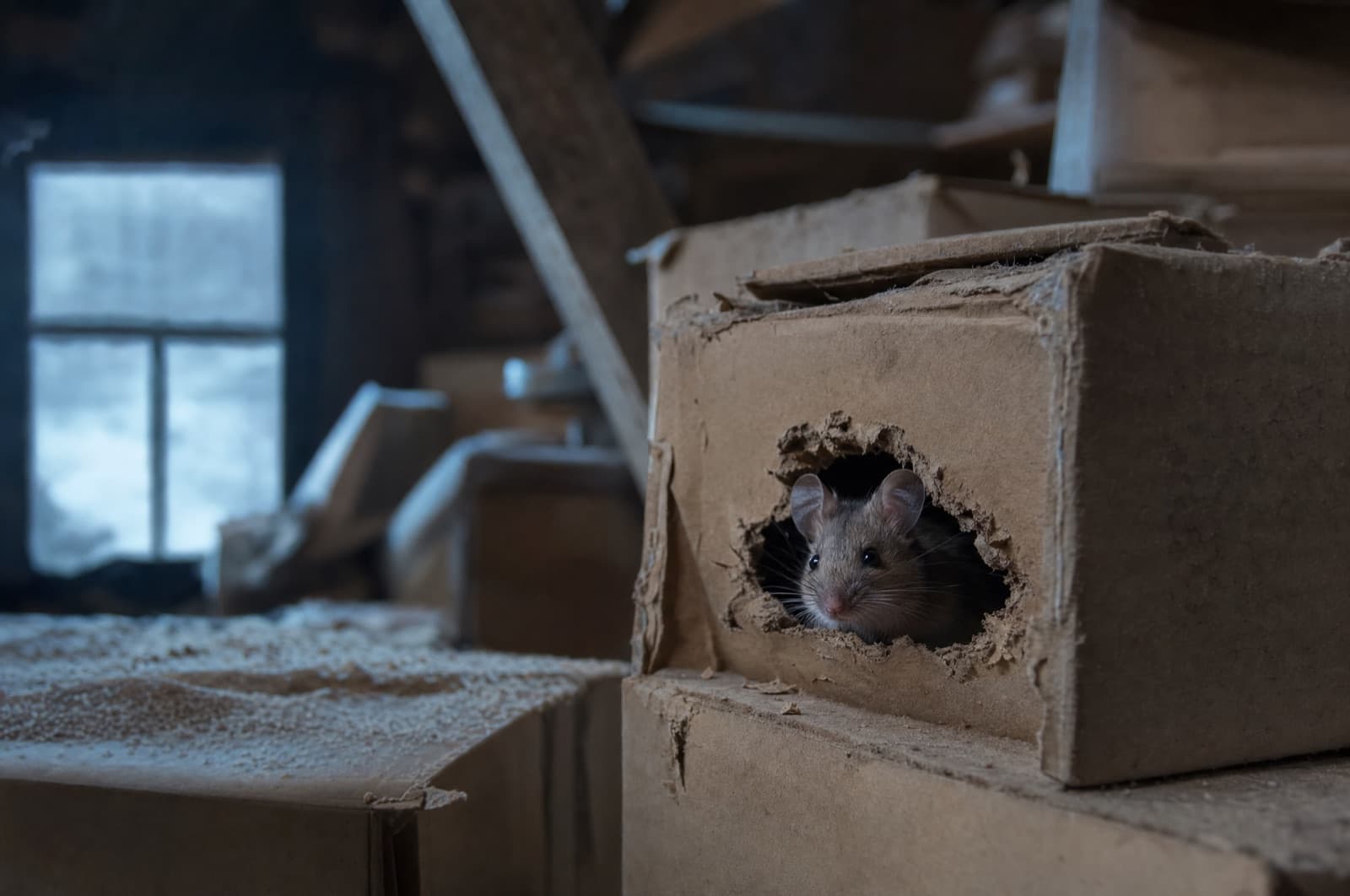
A house mouse in a gnawed cardboard storage box in a cold New Hampshire attic
Daniel Brady · NH-Licensed Pesticide Applicator · License #782664
Reviewed by Daniel Brady

Do pests damage holiday lights or wiring during winter storage?

Yes
Yes. Rodents gnaw wire insulation as part of ordinary, obligate tooth maintenance, and the plastic coating on a coiled string of holiday lights is exactly the soft, edged material they defeat easily. In storage, a box of lights sitting in a garage or attic for eleven months offers both the cable to chew on and, if it's a cardboard box, the nesting material to go with it. The risk isn't just dead lights next December — gnawed insulation on an energized cord is a documented fire-safety issue, which is why extension entomologists flag rodent wire damage specifically.

At a glance

  • The verdict: Yes
The honest answer

The short of it

The verdict
Yes

Rodents gnaw stored light strings and cords for the same reason they gnaw everything else — teeth maintenance, not hunger — and a cardboard box gives them nesting material to go with it.

What actually happens

The busted assumption

Yes

What people assume

That lights sealed in their original packaging, with no food nearby, are safe because 'there's nothing to eat.' Rodents don't gnaw only in search of food — their incisors grow continuously and must be worn down constantly or the animal develops malocclusion, so unbaited cable is still a target purely because it's chewable. The cardboard box itself compounds the risk, since it's nesting material independent of anything electrical inside it.

What actually happens

House mice 'gnaw through electrical wiring, causing fires and failure of freezers, clothes dryers and other appliances' (University of Kentucky Entomology), and University of Nebraska–Lincoln Extension photographs an appliance cord 'severely damaged by house mice' as a documented example of the pattern. A coiled string of lights in a storage box presents the same soft, edged, easily-gnawed target as any other cable a rodent encounters — there's nothing about holiday lights specifically that makes them safer than any other wiring in a garage.

What it means for you
Store light strings and extension cords in hard-sided, sealed containers — metal or thick plastic with a tight lid — off the floor and away from other nesting clutter. Inspect every string before plugging it in each year; if insulation looks gnawed or frayed anywhere along its length, discard that string rather than energizing it. None of this requires a service call — it's the same container logic that applies to any stored attractant in an unheated New Hampshire garage or attic.
In depth

The full picture

01

Why wiring specifically is a target, not just an accident

It's tempting to think of chewed wiring as collateral damage from a rodent looking for food nearby, but the mechanism is more direct than that. Rodent incisors are open-rooted and grow continuously through the animal's life, so gnawing on hard-ish, edged material is routine wear-and-tear maintenance rather than a foraging behavior. That's the same biology behind rodents chewing plastic storage totes, and it applies just as directly to the insulated copper inside a string of holiday lights.

University of Kentucky Entomology documents the consequence plainly: mice 'gnaw through electrical wiring, causing fires and failure of freezers, clothes dryers and other appliances.' That's not a hypothetical — it's cited as an established pattern in appliance and structural wiring, and a coiled cord in a cardboard box is an easier target than most of the wiring in a house, because it's unprotected and often sitting right next to the nesting material a mouse would use anyway.

02

What actually protects a string of lights over a winter

The fix mirrors the storage cluster's established answer for any attractant: get it out of a soft, open container and into something hard-sided with a tight lid, off the floor. A metal storage box or a thick plastic bin with a good gasket does most of the real work; a cardboard box, even a sturdy one, gives a rodent both the cable and the bedding in the same package.

Before plugging any stored string back in, run your hand along its length and look closely at the insulation. Gnawed spots expose bare wire, and an energized bare wire is a fire risk independent of whether the light string still technically works — this is the one place in the storage cluster where the honest advice is 'discard it,' not 'patch it.'

Key takeaways
6 points
  • Yes — rodents gnaw stored light strings and cords for tooth maintenance, not because there's food nearby.
  • Documented consequence: gnawed wiring has caused appliance failures and fires (University of Kentucky Entomology).
  • A cardboard storage box compounds the risk by supplying nesting material alongside the cable.
  • Store lights and cords in hard-sided, sealed metal or thick plastic containers, off the floor.
  • Inspect every string before use each year — discard, don't patch, anything with gnawed insulation.
  • This is DIY prevention; no treatment or service call is required for the storage itself.
New Hampshire context

A New Hampshire garage over a full winter

Manchester's first hard frost lands roughly October 19 to 29 (NOAA), right around when most households pack decorations away for the season — and a box of lights put into an unheated garage or attic at that point typically sits undisturbed until it comes back out in late November or December, close to a two-month window at minimum, sometimes longer if lights are stored year-round in the same spot.

That's ample time for a rodent that's taken up residence nearby to work through a cord's insulation. If you pull out a light string and find bite marks or exposed wire, don't plug it in — and treat it as a reason to check the rest of what's stored in that space for the same pattern.

  • NH-licensed #782664

    Southern New Hampshire

  • Family-owned

    Since 2017

  • Honest routing

    Even when it isn’t us

We serve these communities

ManchesterNashuaConcordDerryBedfordSalemHudsonAmherst
The other half of this question

Want the materials answer rather than the storage answer?

This page is about the winter-storage scenario — your bins, decorations and stored food in an unheated New Hampshire garage or attic, and what actually holds. The damage guide answers the other half: what pests can and cannot chew across the whole house, what genuinely isn’t at risk, and what a repair actually involves.

Read the materials answer

Gnawed insulation is a symptom. The source is worth finding.

Swapping to hard-sided storage fixes next year's lights. If you're finding rodent damage in the garage generally, that's an exclusion question worth a professional look.

Follow-up questions

Frequently asked

Sources & citations(4)
  1. University of Kentucky Entomology — Control of Mice (EF617)

    Mice gnaw through electrical wiring, causing fires and appliance failure

    extensionverified 2026-07-16
  2. University of Nebraska–Lincoln Extension — Rodent-Proof Construction

    Documented example of an appliance cord severely damaged by house mice; rodents gnaw soft materials readily

    extensionverified 2026-07-16
  3. Nature — Lab Animal: Give a rat a bone — satisfying rodents' need to gnaw

    Rodent incisors grow continuously; gnawing is obligate wear rather than food-seeking

    academicverified 2026-07-16
  4. NOAA — Manchester, NH freeze climatology

    Manchester first hard frost typically ~Oct 19-29

    govverified 2026-07-16

Written & reviewed by

Verified

Daniel Brady

NH-Licensed Pesticide Applicator · License #782664 (NHDAMF, RSA 430)

Daniel Brady is the New Hampshire–licensed applicator behind Anchor Pest Services, a family-owned pest control company serving the Manchester area since 2017.

Verify license

Last updated Jul 2026

Honest pest help for New Hampshire homes

We Handle the Rodents, Not the Storage Bins.

Protecting stored lights is a container swap you can do yourself. Anchor Pest Services is worth calling when rodents are actually established in the structure. Family-owned since 2017, NH license #782664, serving Manchester, Nashua, Concord and nearby towns.

  • Honest advice — we'll tell you when a hardware-store fix beats a service call
  • NH-licensed applicators (#782664) — free inspection, same-day service
  • Rodent exclusion and winter pest control across southern and central New Hampshire

NH License #782664 · No obligation · We answer in person