
Skip to content
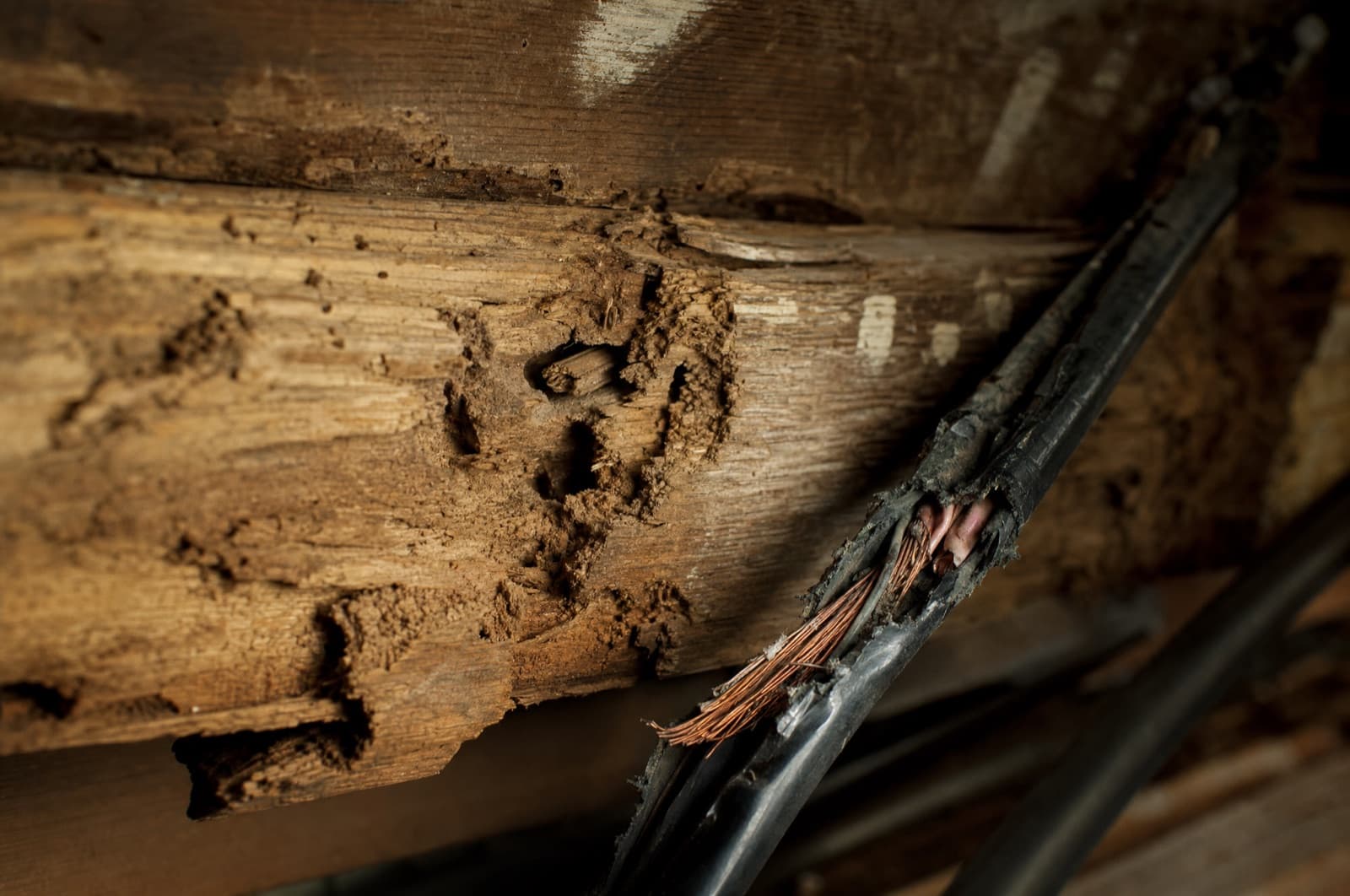
Pest damage evidence — a gnawed structural beam and a chewed electrical wire
Daniel Brady · NH-Licensed Pesticide Applicator · License #782664
Reviewed by Daniel Brady

Do pests chew through plastic or rubber materials?

Functional damage — real
Yes. Rodents readily gnaw plastic and rubber — wire insulation, PEX and PVC supply lines, storage bins, foam board, weatherstripping — because their incisors never stop growing and must be worn down. But they cannot chew solid steel, cured concrete, glass, ceramic tile, or adequate-gauge hardware cloth, and a smooth, hard, edgeless surface gives them nothing to start on. The damage is functional — it breaks a system rather than weakening your house — and new gnawing stops as soon as the rodents are excluded.

At a glance

  • Can it?: Yes
  • How common: Routine
  • Hype: Overstated
  • Evidence: Well documented
  • 5.5 Mohs

    Hardness of rodent incisor enamel — harder than iron or copper, so soft plastics and metals shear easily

    Rat Behavior and Biology

  • 0.4 mm/day

    How fast a house mouse's rootless incisors grow, forcing constant gnawing

    Rat Behavior and Biology

  • <2%

    Share of tooth enamel made of iron-rich pockets — small in volume but decisive for the cutting hardness

    ACS Nano

The honest answer

The short of it

The verdict
Functional damage — real

Yes, rodents chew plastic and rubber routinely — but the honest story is everything they can't chew: copper pipe, steel, cured concrete and glass stop them cold.

The correction

What they claim vs. what the evidence supports

One shared severity track, two markers. The span between them is the hype delta — named out loud.

The claim — rodents chewing through plastic, rubber, and household materials

That rodents can chew through "almost anything" — commonly including concrete, steel, and metal pipe — framing them as essentially unstoppable and every plastic component in your home as equally doomed.

Where the claim comes from: Pest-company blog copy and viral home-maintenance posts, which repeat the "chews through anything" line because an unstoppable pest sells an urgent service call.

Severity, 0–100
Hype says80
55Evidence says
Hype delta25point gapWell documented
The evidence

Rodent incisor enamel is roughly 5.5 on the Mohs scale — genuinely harder than iron or copper — so soft polymers, foam, drywall, and soft metals like aluminum flashing are breached easily and often. But hardness is only half the story: rodents need an edge or a rough surface to start on, and field and patent literature describes them testing a pipe and moving away when it is rigid. Solid steel, cured concrete, glass, ceramic tile, and adequate-gauge galvanized mesh are not breached.

The gap

They chew plastic and soft metal, yes — and that's worth fixing. But "chews through anything" is false, and it matters, because the materials that actually stop a rodent are cheap, ordinary, and sitting in every hardware store.

Damage assessment

What is actually harmed

Damage verdict
Functional damage — real
FunctionalCan it?Yes
The specimen
Pest
House mice, Norway rats, and roof rats (plus squirrels in attics and garages)
What is in question
Plastic and rubber components — wire insulation, supply lines, bins, foam, seals
How common
Routine
Evidence
Well documented
Mechanism

Rodent incisors are rootless and grow continuously — a mouse's grow roughly 0.4 mm a day — and unworn incisors cause malocclusion and eventual starvation. Gnawing is obligate wear, not hunger, which is why nothing edible needs to be involved. Recent neuroscience (Neuron, 2026) shows gnawing is also a dopamine-rewarded motivated behavior rather than a purely mechanical reflex. The incisor's iron-rich outer enamel puts it around 5.5 Mohs, letting it shear soft polymers and soft metals — but only where there is an edge, seam, or rough spot to purchase on.

Actually at risk7
  • Wire and cable insulation (the highest-consequence target — see the electrical pages)
  • PEX and PVC water-supply lines, especially flexible and low-density runs
  • Foam board and expanding spray-foam air sealing
  • Plastic storage bins and "airtight" food containers
  • Vapor barriers, weatherstripping, and rubber door sweeps
  • Soft metals — aluminum flashing, lead, thin copper sheet
  • Automotive wiring looms and vacuum lines in stored vehicles
Not at risk — despite the myth5
  • Copper pipe — rigid and edgeless; rodents test it and move on
  • Steel — studs, plates, and solid hardware
  • Cured concrete and masonry foundations
  • Glass and ceramic tile
  • Galvanized or stainless hardware cloth of an adequate gauge (the standard exclusion material precisely because it works)
Worst realistic case
A chewed supply line that leaks, or a damaged wire run that has to be replaced once the rodents are gone — a real repair, and occasionally an expensive-in-effort one. Not structural failure, and not your house collapsing.

Assessed from: ratbehavior.org (incisor hardness, citing primary literature); ACS Nano 2024 (iron-rich enamel); Neuron 2026 (motivated gnawing); USPTO US10278380 (pipe hardness field observation); ICWDM/extension exclusion guidance

The compounding clock

Does it get worse if you ignore it?

Over time
Compounds

It compounds only while the rodents are there — and stops the day they're excluded.

The timeline
3 stages
  1. DaysReversible

    Exploratory gnawing at an existing edge or seam — a bin corner, a foam gap, a cable tie. Usually invisible unless you're looking.

  2. WeeksReversible

    Established runways mean repeated gnawing in the same spots. Wire insulation is stripped; a flexible supply line may be thinned. Droppings and rub marks appear along the route.

  3. MonthsReversible

    A breached supply line can leak, and stripped wiring can fault. The damage is now a repair job for the relevant trade rather than a patch — but the building itself is still sound.

What stops the clock
Exclusion. Seal entries with steel wool and mortar, sheet metal, or adequate-gauge hardware cloth, and remove the animals — the gnawing ends because the gnawer is gone. Replacing chewed material while rodents are still active just gives them fresh plastic.
Repair scope

Who actually fixes this

Scope, not dollars — the honest answer to “how expensive is it,” routed to the right trade.

Who fixes it
Pest pro first
Effort
A trade visit

Nothing you repair stays repaired while rodents are still inside. The pest has to be resolved first — that part is squarely Anchor's lane — and only then does the damaged system get fixed by whoever owns that system.

The right order
  1. 1
    Resolve the rodents: exclusion, removal, and sealing every entry with materials they cannot breach (steel, mortar, adequate-gauge mesh)
  2. 2
    Then repair the damaged system — an electrician for any chewed wiring, a plumber for a breached supply line, an insulation contractor for ruined foam or batts
  3. 3
    Replace contaminated or chewed materials last, once nothing is coming back for them
Route by symptom
  • Licensed electricianAny wire insulation has been stripped or a circuit is behaving oddly — energized work is never a pest-control job and never a DIY job
  • PlumberA PEX or PVC supply line has been gnawed, or you find unexplained damp near a run
  • You — a DIY patchThe damage is limited to bins, weatherstripping, or a foam gap — swap the material and seal the gap with something they can't chew
Do not
  • Don't replace chewed wiring, pipe, or insulation while rodents are still active — you are buying them new material
  • Don't plug entry holes with expanding foam, plastic, or steel-free filler; they chew straight back through it
  • Don't investigate a suspected chewed wire yourself — that's an electrician's call
Where we help — and where we don't

Anchor stops the rodents and seals the entries — that is genuinely our work, and it's the step that makes every other repair hold. We do not do the electrical or plumbing repair itself, and we'll tell you that up front rather than quoting you for it.

In depth

The full picture

01

Why rodents chew things they have no intention of eating

The single most useful fact about rodent gnawing is that it has nothing to do with hunger. Rodent incisors are rootless and grow continuously — a house mouse's grow roughly 0.4 millimeters every day — and a rodent that stops wearing them down develops malocclusion and eventually starves. Gnawing is obligate maintenance.

That's why food storage isn't the whole answer, and why a spotless garage still gets chewed wiring. Recent work in Neuron (2026) went further and showed that gnawing is a dopamine-rewarded, motivated behavior rather than a passive mechanical response: disrupting the neural circuit abolished gnawing and produced severe malocclusion, while activating it triggered dopamine release. As the study's lead author put it, the old view was that gnawing was "a very passive behavior driven by mechanical considerations." It isn't. Your PEX line is a chew toy that happens to also be a chew toy they're rewarded for using.

02

What they can actually breach — and why plastic loses

Rodent incisor enamel sits around 5.5 on the Mohs scale, harder than iron, copper, platinum, and human enamel. The hardness comes from an iron-rich outer enamel layer; work published in ACS Nano (2024) found those iron-rich pockets make up less than two percent of the enamel by volume yet are decisive for its mechanical properties and acid resistance.

Against that, ordinary building plastics don't stand a chance: PEX and PVC supply lines, wire and cable insulation, foam board, expanding spray foam, vapor barriers, storage bins, weatherstripping, and soft metals like aluminum flashing and lead are all routinely breached. Flexible PVC and low-density polyethylene are chewed noticeably more than rigid PVC and high-density pipe — a distinction the exclusion literature has recognized for a long time.

03

What stops them cold — the part nobody publishes

Hardness is only half the mechanism. A rodent also needs an edge, seam, or rough spot to get its incisors around. A patent summarizing field and laboratory experience with rodent pipe damage describes the behavior plainly: the rodent first feels the pipe, and if it is hard like a rock, it moves away.

So the honest list of what rodents cannot chew is short, cheap, and boring: solid steel, cured concrete, glass, ceramic tile, and galvanized or stainless hardware cloth of an adequate gauge. That last one is not a coincidence — hardware cloth is the standard exclusion material precisely because decades of wildlife-damage-management practice found it holds. Standard extension guidance is to seal openings larger than about a quarter inch for mice and half an inch for rats, using materials from that list rather than foam or plastic.

This is why "they chew through anything" is worse than merely wrong. It's demoralizing, and it's the opposite of actionable. The real answer is that a rodent's list of victories is long but its list of defeats is specific, well known, and available at any hardware store.

04

Functional damage, not structural damage

It's worth being precise about what class of problem this is. Chewed plastic and rubber breaks systems — a supply line leaks, a wire faults, insulation stops insulating, a bin stops protecting what's in it. That's functional damage, and it's genuinely worth fixing.

What it isn't is structural. Rodents gnawing your PVC are not weakening your house. Framing, sheathing, and foundations are not on their menu, and no amount of chewed weatherstripping compounds into a compromised building. The pests that genuinely threaten structure are wood-destroying insects, and they're a different conversation entirely.

The one place this escalates in consequence rather than class is wiring, and it deserves care in both directions. Stripping the insulation off an energized conductor is a sound ignition pathway, and it's why chewed wire gets an electrician rather than a shrug. But you will also read that rodents cause 20 to 25 percent of house fires, and that figure appears in no fire-authority data — NFPA's research on home fires caused by electrical failure or malfunction identifies arcing as the leading factor and names no rodent factor at all. The mechanism is real; the number is invented. We give that its own honest treatment on the fire and wiring pages.

Key takeaways
5 points
  • Yes — rodents chew plastic and rubber routinely, and it's obligate incisor wear, not hunger. A clean house doesn't exempt you.
  • They cannot chew copper pipe, steel, cured concrete, glass, ceramic, or adequate-gauge hardware cloth. "Chews through anything" is false.
  • They need an edge to start on — smooth, hard, and rigid genuinely defeats them.
  • The damage is functional (it breaks a system), not structural (it doesn't weaken your house).
  • New gnawing stops when the rodents are excluded — so resolve the pest before you repair anything.
New Hampshire context

What this looks like in New Hampshire homes

Southern and central New Hampshire's rodent pressure is strongly seasonal: as overnight temperatures drop toward Manchester's first hard frost — historically around October 19 to 29 — house mice and Norway rats push indoors, and the gnawing complaints follow within weeks. The common local pattern is a garage or basement rim joist with a gap larger than a quarter inch, foam-sealed by a previous owner, and chewed straight back open.

Stored vehicles are the other regional classic. A car parked through a New Hampshire winter in an unheated garage is a warm, sheltered, undisturbed box full of exactly the soft polymers rodents prefer, and wiring looms are the usual casualty. If you're storing a vehicle seasonally, the entry points into the garage matter more than anything you put inside it.

  • NH-licensed #782664

    Southern New Hampshire

  • Family-owned

    Since 2017

  • Honest routing

    Even when it isn’t us

We serve these communities

ManchesterNashuaConcordDerryBedfordSalemHudsonAmherstAuburnGoffstownHooksettLitchfieldLoudonMilfordBristol

Service Area Map

Southern New Hampshire

BristolPop. 3,200LoudonPop. 5,500ConcordPop. 43,900HooksettPop. 14,800GoffstownPop. 18,000AuburnPop. 5,700ManchesterPop. 115,600BedfordPop. 23,300LitchfieldPop. 8,500AmherstPop. 11,300DerryPop. 34,500MilfordPop. 15,700HudsonPop. 25,600NashuaPop. 91,100SalemPop. 30,000HQCityHover for info

Rodents chewing your home's plastic? Stop the gnawer, not just the damage.

Anchor handles the part that makes every other repair hold — exclusion and sealing, with materials rodents genuinely can't chew.

Follow-up questions

Frequently asked

Sources & citations(7)
  1. Rat Behavior and Biology — incisor structure and hardness

    Rodent incisor enamel ~5.5 Mohs; continuous (rootless) incisor growth and obligate wear

    academicverified 2026-07-16
  2. ACS Nano — iron-rich enamel in rodent incisors (Max Planck Institute)

    Iron-rich enamel pockets are <2% by volume yet decisive for mechanical properties and acid resistance

    academicverified 2026-07-16
  3. Neuron — A Touch-Guided Neural Circuit Regulates Motivated Gnawing to Maintain Dental Alignment

    Gnawing is a dopamine-rewarded motivated behavior, not a passive mechanical reflex; disruption causes malocclusion

    academicverified 2026-07-16
  4. USPTO US10278380 — rodent-resistant pipe (field observation of gnawing behavior)

    Rodent pipe damage is determined by pipe hardness; the rodent feels the pipe and moves away if it is rigid

    academicverified 2026-07-16
  5. NFPA Research — Home Fires Caused by Electrical Failure or Malfunction (R. Campbell, 2019)

    Arcing is the leading factor in home electrical-failure fires; no rodent factor is identified in fire-cause data — the basis for correcting the circulating 20-25% claim

    fireverified 2026-07-16
  6. Internet Center for Wildlife Damage Management — rodent exclusion

    Seal openings >1/4 inch (mice) and >1/2 inch (rats); hardware cloth, steel, and mortar as exclusion materials

    extensionverified 2026-07-16
  7. UNH Cooperative Extension — rodents in and around the home

    New Hampshire seasonal rodent pressure and structural exclusion practice

    extensionverified 2026-07-16

Written & reviewed by

Verified

Daniel Brady

NH-Licensed Pesticide Applicator · License #782664 (NHDAMF, RSA 430)

Daniel Brady is the New Hampshire–licensed applicator behind Anchor Pest Services, a family-owned pest control company serving the Manchester area since 2017.

Verify license

Last updated Jul 2026

Honest pest help for New Hampshire homes

We Stop the Rodents. We'll Tell You Who Fixes the Rest.

Chewed wiring is an electrician's job and a breached supply line is a plumber's — we won't quote you for either. What Anchor Pest Services does is the step that makes those repairs stick: removing the rodents and sealing every entry with steel, mortar, and mesh they can't breach. Family-owned since 2017, NH license #782664, serving Manchester, Nashua, Concord and nearby towns.

  • Honest advice — we route you to the right trade, even when it isn't us
  • NH-licensed applicators (#782664) — free inspection, same-day service
  • Rodent exclusion and structural pest control across southern and central New Hampshire

NH License #782664 · No obligation · We answer in person