
Skip to content
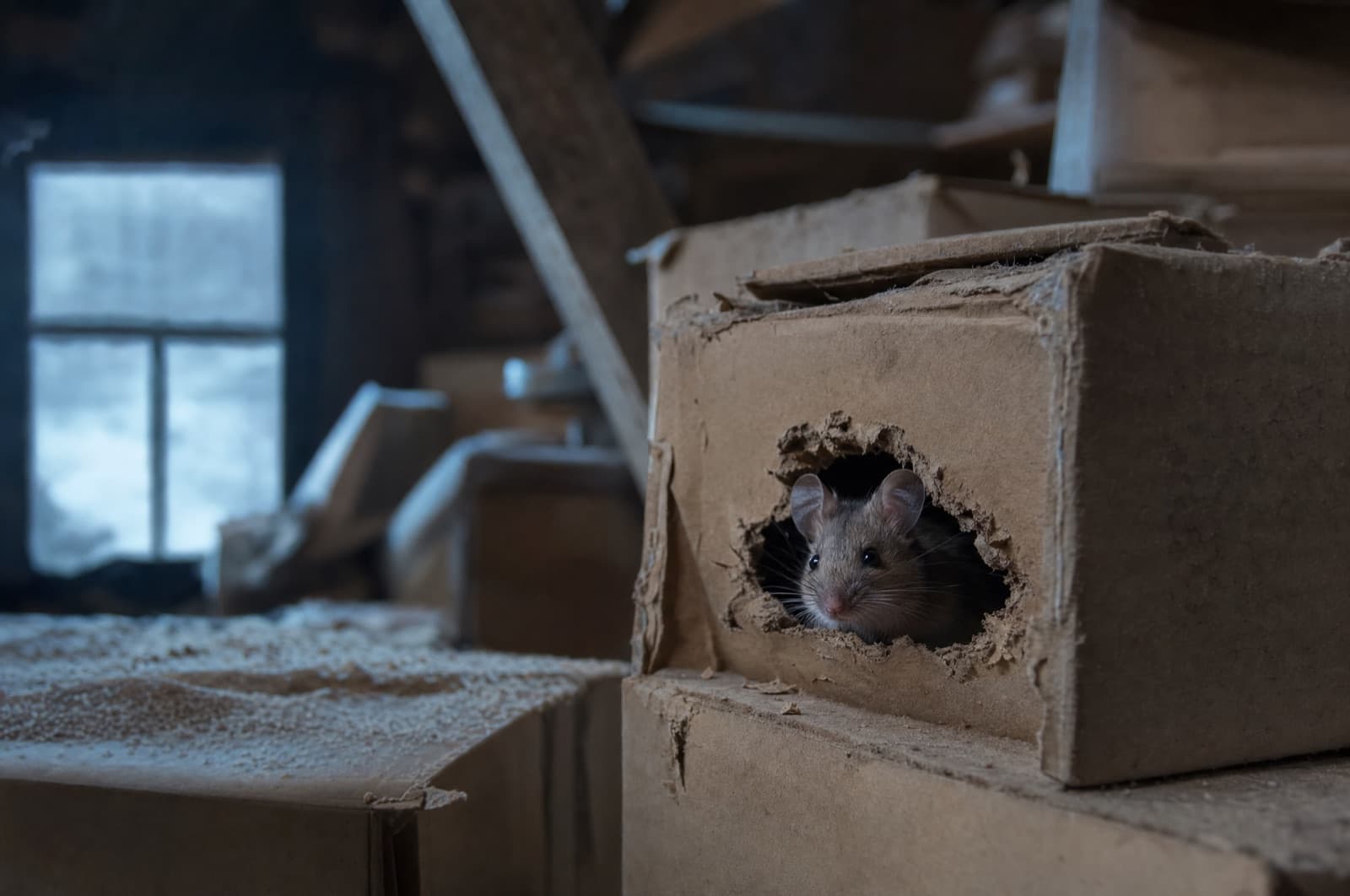
A house mouse in a gnawed cardboard storage box in a cold New Hampshire attic
Daniel Brady · NH-Licensed Pesticide Applicator · License #782664
Reviewed by Daniel Brady

How can homeowners protect stored items in garages or attics from pests?

Do this first
Do this first. An unheated New Hampshire garage or attic is warm relative to outdoors, dark, undisturbed, and often food-adjacent — a nearly ideal five-month rodent shelter. The moves that matter: reduce clutter, because cardboard and loose paper are nesting material; move anything edible or soft into metal or glass; keep stored items up off the floor, since rodents travel along walls and edges; and seal the gaps rodents actually use to get in. This is largely a homeowner project, though sealing an awkward or high gap sometimes calls for a ladder.

At a glance

  • Verdict: Do this first
  • Who does it: You, with a ladder
  • Effort: A project
  • Payoff: High
The honest answer

The short of it

The verdict
Do this first

Declutter, hard-side the attractants, get things off the floor, and seal the gaps — the same afternoon covers all three legs of rodent prevention.

The one question under all of them

Is this actually worth doing?

Every winter job lands somewhere on one honest scale — from what genuinely matters to what our own industry is selling you. Here is where this one lands.

The job being graded
Do this first

Decluttering, moving attractants into hard-sided or metal/glass containers, elevating storage off the floor, and sealing entry gaps in the garage or attic

The scale
Who does it
You, with a ladder
Effort
A project
Payoff
High
What it actually does

It removes harborage, food, and access at the same time — the three legs of rodent IPM that NPIC and CDC both frame as the actual control method, ahead of any trap or treatment. A garage with none of the three is a much less attractive structure to a mouse looking for a place to spend the winter, regardless of what's happening next door.

The line

Rodents don't want your holiday decorations — they want the cardboard box and the quiet. Take those away and the problem usually leaves with them.

Our honest lane

The declutter-and-store part of this job is entirely yours, and it's the same work whether or not you ever call a pest company. Anchor's honest role is the inspection and sealing of gaps you can't easily identify or reach, and trapping if rodents are already established — not a recurring spray treatment aimed at a storage problem. We'll tell you plainly which gaps matter and which don't.

In depth

The full picture

01

Why a garage or attic is a five-month proposition, not a one-time risk

The reason this is worth doing first, rather than worth doing eventually, is timing. Manchester's first hard frost lands roughly October 19 to 29 most years (NOAA), and from there an attached, unheated garage or an attic stays measurably warmer than outdoors, undisturbed for weeks at a stretch, straight through to March. That's not a brief exposure window — it's most of a rodent's active season, and extension guidance is unambiguous that mice and rats are drawn toward exactly this kind of shelter as outdoor temperatures fall and food thins out.

A garage full of cardboard boxes, stacked on the floor, with a bag of birdseed or pet food somewhere in the mix, is an unusually generous version of what a mouse is already looking for. None of that requires anything to have gone wrong yet — it's the baseline condition in a lot of houses.

02

The three legs: harborage, food, access

NPIC and CDC both frame rodent control around the same three variables, and a homeowner controls all three without hiring anyone. Harborage is nesting material and clutter — cardboard, loose paper, and undisturbed piles are what NPIC specifically flags for removal. Food is anything edible left in a bag or thin container; this hub's flagship storage answer already covers why metal and glass are the only container classes that reliably exclude a gnawing rodent, while paper, cardboard, and thin plastic don't. Access is the physical gap — a rodent needs remarkably little of it, and UNH Extension's core advice is to seal exterior cracks, 'paying special attention to the foundation and where pipes and utilities enter the home.'

Do all three in the same afternoon or weekend and you've addressed the standard case completely, without a single product purchase beyond a caulk gun, some hardware cloth, and a few metal containers.

03

Off the floor matters more than people expect

Rodents travel along walls and edges far more than they cross open floor space, which is why boxes stacked directly on a garage floor against a wall get found chewed more often than the same boxes on a shelf a few feet up. A simple wire shelving unit accomplishes two things at once: it puts distance between stored goods and the floor-level travel route, and it makes it easier to actually see what's underneath and behind things during a periodic check — which matters, because nobody has visibility into what's happening at floor level behind a wall of boxes otherwise.

Key takeaways
6 points
  • Rodent control comes down to three variables a homeowner controls directly: harborage, food, and access.
  • Cardboard and loose paper are nesting material — NPIC names it specifically for removal.
  • Metal and glass are the only container classes that reliably exclude a gnawing rodent; thin plastic and cardboard don't.
  • Get stored items off the floor — rodents travel walls and edges, not open floor space.
  • Seal the gaps, especially at the foundation and where pipes and utilities enter — this is the access leg of the same job.
  • This is a homeowner project. Anchor's honest role is the inspection and sealing of gaps you can't reach or identify yourself, and trapping if rodents are already in.
New Hampshire context

The New Hampshire timing that makes this worth doing before, not after

The whole calculation changes around Manchester's first hard frost, roughly October 19 to 29 (NOAA) — that's when outdoor food and shelter for rodents genuinely thin out, and pressure toward any nearby structure rises. Doing the declutter-and-seal project in September gives you a garage or attic that presents nothing appealing right as that pressure starts building.

Doing it in February, after finding chewed boxes or droppings, means an animal has likely been established for months already. At that point the storage fixes still matter, but the honest next question is how it got in — which is worth resolving before the next fall, not after.

  • NH-licensed #782664

    Southern New Hampshire

  • Family-owned

    Since 2017

  • Honest routing

    Even when it isn’t us

We serve these communities

ManchesterNashuaConcordDerryBedfordSalemHudsonAmherst
The other half of this question

Want the materials answer rather than the storage answer?

This page is about the winter-storage scenario — your bins, decorations and stored food in an unheated New Hampshire garage or attic, and what actually holds. The damage guide answers the other half: what pests can and cannot chew across the whole house, what genuinely isn’t at risk, and what a repair actually involves.

Read the materials answer

The storage project is yours. The gaps you can't reach are ours.

Decluttering and hard-siding the attractants is a homeowner afternoon. If you need help finding and sealing the gaps rodents are actually using, that's squarely a pest-pro job — and winter is peak season for it.

Follow-up questions

Frequently asked

Sources & citations(5)
  1. NPIC — Mice

    Harborage, food, and access as the three controllable variables; cardboard flagged for removal

    npicverified 2026-07-16
  2. CDC — Seal Up! Rodent control and exclusion

    Quarter-inch entry threshold; sealing materials; store feed in thick plastic, metal or glass

    govverified 2026-07-16
  3. UNH Cooperative Extension — How Can I Get Rid of the Mice in My House?

    Sealing exterior cracks, especially at the foundation and utility penetrations

    extensionverified 2026-07-16
  4. University of Nebraska–Lincoln Extension — Rodent-Proof Construction

    Rodents readily gnaw soft materials and exploit edges; construction-level exclusion

    extensionverified 2026-07-16
  5. NOAA — Manchester, NH freeze climatology

    Manchester first hard frost typically ~Oct 19-29

    govverified 2026-07-16

Written & reviewed by

Verified

Daniel Brady

NH-Licensed Pesticide Applicator · License #782664 (NHDAMF, RSA 430)

Daniel Brady is the New Hampshire–licensed applicator behind Anchor Pest Services, a family-owned pest control company serving the Manchester area since 2017.

Verify license

Last updated Jul 2026

Honest pest help for New Hampshire homes

We'll Tell You Which Gaps Actually Matter.

Decluttering and container swaps are free advice — do them yourself. Anchor Pest Services is worth calling for the inspection and sealing of gaps you can't easily find, and for trapping if rodents are already established. Family-owned since 2017, NH license #782664, serving Manchester, Nashua, Concord and nearby towns.

  • Honest advice — we'll tell you when a hardware-store fix beats a service call
  • NH-licensed applicators (#782664) — free inspection, same-day service
  • Rodent exclusion and winter pest control across southern and central New Hampshire

NH License #782664 · No obligation · We answer in person