
Skip to content
APS
Anchor Pest Services Field Team · NH-Licensed Pest Control Operators (License #782664)
Reviewed by Tim Boyle

Ants in Walls: How to Find, Treat, and Permanently Eliminate Wall-Void Ant Nests

Treatable — but only with wall-void access methods

Ants in walls cannot be eliminated with surface sprays. The nest — and 85–90% of the colony — sits inside the wall void, unreachable by anything sprayed at outlets or baseboards [19]. Five NH species nest in wall voids: carpenter ants (audible rustling + frass at dusk = call today), odorous house ants (silent, multi-room trails, no frass), pharaoh ants (tiny pale yellow, multiple rooms — STOP spraying, call a pro), acrobat ants (foam debris, not wood frass), and pavement ants (sill-plate seam). Treatment requires matching the access method to the species: drill-and-dust for carpenter and acrobat ants, slow-acting non-repellent bait for odorous house and pharaoh ants, exterior fipronil perimeter for pavement ants and parent colonies [1][2].

At a Glance

  • Short Answer: 5 NH species nest in wall voids — each leaves a different signature and requires a different treatment access method
  • Key Fact: 85–90% of an ant colony stays hidden in the nest at any time, meaning surface sprays at outlets hit only 10–15% of foragers and leave the colony untouched [19]
  • NH Relevance: UNH Extension Fact Sheet 62 identifies wall voids adjacent to moisture sources as the #1 most common indoor carpenter ant satellite location in NH [1]
  • Action Needed: Audible rustling at dusk plus frass at a baseboard or outlet is a same-day call — do not spray first
Key Statistics

Ants in Walls: How to Find, Treat, and Permanently Eliminate Wall-Void Ant Nests — The Numbers

5

NH species that nest in wall voids

85–90%

Colony hidden in nest (never foraging)

1/8 in

Standard drill-and-dust hole diameter

2–3 mm

Carpenter ant kickout slit width

Side-by-Side Comparison

Carpenter Ant Wall Infestation vs. Odorous House Ant Wall Infestation

Carpenter ant and odorous house ant wall infestations look completely different and require opposite treatment approaches. Confusing the two is the most common reason DIY treatments fail inside walls.

Subject A

Carpenter Ant Wall Infestation

Camponotus pennsylvanicus / C. novaeboracensis

Audible sign
Cellophane-rustling / crinkling sound at dusk — diagnostic for mature colonies of 1,500+ workers [2]
Frass at outlets or baseboards
Yes — coarse sawdust + insect body parts. Diagnostic for active excavation [1]
Trail pattern
Single broad trail, slow-moving large workers (6–13 mm), active ~15 min after sundown
Nest behavior when disturbed
Satellite nest tied to one moist stud bay; colony does not relocate easily
Wood damage
Physically excavates wood — smooth clean galleries crossing the grain [2]
DIY spray response
Kills 10–15% foragers; satellite may scatter; nest unaffected [19]
Best treatment access method
Drill-and-dust (deltamethrin dust) + exterior non-repellent perimeter

Bottom line — Audible rustling plus frass equals carpenter ant — call a pro today. Silent multi-room trails with no frass likely equals odorous house ant — use non-repellent bait only, never spray.

Deep Dive

The Full Picture

Ants establish nests inside wall voids when they find three things: a gap to enter, a cavity with harborage, and a moisture gradient that keeps the void hospitable. Five NH species regularly nest in residential wall voids, and each exploits a different combination of these conditions 1. Carpenter ants need wood above 15% moisture content to nest — they excavate smooth cross-grain galleries and kick out coarse frass. Odorous house ants and pharaoh ants need no wood damage at all — they nest in the air space between insulation and gypsum, exploiting the warm still-air microclimate and proximity to plumbing heat 36. Acrobat ants excavate foam insulation rather than wood. Pavement ants enter at the sill plate–foundation seam 210.
01

How to identify which species is in your wall

The most reliable identification method for wall-void ants is the signature they leave, not direct observation of the ant itself.
Read moreAudible rustling at dusk — a cellophane-crinkling sound — combined with coarse frass (sawdust mixed with insect body parts) at an outlet or baseboard is diagnostic for carpenter ants 2. No sound, no frass, but trails in multiple rooms simultaneously indicates polydomous odorous house ants 67. Tiny (1.5–2 mm) pale yellow ants appearing in two or more rooms — especially near hot-water pipes, outlets, or the bathroom — indicates pharaoh ants; this is the highest-consequence misdiagnosis in the wall-void space 45. Fine foam debris (not wood frass) kicked out at an entry point, with workers raising their heart-shaped gaster when tapped, indicates acrobat ants 3.
01
02

The 4 wall-void treatment access methods

Professional treatment of wall-void ants uses one or more of four access methods matched to the species.
Read more(1) Drill-and-dust: a 1/8" hole through gypsum, with a hand-bulb duster delivering deltamethrin 0.05% dust or silica aerogel into the void — standard for carpenter and acrobat ant wall nests with 6–12 months residual in dry voids 15. (2) Foam injection: expanding non-repellent insecticidal foam (fipronil 0.005%) fills irregular voids and contacts returning ants — preferred when the void has an irregular shape or foam insulation 15. (3) Baiting near entry points: non-repellent slow-acting gel bait placed adjacent to (not inside) entry points; the gold standard for OHA and pharaoh ants because the bait is transferred trophallactically to queens that are inaccessible to direct treatment 25. (4) Exterior non-repellent perimeter: fipronil 0.06% or chlorfenapyr as a continuous band at the foundation, targeting plumbing and electrical penetrations; critical for pavement ants and for severing parent-colony connections 15.
02
03

Why surface sprays into outlets fail

The Illinois Department of Public Health documents that typically only 10–15% of an ant colony's workers are outside the nest searching for food at any given time 19.
Read moreSpraying at an outlet hits at most 10–15% of foragers while 85–90% of the colony — including the queen and all brood — remains in the wall void, untouched. Beyond ineffectiveness, pyrethroid sprays are actively harmful for two species. In pharaoh ants, low-rate pyrethroid application experimentally increases the probability of colony splitting (sociotomy), which converts one nest into multiple satellite nests throughout the structure 5. In odorous house ants, repellent sprays trigger sub-nest relocation across the supercolony, expanding the infestation rather than containing it 6.
03
04

Locating the nest before treating

Effective wall-void treatment depends on locating the nest, not just treating visible trails.
Read moreFive location methods are used by licensed inspectors in NH. Visual inspection follows trails at dusk — carpenter ants exit ~15 minutes after sundown and their trail points back toward the nest 2. Moisture meters at suspect stud bays identify wood above 20% WMC, where carpenter ants preferentially nest 1. Acoustic stethoscopes detect the distinctive rustling and mandible-clicking of a disturbed carpenter ant satellite when the wall is gently tapped 2. Thermal imaging (IR) cameras are useful for identifying moisture gradients and large nests, but industry guidance is explicit: IR cannot directly image individual ants or small trails — it reveals wet wood, not the ants themselves [p5§4.3]. Borescopes inserted through a 3 mm pilot hole allow direct visual confirmation of stud-bay contents without major opening.
04
05

Carpenter ant wall-void biology in NH

UNH Extension Fact Sheet 62 identifies wall voids adjacent to moisture sources as the #1 indoor carpenter ant satellite location in NH 1.
Read moreA satellite colony is a subset of workers and brood, without a queen, maintained as an outpost of a parent colony that is typically in a nearby tree stump, dead hardwood, or structural wood with persistent moisture. Satellites are tied to single stud bays where wood moisture content exceeds 15% MC — typically caused by plumbing leaks, ice-dam-driven infiltration, or failed caulking at window frames. Hansen & Klotz 2 document that mature satellite colonies of 1,500+ workers produce audible cellophane-rustling detectable on still nights with an ear pressed to the wall. Kickout holes are slit-like, 2–3 mm wide — not round. Round holes suggest a different pest.
05
06

Odorous house ant polydomy and wall voids

Odorous house ants in urbanized settings develop extreme polygyny (multiple queens), polydomy (multiple nest sites), and supercolonial structure 7.
Read moreA single supercolony can maintain dozens of sub-nests across the interior walls of multiple units in the same building. Buczkowski & Bennett 6 demonstrated that repellent disturbance triggers rapid sub-nest relocation — ants abandon their current void, mobilize brood and queens, and establish new sub-nests in previously unoccupied walls. This is why DIY sprays reliably worsen OHA infestations: each spray event increases the colony's footprint. Non-repellent gel bait placed near entry points, transferred trophallactically to all queens, is the only DIY approach with colony-level effect.
06
07

The pharaoh ant wall-void STOP-SPRAY warning

Pharaoh ants in NH are found exclusively indoors — they cannot survive New England winters outdoors 4.
Read moreTheir preferred habitat is exactly what wall voids near plumbing chases and electrical conduit provide: warm, humid air above 18°C, thermal gradients to exploit, and protection from weather. The critical distinction from other wall-void species is the budding response to any insecticidal disturbance. Feng, Choe & Lee 5 experimentally demonstrated that pyrethroid aerosols at low application rates significantly increase the probability of sociotomy in pharaoh ant colonies of all sizes. Essential-oil-based products caused budding at all colony sizes and all application rates. In practice, a homeowner spraying one outlet converts one nest into multiple satellite nests across the structure, each with its own queen, extending the eradication timeline by months.
07
08

Cost of action vs cost of delay

For carpenter ant wall-void infestations, the cost-of-delay multiplier is 3–5× per year — annual excavation compounds [p5§6.5].
Read moreA 2026 NH one-time treatment at the moderate stage costs $250–$500 18. At the severe or multi-bay stage, cost rises to $800–$1,200+ for the pest control component, plus structural wood replacement quoted separately by the coordinating contractor. The 8–23× cost-of-delay return on early intervention applies specifically to carpenter ant cases where year-one treatment ($250–$600) avoids year-five repair costs ($4,000–$11,500+) 18. For OHA and pharaoh ants, the cost-of-delay driver is the budding multiplier — each spray event delays resolution by 6–12 weeks 56.
08

Bottom line — Wall-void ant infestations require species identification before treatment. The wrong approach — especially DIY sprays for pharaoh or odorous house ants — converts a manageable infestation into a multi-room problem. Audible rustling plus frass is always a same-day call.

NH Carpenter Ant Species

Carpenter ants aren't one species — they're four

Five NH species commonly nest in wall voids. Their wall-void signatures are distinct enough to diagnose species from behavioral cues alone — which matters because the treatment methods are incompatible between species.

Species 1

Odorous House Ant

Tapinoma sessile

Size
2.4–3.3 mm
Color
Uniform dark brown to nearly black, slightly shiny
Nest
Wall voids near plumbing, insulation, bathroom subfloors — the single most common indoor wall-void nest species in NE homes [6]
Aggression
NH Prevalence

Distinguishing feature

Silent in walls, no frass, multi-room trails. Crush-and-smell test: rotten coconut / blue cheese odor (6-methyl-5-hepten-2-one) [8]. Petiolar node concealed under gaster — no visible 'bump' between thorax and abdomen. Sprays trigger budding [6].

Species 2

Pharaoh Ant

Monomorium pharaonis

Size
1.5–2 mm
Color
Pale yellow to light amber; slightly darker gaster tip
Nest
Wall voids near plumbing chases, electrical conduit, heat sources above 18°C — strictly indoor in NH [4]
Aggression
NH Prevalence

Distinguishing feature

STOP-SPRAY WARNING: DIY pyrethroid sprays at any application rate significantly increase the probability of colony splitting (sociotomy), multiplying satellite nests throughout the structure [5]. Tiny pale yellow ants appearing in multiple rooms simultaneously is the signature. 12-segment antenna with 3-segment club distinguishes from thief ant (10-segment, 2-segment club).

Species 3

Acrobat Ant

Crematogaster cerasi

Size
2.5–3.5 mm
Color
Bicolored — dark brown to black gaster, reddish-brown mesosoma
Nest
Wall voids where EPS/polystyrene foam insulation has been excavated, or water-damaged framing [3]
Aggression
NH Prevalence

Distinguishing feature

Kicks out fine foam debris (not wood frass) at entry points. Heart-shaped gaster raised in alarm posture when wall is tapped. Bicoloration and 3 mm size separate from carpenter ants. Indicates foam insulation or moisture-damaged wood in the wall cavity.

Species 4

Pavement Ant

Tetramorium immigrans

Size
2.5–4 mm
Color
Uniform dark brown to nearly black; parallel rugose grooves on head and thorax
Nest
Soil under foundation slabs; occasionally in wall voids where foundation wall meets sill plate
Aggression
NH Prevalence

Distinguishing feature

Usually enters via sill-plate seam rather than mid-wall outlets. Two visible petiolar nodes and rugose parallel grooves on head are diagnostic [10]. Responds well to exterior non-repellent perimeter treatment — unlike OHA and pharaoh ants.

Species 5

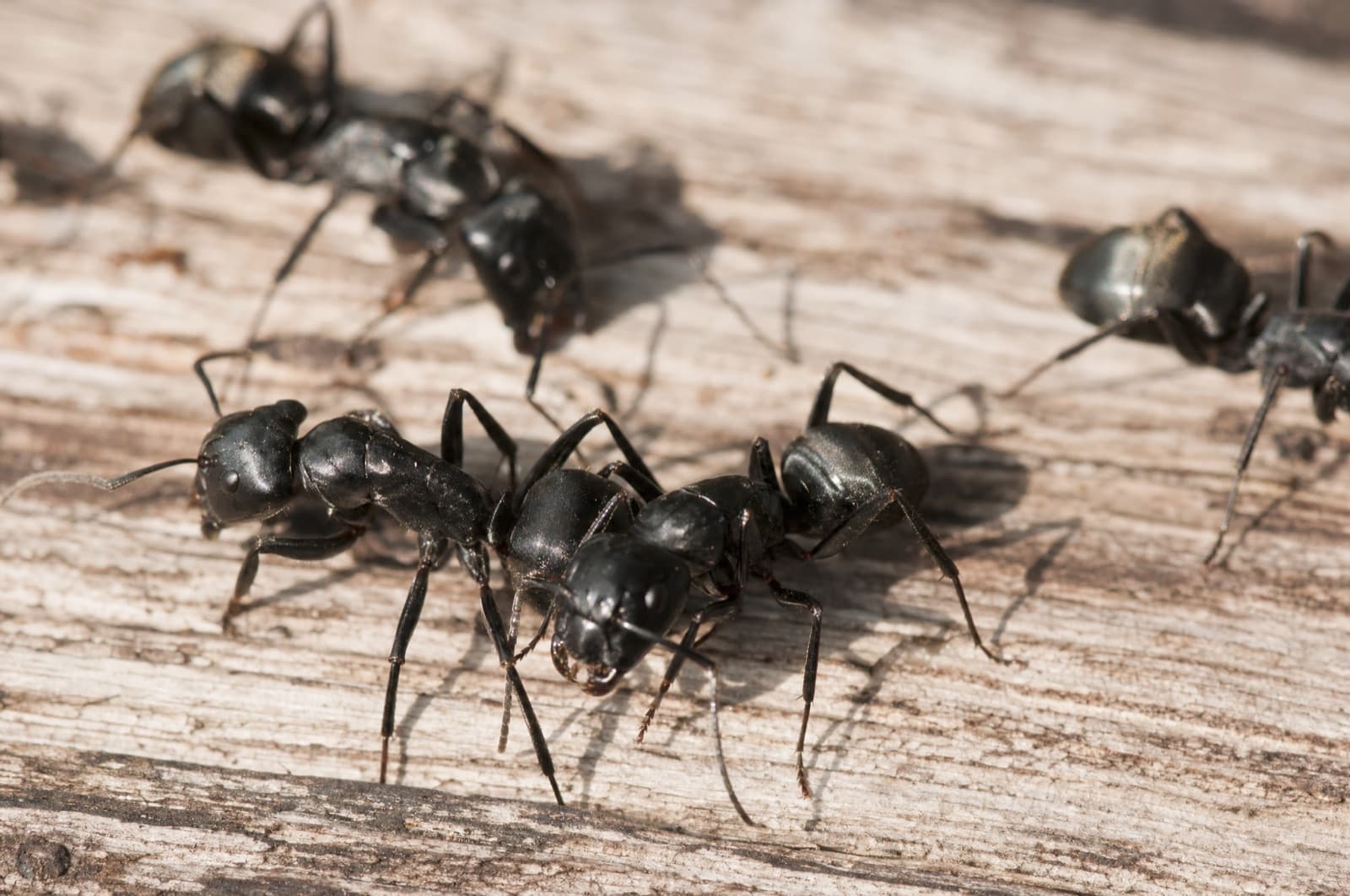
Black Carpenter Ant

Camponotus pennsylvanicus

Size
6–13 mm
Color
Uniformly matte black; single-node petiole; evenly rounded thorax profile
Nest
Wall voids in moisture-damaged stud bays — UNH FS 62's #1 indoor satellite location in NH [1]
Aggression
NH Prevalence

Distinguishing feature

Audible cellophane-rustling at dusk is diagnostic for mature colonies. Frass piles (coarse sawdust + insect body parts) at outlets or baseboards confirm active excavation. Workers physically excavate smooth cross-grain galleries. Slit-like kickout holes 2–3 mm wide — not round [2].

NH Risk Heat Map

Carpenter ant pressure by NH county

Wall-void ant pressure follows NH's housing age distribution. Counties with older housing have higher proportions of balloon-framed and moisture-compromised stud bays — the primary carpenter ant satellite habitat.

HillsboroughExtreme riskRockinghamExtreme riskMerrimackHigh riskStraffordHigh riskCheshireHigh riskManchester HQ
Low
Moderate
High
Extreme

Hillsborough County

Extreme

Highest wall-void carpenter ant case volume in NH. Manchester and Nashua's pre-1960 housing stock has decades of accumulated moisture cycling in stud bays. OHA supercolonies are also a consistent problem in multi-unit housing [7].

Rockingham County

Extreme

Coastal humidity creates persistent above-15% WMC conditions in exterior walls. Salem, Derry, Auburn, and Hampstead see heavy carpenter ant wall-void pressure from May through October.

Merrimack County

High

Concord's older housing corridor and Merrimack River humidity drive elevated risk. Balloon-framed homes in Concord and Boscawen are particularly vulnerable to multi-bay satellite infestations.

Strafford County

High

Rochester and Dover wetland-adjacent properties see elevated carpenter ant wall-void pressure. Pharaoh ant activity is documented in Dover multi-unit housing [4].

Cheshire County

High

27.3% pre-1940 housing stock — the highest proportion among the five service counties. Keene's older Victorian and Craftsman homes have extensive balloon framing providing uninterrupted stud-bay access for satellite nests.

Bottom line — If your home is in Hillsborough or Rockingham County and was built before 1970, assume carpenter ant wall-void risk is elevated. Annual moisture audits at sill plates and rim joists are the most cost-effective prevention measure.

Visual Identification

What wall-void ant infestations look like

Each NH wall-void species leaves a different visible signature. Match what you see to the species before calling or treating.

Sign 1

Carpenter ant frass at outlet

Coarse sawdust-like debris mixed with dark insect body parts — legs, antennae, thorax fragments — piled at the base of an outlet or switch plate. The presence of insect parts distinguishes this from construction dust or termite frass. Always located below a slit-like 2–3 mm kickout opening [2].

Sign 2

Carpenter ant kickout slit in baseboard

A slit-like, irregular opening 2–3 mm wide (~1/8 inch) in a baseboard, door frame, or window trim — not perfectly round. Workers push excavated wood and insect debris through this hole. Frass typically accumulates directly below. Contrast with round holes from beetles or old-house borers [2].

Sign 3

Foam debris from acrobat ant excavation

White or off-white foam granules at an outlet or baseboard, with no wood shavings and no insect parts. Acrobat ants excavate EPS or polystyrene foam insulation inside the wall cavity, kicking out foam debris rather than wood frass. Workers are 3 mm, bicolored, and raise their heart-shaped gaster in alarm when the wall is tapped [3].

Sign 4

Pale yellow pharaoh ant trail at outlet

A dense, fast-moving trail of tiny (1.5–2 mm) pale yellow ants emerging from or traveling along an outlet on an interior bathroom or kitchen wall. If you see this pattern in more than one room, do not spray anything — call a professional. DIY aerosol sprays at any application rate experimentally trigger colony splitting [5].

Sign 5

Audible rustling sign (carpenter ant)

Mature carpenter ant satellites of 1,500+ workers produce an audible cellophane-rustling or crinkling sound detectable by pressing an ear to the wall after dusk. The sound intensifies when the wall is gently tapped with a screwdriver handle, which disturbs workers inside galleries. This is a Tier 3 EMERGENCY signal per the 3-tier urgency scale [2].

Sign 6

Drywall pinholes in a vertical line

When multiple tiny pinholes appear in a vertical line following a stud bay, this indicates a single carpenter ant satellite nest in that stud bay. Yellow or brown moisture staining, blistered paint, or bowed drywall near the pinholes means the colony is within 6 feet. Multiple pinhole clusters in different bays indicate multiple satellite nests — a Year 5+ severe-infestation pattern [2].

Decision Tree

Should you call a pro?

Use this 4-question branch to determine your next action. The pharaoh-ant path requires professional treatment — do not apply sprays while working through this tree.

Are you hearing sounds inside the wall — rustling, crinkling, papery noise — especially after dark?

Transparent Cost Calculator

What carpenter ant treatment actually costs

Wall-void ant treatment costs depend on which species you have, how many wall bays are involved, and whether wood replacement is needed. These are 2026 NH market rates for southern NH (Hillsborough, Rockingham, Merrimack, Strafford, Cheshire counties).

Home size

Infestation severity

Treatment type

Estimated cost

$191$383

One-time exterior perimeter + inspection

Exterior non-repellent fipronil band, interior trail baiting, moisture audit. Standard for OHA, pharaoh, and pavement ant wall infestations.

All figures are 2026 southern NH market rates synthesized from Hillsborough, Rockingham, Merrimack, Strafford, and Cheshire county operators. Drill-and-dust add-ons are $300–$600 above the base perimeter treatment cost. Structural wood replacement is quoted separately by the coordinating contractor and is not included here.

Treatment Effectiveness

How long does each method actually last?

DIY repellent pyrethroid spray at outlet or wall

$8–$20 · DIY

2–4 hours

Kills only the 10–15% of foragers outside the nest [19]. Triggers budding in OHA and pharaoh ants [5][6]. Does not penetrate to nest. The dominant DIY failure mode for wall infestations.

DIY non-repellent gel bait at trail entry

$30–$50 · DIY

2–3 weeks

Effective for OHA and pavement ants when colony is accessible to foragers. Hansen 2008 field success 55% overall [13]. Fails when nest is deep in wall void and queen is inaccessible.

Pro drill-and-dust (deltamethrin 0.05% + silica aerogel)

$300–$600 add-on · Professional

6–12 months residual

Standard for carpenter ant and acrobat ant wall nests. 1/8" hole through gypsum; dust fills the void and contacts ants returning to nest [15]. Residual lasts 6–12 months in a dry void.

Pro foam injection (fipronil 0.005%)

$300–$600 add-on · Professional

3–6 months

Expanding foam fills irregular voids and delivers active ingredient to ants in contact. Preferred for voids with irregular shape or foam insulation. Non-repellent — ants cannot detect and avoid [15].

Pro exterior non-repellent perimeter (fipronil 0.06%)

$250–$500 (combined with inspection) · Professional

90 days

Fipronil non-repellent at 0.06% applied as a continuous band; ants transfer the active ingredient to nestmates via trophallaxis. BASF label: 100% colony control claim with documented transfer effect [15]. Critical for parent colonies in nearby stumps or trees.

Prevention Playbook

How to stop carpenter ants from coming back

1

Seal all plumbing penetrations through the subfloor and sill plate with fire-rated expanding foam — tub waste lines, toilet flanges, and sink drain rough-ins are the top bathroom-wall ant entry points [1].

2

Seal electrical penetrations through the top plate and bottom plate of exterior walls with non-expanding silicone caulk before winter — warm air pockets in cable chases are exactly what pharaoh and carpenter ants exploit [3].

3

Caulk all window and door frame perimeters where trim meets siding annually — failed caulk is the single most common exterior entry route for NH carpenter ant satellites [1].

4

Fix ice-dam-driven roof leaks within 30 days of detection — in NH, ice-dam-driven moisture above exterior walls is the dominant cause of stud-bay wood moisture content exceeding the 20% WMC threshold where carpenter ants nest [1].

5

Trim vegetation, mulch, and firewood to maintain at least 12 inches of clearance from siding — OHA supercolonies treat dense vegetation as contiguous territory and readily extend into wall voids from adjacent landscape [7].

6

Replace any water-damaged sheathing, sill plates, or rim-joist insulation immediately after repair — wood moisture content above 15% is the primary carpenter ant habitat qualifier; wood below 15% MC is essentially carpenter-ant-proof [1].

Local Context

Why NH Homes Are Especially Vulnerable to Wall-Void Ant Nests

New Hampshire's median owner-occupied home was built in 1982, and approximately 22% of NH homes were built before 1950 [18]. Pre-1940 balloon-framed construction creates uninterrupted stud cavities running from the sill plate to the roof — providing vertical highways for carpenter ant satellite nests. Ice-dam-driven roof leaks above exterior walls push wood moisture content above the 20% WMC threshold where carpenter ants preferentially nest, creating recurring wall-void infestation cycles that surface treatments cannot break. Cheshire County has the highest proportion of pre-1940 housing stock in the service area at 27.3%.

Key Local Data

Hillsborough and Rockingham counties carry EXTREME pressure for carpenter ant wall-void infestations, driven by older wood-frame housing and humid continental summers averaging +3°F warmer than 1901 baselines [18].

Common Questions

Frequently Asked

Sources & References

Where this data comes from

  1. [1]
  2. [2]
  3. [3]
  4. [4]
  5. [5]
  6. [6]
  7. [7]
  8. [8]
  9. [9]
  10. [10]
  11. [11]
  12. [12]
Wall-Void Ant Specialists

Sounds + frass + winter sighting = call today

Our inspectors use moisture meters, acoustic stethoscopes, and borescopes to locate wall-void nests — then treat with drill-and-dust, foam injection, or targeted baiting matched to your species.

NH Licensed Pest Control Operators — License #782664 Free inspection includes nest location and species ID 30-day follow-up on all wall-void treatments Family-owned and Manchester-based since 2017