
Skip to content
APS
Anchor Pest Services Field Team · NH-Licensed Pest Control Operators (License #782664)
Reviewed by Tim Boyle

Ant Season in New Hampshire: Month-by-Month Calendar for Manchester, Bedford, and Nashua

April–October outdoors; winter sighting = indoor nest

NH ant season is roughly mid-April to late October, peaking July–August. Carpenter ants emerge when sustained 3-day temperatures stay above 50°F — usually mid-April in Hillsborough and Rockingham counties. The primary swarm window (large winged carpenter ants on windows at dusk after rain) runs May through mid-June. A pre-winter foraging spike hits in September as food becomes scarce outdoors. Ants are otherwise dormant November through March — so any large black ant seen indoors in January or February is not a lost forager: it is coming from a nest inside your heated walls, per UNH Cooperative Extension's Rachel Maccini.

At a Glance

  • Short Answer: NH ant season runs mid-April through October; outdoor carpenter ants peak July–August; primary swarm is May–June
  • Key Fact: Per UNH Cooperative Extension: any large black ant seen indoors in January or February in NH means you have a nest inside your home
  • NH Relevance: NH temperatures have risen +3°F since 1901 — directly lengthening the carpenter ant foraging season and shifting much of southern NH from Zone 5b to Zone 6a
  • Action Needed: Schedule a spring inspection by April 1 (southern NH) or April 15 (Cheshire/Strafford) — before the May–June primary swarm
Key Statistics

Ant Season in New Hampshire: Month-by-Month Calendar for Manchester, Bedford, and Nashua — The Numbers

Apr–Oct

Active foraging season in NH

+3°F

NH warming since 1901

8–11 days

Earlier spring ice-out vs. 50 yrs ago

Jan–Feb

Winter sighting = interior nest (UNH)

Deep Dive

The Full Picture

New Hampshire ant season runs from approximately mid-April through late October, with a primary carpenter ant swarm window in May–June and peak foraging pressure in July–August. The single most important seasonal fact in NH: carpenter ant workers are dormant below ~41°F — so any live large black ant seen indoors in January or February is evidence of an established nest inside the home, not a forager from outside 12. This rule, stated verbatim by Rachel Maccini of UNH Cooperative Extension: 'If you see large ants inside your house in January or February, she said, you may have trouble. Winter activity typically means you have a nest inside your home. If that's the case, the UNH Cooperative Extension recommends you hire a professional' 2.
01

January–February: Diapause — Any Indoor Sighting Is Diagnostic

From November through early March, outdoor carpenter ant colonies are in diapause — workers sealed in parent nests in tree stumps, logs, and forest-edge trees, metabolically slowed by glycerol antifreeze that allows colony tolerance to temperatures as low as 5–15°F 6.
Read moreSustained outdoor temperatures in southern NH remain well below the 41°F inactivity threshold through this window 6. A live large black ant moving indoors in January or February therefore cannot have traveled from an outdoor colony — it is emerging from a satellite nest located in a heated wall void, attic top plate, hollow door frame, or behind plumbing chases inside the home 2. UNH Extension explicitly recommends calling a professional in response to this sighting 2. Do not wait for spring.
01
02

March: Late Diapause — Watch for Indoor Swarmers

March brings daytime air temperatures of 40–50°F — occasionally warm enough to send a few workers outside on sunny afternoons — but sustained outdoor foraging does not restart until April 1.
Read moreThe critical March diagnostic is indoor swarmers (alates — winged reproductives). Mature satellite nests inside heated wall voids maintain temperatures of 60–75°F year-round, and those nests can be triggered into alate production by warmth and increasing photoperiod as early as late February or March — months before outdoor swarm conditions exist 1. Finding a winged carpenter ant on an indoor windowsill in March indicates a colony that has been established inside the structure for at least 3 years, large enough to produce reproductives 7. This is a Tier 3 EMERGENCY indicator per damage-progression research.
02
03

April: Emergence — Foraging Restarts at Sustained 50°F

Outdoor foraging resumes when the sustained 3-day average temperature exceeds 50°F (10°C) — typically mid-April in southern NH counties (Hillsborough, Rockingham, southern Merrimack) 16.
Read moreFirst visible signs are large black ants on patio edges, wood piles, and tree stumps. Satellite-nest workers also begin appearing inside homes, often along sill-plate edges and under baseboard heaters. This is the optimal window to book a spring perimeter inspection — before the swarm, while colony populations are still building, and before the July–August peak demand when NH operators carry 3–6 week backlogs 1. Southern NH service window: target inspections by April 1. Cheshire/Strafford: target April 15 1.
03
04

May–June: Primary Swarm Window in NH

The primary carpenter ant swarm window in southern New Hampshire runs from mid-May through mid-June 17.
Read moreSwarm conditions: air temperature above 70°F, humidity above 70%, typically after rain at dusk. Major Camponotus pennsylvanicus mating flights produce hundreds of winged reproductives per mature colony; mature colonies (3+ years old, 2,000+ workers) produce 200–400 swarmers annually 7. Swarmers found on interior windowsills during May–June indicate either (a) an outdoor parent colony within ~100 m whose swarmers entered through gaps, or (b) a mature interior satellite colony producing reproductives from inside the heated wall. The second scenario is more structurally serious and warrants immediate professional inspection. New dealate queens (wing-shed) emerging from swarms seek moist wood cavities to establish new colonies — making June a critical prevention window 1.
04
05

July–August: Peak Foraging — Heaviest Indoor Incursion

July and August represent peak carpenter ant foraging pressure across NH.
Read moreWorkers forage almost exclusively nocturnally, with peak trail activity in the 15–30 minutes after sunset 6. Indoor incursion is heaviest as established satellite colonies in wall voids send workers out to forage. Nocturnal trails are visible on patios, decks, sill plates, and along foundation edges. In August, workers begin transferring brood to satellite sites (inside heated wall voids and behind kitchen and bathroom plumbing) in preparation for winter 1. This is the highest-demand service window for NH pest operators — Manchester and Nashua suburban markets carry 3–6 week lead times in mid-summer. If you have not already scheduled a treatment, book in June for July/August service 1.
05
06

September–October: Pre-Winter Foraging Spike and Seasonal Shutdown

September brings a pre-winter foraging spike that many homeowners misread as a new infestation: as outdoor food sources decline, indoor incursion by established satellite colonies increases as workers cache food pre-winter 1.
Read moreThis is NOT a new ant problem — it is the established satellite colony that has been there since spring becoming more aggressive about indoor access. September–October is a high-conversion window for transitioning to quarterly service plans, as the colony is demonstrably active. October begins the shutdown ramp: as sustained daytime temperatures drop below 50°F, last-surface activity winds down and workers retreat to parent nests 1. The foraging season in southern NH typically closes mid-to-late October.
06
07

November–December: Pre-Diapause and Full Dormancy

By November, outdoor colonies are sealed with workers and pre-formed alate brood for winter.
Read moreRare warm-day worker excursions can occur in early December during Indian-summer conditions 1. Ants seen outdoors in late fall are consistent with normal seasonal shutdown — no structural concern if activity is declining and exclusively outdoor. However, any large black ant seen indoors in November or December follows the same winter-sighting rule as January–February: heated indoor satellite nests remain active year-round at 60–75°F wall-void temperatures, so indoor winter-month worker sightings indicate an interior colony 2. The winter quarterly maintenance visit — typically scheduled January–February — is the correct time to conduct interior inspections catching satellite colonies before the spring swarm 9.
07
08

NH's Warming Climate Is Lengthening the Season

New Hampshire's statewide average temperature has increased by 3°F since 1901, with fall and winter warming fastest 3.
Read moreProjections from the NH Climate Assessment 2021 indicate an additional 2.2–2.4°F of warming by 2040 3. The freeze-free season in the Northeast was already 10 days longer during 1991–2010 versus 1961–1990 4. The 2023 USDA Plant Hardiness Zone map shifted much of southern NH from Zone 5b to Zone 6a (5°F warmer winter minima) 5. Net effects on ant season: earlier spring emergence (ant foraging may start up to a week earlier than it did 30 years ago), later fall shutdown, and more overwintering survival of satellite nests in marginally-heated wall voids — producing more 'warm winter day' indoor sightings of satellite-nest workers 3. Ice-out on Lake Winnipesaukee is now 8 days earlier than 50 years ago, and Lake Sunapee 11 days earlier — proxy measures of the warming trend that is progressively extending NH ant season at both ends 3.
08
09

Southern NH vs. Northern NH Seasonal Variation

Ant season timing varies meaningfully across NH's geography.
Read moreSouthern NH (Hillsborough and Rockingham counties, Zone 6a/6b) typically sees emergence in mid-April and seasonal shutdown in late October — roughly a 6.5-month active window 10. The Atlantic coastal strip of Rockingham County (Zone 6b — Portsmouth, Hampton, Seabrook) has the longest foraging window in the state, potentially extending into early November 10. Interior and northern NH (Cheshire, Strafford, northern Merrimack — Zone 5b–6a) sees emergence delayed to early May and earlier shutdown in mid-October — approximately a 5.5-month window 10. Cheshire County is notable not for early emergence but for elevated winter-sighting risk: its 27.3% pre-1940 housing stock includes widespread balloon-frame construction providing uninterrupted vertical stud cavities that function as year-round indoor habitat for satellite colonies even when outdoor temperatures are sub-zero 10.
09
10

When to Schedule Treatments by Season

A quarterly pest service plan provides coverage across all four seasonal phases 9: Spring visit (March–April) — primary inspection plus pre-swarm perimeter treatment plus moisture audit; Summer visit (June–July) — full perimeter retreat plus interior checkpoint at peak activity; Fall visit (September–October) — pre-winter exterior treatment plus interior recap of satellite activity; Winter visit (January–February) — interior inspection and UNH FS 62 winter-sighting check that catches indoor satellite colonies before spring swarm.
Read moreQuarterly plan pricing in southern NH runs $480–$840 per year 11. One-time treatment for a confirmed moderate infestation runs $250–$500 11. For homeowners who spot activity in July or August: book immediately — the peak-season backlog in Manchester and Nashua runs 3–6 weeks. The best booking window for cost-effectiveness is March, before swarm season begins 1.
10

Bottom line — NH ant season is a mid-April through October phenomenon outdoors — but any heated home with an established satellite nest has year-round ant activity at the colony level, regardless of outdoor temperatures. The winter-sighting rule (large black ant indoors in January–February = interior nest) is the single most important seasonal fact for NH homeowners, backed directly by UNH Cooperative Extension guidance.

NH Carpenter Ant Species

Carpenter ants aren't one species — they're four

Different ant species in New Hampshire follow different seasonal schedules. Applying the carpenter ant seasonal rule to a pharaoh ant — which is active year-round indoors — leads to the wrong diagnosis. Use this guide to match the species to the season.

Species 1

Black Carpenter Ant

Camponotus pennsylvanicus

Size
6–13 mm
Color
Matte black; workers polymorphic (major and minor castes)
Nest
Moist or decayed wood — outdoor parent colony in stumps/trees; indoor satellite in wall voids, rim joists, attic top plates
Aggression
NH Prevalence

Distinguishing feature

Foraging Apr–Oct; primary swarm May–Jun at dusk after rain; diapause Nov–Mar. Winter indoor sighting = interior satellite nest, never a lost forager.

Species 2

Pavement Ant

Tetramorium immigrans

Size
3–4 mm
Color
Dark brown to black with parallel grooves on head and thorax
Nest
Under driveways, sidewalks, concrete slabs, and foundation edges
Aggression
NH Prevalence

Distinguishing feature

Foraging Apr–Oct; mating flights late May to early Jun; slab/sidewalk emergence visible year-round in heated buildings. Not subject to the winter-sighting rule — smaller than carpenter ants.

Species 3

Odorous House Ant (OHA)

Tapinoma sessile

Size
2.5–3 mm
Color
Dark brown-black, uniform coloration
Nest
Moist wall voids near hot-water pipes, behind dishwashers, in soil under mulch and landscaping timbers
Aggression
NH Prevalence

Distinguishing feature

Foraging Apr–Oct outdoors; secondary warm-day indoor winter activity. Rotten-coconut odor when crushed is diagnostic. Polydomous budding makes spray treatment counterproductive.

Species 4

Pharaoh Ant

Monomorium pharaonis

Size
1.5–2 mm
Color
Yellow to light brown with darker gaster
Nest
Year-round indoor only in NH — hospitals, apartment buildings, heated kitchens. Cannot survive NH winters outdoors.
Aggression
NH Prevalence

Distinguishing feature

NO seasonal pattern in NH — active 12 months per year indoors. A winter sighting of tiny yellow ants is NOT the carpenter ant winter-sighting rule. Spray applications cause budding; use bait-only IPM.

Species 5

Citronella Ant

Lasius claviger / L. interjectus

Size
3–4 mm
Color
Bright yellow
Nest
Subterranean — under stones, logs, foundation edges; feeds on root-feeding aphid honeydew
Aggression
NH Prevalence

Distinguishing feature

Alate flights September–October (and occasional April–May); otherwise underground and invisible. Strong lemon/citronella odor when crushed. Causes no structural damage — swarming inside a basement in fall is typically citronella ants, not carpenter ants.

Species 6

Field Ant (Formica)

Formica subsericea

Size
5–8 mm
Color
Red-and-black bicolored; some all-black or all-red depending on species
Nest
Outdoor mounds in lawns, meadows, and forest-field edges; rarely nests indoors
Aggression
NH Prevalence

Distinguishing feature

Foraging May–September; mound activity peaks July. Notched/uneven thorax profile distinguishes from carpenter ant (smooth arched thorax). Primarily an outdoor pest; does not apply to winter-sighting rule.

NH Risk Heat Map

Carpenter ant pressure by NH county

Ant season timing and pressure vary across NH's five service counties based on USDA hardiness zone, housing age, and forest-edge density. Southern coastal zones have the longest foraging window; interior counties have shorter but still significant active seasons.

RockinghamExtreme riskHillsboroughExtreme riskMerrimackHigh riskStraffordHigh riskCheshireHigh riskManchester HQ
Low
Moderate
High
Extreme

Rockingham County

Extreme

The Atlantic coastal strip is the only NH territory in USDA Zone 6b — the longest foraging window in the state (mid-April to early November). Portsmouth's pre-1900 clapboard housing and high-value Seacoast properties create extreme per-home risk. Summer lead times for pest service run 3–6 weeks in Salem, Derry, and Londonderry.

Hillsborough County

Extreme

Zone 6a covers Manchester, Nashua, Bedford, Hudson, and Goffstown — a mid-April emergence with foraging through late October. Highest absolute ant-service volume in NH. Manchester's pre-1940 balloon-framed West Side and North End neighborhoods generate the majority of winter-sighting calls (January–February indoor ant = interior nest per UNH FS 62).

Merrimack County

High

Concord and surrounding rural towns sit in Zone 5b–6a with a mid-April to mid-October foraging window. Mixed older urban housing in Concord's South End and heavily forested western towns (Henniker, Warner) see both early-spring satellite-nest activity and elevated September pre-winter incursion spikes.

Strafford County

High

Dover and Rochester anchor Zone 5b–6a territory with a foraging window similar to Merrimack County (~mid-April to mid-October). Strafford has ~22% pre-1950 stock and a median construction year of 1979, increasing winter alate-emergence risk from unventilated heated wall voids in older mill-era housing.

Cheshire County

High

Keene and the Monadnock region sit in Zone 5b–6a with a somewhat shorter foraging window (early May to mid-October in interior elevations). However, Cheshire has the oldest housing stock of any service county — 27.3% built before 1940, median year 1973 — with widespread balloon-frame construction providing continuous stud bays ideal for year-round indoor satellite nests. Pre-1940 homes here face winter-sighting risk even when outdoor ants are fully dormant.

Bottom line — Regardless of county, the NH winter-sighting rule is universal: any large black ant active indoors from November through March indicates a heated interior satellite nest, not seasonal outdoor foraging. Southern NH homeowners should schedule spring inspections by April 1; Cheshire and Strafford by April 15.

Visual Identification

What NH Ant Activity Looks Like Month by Month

Seasonal signs vary significantly by month. These images show what to look for at each phase of NH ant season — from spring foragers to winter diagnostic clues.

Sign 1

Spring Foragers on Patio (April)

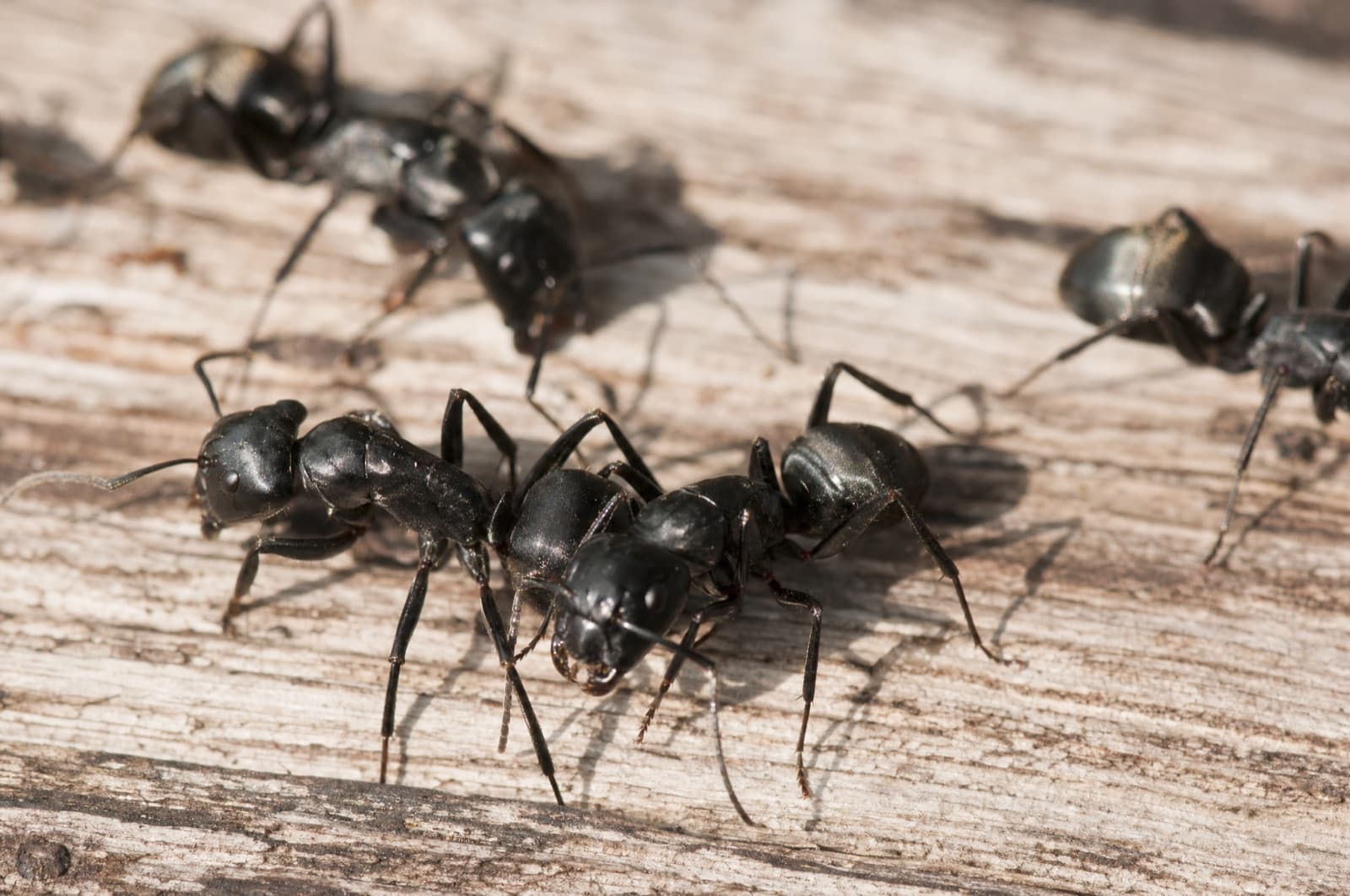
As sustained temperatures exceed 50°F in mid-April, the first carpenter ant workers emerge to forage. Look for large (6–13 mm) matte-black ants on patio edges, wood piles, and tree stumps. These are satellite-colony workers establishing foraging trails before the main swarm.

Sign 2

Swarmers at Windows (May–June)

Primary carpenter ant swarm flights occur May through mid-June when air temperatures exceed 70°F and humidity is above 70%, typically after rain at dusk. Winged alates (swarmers) are drawn to lit windows and windowsills. Finding them indoors during this window indicates a mature colony (3+ years) inside or within 100 m of the home.

Sign 3

Peak-Summer Trail at Sill Plate (July–August)

July and August bring the heaviest indoor incursion — nocturnal foraging trails along sill plates, under sliding doors, and across kitchen floors after sundown. Workers are foraging-only during this phase, not nesting. Trails visible shortly after sunset are the signature of July–August peak activity.

Sign 4

Fall Pre-Winter Frass (September)

As outdoor food sources diminish in September, established satellite colonies increase indoor incursion and may push new frass (coarse wood fiber mixed with insect parts) from wall voids. This often looks like a 'new' infestation but is actually a known satellite colony caching pre-winter. Frass appearing in September indicates an established interior nest.

Sign 5

Indoor Alate in Heated Home (February–March)

A winged carpenter ant (alate) found indoors in February or March — before any outdoor activity — is diagnostic of a mature satellite colony (3+ years old) inside the home's heated wall voids. The warmth and photoperiod of a heated home can trigger alate emergence months before outdoor swarm conditions. This is a Tier 3 EMERGENCY indicator.

Sign 6

Winter Worker on Baseboard (January–February)

Any live large black ant moving on a baseboard or kitchen floor in January or February in New Hampshire is not a forager from outside — outdoor carpenter ants are dormant below 41°F. Per UNH Cooperative Extension, this indicates an established interior nest in heated wall voids, attic top plates, or behind plumbing chases. Schedule a professional inspection within the week.

Decision Tree

Should you call a pro?

Use this seasonal triage tool to determine whether your ant sighting is a normal outdoor foraging event, an established indoor nest, or a seasonal swarm. Month of sighting is the first and most important variable.

What month did you see the ant(s)?

Prevention Playbook

How to stop carpenter ants from coming back

1

Clear gutters by April 1 and repair any roof or eave moisture damage before the carpenter ant emergence — ice-dam-driven wood decay at rafter tails and sill plates is the single biggest predictor of carpenter ant satellite colonization in NH homes.

2

Trim back any overhanging tree branches and shrubs that contact the house by April 15 — these are the physical bridges carpenter ant workers use to access the structure from parent-colony trees and stumps within 100 m.

3

Stack and store firewood at least 20 feet from the foundation off the ground — woodpiles are prime parent-colony habitat and represent a direct satellite-nest transfer risk when brought indoors before burning.

4

Eliminate outdoor food sources near the foundation in summer (pet food, open compost, fallen fruit, hummingbird feeders) to reduce the foraging incentive that draws workers across the foundation and into wall voids during peak July–August pressure.

5

Seal all foundation penetrations (pipe sleeves, conduit entries, dryer vents, cable runs) with copper mesh and caulk before fall — the same entry points used by carpenter ant workers in summer become the access points for late-season satellite brood transfer in September.

6

Conduct an interior moisture audit each February: check under sinks, around water heaters, under bathroom vanities, and along the sill plate in the basement — any active moisture source at or below these levels is actively feeding the wet-wood conditions that sustain indoor carpenter ant satellite nests year-round.

Local Context

Why NH Ant Season Is Getting Longer

New Hampshire's statewide average temperature has risen 3°F since 1901 — with fall and winter warming fastest — directly extending the carpenter ant active foraging season at both ends. The 2023 USDA Plant Hardiness Zone map shifted much of southern NH from Zone 5b to Zone 6a (5°F warmer winter minima vs. 2012), and the Atlantic coastal strip of Rockingham County is now in Zone 6b — the warmest in the state. Projections indicate an additional 2.2–2.4°F of warming by 2040, meaning earlier spring emergence and later fall shutdown are the direction of travel, not outliers.

Key Local Data

Spring ice-out on Lake Winnipesaukee is now 8 days earlier than 50 years ago, and Lake Sunapee is 11 days earlier — a measurable NH-specific indicator of the warming trend that is lengthening the ant-active season.

Common Questions

Frequently Asked

Sources & References

Where this data comes from

  1. [1]
  2. [2]
  3. [3]
  4. [4]
  5. [5]
  6. [6]
  7. [7]
  8. [8]
  9. [9]
  10. [10]
Serving Manchester, Nashua, Bedford & Southern NH

Book Your Spring Inspection Before the May–June Swarm

Pre-emergence inspections catch Year-1 satellite nests before worker populations peak. July–August backlogs in the Manchester/Nashua market run 3–6 weeks — spring booking is the cost-effective path.

NH Pesticide Control License #782664 Family-owned since 2017 — Manchester-based Free initial inspection for seasonal ant concerns 30-day follow-up guarantee on all treatments