
Skip to content
APS
Anchor Pest Services Field Team · NH-Licensed Pest Control Operators (License #782664)
Reviewed by Tim Boyle

Common Ants in New Hampshire: 12 Species You'll Actually See (And 4 You Won't)

12 species in NH — 3 need a pro, 9 you can handle

Southern New Hampshire has 12 ant species that regularly enter homes and yards. Pavement ants and odorous house ants account for the most service calls, but carpenter ants are the only species causing structural damage. Pharaoh ants — tiny pale yellow ants found mostly in multi-unit buildings — rank 5/5 for urgency because DIY sprays trigger a budding response that multiplies the colony. Four species widely blamed online are not established in NH: Argentine ant, tawny crazy ant, red imported fire ant, and ghost ant. Identifying which species you have before treating is critical — the right approach for one can catastrophically worsen another.

At a Glance

  • Short Answer: 12 ant species commonly found in NH homes; 4 species often blamed but not actually here
  • Key Fact: Carpenter ants are the #1 structural pest in NH per UNH Extension, but pavement and odorous house ants account for the most service calls statewide
  • NH Relevance: All 5 southern NH counties have HIGH or EXTREME ant pressure; species mix varies by county housing age and forest proximity
  • Action Needed: Identify the species first — treatment that works for one ant can make another dramatically worse (pharaoh ants + sprays = budding catastrophe)
Key Statistics

Common Ants in New Hampshire: 12 Species You'll Actually See (And 4 You Won't) — The Numbers

12

Species you'll actually see in NH

4

Species that AREN'T in NH

84%

NH forest cover (2nd most-forested US state)

5/5

Urgency: large black ants in Jan–Feb

Deep Dive

The Full Picture

New Hampshire's ant fauna contains at least 12 species that regularly enter homes and yards — ranging from the structurally dangerous carpenter ants to harmless nuisance foragers. The ranked list below is based on combined homeowner-encounter frequency in southern NH, abundance in New England's ant fauna (Ellison et al. 2012 3), and confirmed NH/NE records. Urgency ratings follow the sign-by-sign severity matrix for NH ant pest identification. A critical note before beginning: this page explicitly debunks four species that homeowners frequently blame but that cannot establish outdoor populations in New Hampshire. Using misidentification as the basis for a treatment purchase is one of the most expensive ant-related mistakes NH residents make.
01

The UNH Extension Baseline and the Five-Species Carpenter Ant Update

UNH Cooperative Extension Pest Fact Sheet 62 (Eaton & Maccini 2016) 1 is the authoritative state-level reference for NH carpenter ants.
Read moreIt states: 'Carpenter ants (Camponotus spp.), along with termites, are the most troublesome structural pest in New Hampshire. Four species live in the state, three entirely black, the fourth black with a red-brown midsection.' That statement is accurate for the species it describes — but it predates the 2017 taxonomic revision by Wagner et al. 4 that elevated C. chromaiodes as a species distinct from C. ferrugineus. Modern taxonomy (AntWiki; BugGuide; Ellison et al. 2012 3) now supports FIVE Camponotus species in New Hampshire: C. pennsylvanicus (very common), C. novaeboracensis (common), C. herculeanus (occasional, boreal/coniferous, White Mountains), C. nearcticus (occasional, arboreal), and C. chromaiodes (rare, southern NH only). The discrepancy is a citation-age issue, not a factual error in UNH Extension — pest managers and homeowners should use the five-species list for current work.
01
02

The Four Species That Are NOT Established in New Hampshire

Argentine ant (Linepithema humile): The eastern U.S.
Read morelatitudinal limit for established outdoor populations is approximately 35° N (NC Piedmont). Winter soil temperatures below 5°C for more than 8.5 consecutive days cause colony collapse (Brightwell, Labadie & Silverman 2010 7). Southern NH winter soil temperatures routinely exceed this threshold for weeks. If 'Argentine ants' are reported in NH, the identification is almost certainly wrong — most likely OHA or pavement ant. Tawny crazy ant (Nylanderia fulva): A southern U.S. invasive (Gulf states, SE), not established in New England. The native N. faisonensis northern limit is approximately 42.3° N (southern MA per Trager 1984; Wetterer 2011 9). The actually-present NH 'crazy ant' indoors is N. flavipes — but only in heated greenhouses and commercial buildings. Red imported fire ant (Solenopsis invicta): Northern climatic limit far south of NH. Ghost ant (Tapinoma melanocephalum): Tropical species; only intercepted in heated commercial settings in the Northeast. Using Argentine-ant or fire-ant-targeted products on NH's actual pests (OHA, pavement ant) wastes money and may worsen the infestation.
02
03

Ranks 1–4: The High-Urgency Indoor Species

Pavement ants (rank 1) are the dominant urban ant in southern NH's paved suburban landscape 1.
Read moreThey respond well to contact insecticides and don't bud, making them the most straightforward DIY situation. Odorous house ants (rank 2) are native and ubiquitous in NH deciduous forest; Buczkowski (2010) 8 documented dramatic life-history shifts in urbanized OHA toward extreme polygyny and polydomy, making them the single most problematic small dark ant in New England homes when sprays are misapplied. The two carpenter ant species (ranks 3–4) are the state's structural pest anchors — C. pennsylvanicus dominates from the Seacoast to the southern tier; C. novaeboracensis is common in wooded suburbs and wetland-adjacent properties. Both carry a 5/5 urgency rating.
03
04

The Winter Sighting Diagnostic (UNH Extension)

Per Rachel Maccini, UNH Cooperative Extension (quoted in Bodin 2016, Northern Woodlands 2): 'If you see large ants inside your house in January or February, you may have trouble.
Read moreWinter activity typically means you have a nest inside your home.' This is the single highest-confidence field diagnostic for an active indoor carpenter ant nest in NH. Carpenter ants are dormant below approximately 5°C (41°F) outdoors; workers visible inside a heated structure in midwinter are NOT foraging from an outdoor colony — they are workers from a satellite nest in a heated wall void or other interior location. Any January–February sighting of large black ants warrants same-week professional contact.
04
05

Ranks 5–9: Medium-Urgency Outdoor Species

Citronella ants (rank 5) create significant homeowner anxiety during their fall and spring mating flights — Penn State Extension notes they are 'very common in the eastern United States and are frequently confused with termites when they swarm into the living areas of homes.' Lemon odor when crushed is diagnostic.
Read moreField ants (Formica subsericea, rank 6) overlap with carpenter ants in size and color but are exclusively outdoor nesters; the lateral thorax silhouette test (two-humped vs. single arch) resolves the ID in seconds (Ellison et al. 2012 3). Acrobat ants (rank 7) are often a secondary indicator of moisture damage. Thief ants (rank 8) earn their 'Dirty 22' FDA listing (Sulaiman et al. 2012 11) and should be confirmed by antenna count before treatment to avoid pharaoh-ant misdiagnosis. Cornfield ants (rank 9) are primarily a lawn concern with Labor Day flight events that alarm homeowners.
05
06

Pharaoh Ant: The Institutional High-Stakes Species

Pharaoh ants (rank 10) carry a 5/5 urgency rating despite LOW-to-MEDIUM NH prevalence because the cost of misidentification is severe.
Read moreWetterer (2010) 5 published the first confirmed NH pharaoh ant record and documented that in temperate regions the species is 'found almost exclusively indoors.' NH infestations cluster in hospitals, multi-family apartments, food-service facilities, and nursing homes. Every spray product — including pyrethroid-based and essential oil-based over-the-counter products — has been experimentally shown to trigger budding (Feng, Choe & Lee 2025 6), converting single nests into distributed satellite networks that are exponentially harder to eradicate. IGR-based bait (methoprene, pyriproxyfen) applied by a professional coordinated across all affected units is the only evidence-based approach.
06
07

Ranks 11–12: Low-Urgency Small Species

Brachymyrmex depilis (rank 11) is the only NH pest ant with 9 antennal segments — unique, and immediately diagnostic when confirmed at 20× magnification.
Read moreIt is a rare indoor pest and almost always moisture-related at the foundation. Little black ants (rank 12 — M. minimum or the native NE Monomorium emarginatum / M. viridum, per Ellison et al. 2012 3) are shiny black, 1.5–2 mm, and generalists. They carry a 12-segment antenna with 3-segment club (same as pharaoh) but the color difference — shiny black vs. pale yellow — is immediately distinguishing. Dual sweet/grease bait + perimeter spray is effective.
07
08

The Four Most Consequential ID Separators for NH Homeowners

1.
Read moreFormica vs. Camponotus (both large, dark, potentially bicolored): lateral thoracic profile — single smooth arch = carpenter ant; two humps/notch = field ant. 2. Pharaoh vs. thief ant (both tiny, pale yellow): antenna segment count — 12 segments + 3-segment club = pharaoh (stop, call pro); 10 segments + 2-segment club = thief (DIY grease bait). 3. OHA vs. pavement ant (both ~3 mm dark): crush test — rotten-coconut smell = OHA (bait only, no spray); no odor + parallel head rugae = pavement ant (spray tolerated). 4. Citronella alate vs. termite alate (both found in basement flights): elbowed antennae + pinched waist + lemon odor = citronella ant; straight beaded antennae + no waist + four equal wings = termite. These four tests resolve over 90% of NH ant ID calls without any equipment beyond a white paper towel and a 10× magnifier.
08
09

Why NH's Forest Cover Matters for Ant Pressure

New Hampshire is 84% forested — the second-most-forested state in the U.S.
Read moreper USDA Forest Service NRS-RB-119 12. The maple/beech/birch group occupies 52% of NH forest land. American beech carries 92% of its volume in low-grade wood due to beech bark disease — creating a massive pool of partially decayed standing wood that is the preferred parent-colony substrate for C. pennsylvanicus. Any NH home within approximately 100 m of a forest edge containing standing dead or decaying maple, beech, or pine is at elevated risk for satellite-nest formation; within 30 m is highest risk. NH's 3°F warming since 1901 (Lemcke-Stampone et al. 2022 13) has extended the carpenter ant active season and increased overwintering survival in marginally-heated wall voids.
09

Bottom line — Twelve species, five of which require more than basic DIY, and two (carpenter ants and pharaoh ants) that require professional treatment. The species ID is not optional — it determines whether the correct response is perimeter spray, IGR bait, drill-and-dust, or doing nothing.

NH Carpenter Ant Species

Carpenter ants aren't one species — they're four

The 12 ant species ranked by frequency of encounter in southern NH homes and yards. Urgency scores (1–5) follow the sign-by-sign severity matrix from regional pest entomology literature. The UNH Cooperative Extension identifies carpenter ants as 'the most troublesome structural pest in New Hampshire' [1]. Note: UNH Fact Sheet 62 (Eaton & Maccini 2016) [1] states 'four species' of Camponotus live in NH — but that publication predates the 2017 taxonomic revision by Wagner et al. [4] that elevated C. chromaiodes as a distinct species. Current taxonomy supports five Camponotus species in NH; see species #3–4 and the full-answer section for details.

Species 1

Pavement Ant (Immigrant Pavement Ant)

Tetramorium immigrans

Size
2.5–4 mm
Color
Uniform dark brown to nearly black; legs and antennae slightly paler
Nest
Soil under and along pavement, foundation slabs, driveway joints, retaining walls; occasional indoor wall voids near heat sources
Aggression
NH Prevalence

Distinguishing feature

Parallel longitudinal rugae ('fingerprint' grooves) on head and pronotum; two clearly visible petiolar nodes; small propodeal spines. No odor when crushed. Taxonomic note: formerly called T. caespitum in pre-2017 literature — all North American records are now T. immigrans per Wagner et al. 2017 [4]. Urgency: 2/5 — DIY first (perimeter spray + sweet bait).

Species 2

Odorous House Ant (OHA)

Tapinoma sessile

Size
2.4–3.3 mm
Color
Uniform dark brown to nearly black, slightly shiny
Nest
Outdoors under stones, logs, mulch, landscape timbers; indoors in wall voids near plumbing, under bath and kitchen subfloors, in insulation
Aggression
NH Prevalence

Distinguishing feature

Rotten-coconut or blue-cheese odor when crushed — the dominant volatile is 6-methyl-5-hepten-2-one (Penick et al. 2015 [10]). Petiolar node is flattened and hidden beneath overhanging gaster; in lateral view the gaster appears to sit directly on the thorax. CRITICAL: do NOT spray — repellent sprays trigger budding and scatter colonies (Buczkowski & Bennett 2008 [8]). Use non-repellent bait gel only. Urgency: 3/5.

Species 3

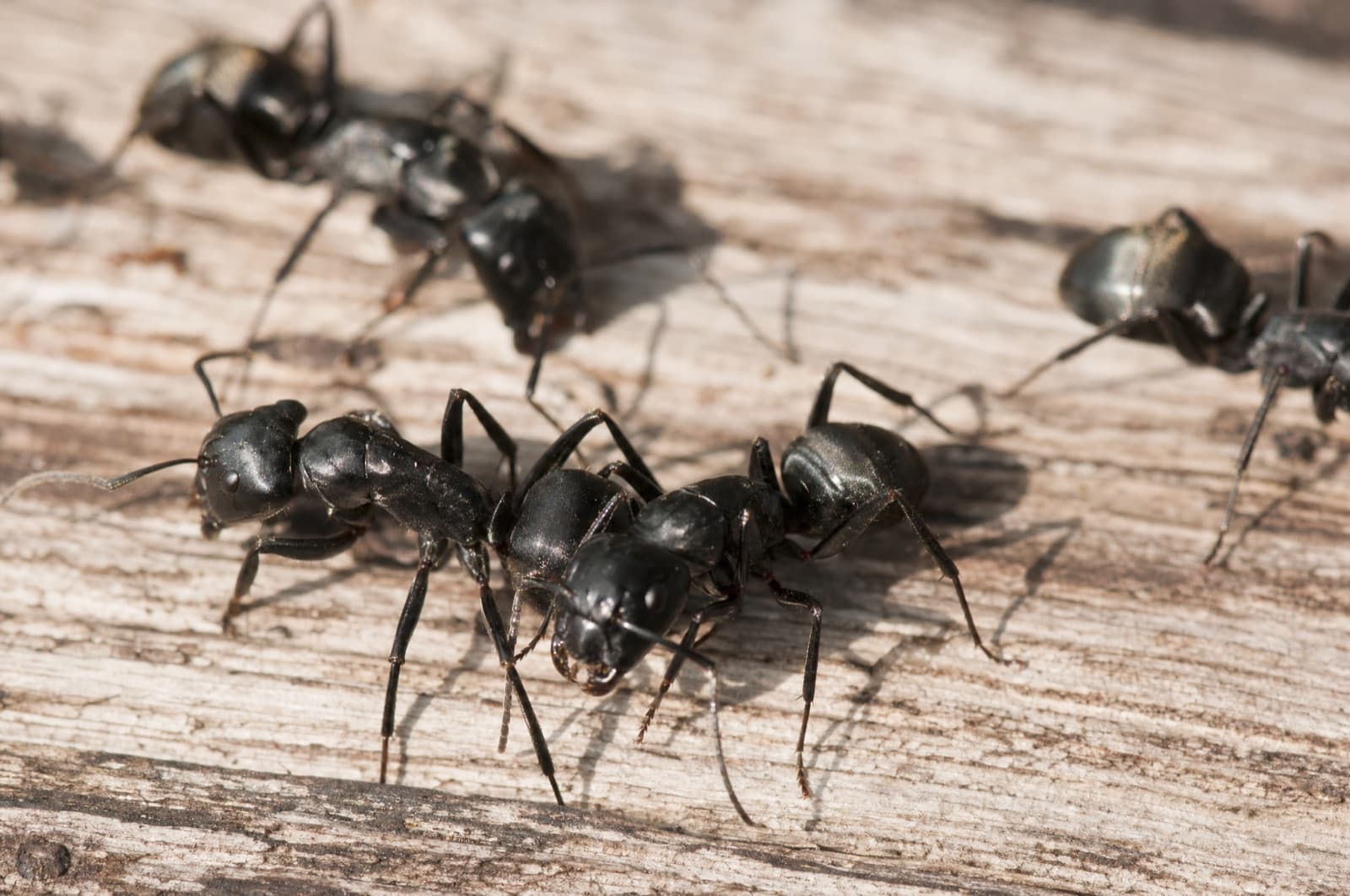
Black Carpenter Ant (Eastern Black Carpenter Ant)

Camponotus pennsylvanicus

Size
6–13 mm (polymorphic)
Color
Uniformly matte black with dense pale-yellow appressed pubescence on gaster
Nest
Moist or decaying structural wood (>15% moisture content); outdoors in stumps, logs, dead branches; indoors in sill plates, around plumbing leaks, in wall voids
Aggression
NH Prevalence

Distinguishing feature

The #1 structural pest in NH: 'Carpenter ants (Camponotus spp.), along with termites, are the most troublesome structural pest in New Hampshire' (Eaton & Maccini 2016, UNH Fact Sheet 62 [1]). Single-node petiole (one bump between thorax and abdomen); evenly rounded thoracic dorsum in lateral profile; 12-segment geniculate antennae without a club. Any large black ant seen indoors January–February = active indoor nest per UNH Extension guidance [2]. Urgency: 5/5 — professional treatment strongly recommended.

Species 4

New York Carpenter Ant

Camponotus novaeboracensis

Size
5–10 mm (polymorphic)
Color
Black head and gaster with bright red-orange mesosoma and legs; short same-colored gastral setae
Nest
Rotten wood, logs, stumps, dead branches; common in deciduous and mixed-hardwood forest; occasional structural nests in moisture-damaged homes
Aggression
NH Prevalence

Distinguishing feature

The bicolored (red thorax + black head/gaster) pattern is distinctive. Second-most-encountered carpenter ant in NH; common in wooded suburbs, lakefront, and wetland-adjacent properties. Same single-node petiole and evenly rounded thorax as C. pennsylvanicus. Short gastral setae the same color as the cuticle — distinguishes from C. chromaiodes (which has long golden setae). Urgency: 5/5 — structural risk equal to C. pennsylvanicus.

Species 5

Citronella Ants (Smaller and Larger Yellow Citronella Ants)

Lasius claviger / Lasius interjectus

Size
2.5–4.5 mm
Color
Pale yellow to yellow-brown throughout; subterranean; workers rarely seen aboveground except as alates
Nest
Soil under stones, along and under house foundations; well-decayed stumps; tend root-feeding aphids and mealybugs for honeydew
Aggression
NH Prevalence

Distinguishing feature

Strong lemon/citronella odor when crushed — the fastest field confirmation. Alate swarms from basement cracks in September–October or April–May are frequently mistaken for termites. KEY DIAGNOSTIC: citronella alates have elbowed antennae + pinched waist + unequal wing pairs (forewing larger) + yellow body + lemon odor. Termites have straight bead-like antennae, no waist, four equal wings, no odor. Saving a homeowner from an unnecessary termite treatment ($1,500+) is the single biggest value of knowing this species. Urgency: 1/5 — no treatment needed; vacuum alates, seal foundation cracks.

Species 6

Silky Field Ant (Black Field Ant)

Formica subsericea

Size
4–8 mm (monomorphic to weakly polymorphic)
Color
Matte black with silvery-gray pubescence; bicolored red-and-black in some Formica species (F. neorufibarbis)
Nest
Soil mounds in open lawns, pastures, field edges, along foundations; rarely nests in structures but workers regularly forage indoors
Aggression
NH Prevalence

Distinguishing feature

THE KEY SEPARATOR FROM CARPENTER ANTS: thoracic dorsum clearly two-curved in lateral profile — an anterior promesonotal hump and a separate, lower propodeum. Carpenter ants have a single evenly rounded arch. This lateral-thorax silhouette test resolves >95% of large-black-ant ID questions in NH (NC State Urban Pests; Ellison et al. 2012 [3]). Sprays formic acid from acidopore when disturbed; does not sting. Urgency: 2/5 outdoor; professional rarely needed.

Species 7

Acrobat Ant

Crematogaster cerasi

Size
2.5–3.5 mm
Color
Bicolored — dark brown to black head and gaster, reddish-brown mesosoma (variable)
Nest
Arboreal — under bark, dead branches, old woodpecker holes; structurally in wall voids, foam insulation, and water-damaged door/window framing; often re-occupies old carpenter ant galleries
Aggression
NH Prevalence

Distinguishing feature

Heart-shaped (cordate) gaster dorsally flattened, attached to the dorsal surface of the gaster — when disturbed, workers raise the gaster up and over the thorax in the 'acrobat' posture. 11-segmented antenna with a 3-segment club. Finding acrobat ants in wall voids almost always signals underlying moisture damage — the ant is a reliable secondary indicator. Urgency: 3/5 (rises to 4/5 in foam insulation or modern construction).

Species 8

Thief Ant (Grease Ant)

Solenopsis molesta

Size
1.3–1.8 mm
Color
Pale yellow to honey-amber; gaster sometimes slightly darker
Nest
Soil cracks, under stones, in or near nests of larger ants; indoors in wall voids, behind baseboards, under cabinets near grease and protein sources
Aggression
NH Prevalence

Distinguishing feature

10-segmented antenna with a sharply defined 2-segmented club — the single most reliable separator from pharaoh ant (which has 12 segments and a 3-segment club). Grease/protein preference (peanut butter, bacon grease, hot dog) over sugar bait is a useful field test. Both thief ant and pharaoh ant are on the FDA 'Dirty 22' list of arthropods associated with foodborne pathogen transmission (Sulaiman et al. 2012 [11]). Urgency: 3/5 — DIY with grease/protein borate bait; confirm ID before treating.

Species 9

Cornfield Ant (Labor Day Ant)

Lasius neoniger

Size
2–3 mm
Color
Brown (not yellow like the citronella ants); workers slightly paler than F. subsericea
Nest
Soil nests in lawns, athletic fields, driveways, golf greens — produces small crater mounds; tends root aphids; only occasionally enters houses
Aggression
NH Prevalence

Distinguishing feature

Nuptial flights peak late August–early September, earning the 'Labor Day ant' nickname (Hölldobler & Wilson 1994). Late-summer crater mounds in lawn + 2–3 mm brown ants swarming near Labor Day weekend = almost certainly L. neoniger. Indoor presence is rare and typically self-resolves. Urgency: 1/5 — DIY perimeter or monitor.

Species 10

Pharaoh Ant

Monomorium pharaonis

Size
1.5–2 mm
Color
Pale yellow to light amber, slightly translucent; dark gaster tip
Nest
Strictly indoor in temperate NH — cannot survive NH winters outdoors; wall voids near plumbing, behind baseboards, in electrical outlets, near hot-water pipes; hospitals, multi-family apartments, nursing homes
Aggression
NH Prevalence

Distinguishing feature

12-segmented antenna with a distinct 3-segmented club; two petiolar nodes; very small. Wetterer (2010) [5] published the first known NH pharaoh ant record: 'in temperate areas, it is found almost exclusively indoors.' CRITICAL WARNING: colonies reproduce by BUDDING — a queen plus workers split off without a mating flight when disturbed by spray. Feng, Choe & Lee (2025) [6] showed that ALL over-the-counter spray products (pyrethroid and essential oil) increase budding probability. STOP all DIY spraying; baiting with slow-acting IGR baits (methoprene, pyriproxyfen) or boric acid is the only effective approach. Multi-unit coordinated treatment required. Urgency: 5/5 — professional only.

Species 11

Hairless Rover Ant (Little Yellow Ant)

Brachymyrmex depilis

Size
1.3–2 mm
Color
Pale yellow to pale amber, almost translucent
Nest
Soil, under stones, in rotting wood — predominantly subterranean; forages on root-aphid honeydew; rare indoor pest, usually near foundation moisture
Aggression
NH Prevalence

Distinguishing feature

9-segmented antenna — UNIQUE among New England pest ants. All other NH tiny pale-yellow ants (pharaoh: 12-segment; thief: 10-segment) have more antennal segments. Single petiolar node concealed beneath gaster (similar profile to OHA but pale yellow not dark). The B. patagonicus (aggressive rover ant) is restricted to the southern U.S. and is NOT in NH. Urgency: 1/5 — rare indoor occurrence; address foundation moisture.

Species 12

Little Black Ant

Monomorium minimum / Monomorium emarginatum

Size
1.5–2 mm
Color
Shiny black to dark brown throughout; monomorphic
Nest
Outdoor in soil, rotting wood, under stones; indoor in wall voids, woodwork, masonry — a generalist
Aggression
NH Prevalence

Distinguishing feature

Shiny black body + tiny size (1.5–2 mm) + 12-segment antenna with 3-segment club + generalist diet (sweets, grease, honeydew, insects). Note: Ellison et al. 2012 [3] emphasize M. emarginatum and M. viridum as the dominant native NE Monomorium; true M. minimum records in NH are sparse. Whatever the species, treatment is the same: sweet liquid bait + perimeter non-repellent spray. Less budding-prone than OHA or pharaoh; responds well to standard IPM. Urgency: 2/5 — DIY dual-bait.

NH Risk Heat Map

Carpenter ant pressure by NH county

Ant pressure across NH's five southern service counties reflects housing age, forest proximity, and species composition. Carpenter ants drive the structural-risk ratings; pavement and OHA add volume in all dense urban areas. Ratings calibrated against UNH Extension entomology call volume, regional pest-industry reporting, and US Census housing-age data [12].

HillsboroughExtreme riskRockinghamExtreme riskMerrimackHigh riskStraffordHigh riskCheshireHigh riskManchester HQ
Low
Moderate
High
Extreme

Hillsborough County

Extreme

Highest absolute case volume in the state. Manchester's pre-1940 balloon-framed mill housing and Nashua's pre-1960 stock carry the highest carpenter-ant structural risk; dense suburban OHA and pavement ant populations throughout Bedford, Goffstown, Hooksett, and Merrimack town. Pharaoh ant cases concentrated in Manchester and Nashua multi-unit housing and healthcare facilities.

Rockingham County

Extreme

Portsmouth's pre-1900 clapboard housing on tidal moisture represents the highest carpenter ant structural risk in NH. Salem, Derry, and Hampton carry heavy pavement ant and OHA pressure. The coastal USDA Zone 6b strip provides NH's longest annual carpenter ant foraging window. Approximately 16% of housing stock pre-dates 1950 [12].

Merrimack County

High

Concord's downtown and South End contain extensive pre-1940 wood-framed stock; surrounding rural towns (Henniker, Warner, Andover) have classic forest-edge carpenter ant exposure. OHA and pavement ant pressure is high throughout the county's suburban ring.

Strafford County

High

Dover and Rochester both have substantial pre-1940 mill-era housing stock driving carpenter ant pressure. Approximately 22% of Strafford County homes pre-date 1950 [12] — tied for the highest pre-1950 share among the five service counties alongside Cheshire. UNH-Durham concentration of older university rentals adds to complaint volume.

Cheshire County

High

Highest per-home risk in the state for structural carpenter ant infestation. Cheshire County has 27.3% of homes built before 1940 — the oldest housing stock of any NH service county — and a median construction year of 1973 (Point2Homes / US Census ACS [12]). Heavy Monadnock-region forest interface with abundant decaying beech and maple drives parent-colony pressure. Monadnock Pest & Wildlife identifies carpenter ants as 'arguably the most prolific household pest in New Hampshire.'

Bottom line — Every southern NH county carries HIGH or EXTREME ant pressure from at least one species. Your home's year of construction and distance from forest edge are the two strongest predictors of carpenter ant risk specifically — homes built before 1985 and within 100 m of a forested boundary should assume the question is 'when,' not 'if.'

Decision Tree

Should you call a pro?

Four questions branching to a species ID and urgency verdict. Works for live ant sightings; if you only have signs (frass, hollow wood, sounds), go directly to Q3.

Have you seen the ant directly, or only signs (frass, sounds, swarmers)?

Prevention Playbook

How to stop carpenter ants from coming back

1

Eliminate moisture at the perimeter first: fix leaks under sinks, in roof valleys, and around window frames — wet wood is the non-negotiable prerequisite for carpenter ant nesting and acrobat ant secondary colonization.

2

Remove carpenter ant harborage within 50 feet of the foundation: tree stumps, decaying logs, woodpiles on the ground, dead branches touching the roof or siding.

3

Seal foundation cracks and utility penetrations with caulk or expanding foam — this is the primary entry route for pavement ants, OHA, and carpenter ant foragers from outdoor parent colonies.

4

Trim all shrubs, vines, and tree branches away from contact with the house — vegetation contact is the fastest highway for carpenter ant foragers moving from a parent colony into a satellite nest location.

5

Never store firewood against the house or on the ground; use a metal rack at least 20 feet from the foundation with airflow underneath — ground-contact woodpiles are ideal parent-colony sites for C. pennsylvanicus.

6

For multi-unit housing: if ANY unit has tiny pale yellow ants, notify management immediately and treat the building as a single pharaoh ant problem requiring coordinated IGR bait — fragmented unit-by-unit spray attempts will drive budding across the entire structure.

Local Context

Why New Hampshire Has One of the Most Complex Ant Faunas in the Northeast

NH's position at the edge of multiple biogeographic zones — boreal-to-temperate transition, coastal-to-inland humidity gradient, and second-most-forested state in the U.S. — means it hosts both northern specialists (C. herculeanus, the boreal carpenter ant, in the White Mountains) and more southern species at or near their northern limits (C. chromaiodes in southern counties only). The 3°F warming trend since 1901 is gradually shifting the ant community composition southward. Species that are marginal in NH today may become common in the next 20–30 years.

Key Local Data

NH is 84% forested with a maple/beech/birch group occupying 52% of forest land — the largest low-grade decaying-wood pool in the Northeast, which is the primary reason carpenter ant structural infestations are classified as the #1 structural pest concern in the state (USDA FS NRS-RB-119; Eaton & Maccini 2016 [1]).

Common Questions

Frequently Asked

Sources & References

Where this data comes from

  1. [1]
  2. [2]
  3. [3]
  4. [4]
  5. [5]
  6. [6]
  7. [7]
  8. [8]
  9. [9]
  10. [10]
  11. [11]
  12. [12]
  13. [13]
Family-owned since 2017

Identified your ant? The next step depends entirely on the species.

Carpenter ants and pharaoh ants require professional treatment. Pavement ants and OHA often don't — but only if you treat with the right product. We'll tell you which situation you're in at no cost.

NH-licensed pest control operators (License #782664) Free inspection — no obligation 30-day follow-up included with treatment Serving Manchester, Nashua, Concord, Derry, Bedford, and surrounding towns since 2017