
Skip to content
APS
Anchor Pest Services Field Team · NH-Licensed Pest Control Operators (License #782664)
Reviewed by Tim Boyle

How Do Exterminators Get Rid of Ants in Walls? The Professional Workflow Explained

Yes — pros use a structured 4-stage workflow

Exterminators eliminate wall-void ant nests using four tools and four treatment access methods. They locate nests with moisture meters (threshold >20% wood moisture content), acoustic stethoscopes listening for carpenter ant rustling, borescopes inserted through a 3 mm pilot hole, and bait-and-follow techniques for odorous house and pharaoh ants [1][2]. Treatment is matched to species: drill-and-dust through a 1/8" hole with deltamethrin 0.05% or silica aerogel for carpenter ants; non-repellent fipronil foam injection for irregular voids; slow-acting gel bait near entry points for odorous house ants and pharaoh ants. All jobs include exterior non-repellent fipronil at 0.06% on the foundation perimeter. The critical distinction from DIY is non-repellent product selection — ants cannot detect these products and transfer them to the queen [15].

At a Glance

  • Short Answer: Pros use 5 locator tools and 4 treatment access methods matched to species — the inspection phase determines which combination is used
  • Key Fact: Pro colony elimination rate is 80–95% in a single visit when the parent nest is correctly located — versus 55% field success for best-in-class DIY baits [13]
  • NH Relevance: UNH Cooperative Extension FS 62 identifies wall voids adjacent to moisture sources as the #1 indoor carpenter ant satellite location in NH [1]
  • Action Needed: Stop spraying and call for a free inspection — previous DIY spray history can complicate bait acceptance and should be disclosed to the inspector
Key Statistics

How Do Exterminators Get Rid of Ants in Walls? The Professional Workflow Explained — The Numbers

4

Wall-void treatment access methods

80–95%

Pro colony elimination rate (nest located)

30 days

Industry-standard follow-up window

>20%

Wood moisture threshold for nest habitat

Deep Dive

The Full Picture

The professional workflow for eliminating wall-void ant nests consists of four stages: free inspection and species identification, nest location using calibrated tools, targeted treatment matched to species, and 30-day verification. Each stage builds on the last — imprecise species ID leads to wrong treatment selection, and wrong treatment (especially sprays for pharaoh or OHA) multiplies satellite nests rather than eliminating them 56. The workflow described here is the standard used by licensed NH operators including Modern Pest, JP Pest, Colonial, and Anchor Pest Services.
01

Stage 1 — Free inspection and species identification (30–60 min)

The inspection begins at the exterior perimeter — a slow walk with particular attention to siding condition at plumbing and electrical penetrations, caulk failures at window and door frames, sill-plate moisture staining, and visible trails at the foundation.
Read moreInterior inspection follows: trail-following from frass piles and outlet activity, basement sill-plate inspection, and a moisture audit of suspect wall sections. Written documentation of trail locations, activity times provided by the homeowner, and species characteristics observed (size, color, frass presence, crush-odor if OHA suspected) informs the treatment plan. Species ID is the most consequential step — carpenter ant versus OHA versus pharaoh ant requires completely different access methods and products 12.
01
02

Stage 2 — Nest location using 5 professional tools

Visual inspection at dusk is the starting point — carpenter ants exit the nest approximately 15 minutes after sunset in a recognizable single-file trail that can be followed back to the entry point.
Read moreMoisture meters (pin or pinless) are applied to the suspect stud bays: readings above 20% WMC flag potential carpenter ant nesting habitat 1. Acoustic stethoscopes amplify the distinctive cellophane-rustling and mandible-clicking of a disturbed carpenter ant satellite when the wall is gently tapped — audible activity in load-bearing structural members is a Tier 3 EMERGENCY 2. Thermal imaging (IR) is sometimes used to identify moisture gradients and large carpenter ant carton nests by surface-temperature contrast; however, IR cameras cannot directly image individual ants or small ant trails — this is widely overstated in pest control marketing, and industry guidance from FLIR and GTGUARD confirms this limitation [p5§4.3]. Borescopes inserted through a 3 mm pilot hole allow direct visualization of stud-bay contents before committing to drill-and-dust access.
02
03

Stage 3 — Treatment: 4 access methods matched to species

Drill-and-dust is the standard for confirmed carpenter ant and acrobat ant wall nests: a 1/8" hole through the gypsum allows a hand-bulb duster to deliver deltamethrin 0.05% dust or CimeXa silica aerogel throughout the void 15.
Read moreThe dust coats surfaces and ants returning to the nest; residual lasts 6–12 months in dry voids. Foam injection (fipronil 0.005%) is preferred when the void has irregular geometry or foam insulation — the expanding foam fills the space and delivers active ingredient to ants in contact. Baiting near entry points is the gold standard for OHA and pharaoh ants: slow-acting non-repellent bait gel placed adjacent to (not inside) entry points transfers trophallactically to queens that are inaccessible to direct treatment 25. Exterior non-repellent perimeter (fipronil 0.06% or chlorfenapyr) is applied at every job as a continuous foundation band — BASF's documented 100% colony control claim relies on the transfer-effect mechanism where ants carry active ingredient back to the nest 15.
03
04

Products used (by active ingredient, not brand name)

Licensed NH operators use products unavailable to consumers without a pesticide applicator's license.
Read moreFor dust treatments: deltamethrin 0.05% (professional formulation) and silica aerogel (CimeXa) are the primary products — both non-repellent in the void context, with 6–12 months residual. For foam injection: fipronil 0.005% foam is the standard; imidacloprid foams are an alternative. For gel baiting: abamectin 0.011% (protein-matrix granule, the only DIY product with peer-reviewed colony-elimination data per Hansen 2008 13), indoxacarb 0.05% gel, and boric acid bait gels are used by species and season. For perimeter treatment: fipronil 9.1% concentrate diluted to 0.06% — non-repellent, with transfer effect documented in termite and ant field trials 15. The pro advantage is product selection calibrated by colony size, species, and season — not available in consumer formulations.
04
05

The IR thermal imaging caveat

Thermal imaging cameras are frequently advertised by pest control companies as a tool for 'seeing ants in walls.' Industry guidance from FLIR and GTGUARD is explicit: IR cameras cannot image individual ants or small trails inside walls [p5§4.3].
Read moreWhat IR can reliably detect is surface-temperature contrast from moisture gradients (wet wood vs. dry wood) and, in some cases, the thermal mass of a large carpenter ant carton nest. These are useful — wet wood identified by IR is often nest habitat — but a homeowner seeing 'thermal imaging' in a marketing pitch should understand they are paying for moisture mapping, not direct ant visualization. The five-tool approach (visual, moisture meter, acoustic stethoscope, borescope, bait-follow) is the comprehensive standard.
05
06

Stage 4 — Verification benchmarks

The 30-day follow-up is an industry standard for NH carpenter ant wall treatments.
Read moreThe benchmarks are specific: frass cessation within 30 days of treatment (new frass after 30 days triggers re-treatment), indoor ant sightings dropping to zero within 14 days (audible activity in structural members gone at 60 days for severe cases), and moisture remediation documented for the moisture source identified during inspection [p4§2]. For OHA and pharaoh ant bait treatments, the trophallaxis transfer takes 2–3 weeks — applying any spray during this window interrupts the colony kill. The re-service guarantee is standard for NH operators: free re-treatment between scheduled quarterly visits if pests return within the plan window.
06
07

DIY vs. professional success rates

Hansen (2008) tested 7 commercial bait formulations across 72 field sites in NH, WA, OR, and ID against carpenter ants, finding a 55% field colony-elimination success rate versus greater than 95% in lab conditions 13.
Read moreThe gap between lab and field reflects the real-world challenges DIY users face: wrong bait selection for the season (carpenter ants shift between protein-seeking spring and sugar-seeking summer phases — Tripp et al. 2000 [p4§3]), placement near repellent residues that cause bait avoidance, and inability to access the nest directly. Professional treatment with correctly located parent nest achieves 80–95% colony elimination in a single visit [p4§2]. The inter-colony variability in fipronil LT50 (7.4–29.3 hours per Hannum & Miller, cited in Wiltz et al. 2014 17) illustrates why licensed operators calibrate product selection to the specific colony — a capability DIY users cannot replicate.
07
08

What homeowners should do before and after the pro visit

Before the visit: stop all spraying at least two weeks before the inspection — residual repellents compromise bait acceptance and mask behavioral data 5.
Read moreDocument frass locations, ant activity times, and entry points with photos. Clear access to suspect walls by moving furniture away from baseboards and emptying under-sink cabinets. After treatment: do not spray any insecticide for 30 days — bait trophallaxis to the queen takes 2–3 weeks, and spraying workers carrying bait interrupts the transfer [p4§2]. Sweep frass locations on day 7, day 14, and day 30; photograph and date any new frass. Schedule the 30-day follow-up before the inspector leaves the property — it should be on the calendar before you close the door.
08

Bottom line — Professional wall-void ant treatment works because it combines species-accurate identification, calibrated locator tools, professional-grade non-repellent products, and documented follow-up benchmarks — not because pros spray harder than homeowners.

NH Carpenter Ant Species

Carpenter ants aren't one species — they're four

Each NH wall-void species has a distinct professional treatment recommendation. Using the wrong method — especially a repellent spray for OHA or pharaoh ants — delays resolution by weeks and multiplies satellite nests.

Species 1

Black Carpenter Ant

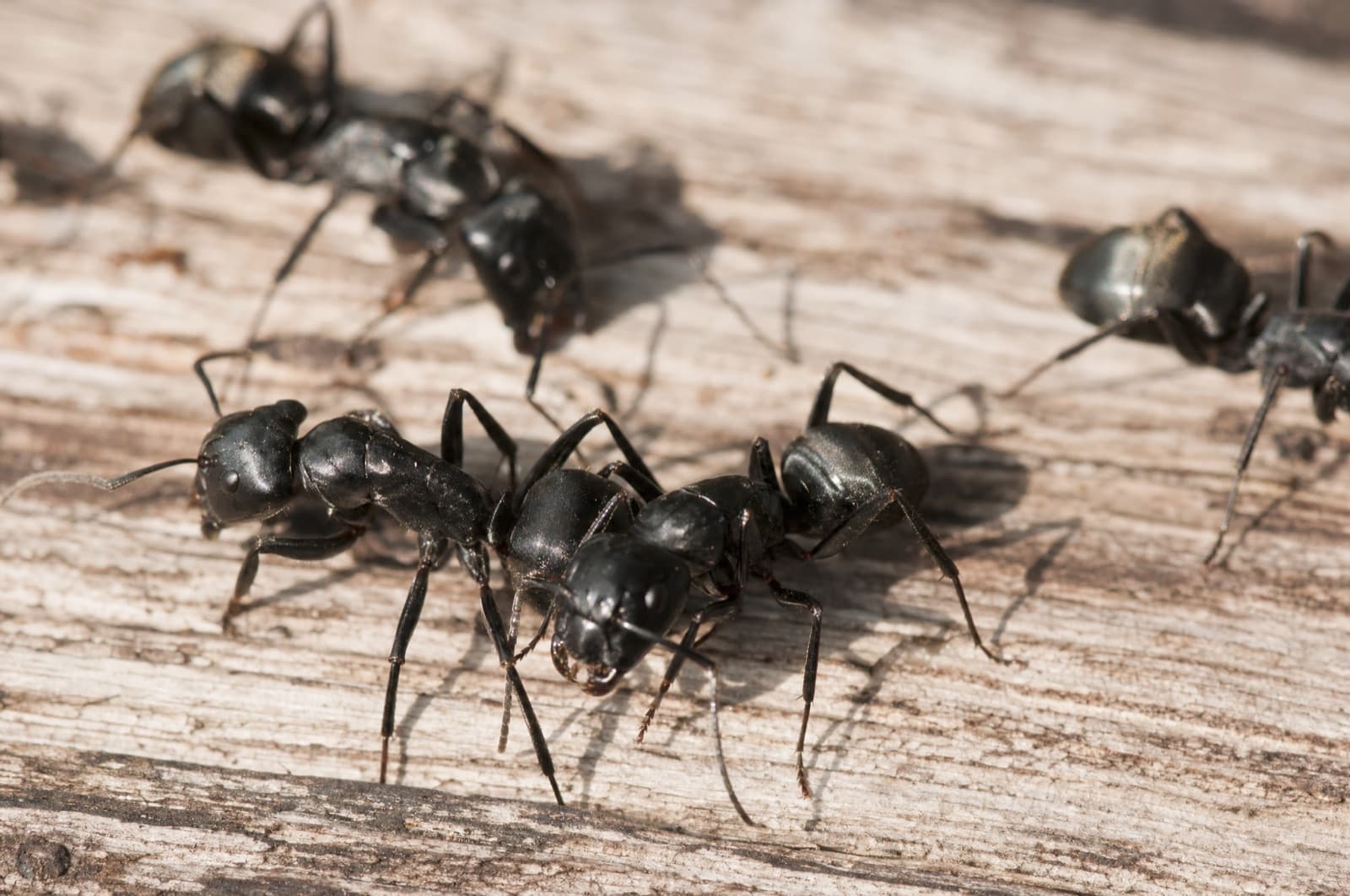
Camponotus pennsylvanicus

Size
6–13 mm
Color
Uniformly matte black; evenly rounded single-curve thorax; single-node petiole
Nest
Moisture-damaged stud bays in wall voids — UNH FS 62's #1 indoor satellite location [1]
Aggression
NH Prevalence

Distinguishing feature

Pro treatment: drill-and-dust (deltamethrin 0.05% or CimeXa silica) + exterior non-repellent fipronil perimeter + 30-day follow-up. Locate with moisture meter (>20% WMC) and acoustic stethoscope. Audible rustling at dusk confirms satellite colony [2].

Species 2

Odorous House Ant

Tapinoma sessile

Size
2.4–3.3 mm
Color
Uniform dark brown to nearly black; concealed petiole; coconut/blue-cheese odor when crushed
Nest
Wall voids near plumbing, insulation, bathroom subfloors — most common indoor wall-void nest species in NE [6]
Aggression
NH Prevalence

Distinguishing feature

Pro treatment: non-repellent gel bait (borate/sugar or fipronil gel) placed near (not inside) entry points. Control outdoor honeydew sources. Repellent sprays are explicitly contraindicated — trigger sub-nest relocation and expand the infestation [6][7]. Multi-room trails with no frass = OHA.

Species 3

Pharaoh Ant

Monomorium pharaonis

Size
1.5–2 mm
Color
Pale yellow to light amber; darker gaster tip; 12-segment antenna with 3-segment club
Nest
Wall voids near plumbing chases, electrical conduit, heat sources — strictly indoor in NH [4]
Aggression
NH Prevalence

Distinguishing feature

STOP-SPRAY WARNING: Any pyrethroid or essential-oil spray triggers colony splitting (sociotomy) at all colony sizes [5]. Pro treatment: slow-acting IGR or boric acid bait ONLY — no sprays, no dust in voids. Coordinated multi-unit treatment often required in NH multi-family housing. Pale yellow tiny ants in 2+ rooms = pharaoh ant presumed.

Species 4

Acrobat Ant

Crematogaster cerasi

Size
2.5–3.5 mm
Color
Bicolored — dark gaster, reddish-brown mesosoma; heart-shaped gaster raised in alarm
Nest
Wall voids with EPS/polystyrene foam insulation or water-damaged framing; old carpenter-bee galleries
Aggression
NH Prevalence

Distinguishing feature

Pro treatment: drill-and-dust (deltamethrin or silica aerogel) + moisture remediation of underlying water-damaged wood. Fine foam debris (not wood frass) at entry points is the signature. Indicates foam insulation damage or moisture problem behind the wall [3].

Species 5

Pavement Ant

Tetramorium immigrans

Size
2.5–4 mm
Color
Dark brown to nearly black; parallel rugose grooves on head and thorax; two visible petiolar nodes
Nest
Soil under foundation; occasionally wall voids at sill-plate seam
Aggression
NH Prevalence

Distinguishing feature

Pro treatment: exterior non-repellent perimeter (fipronil or dinotefuran) at foundation band + granular outdoor bait (abamectin or hydramethylnon). Responds to sprays unlike OHA and pharaoh ants. Typically enters at sill-plate seam, not mid-wall outlets [10].

NH Risk Heat Map

Carpenter ant pressure by NH county

NH wall-void ant pressure follows housing age and moisture patterns. Older balloon-framed homes and properties with ice-dam histories carry the highest carpenter ant satellite risk; pharaoh ant risk is concentrated in heated multi-unit buildings.

HillsboroughExtreme riskRockinghamExtreme riskMerrimackHigh riskStraffordHigh riskCheshireHigh riskManchester HQ
Low
Moderate
High
Extreme

Hillsborough County

Extreme

Highest wall-void carpenter ant case volume in NH. Manchester and Nashua's pre-1960 housing stock + humid summers create recurring stud-bay moisture problems. OHA is a year-round wall-void issue in multi-unit properties [7].

Rockingham County

Extreme

Coastal humidity maintains above-15% WMC in exterior walls longer each season. Salem, Derry, Auburn, and Hampton see heavy carpenter ant wall-void pressure. Pro drill-and-dust treatments are the dominant wall-void service call in this county.

Merrimack County

High

Concord corridor and Merrimack River humidity. Older homes in Concord, Boscawen, and Loudon with original balloon framing are highest risk for multi-bay satellite infestations requiring borescope inspection.

Strafford County

High

Rochester and Dover wetland-adjacent properties carry elevated carpenter ant satellite pressure. Dover multi-unit housing has documented pharaoh ant activity requiring coordinated building-wide bait treatment [4].

Cheshire County

High

27.3% pre-1940 housing stock — highest among the five service counties. Keene's Victorian and Craftsman-era balloon framing provides uninterrupted stud cavities from sill to roof. Drill-and-dust treatments often require access at multiple elevations.

Bottom line — Any NH home built before 1970 with a documented ice-dam history should have annual moisture audits at sill plates and rim joists as a baseline prevention measure.

Visual Identification

The professional wall-void inspection and treatment workflow

What a licensed NH inspector actually does during a wall-void ant service call — from moisture audit to treatment verification.

Sign 1

Moisture meter reading at suspect stud bay

A pin or pinless moisture meter pressed to the wall surface at the suspect stud bay. Readings above 20% wood moisture content (WMC) correlate with carpenter ant nesting habitat. Wood below 15% MC is essentially carpenter-ant-proof. The inspector marks all readings above threshold on a site diagram for treatment planning [1].

Sign 2

Acoustic stethoscope on wall surface

The acoustic stethoscope is pressed to the wall while the inspector gently taps a screwdriver handle against the surface. Disturbed carpenter ants produce a distinctive cellophane-rustling or mandible-clicking sound amplified through the stethoscope. This technique confirms live colony presence and localizes the nest bay before drilling [2].

Sign 3

Borescope inspection through 3 mm pilot hole

A fiber-optic borescope inserted through a 3 mm pilot hole in the drywall allows direct visual confirmation of stud-bay contents — ant workers, frass accumulation, galleries in wood, or foam debris. This avoids unnecessary wall opening and documents nest presence for the treatment plan.

Sign 4

Drill-and-dust treatment in progress

The inspector drills a 1/8" hole through the gypsum at the confirmed nest bay, then inserts the nozzle of a hand-bulb duster to blow deltamethrin 0.05% dust or CimeXa silica aerogel throughout the void. The dust coats surfaces and ants returning to the nest. A single properly placed application has 6–12 months residual in dry voids [15].

Sign 5

Foam injection at outlet or wall void

Non-repellent insecticidal foam (fipronil 0.005%) is injected through a fitting at a drilled access port or directly through an outlet box. The foam expands to fill irregular void geometry and contacts ants that return to the nest. Preferred for voids with foam insulation where dust drift is limited [15].

Sign 6

Exterior perimeter non-repellent application

A continuous band of fipronil at 0.06% is applied along the foundation perimeter, extending 12 inches up the siding and 12 inches out on the ground surface. All plumbing penetrations, electrical conduit entry points, and weep holes receive targeted application. Ants that contact the product transfer it to nestmates via trophallaxis, achieving colony-level control [15].

Decision Tree

Should you call a pro?

Use this 3-question branch to determine whether DIY or professional treatment is appropriate for your wall-void ant situation.

What signs are you seeing that suggest ants are in your walls?

Transparent Cost Calculator

What carpenter ant treatment actually costs

Professional wall-void ant treatment costs vary by species, number of bays involved, and access difficulty. These are 2026 NH market rates for southern NH operators.

Home size

Infestation severity

Treatment type

Estimated cost

$191$383

One-time inspection + perimeter + baiting

Free inspection with moisture audit and species ID, exterior non-repellent fipronil perimeter, interior gel baiting at entry points. Appropriate for OHA, pharaoh, and pavement ant wall infestations.

All figures are 2026 southern NH market rates. Drill-and-dust add-ons are $300–$600 above base perimeter pricing. Structural wood replacement, if required after carpenter ant damage confirmation, is quoted separately by the coordinating contractor. These figures do not include structural repairs.

Treatment Effectiveness

How long does each method actually last?

DIY repellent pyrethroid spray (indoor)

$8–$20 · DIY

2–4 hours knockdown

Kills 10–15% of foragers only; triggers budding in pharaoh and OHA colonies [5][6][19]. Does not penetrate to nest. Hansen 2008: 55% field success ceiling even for best-in-class DIY baits [13].

DIY non-repellent gel bait at trail entry

$30–$50 · DIY

2–3 weeks

Effective only when colony is small and all foragers contact bait. Hansen 2008 field success 55% across 7 bait types in 72 field sites [13]. Fails when queen is deep in an inaccessible wall void.

Pro drill-and-dust (deltamethrin 0.05% or silica aerogel)

$300–$600 add-on · Professional

6–12 months residual

Standard method for carpenter ant and acrobat ant wall nests. 1/8" hole through gypsum, hand-bulb duster delivers dust to void. 6–12 months residual in dry voids. Direct nest contact; 80–95% colony elimination when nest located [p4§2].

Pro foam injection (fipronil 0.005%)

$300–$600 add-on · Professional

3–6 months

Expanding non-repellent foam fills irregular voids and contacts returning workers who transfer active ingredient to the queen. Preferred for voids with foam insulation or irregular geometry. BASF: 100% colony control documented with transfer effect [15].

Pro exterior non-repellent perimeter (fipronil 0.06%)

$250–$500 (base service) · Professional

90 days

Continuous foundation band targeting plumbing and electrical penetrations. BASF label permits two applications per calendar year at 0.06% for ant control. Colony collapse via trophallaxis transfer effect within 30–90 days [15].

Full IPM combination (perimeter + void access + baiting + 30-day follow-up)

$480–$840/year (quarterly plan) · Professional

12+ months

90% of NPMA-surveyed pest professionals endorse multi-mode IPM as the most effective approach [12]. Quarterly plan includes 4 visits with free re-service. Industry re-infestation rate under 5% at 12 months vs 10–20% for single one-time treatments [p4§3].

Prevention Playbook

How to stop carpenter ants from coming back

1

Stop any DIY spraying at least two weeks before the inspector arrives — active residual from pyrethroid sprays compromises bait acceptance and the inspector needs accurate behavioral data [5].

2

Photograph all ant activity locations with timestamps before the inspection — trail origin points, outlet locations, frass pile positions, and estimated ant sizes. This saves 15–20 minutes of the inspection and improves treatment plan accuracy.

3

Clear access to all suspected wall sections — move furniture away from baseboards where you've seen ants, empty under-sink cabinets near plumbing penetrations, and remove items stacked against exterior walls.

4

Note the time of day when you see ant activity — carpenter ants are nocturnal with peak activity ~15 minutes after sunset; pharaoh and OHA ants are active 24 hours; pavement ants peak during daylight. Activity timing helps inspectors confirm species ID without extensive sampling [2].

5

Do not repair or caulk entry points before the inspection — sealing entry points before baiting has been completed traps bait-carrying workers outside the nest and stops the trophallactic transfer to the queen.

6

Locate your water shut-off and know the last time any plumbing in the suspect wall was serviced — moisture history is one of the inspector's primary questions for carpenter ant wall nests [1].

Local Context

Why NH Wall-Void Ant Treatment Differs from National Averages

New Hampshire's older housing stock — 22% of homes built before 1950, median owner-occupied build year 1982 — creates structural conditions that increase wall-void ant complexity [18]. Pre-1940 balloon framing provides uninterrupted stud cavities from sill to roof, allowing carpenter ant satellites to establish at any elevation. Ice-dam-driven roof leaks above exterior walls create recurring moisture above the 20% WMC threshold even after the visible leak is repaired. NH inspectors who serve Hillsborough and Rockingham counties — EXTREME pressure counties — typically find parent colonies in stumps or structural wood within 50 meters of the foundation, making exterior perimeter treatment essential alongside any interior void access.

Key Local Data

Cheshire County has 27.3% pre-1940 housing stock — the highest proportion among NH's five service counties — meaning Keene-area homes have a disproportionate incidence of balloon-framed stud cavities that require borescope inspection to fully assess [18].

Common Questions

Frequently Asked

Sources & References

Where this data comes from

  1. [1]
  2. [2]
  3. [3]
  4. [4]
  5. [5]
  6. [6]
  7. [7]
  8. [8]
  9. [9]
  10. [10]
  11. [11]
  12. [12]
Professional Wall-Void Ant Treatment

See what a real pro inspection looks like — before you book

We walk you through the inspection findings, species ID, and treatment plan before we start. No high-pressure upsell. Free re-service if ants return between quarterly visits.

NH Licensed Pest Control Operators — License #782664 Free inspection includes moisture audit and written treatment plan 30-day follow-up on all wall-void treatments included Family-owned and Manchester-based since 2017