
Skip to content
APS
Anchor Pest Services Field Team · NH-Licensed Pest Control Operators (License #782664)
Reviewed by Tim Boyle

What are the big black ants in my house?

Almost certainly carpenter ants or Formica field ants

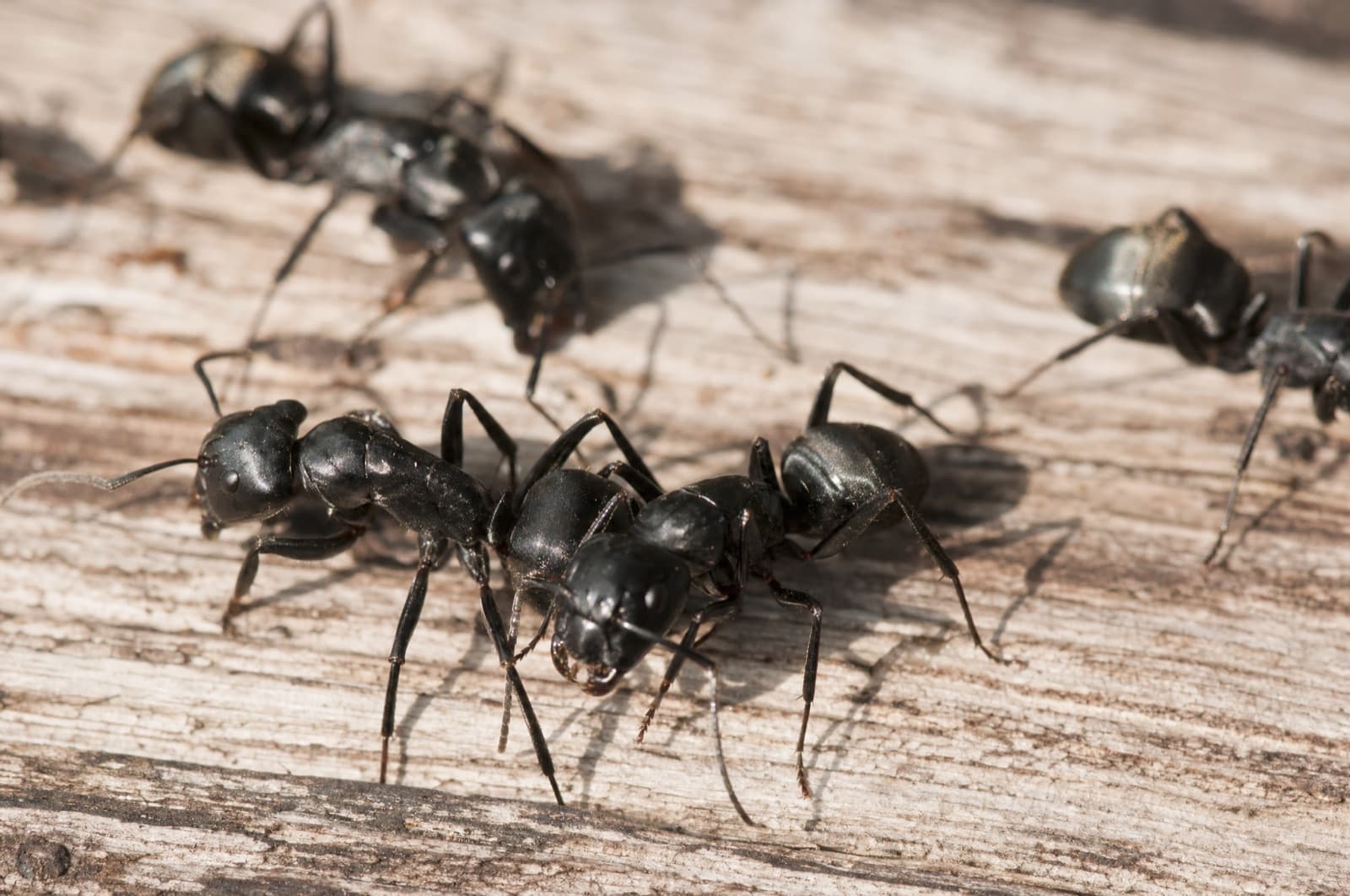
Big black ants in a New Hampshire house are almost always one of two species: Camponotus pennsylvanicus (black carpenter ant, 6–13 mm) or Formica subsericea (black field ant, 5–8 mm). Both are matte black and overlap in size, so color alone won't resolve the ID. The decisive test is the thorax profile viewed from the side: a single evenly rounded arch indicates a carpenter ant; two distinct humps with a notch in between indicates a field ant. Carpenter ants are the structural pest — Formica is a yard nuisance. If you see any big black ant indoors in January or February, UNH Extension states this confirms an interior nest.

At a Glance

  • Short Answer: Big black ants indoors in NH are almost always carpenter ants — the #1 structural pest in the state — or Formica field ants, which require no structural treatment
  • Key Fact: Camponotus pennsylvanicus workers range 6–13 mm; a mature colony reaches 2,000–3,000 workers and produces 200–400 winged swarmers annually
  • NH Relevance: UNH Cooperative Extension Fact Sheet 62 names carpenter ants 'the most troublesome structural pest in New Hampshire' — and Hillsborough and Rockingham counties rank HIGH-EXTREME for infestation pressure
  • Action Needed: Photograph the ant in lateral profile, apply the thorax test, note the month and time of sighting, then inspect within 6 feet for frass
Field Identification Card

How to identify a black carpenter ant worker (camponotus pennsylvanicus)

Camponotus pennsylvanicus (De Geer, 1773) — Black Carpenter Ant

Anatomical DiagramSide view, labeled
Elbowed antennaeHeart-shaped headEvenly rounded thoraxSINGLE-NODE petiole(termites have NO node)Gaster (abdomen)6 segmented legs0mm4mm8mm12mm16mm20mmACTUAL SIZE SCALE
Body Size

613 mm

Minor workers are roughly the length of a grain of long rice (6–9 mm); major workers are nearly as long as a US dime is wide (10–13 mm)

0510152025mm
Color

Uniformly dull matte black across head, thorax, and gaster; dense pale-yellow appressed pubescence on the gaster creates a faint sheen in direct light

Diagnostic Features
  • 1Single-node petiole — the single erect 'bump' between the thorax and gaster is the #1 diagnostic. Pavement ants and pharaoh ants have two nodes; termites have no visible node.
  • 2Evenly rounded thorax in lateral profile — the dorsal surface sweeps in a single smooth arch from front to rear with no notch, dip, or hump. If you see two humps, it is Formica, not Camponotus.
  • 3Geniculate (elbowed) antennae — 12 segments, long scape bends sharply at a joint. Termite antennae are straight and bead-like.
  • 4Polymorphic size — minor workers 6–9 mm, major workers 10–13 mm, all from the same colony. A trail containing both sizes confirms carpenter ants (pavement and field ants are monomorphic).
Key Statistics

What are the big black ants in my house — The Numbers

6–13mm

Carpenter ant worker size

10 sec

Time to apply thorax test

Jan–Feb

Winter sighting = interior nest

8–23×

ROI on Year-1 intervention

Side-by-Side Comparison

Carpenter Ant vs. Black Field Ant

The two species most commonly reported as 'big black ants' in NH homes share size and color but differ in biology, damage potential, and treatment urgency. Getting the ID right determines whether you need an exterminator or a broom.

Subject A

Carpenter Ant

Camponotus pennsylvanicus

Size range
6–13 mm (polymorphic — trail contains multiple sizes)
Thorax profile (lateral view)
Single evenly rounded arch — no breaks or notches
Foraging time
Predominantly nocturnal — emerges ~15 min after sundown (Illinois DPH)
Nests in structural wood?
Yes — excavates galleries in moisture-damaged wood >15% MC; primary NH structural pest
Damage potential
Structural — galleries in sill plates, rim joists, window frames; Year 5+ cost $4,000–$11,500+ (NH data)
Treatment urgency
High — UNH Extension recommends professional inspection; 8–23× ROI on Year-1 treatment
NH treatment cost (2026)
$250–$500 one-time moderate; $800–$1,200+ severe multi-nest

Bottom line — View the ant from the side and look at the thorax outline: single smooth arch = carpenter ant (call a pro if found indoors repeatedly or in winter); two humps with a notch = field ant (monitor outdoors, no structural urgency).

Deep Dive

The Full Picture

When a homeowner in Manchester or Nashua searches for 'big black ants in my house,' they are usually looking at one of two species: Camponotus pennsylvanicus (the black carpenter ant) or Formica subsericea (the black field ant). These two species overlap in size — both can reach 6–8 mm — and share the same matte-black color. Color alone cannot resolve the identification. The only reliable field test is the thorax profile viewed from the side 1. This page walks through that test, the three NH carpenter ant species a homeowner might encounter, and the indicators that convert a sighting from 'monitor' to 'call today.'
01

The thorax profile test — the gold standard

Place your phone in macro mode and photograph the ant from the side against a white paper background.
Read moreZoom in on the middle body segment (mesosoma). If the dorsal outline sweeps in a single smooth arch from front to rear with no breaks, notches, or humps, you are looking at a Camponotus — a carpenter ant. If the outline shows two distinct bumps separated by a clear dip or notch, you are looking at a Formica field ant 12. This distinction, documented in NC State Urban Pests and Ellison et al. (2012) A Field Guide to the Ants of New England, is the single most reliable way to separate these two species without a microscope.
01
02

Why the thorax test matters more than color or size

Formica subsericea major workers reach 7–8 mm — fully overlapping the lower end of Camponotus pennsylvanicus minor workers (6–9 mm).
Read moreColor is equally unreliable: both species are matte black, and Formica workers have a silvery sheen that can look different under different lighting 2. Even behavioral cues can mislead: both species appear indoors, and both can be found near foundations. The thorax test eliminates all these ambiguities in a single observation. NC State Extension and UNH Extension both cite this feature as the definitive separator 13.
02
03

The winter indoor sighting rule

Camponotus pennsylvanicus is dormant outdoors when ambient temperatures fall below 41°F (5°C).
Read moreWorkers tolerate internal colony temperatures of 5–15°F by producing glycerol antifreeze 4. Any large black ant seen indoors in January or February in New Hampshire is not a scout from an outdoor colony — the outdoor colony is sealed and inactive. UNH Cooperative Extension's Rachel Maccini states explicitly: 'If you see large ants inside your house in January or February, you may have trouble. Winter activity typically means you have a nest inside your home' 35. This single sighting is sufficient justification to schedule a professional inspection same-day.
03
04

Camponotus pennsylvanicus — the dominant NH species

The black carpenter ant is the most troublesome structural pest in New Hampshire per UNH Cooperative Extension Fact Sheet 62 (Eaton & Maccini 2016) 3.
Read moreWorkers are uniformly matte black with a faint pale-yellow sheen from gaster hairs, polymorphic in size (6–13 mm), and predominantly nocturnal — Illinois DPH documents workers emerging about 15 minutes after sundown 1. A mature colony contains 2,000–3,000 workers and produces 200–400 winged swarmers per year 6. The colony requires wood at >15% moisture content; the parent nest is almost always at a moisture-damage site — a leaking gutter, failed window flashing, ice-dam-damaged eave, or saturated sill plate.
04
05

Camponotus novaeboracensis and nearcticus — the two other NH species

Camponotus novaeboracensis (New York carpenter ant) is the second most common NH carpenter ant.
Read moreWorkers are bicolored with a bright red-orange mesosoma against a black head and gaster (6–9 mm minors, up to 13 mm majors) 1. At a distance or in low light, minor workers can read as 'big black ant' because the dark head and gaster dominate the silhouette. The treatment urgency is identical to C. pennsylvanicus. Camponotus nearcticus is smaller (3.5–7.5 mm), concolorous dark brown to black, with a shiny largely hairless gaster — occasionally mistaken for field ants due to size. Less commonly a structural pest but documented in NH homes with cool damp framing 1.
05
06

Formica subsericea — the look-alike that needs no treatment

Formica subsericea is the dominant black field ant in NH lawns and forests 25.
Read moreIts workers are matte black with a distinctive silvery sheen, 5–8 mm, monomorphic. F. subsericea builds soil mounds outdoors, forages diurnally, and sprays formic acid defensively when disturbed — a behavioral tell that carpenter ants rarely exhibit before biting. Critically, Formica does not excavate structural wood and poses no damage risk. If the thorax test shows two humps and the ant is seen outdoors during the day or in a superficial foundation perimeter trail, no structural treatment is warranted 5.
06
07

What frass confirms

Once the thorax test indicates carpenter ant, search within 6 feet of the sighting for frass.
Read moreCarpenter ant frass is coarse, fibrous, and contains visible insect body parts — legs, head capsules, and antennal segments — visible under a 10x hand lens or phone macro 7. This combination of 'pencil-sharpener shavings' mixed with dark specks is unique to carpenter ants in NH. No other wood-destroying organism produces it. A frass pile that reforms within 72 hours of sweeping confirms an active nest 7. If frass is found, escalate immediately to a professional inspection regardless of season.
07
08

The cost of waiting — why early ID matters

A homeowner who correctly identifies a carpenter ant infestation in Year 1 and schedules treatment spends $250–$600 total (treatment + any cosmetic repair).
Read moreThe same infestation untreated through Year 5 costs $4,000–$11,500+, an 8–23× cost multiplier 8. NH homeowners insurance does not cover carpenter ant structural damage — it is classified as preventable maintenance failure. The thorax test, the frass check, and the winter-sighting rule are the three low-cost diagnostics that determine whether that escalation is necessary.
08

Bottom line — If the ant is over 6 mm and the thorax shows a single smooth curve, you are looking at a carpenter ant — treat with urgency proportional to the month, the number of sightings, and whether frass is present. If the thorax shows two humps, it is a Formica field ant with no structural urgency.

Self-Assessment Tool

How urgent is your situation?

Answer 3 questions about what you saw. The result tells you whether to monitor, identify further, or call today.

1

How large are the ants you are seeing?

2

Looking at the ant from the side, what does the thorax (mid-body) look like?

3

When and where are you seeing them?

NH Carpenter Ant Species

Carpenter ants aren't one species — they're four

Southern NH has three Camponotus species a homeowner is likely to encounter indoors. All three require the same urgency of response — the ID matters for biology, but treatment is professional-grade for all.

Species 1

Black Carpenter Ant

Camponotus pennsylvanicus

Size
6–13 mm
Color
Uniformly matte black with pale-yellow hair on gaster
Nest
Moisture-damaged structural wood, dead trees, stumps
Aggression
NH Prevalence

Distinguishing feature

All-black body with pale gaster pubescence. The default carpenter ant in NH and the species behind the majority of structural cases statewide. Workers are strongly polymorphic — seeing a mix of sizes on the same trail is diagnostic.

Species 2

New York Carpenter Ant

Camponotus novaeboracensis

Size
6–11 mm
Color
Black head and gaster, bright red-orange mesosoma and legs
Nest
Rotting logs, dead hardwood branches, occasionally structural wood
Aggression
NH Prevalence

Distinguishing feature

Bicolored — the red mid-body contrasts sharply with the black head and gaster. At a distance or in low light, minors can appear 'mostly black.' Look for the red thorax in any good photo. Same structural urgency as C. pennsylvanicus.

Species 3

Smaller Carpenter Ant

Camponotus nearcticus

Size
3.5–7.5 mm
Color
Concolorous dark brown to black; shiny, largely hairless gaster
Nest
Dead twigs, hollow stems, occasionally damp attic framing
Aggression
NH Prevalence

Distinguishing feature

Smaller than C. pennsylvanicus — easily confused with field ants. Shiny hairless gaster (vs. hairy gaster of pennsylvanicus) is the best separator. Less common as a structural pest but documented in NH homes with cool, damp framing.

NH Risk Heat Map

Carpenter ant pressure by NH county

Carpenter ant pressure varies by county, but all five southern NH service counties warrant active monitoring — especially in homes built before 1990.

HillsboroughExtreme riskRockinghamExtreme riskMerrimackHigh riskStraffordHigh riskCheshireHigh riskManchester HQ
Low
Moderate
High
Extreme

Hillsborough County

Extreme

Highest absolute case volume in NH. Manchester's pre-1940 mill-era balloon-frame housing and Nashua's older stock, combined with the deciduous forest borders of Bedford, Amherst, and Goffstown, create near-ideal carpenter ant conditions.

Rockingham County

Extreme

Portsmouth's 18th–19th century clapboard housing on tidal moisture is the oldest dense stock in NH. Salem, Derry, and Hampton see heavy seasonal pressure. The Atlantic coast section is USDA Zone 6b — the longest annual foraging window in the state.

Merrimack County

High

Concord's pre-1940 wood-frame downtown housing and the rural forest-edge towns of Henniker and Warner carry sustained carpenter ant pressure. Forest cover extends the parent-colony harborage pool throughout the county.

Strafford County

High

Dover and Rochester both have substantial pre-1940 housing stock and mill-era multi-family construction. Proximity to UMaine Extension data confirms Camponotus pennsylvanicus as the dominant species in adjacent Maine counties.

Cheshire County

High

27.3% of homes built before 1940 — the oldest housing stock of the five service counties. Per-home pressure is as high as Hillsborough despite lower population. Keene's historic village center and the Monadnock region's heavy forest cover sustain large parent colonies near structures.

Bottom line — If your NH home was built before 1985 and sits within 300 feet of a wooded area, assume carpenter ant parent colonies are present nearby. The question is whether they have found a moisture-damaged entry point into your structure.

Visual Identification

What you are seeing — side-by-side visual reference

The three most commonly reported 'big black ant' encounters in NH homes. Each image emphasizes the one feature that resolves the ID.

Sign 1

Carpenter ant — lateral profile

View from the side shows the single smooth arch of the thorax — no notch, no bump. The single-node petiole is visible as a small erect scale between thorax and abdomen. This is the confirmation that makes an ID definitive. Color is uniformly matte black.

Sign 2

Formica field ant — lateral profile

The Formica thorax clearly shows two distinct humps in lateral view — a taller anterior hump and a lower rear section with a visible depression between them. This is the feature that separates it from carpenter ants. Workers are also slightly smaller and faster-moving.

Sign 3

C. novaeboracensis — dorsal view

The bicolored New York carpenter ant shows a bright red-orange mesosoma (middle section) contrasting with a black head and gaster. At a distance the red may read as brown or even dark, so a close photo in natural light is needed for confirmation. Same structural urgency as the all-black species.

Sign 4

Frass confirmation — the next step

Once you have photographed the ant, look within 6 feet of the sighting for this: a small cone of coarse sawdust-like material mixed with tiny dark specks. The dark specks are insect body parts — legs, antennae, head capsules. This combination is uniquely produced by carpenter ants and confirms an active nest is nearby.

Decision Tree

Should you call a pro?

Four branching questions produce a clear action recommendation. Takes under 30 seconds.

How large is the ant you are seeing?

Prevention Playbook

How to stop carpenter ants from coming back

1

Eliminate moisture sources first — carpenter ants require wood moisture content above 15% to establish a colony. Fix roof leaks, gutter overflows, plumbing drips, and failed window flashing before any other intervention.

2

Caulk utility penetrations and foundation cracks — workers travel along structural edges and enter through gaps as small as 1/8 inch around electrical conduit, plumbing lines, and window frames.

3

Keep tree branches and shrubs trimmed 18 inches from the house — every branch touching the structure is a foraging bridge that bypasses exterior perimeter treatments.

4

Store firewood at least 20 feet from the foundation on a raised platform — firewood is one of the most common parent-colony origin sites in New England residences (UNH Extension Fact Sheet 62).

5

Remove dead stumps and decaying logs within 100 yards of the house — stumps in decay class 2–3 are the preferred parent-colony substrate; each stump within 100 yards increases satellite-nest risk.

6

Schedule an annual professional inspection, especially after any ice-dam or roof-leak event — the window between Year 1 ($250–$600 total cost) and Year 5 ($4,000–$11,500+) is only a few seasons, and active colonies are rarely visible until Year 3 when frass first appears.

Local Context

Why NH homes are the top target for big black ants

New Hampshire's 84% forest cover, dominated by the maple/beech/birch group, places millions of acres of decaying wood within foraging distance of virtually every home in the state. The state's median owner-occupied home was built in 1982 — meaning most NH homes predate modern moisture barriers and ice-shield underlayment requirements. Chronic ice-dam moisture loading at eaves and sill plates creates the >15% wood moisture content that Camponotus pennsylvanicus queens require for colony founding.

Key Local Data

About 22% of NH homes were built before 1950, and Cheshire County leads at 27.3% pre-1940 — the oldest housing stock of the five service counties (US Census ACS).

Common Questions

Frequently Asked

NH-Licensed Since 2017

Big black ant in the house? Get a definitive ID and an action plan.

Anchor Pest Services provides free carpenter ant inspections for Manchester, Nashua, Bedford, and surrounding communities. If it's a carpenter ant, we find the nest. If it's a field ant, we tell you so — and you pay nothing.

NH Pesticide Applicator License #782664 Free inspection — no obligation 30-day follow-up included with all treatments Serving southern NH since 2017