
Skip to content
APS
Anchor Pest Services Field Team · NH-Licensed Pest Control Operators (License #782664)
Reviewed by Tim Boyle

Carpenter ants vs. black ants: how to tell them apart

Size + thorax test resolves it in 10 seconds

In New Hampshire, the common 'black ants' homeowners see are pavement ants (2.5–4 mm), odorous house ants (2.4–3.3 mm), Formica field ants (5–8 mm), and carpenter ants (6–13 mm). Carpenter ants are the only structurally damaging species. Resolve the ID with three quick tests: (1) Size — anything under 5 mm is not a carpenter ant. (2) Crush odor — rotten coconut smell = odorous house ant, not carpenter ant. (3) Thorax profile in lateral view — single smooth arch = carpenter ant or possible Formica; two distinct humps with a notch = Formica only. Treatment differs entirely by species, so getting the ID right matters for both cost and outcome.

At a Glance

  • Short Answer: Carpenter ants are 3–5× larger than the common NH black ants and are the only species that structurally damages wood — size alone eliminates carpenter ant from ants under 5 mm
  • Key Fact: Carpenter ants reach 6–13 mm; pavement ants peak at 4 mm; odorous house ants peak at 3.3 mm — size resolves the call in under 5 seconds for anything under 5 mm
  • NH Relevance: Carpenter ants account for 66% of professionally treated ant species nationally (NPMA Hansen 2012) and are 'the most troublesome structural pest in New Hampshire' per UNH Cooperative Extension
  • Action Needed: Measure the ant against a coin (US dime = 18 mm), smell it when crushed, look at the thorax from the side — three tests take 30 seconds and determine whether you need no treatment, baits, or a professional inspection
Field Identification Card

How to identify a carpenter ant worker (camponotus pennsylvanicus)

Camponotus pennsylvanicus (De Geer, 1773) — Black Carpenter Ant

Anatomical DiagramSide view, labeled
Elbowed antennaeHeart-shaped headEvenly rounded thoraxSINGLE-NODE petiole(termites have NO node)Gaster (abdomen)6 segmented legs0mm4mm8mm12mm16mm20mmACTUAL SIZE SCALE
Body Size

613 mm

Minor workers (6–9 mm) are about one-third the width of a US dime; major workers (10–13 mm) nearly half a dime — noticeably larger than any of the common small black ants

0510152025mm
Color

Uniformly matte black; dense pale-yellow appressed pubescence on gaster creates faint sheen in direct light

Diagnostic Features
  • 1Single-node petiole — one erect scale-like node between thorax and gaster. Pavement ants and little black ants have two nodes; odorous house ants have one but it is hidden under the gaster. Node count is visible at 10× phone macro magnification.
  • 2Evenly rounded thorax in lateral profile — a single continuous smooth arch with no notch, spines, or humps. This single feature separates carpenter ant from Formica field ant (which has two humps) and from pavement ant (which has propodeal spines).
  • 312-segmented geniculate antennae with no defined club at the tip. Pavement ants have a 3-segment antennal club; so do little black ants and pharaoh ants. The absence of a club is visible under phone macro.
  • 4Polymorphic size — minor and major workers in the same colony differ by up to 2× in length. A trail with multiple ant sizes confirms Camponotus (all other common NH black ants are monomorphic — identical worker sizes).
Key Statistics

Carpenter ants vs. black ants: how to tell them apart — The Numbers

6–13mm

Carpenter ant worker (vs 2.5–4 mm pavement)

5 species

NH Camponotus species (correct count)

$250–500

Carpenter ant vs $110–200 general ant treatment

8–23×

Cost multiplier of untreated Year-1 infestation by Year 5

Side-by-Side Comparison

Carpenter Ant vs. Pavement Ant

The most common misidentification calls in NH: homeowners see a dark ant trail and call it 'black ants,' not knowing that 'black ant' covers four species with completely different biology, damage potential, and treatment approaches. This table resolves the most common comparisons.

Subject A

Carpenter Ant

Camponotus pennsylvanicus

Worker size
6–13 mm (polymorphic — multiple sizes on same trail)
Petiolar node count
1 node (single erect scale between thorax and gaster)
Thorax surface
Smooth, no ridges, no spines, evenly rounded
Foraging time and pattern
Predominantly nocturnal; large slow individual foragers or loose trails
Nests in structural wood?
Yes — excavates galleries in moisture-damaged wood; the #1 NH structural ant pest
NH treatment cost (2026)
$250–$500 one-time moderate; $800–$1,200+ severe
Treatment urgency
High — 8–23× cost multiplier of untreated infestation from Year 1 to Year 5

Bottom line — Size alone resolves carpenter ant vs pavement ant instantly: anything under 5 mm is not a carpenter ant. If the ant is under 5 mm, the urgency drops dramatically and DIY treatment is usually appropriate.

Deep Dive

The Full Picture

When a homeowner says 'black ants,' they could mean any of five distinct New Hampshire ant species, each with completely different biology and a completely different correct treatment. Carpenter ants are the only one that damages structural wood. The other four — pavement ants, odorous house ants, Formica field ants, and little black ants — are nuisance species that require no structural urgency and can often be managed with targeted DIY approaches 13. Getting the ID right in 30 seconds with three tests saves both money and structural integrity.
01

Test 1: Size — the fastest filter

A US dime is 18 mm in diameter.
Read moreCarpenter ant minor workers (6–9 mm) are roughly one-third of that width; major workers (10–13 mm) are more than half. Pavement ants (2.5–4 mm), odorous house ants (2.4–3.3 mm), and little black ants (1.5–2 mm) are all substantially smaller. Any ant under 5 mm is not a carpenter ant 12. This single test eliminates carpenter ant from the majority of 'small black ant trail' sightings without requiring any other examination.
01
02

Test 2: Crush odor — the OHA separator

Crush one ant between your fingers on a clean white surface and smell it immediately.
Read moreA strong rotten-coconut or blue-cheese odor is the diagnostic of Tapinoma sessile — the odorous house ant. This odor comes from 6-methyl-5-hepten-2-one, which Penn State Extension confirms is present at ~100× the concentration of any other volatile in OHA workers 4. No other NH ant produces this specific odor. Carpenter ants produce no distinctive smell on crushing — at most a faint formic acid scent if a worker has sprayed. If you smell coconut, treat as OHA; if you smell nothing, proceed to the thorax test.
02
03

Test 3: Thorax profile — the carpenter ant vs Formica separator

For any ant over 5 mm with no distinctive odor, photograph from the side with phone macro mode and examine the thorax outline.
Read moreCarpenter ant (Camponotus): a single smooth arch from front to rear of the thorax with no breaks, notches, or humps. Formica field ant: two distinct humps with a clear depression between them — the anterior promesonotal section is elevated, and the rear propodeum section is lower 25. This test is definitive. NC State Urban Pests documents it as the gold standard separator between these two species, which otherwise overlap in size and color in the 5–8 mm range.
03
04

The pavement ant — size and ridges resolve it

Pavement ants (Tetramorium immigrans) are the dominant urban ant in NH's paved spaces — sidewalks, driveway cracks, and stone patios in Manchester, Nashua, and Portsmouth 34.
Read moreWorkers are 2.5–4 mm with two petiolar nodes (visible as two small bumps between thorax and gaster) and parallel longitudinal ridges running the length of the head and thorax. Their spring 'sidewalk wars' — mass battles between neighboring colonies that produce visible ant piles on pavement — are sometimes mistaken for an infestation. Pavement ants respond well to perimeter non-repellent spray plus sweet granular bait. NPMA national data (Hansen 2012) rank pavement ants the third most-treated ant species at 59% of PMPs surveyed 3.
04
05

The odorous house ant — why sprays make it worse

Odorous house ants (Tapinoma sessile) are polydomous — a single supercolony can maintain hundreds of sub-nests with multiple queens across an entire neighborhood block 45.
Read moreWhen a repellent pyrethroid spray is applied to a foraging trail, the alarm disrupts the colony's chemical communication and triggers budding: queens and workers relocate to form new satellite nests away from the treated area, multiplying the number of nests. Buczkowski & Bennett (2008) demonstrated this dynamic experimentally. The correct treatment is a non-repellent slow-acting bait (borate or fipronil gel) placed on the active trail — workers take it back to the nest and share it via trophallaxis, eventually reaching all sub-colony queens.
05
06

The acrobat ant — moisture indicator, not a primary pest

Crematogaster cerasi (acrobat ant) is a bicolored 2.5–3.5 mm ant that raises its heart-shaped gaster over its thorax when disturbed — the unique alarm posture from which it gets its name 45.
Read moreIn NH, acrobat ants frequently nest in old carpenter ant galleries, moisture-damaged window frames, and foam insulation. Seeing acrobat ants in a home suggests either prior carpenter ant activity or an active moisture defect that is attracting a secondary colonizer. The acrobat ant itself causes no primary structural damage, but its presence is a diagnostic flag for underlying problems.
06
07

Treatment cost differential — why ID matters financially

The 2026 NH market rate differential between species is substantial.
Read moreA general household ant treatment (pavement, OHA) runs $110–$200 one-time. A moderate carpenter ant treatment requiring nest location, wall-void drilling, and dust injection runs $250–$500. A severe multi-nest carpenter ant infestation runs $800–$1,200+ 8. Misidentifying a carpenter ant infestation as a 'regular black ant' problem and treating it with a $15 bait station leaves the nest untouched and allows structural damage to compound. The correct ID at first sighting converts the most expensive pest problem from multi-year structural damage into a manageable single-season treatment.
07
08

Sugar ants — a clarification

The term 'sugar ant' has no single scientific meaning in New England.
Read moreIn NH homeowner vernacular, it typically refers to odorous house ants (following sweet trails to kitchens), pavement ants (attracted to sweet spills), or occasionally acrobat ants. True sugar ants (Camponotus consobrinus) are native to Australia and not present in NH. The confusion is harmless as long as the treatment matches the actual species — but calling OHA a 'sugar ant' and reaching for a contact spray will trigger the budding response that turns a manageable one-room problem into a multi-room one 45.
08

Bottom line — The three-test ID sequence — size, crush odor, thorax profile — takes 30 seconds and determines whether you are facing a nuisance requiring DIY bait, a structural pest requiring professional treatment, or a field ant requiring no treatment at all. Getting it right at first sighting is the difference between a $200 resolution and a $4,000+ structural repair.

Self-Assessment Tool

How urgent is your situation?

Three quick tests identify which 'black ant' you are seeing and route you to the right response.

1

How large is the ant against a coin? (A US dime is 18 mm wide.)

2

Crush one ant on a clean white surface and smell it. What do you detect?

3

Look at the ant from the side. What does the thorax (mid-body) dorsal outline look like?

NH Carpenter Ant Species

Carpenter ants aren't one species — they're four

The five NH ant species most commonly described as 'black ants.' Each has a unique diagnostic feature, different damage potential, and a different treatment approach.

Species 1

Black Carpenter Ant

Camponotus pennsylvanicus

Size
6–13 mm
Color
Uniformly matte black with pale-yellow gaster pubescence
Nest
Moisture-damaged structural wood; dead trees and stumps
Aggression
NH Prevalence

Distinguishing feature

The only NH 'black ant' that excavates structural wood. Single smooth thorax curve, single-node petiole, polymorphic size (trail contains multiple ant sizes). NH's #1 structural pest per UNH Extension. Urgency: 5/5.

Species 2

Pavement Ant

Tetramorium immigrans

Size
2.5–4 mm
Color
Uniform dark brown to nearly black; legs and antennae slightly paler
Nest
Soil under pavement, sidewalk cracks, foundation slabs; occasional indoor nests near heat
Aggression
NH Prevalence

Distinguishing feature

Two petiolar nodes (unique to Myrmicinae), parallel ridges (rugae) on head and thorax, pair of propodeal spines. Famous for territorial 'sidewalk wars' between colonies in spring. No structural damage. Urgency: 2/5.

Species 3

Odorous House Ant (OHA)

Tapinoma sessile

Size
2.4–3.3 mm
Color
Uniform dark brown to nearly black, slightly shiny
Nest
Wall voids near plumbing, under kitchen/bathroom floors, outdoor in soil under mulch and stones
Aggression
NH Prevalence

Distinguishing feature

Rotten-coconut/blue-cheese odor when crushed — the diagnostic. Single petiolar node hidden beneath gaster. Polydomous supercolonies in urban NH. CRITICAL: sprays trigger colony budding. Bait-only treatment required. Urgency: 3/5 nuisance.

Species 4

Silky Field Ant

Formica subsericea

Size
5–8 mm
Color
Matte black with silvery sheen from fine pubescence
Nest
Soil mounds in lawns, field edges, along foundations; does not nest in structural wood
Aggression
NH Prevalence

Distinguishing feature

Two-hump notched thorax in lateral profile is the gold standard separator from carpenter ants. Diurnal forager. Sprays formic acid defensively. No structural damage. Urgency: 1–2/5 outdoor nuisance.

Species 5

Acrobat Ant

Crematogaster cerasi

Size
2.5–3.5 mm
Color
Bicolored — dark brown to black gaster, reddish-brown mesosoma; variable
Nest
Moisture-damaged wood, foam insulation, old carpenter-ant galleries; often co-occurs with C. pennsylvanicus
Aggression
NH Prevalence

Distinguishing feature

Heart-shaped gaster raised over thorax in alarm posture (the 'acrobat' behavior). Often found in old carpenter ant galleries — if acrobat ants are present, carpenter ants may have been too. No primary structural damage but indicator of moisture problems. Urgency: 3/5.

NH Risk Heat Map

Carpenter ant pressure by NH county

Carpenter ant pressure in NH varies by county and housing stock age. The five service counties each have distinct ant species pressure profiles.

HillsboroughExtreme riskRockinghamExtreme riskMerrimackHigh riskStraffordHigh riskCheshireHigh riskManchester HQ
Low
Moderate
High
Extreme

Hillsborough County

Extreme

Highest carpenter ant case volume in NH. Manchester's older balloon-frame housing and Nashua's pre-1960 stock carry elevated structural risk. OHA is also a dominant urban complaint species in dense neighborhoods. Pavement ants dominate paved suburban areas throughout the county.

Rockingham County

Extreme

Carpenter ant pressure is extreme for coastal and lakefront properties; HIGH in Salem, Derry, and Londonderry. Formica field ants are widespread in the suburban lawn environment and frequently cause misidentification calls during their spring sidewalk-war displays.

Merrimack County

High

Concord's older downtown housing supports carpenter ant satellite nest activity. OHA is documented in Merrimack River valley homes with wall-void moisture. Pavement ants are abundant along Concord's downtown sidewalk corridors.

Strafford County

High

Dover and Rochester mill-era housing shows elevated carpenter ant incidence. Acrobat ants are commonly found in homes with EIFS or polystyrene insulation — often in old carpenter ant galleries from prior infestations.

Cheshire County

High

27.3% of homes built before 1940 — the oldest stock of the five service counties — combined with the Monadnock region's heavy forest cover produces high per-home carpenter ant pressure. Field ants are abundant in rural lawn and field-edge settings.

Bottom line — The ID test that matters most in NH: if the ant is over 5 mm, take a lateral profile photo to confirm single-curve (carpenter ant) vs two-hump thorax (Formica). Everything under 5 mm resolves to a non-structural species with lower urgency.

Visual Identification

Side-by-side: the five NH black ants at matched magnification

Each image is calibrated to show the single most diagnostic feature for that species. The size comparison in this grid resolves most identification questions instantly.

Sign 1

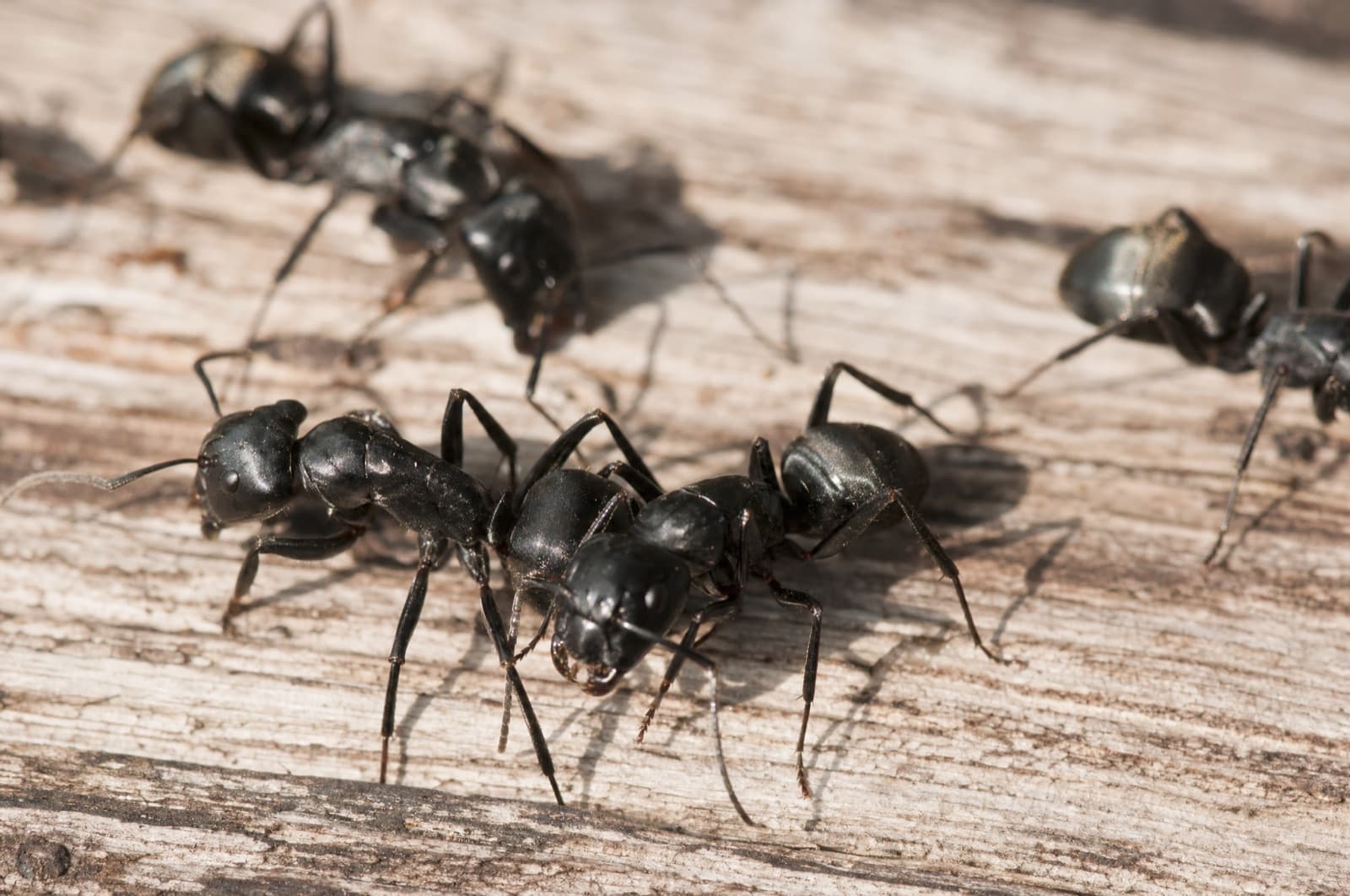
Carpenter ant — smooth single thorax arch

Lateral profile showing the defining feature: a single evenly rounded arch from front to rear of the thorax with no breaks, notches, or spines. Size 6–13 mm — the largest ant in this comparison. This is the ant that requires structural treatment when found indoors.

Sign 2

Pavement ant — ridged head and two nodes

Viewed from above, the parallel ridges (rugae) running the length of the head capsule and thorax are visible to the naked eye on pavement ants under good lighting. Two petiolar nodes are visible from the side. Workers are 2.5–4 mm — one-third to one-half the size of a carpenter ant minor.

Sign 3

Odorous house ant — hidden node, no smell yet

The OHA's single petiolar node is flattened and concealed beneath the first gastral segment — making the gaster appear to sit directly on the thorax in lateral view. Workers are 2.4–3.3 mm. The rotten-coconut crush test is the fastest ID. Critical treatment note: spraying OHA triggers colony budding.

Sign 4

Formica field ant — two-hump notched thorax

The definitive lateral view of Formica subsericea showing the two-hump thorax: a taller anterior hump (promesonotal section) and a clearly lower posterior section (propodeum) with a visible depression between them. Size 5–8 mm overlaps carpenter ant minors, making this the most frequently confused pair. Thorax outline resolves it.

Decision Tree

Should you call a pro?

A branching ID guide that routes each 'black ant' sighting to a species diagnosis and treatment recommendation.

How large is the ant? (Compare to a US dime, which is 18 mm wide.)

Prevention Playbook

How to stop carpenter ants from coming back

1

Address moisture defects before any ant infestation escalates — carpenter ants require >15% wood moisture content for colony founding; eliminating roof leaks, gutter overflows, and plumbing drips removes the primary attractant.

2

Use the three quick tests before purchasing any treatment: (1) size against a coin, (2) crush odor, (3) thorax profile photo — matching the ant to the correct species prevents the wrong product from making the problem worse (especially for OHA, where sprays trigger budding).

3

Apply only non-repellent baits for odorous house ants and pharaoh ants — contact pyrethroid sprays cause colony fission into new satellite nests, converting a single-room problem into a whole-house problem within days.

4

Seal foundation cracks, utility penetrations, and window frame gaps with silicone caulk to block all species of foraging ants, regardless of species — exclusion is effective against all of them simultaneously.

5

Store firewood at least 20 feet from the foundation, elevated off the ground — firewood provides harborage for carpenter ant parent colonies and under-stack conditions for pavement and field ant soil nests.

6

Schedule an annual perimeter inspection in April before the May–June swarm window — catching a newly founded carpenter ant colony in Year 1 costs $250–$600 versus $4,000–$11,500+ if discovered at Year 5 (NH 2026 cost-of-delay data).

Local Context

Why NH homeowners see so many different 'black ants'

New Hampshire's 84% forest cover, aging housing stock (median build year 1982, ~22% pre-1950), and humid continental climate sustain the full range of eastern US ant species. Carpenter ants thrive in the moisture-damaged wood of older homes; odorous house ants exploit the polydomous niche of suburban landscape mulch and wall voids; pavement ants dominate the dense pavement footprint of Manchester, Nashua, and Portsmouth; field ants populate the lawn-forest edges of every county. This species diversity means a homeowner in Hillsborough County could plausibly encounter all four in the same yard within a single season.

Key Local Data

Nationally, carpenter ants are the most-treated ant species by professional PMPs at 66%, followed by odorous house ants at 62% and pavement ants at 59% — a ranking that matches NH operator complaint data almost exactly (NPMA Hansen 2012).

Common Questions

Frequently Asked

Species ID + Treatment Plan

One inspection tells you exactly which ant — and exactly what it needs.

Anchor Pest Services provides free carpenter ant inspections and ant species identification across Manchester, Nashua, Bedford, Derry, and surrounding southern NH communities. No guessing, no wrong treatment.

NH Pesticide Applicator License #782664 Free inspection — no obligation 30-day follow-up included with all treatments Serving southern NH since 2017