
Carpenter Ants vs Termites: Damage, Identification, and Which One You Have
At a Glance
- Short Answer: Three tests — waist, antennae, frass — separate them definitively in under 30 seconds
- Key Fact: Subterranean termites are the top U.S. wood-destroying pest nationally, but in New Hampshire carpenter ants are the #1 wood-destroying pest because termites are near their northern range limit
- NH Relevance: UNH Cooperative Extension Pest Fact Sheet 62 states verbatim that carpenter ants are 'the most troublesome structural pest in New Hampshire'; termites are present but rarely the primary threat
- Action Needed: Run the waist-antennae-frass test, then call for a free inspection — treatment approach and urgency differ dramatically between the two pests, so get a written quote for the pest you actually have
The short of it
Carpenter ants and subterranean termites both damage wood and both produce swarmers — but they are easy to tell apart on three features: waist, antennae, and frass. A carpenter ant has a pinched waist with a single petiole node; a termite has a uniform cylindrical body. Carpenter ant antennae are geniculate (elbowed); termite antennae are straight and bead-like. Carpenter ants produce coarse fibrous frass with insect parts below kickout slits; termites produce no surface frass at all. In New Hampshire, the vast majority of wood-destroying insect calls involve carpenter ants, not termites — subterranean termites exist in NH but at low density, near the northern edge of their range.
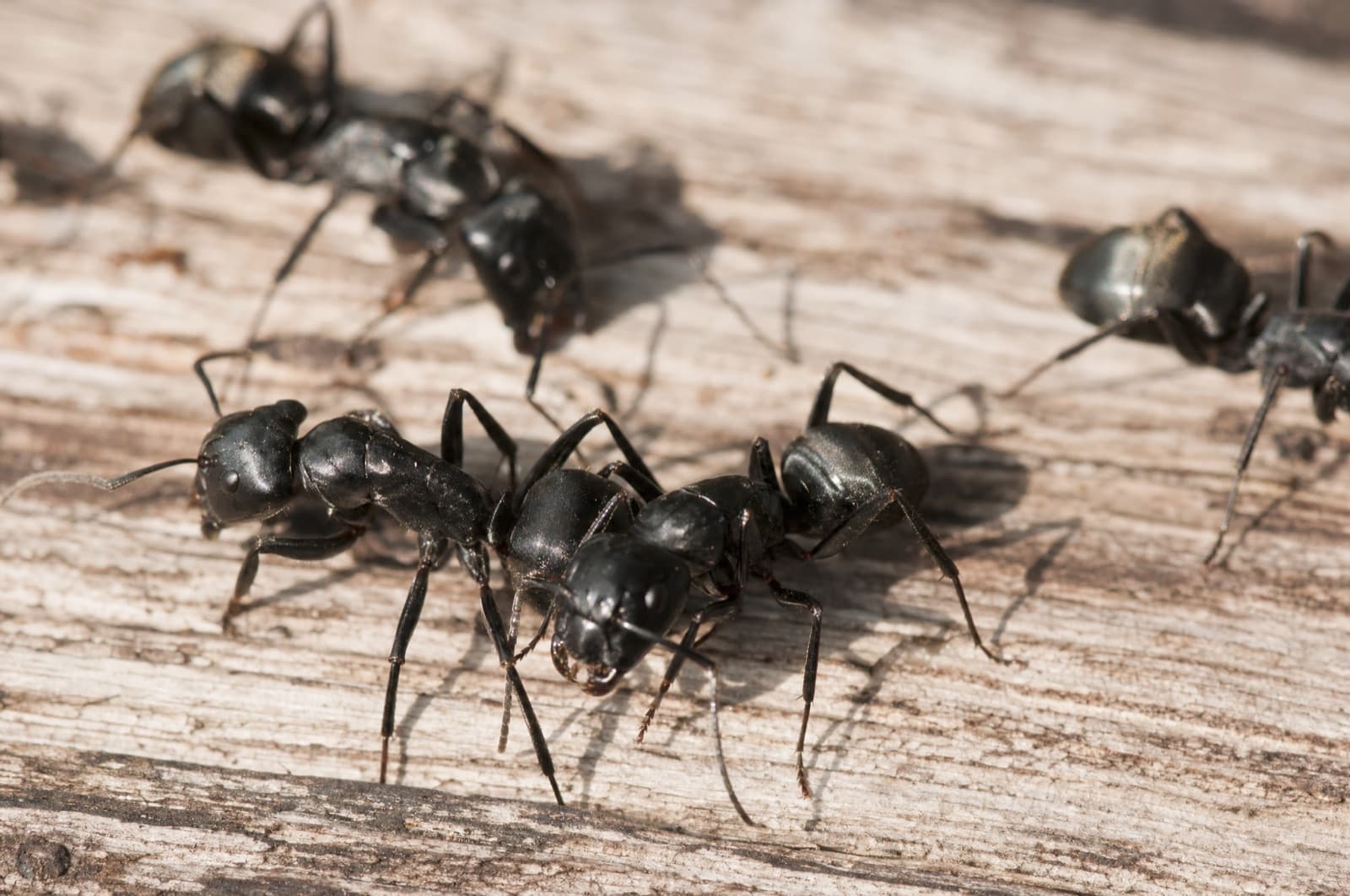
How to identify a carpenter ant worker
Camponotus pennsylvanicus (Black Carpenter Ant — dominant NH species)
6–13 mm
Major workers are about the length of a grain of long rice; much larger than the creamy-white 3–6 mm termite worker
Matte black; C. novaeboracensis shows bright red-orange mesosoma with black head and gaster. Workers range from minor (6–9 mm) to major (10–13 mm) with proportionally larger heads
- Single-node petiole — a single erect vertical scale between the thorax and abdomen. This is the #1 diagnostic: termites have no petiole at all, and two-noded ants (pavement, pharaoh) are eliminated immediately.
- Geniculate (elbowed) antennae with 12 segments and a long scape — the sharp elbow bend is absent in termites, whose antennae are straight and bead-like (moniliform).
- Evenly rounded thorax (mesosoma) in lateral profile — no spines, no notch, smooth arc. Formica field ants have a notched thorax; carpenter ants do not.
- Forewing substantially longer than hindwing in alates (1.3–1.5× longer), with a yellowish-tinted membrane. Termite alates have four equal-length milky-white wings — this single feature resolves 100% of swarmer ID confusion.
Carpenter Ants vs Termites: Damage, Identification, and Which One You Have — The Numbers
#1
NH wood-destroying pest: carpenter ants
3 tests
To ID carpenter ants vs termites
6 mo–2 yr
Termite structural damage timeframe
3–6 yrs
Carpenter ant colony to structural compromise
Carpenter Ant vs. Subterranean Termite
New Hampshire homeowners most often confuse carpenter ants and subterranean termites when they find wood damage, swarmers, or frass. The comparison matters because treatment cost, urgency, and the biology of the problem are completely different. Use this table as a field guide.
Carpenter Ant
Camponotus spp. — abundant statewide in NH
- Body shape
- 3 clear body regions; distinctly pinched waist with a single-node petiole between thorax and abdomen
- Antennae
- Geniculate (elbowed) — sharp 90° bend after a long first segment (scape); 12 segments total
- Worker color and size
- 6–17 mm; black or black with red-orange thorax (C. novaeboracensis); polymorphic — minor and major workers in same colony
- Wings (alates / swarmers)
- Forewing 1.3–1.5× longer than hindwing; yellowish-tinted membrane; wings clipped off by female after mating
- Frass and external signs
- Coarse fibrous frass with visible insect parts (legs, antennae, pupal casing fragments) piled below slit-shaped 2–3 mm kickout openings
- Gallery wall texture and grain direction
- Smooth, sanded, polished walls — 'clean with smooth walls' (UNH Ext. Eaton & Maccini 2016); galleries cross the wood grain freely
- Wood interaction mechanism
- Excavate only — do NOT eat wood; lack cellulose-digesting enzymes; eject all removed wood as frass
- Speed to structural compromise
- Slow — 3–6 years to a damaging colony; structural failure takes longer still
- Swarm timing and behavior
- Late May–early July outdoors (late afternoon/evening); January–April indoors from interior nest — indoor swarmers are diagnostic of an established colony inside the structure
- NH prevalence
- Abundant statewide; #1 wood-destroying pest in NH per UNH Cooperative Extension Pest Fact Sheet 62 (Eaton & Maccini 2016)
- Treatment approach and relative cost
- One-time perimeter + nest injection for a defined infestation; quarterly prevention plan for higher-risk homes — generally the less expensive of the two to treat
- Relative U.S. structural damage
- A meaningful but far smaller share of national wood-destroying-insect damage than termites (no NPMA-published figure for carpenter ants specifically)
Bottom line — If you find coarse fibrous sawdust with insect parts below a slit-shaped opening, you have carpenter ants. If you find mud tubes on your foundation or hollowed wood with no surface frass, call for a termite inspection. In New Hampshire, the carpenter ant scenario is vastly more likely — but either pest requires professional treatment.
The full picture
Body Anatomy: The Waist Test
Read more
Carpenter ants (Camponotus spp.) have three clearly defined body regions: head, mesosoma (thorax), and metasoma (gaster). Between the mesosoma and metasoma sits the petiole — a single-node erect vertical scale that creates the characteristic pinched waist visible even to the naked eye 3. Subterranean termites (Reticulitermes flavipes) have only two apparent body regions, with a broad cylindrical body and no pinched waist — uniform in width from head to tip 12. If you can see a waist with a distinct node, you have an ant. If the body is uniform and tube-shaped, you have a termite. The worker ant's thorax is also evenly rounded in lateral profile — the smooth arch is another useful secondary diagnostic against field ants (Formica), which show a notched thorax 3.Antennae: Elbowed vs. Straight Bead
Read more
The elbow is visible to the naked eye and is the same feature that separates all ants from termites 3. Termite antennae are moniliform (bead-like) — a string of roughly equal-sized round segments with no bend or elbow. This feature is reliable on both workers and alates (swarmers) 12. If you have a dead insect and a 10× hand lens, antennal shape resolves identification even when the body is partially damaged. Carpenter ant antennae total 12 segments in workers and females; termite antennae have approximately 15–16 segments, but counting segments is rarely necessary — the presence or absence of the elbow bend is sufficient.Wings (Alates / Swarmers): The Four-Wing Test
Read more
The four-wing test separates them definitively 3. Carpenter ant alates: forewing is 1.3–1.5× longer than the hindwing; wings have a yellowish tint in Camponotus pennsylvanicus. Termite alates: all four wings are equal length, equal shape, and milky-white — much longer than the body itself 12. Wing shedding also differs: carpenter ant females clip their own wings after mating and retain the stubs; termites shed all four wings near-simultaneously on landing, leaving neat piles of equal-length wings. If you find unequal shed wings, it's carpenter ants. If you find four equal-length milky wings in a pile, it's termites. In New Hampshire, indoor swarmers appearing January through April are almost always carpenter ants emerging from an interior nest — subterranean termites rarely swarm indoors in NH 14.Frass: The Single Most Diagnostic External Sign
Read more
Carpenter ants excavate wood — they do not eat it — and eject all removed material through slit-shaped kickout openings approximately 2–3 mm wide 23. This frass is coarse, fibrous, and resembles pencil-sharpener shavings mixed with insect body parts: legs, head capsules, antennae, and pupal cocoon fragments are visible under a 10× hand lens 25. UNH Extension Fact Sheet 62 (Eaton & Maccini 2016) states verbatim: 'Unlike termite galleries that are packed with a mud-like deposit, carpenter ant galleries are clean with smooth walls' 1. Subterranean termites produce NO surface frass — they digest wood and pack fecal material into galleries as mud. The only external termite sign is mud shelter tubes on foundations, piers, or wall surfaces (6–25 mm wide) 12. This single feature — frass present vs. absent — is diagnostic in the field.Gallery Morphology: Smooth vs. Mud-Packed
Read more
Carpenter ant galleries are smooth, polished, and 'sandpapered' — workers actively maintain the gallery walls and no mud, soil, or fecal material lines the interior. The only contents are ants, brood, and occasional un-swept frass 12. Galleries cross the wood grain freely, following moisture-damaged springwood but passing through summerwood as the chamber network expands 2. Termite galleries are rough, mud-packed, and fecal-lined — workers pack consumed wood plus soil into every chamber. Galleries run almost exclusively with the grain because termites are eating along the grain of the soft springwood 12. If you probe suspect wood with a flat-blade screwdriver and find smooth empty chambers with sharp edges, it's carpenter ants. If you find honeycomb-like chambers packed with soil and mud running with the grain, it's termites.Wood Interaction Mechanism: Excavate vs. Eat
Read more
Carpenter ants lack cellulose-digesting enzymes — they cannot eat wood. They excavate galleries with triangular mandibles bearing 5–7 teeth, and all removed wood is ejected as frass 13. Their actual food sources are honeydew from aphids and scale insects (primary), insect protein (secondary), and sweets and fats 3. Subterranean termites host gut protozoa and bacteria that digest cellulose — they genuinely consume the wood matrix. A colony of 60,000 termite workers may consume approximately 2–3 linear feet of 2×4 pine per year (NPMA) 2. This eating mechanism explains why termite damage is faster per structure, why termite galleries are packed with mud (fecal waste), and why termites need no kickout hole — there is nothing to eject.Speed and Scale of Structural Damage
Read more
Carpenter ant colonies take 3–6 years to reach a size capable of causing damaging structural excavation — Year 1 (10–20 workers) is undetectable; Year 3 (500–2,000 workers) produces the first localized wood repairs; Year 5+ (2,000–6,000+ workers) can require major structural framing repair 24. Subterranean termites can cause significant structural damage in 6 months to ~2 years because they eat rather than excavate, and their galleries span sound wood along the grain 2. Nationally, subterranean termites are the single largest source of structural wood-destroying-insect damage per NPMA, far ahead of carpenter ants (no NPMA-published carpenter ant figure exists) 2. Despite the per-house speed advantage of termites, carpenter ants cause more total structural damage in New Hampshire because they are abundant statewide while termites remain sparse 1.NH Prevalence: Why Carpenter Ants Win in New Hampshire
Read more
First, geographic prevalence: Reticulitermes flavipes is near the northern edge of its U.S. range in NH — many towns have zero termite pressure. Second, climate match: carpenter ants produce glycerol antifreeze and tolerate 5–15°F in sealed nests, while termites cannot match this cold tolerance 5. Third, NH housing stock: the median NH owner-occupied home was built in 1982, with ~22% of homes pre-dating 1950 — old wood-framed construction with balloon framing, moisture-prone sill plates, and ice-dam-vulnerable eaves 5. Fourth, NH forest cover: at 84% forested, with the maple/beech/birch group (prime carpenter ant host trees) occupying 52% of forest land area, virtually every NH home is within 100 meters of a potential parent colony site 5. Fifth, detection lag: termites are rare enough that inspectors don't always look; but per-state, carpenter ants damage vastly more homes 2.Treatment Cost Comparison and What to Expect
Read more
Carpenter ant work ranges from a one-time treatment for a defined infestation to a quarterly preventive plan for higher-risk homes; severe multi-nest jobs cost more. Termite treatment — a full liquid termiticide perimeter application or a bait station system — is a more involved job that generally costs more than carpenter ant work. Repair scope also differs: carpenter ant damage runs from cosmetic patching to major structural repair; termite repair can be extensive, with severe cases higher still. Neither pest is covered by standard NH homeowners insurance — both are classified as preventable maintenance failure. Because costs vary by infestation size and access, the only reliable figure is a written quote after inspection. A professional inspection is the only way to confirm which pest you have and plan treatment accordingly. In NH, a free inspection at first sighting is the highest-value action available to a homeowner.Bottom line — In New Hampshire, the three-test field diagnosis (waist-antennae-frass) resolves carpenter ant vs. termite ID in under a minute. The probability is heavily weighted toward carpenter ants in NH — but the treatment protocols, costs, and structural urgency differ enough that professional confirmation is warranted before spending money on treatment.
What carpenter ants do to a home over time
Carpenter ants and termites operate on completely different damage timelines. This comparison shows why termites are more dangerous per-house but carpenter ants damage more NH homes in aggregate.
Carpenter ant: 10–20 workers. Termite: colony established; several hundred to thousands already present at time of discovery
Carpenter ant: single claustral chamber the size of a quarter; undetectable. Termite: galleries established in foundation-level wood, often undetected until mud tubes appear
No repair needed (carpenter ant); minimal if caught early (termite)
A founding carpenter ant queen seals herself in moisture-damaged wood and raises 10–20 workers from her own body reserves — damage is literally undetectable at this stage. Subterranean termite colonies, by contrast, are rarely discovered at true founding; most NH discoveries occur when a mature or semi-mature colony has already been working for 1–3 years. The key difference: carpenter ants leave visible frass; termites leave none until mud tubes appear on exposed surfaces.
Carpenter ant pressure by NH county
Carpenter ant and termite pressure differ dramatically by county in New Hampshire. Carpenter ants are statewide; termites are sparse and geographically concentrated near the southern border and coast.
Hillsborough County
ExtremeHighest absolute volume of carpenter ant calls in NH. Manchester's pre-1940 mill-era housing and extensive deciduous forest borders create HIGH-to-EXTREME pressure. Termite pressure exists but is not the dominant WDI threat; most wood-destroying insect activity is carpenter ants. Median home construction year 1979; ~18% of homes pre-1940.
Rockingham County
ExtremeSeacoast zone (Portsmouth, Hampton, Exeter) has the oldest dense housing stock in NH — including pre-1900 clapboard — plus the warmest annual foraging window (USDA Zone 6b on the coast). Carpenter ant pressure EXTREME for high-value properties. Termite pressure slightly higher here than inland counties due to warmer microclimate, but still well below carpenter ant rates.
Merrimack County
HighState capital region. Concord's downtown and South End contain extensive pre-1940 wood-framed stock. Carpenter ant pressure HIGH. Surrounding rural towns (Henniker, Warner, Andover) have deep forest interfaces. Termites: low presence; carpenter ants remain the primary structural pest.
Strafford County
HighDover and Rochester have substantial pre-1940 mill-era stock; ~22% of homes pre-1950 across the county. Carpenter ant pressure HIGH. Termites: low to minimal — northerly position reduces termite suitability. Any suspected termite activity in Strafford warrants professional confirmation before assuming termites over carpenter ants.
Cheshire County
HighIn Cheshire the wood-destroying-insect question is almost always carpenter ants, not termites: the Keene region sits far inside the northern edge of the subterranean termite range, so termite probability is very low. Meanwhile the heavy Monadnock forest interface and the county's oldest-in-region median build year (1973) keep per-home carpenter ant pressure comparable to urban Hillsborough despite lower population density.
Bottom line — Across all five NH service counties, carpenter ants are the dominant wood-destroying threat. If you have wood-destroying insect damage in NH, the probability is overwhelmingly carpenter ants rather than termites — but a professional inspection is the only way to confirm which pest you are dealing with.
How to keep ants from coming back
Eliminate moisture sources — repair roof leaks, plumbing leaks, ice-dam damage, and failed window or door flashing. Wood moisture content above 15% is the threshold that makes carpenter ant excavation practical; termites can attack sound dry wood but are rarely present in NH to begin with.
Remove or treat standing dead or decaying trees, stumps, and woodpiles within 100 meters of the house — these are the primary parent-colony sites for NH carpenter ants and should be eliminated or treated before the colony establishes a satellite nest in the structure.
Keep firewood stored off the ground, away from the foundation, on a concrete pad, and only bring inside what you will burn within 48 hours — firewood is one of the most common parent-colony origin sites for New England carpenter ant infestations.
Maintain a 12-inch clearance between the foundation and any mulch, soil, or wood debris — subterranean termites travel through soil contact to reach wood; carpenter ants use vegetation as bridges from outdoor parent nests.
Inspect sill plates and rim joists in your basement or crawl space annually with a flashlight after dark — these are the most common indoor carpenter ant nesting sites in NH given older foundations and unconditioned basements.
Schedule a professional inspection at first sighting of large black ants, frass, mud tubes, or swarmers — early intervention costs far less than the structural repair a Year-5 infestation can require.
Not Sure If You Have Ants or Termites?
A licensed NH inspector can confirm the species, locate the nest, and give you an exact quote — at no charge.
Why Carpenter Ants Dominate in New Hampshire (Not Termites)
UNH Cooperative Extension Pest Fact Sheet 62 (Eaton & Maccini 2016) states verbatim: 'Carpenter ants (Camponotus spp.), along with termites, are the most troublesome structural pest in New Hampshire.' Subterranean termites (Reticulitermes flavipes) are present in NH but near the northern edge of their U.S. range — many NH towns have zero or near-zero termite pressure. Carpenter ants, by contrast, are adapted to New England winters: they accumulate up to 50% body fat and produce glycerol antifreeze to survive at 5–15°F, allowing year-round survival in heated wall voids. NH's 84% forest cover, old housing stock (median build year 1982, ~22% pre-1950), and chronic ice-dam moisture loading create near-ideal conditions for carpenter ant colonization of homes.
Frequently asked questions
Where this data comes from
- [1]
- [2]
- [3]
- [4]
- [5]
- [6]
- [7]
- [8]
- [9]
- [10]
Written & reviewed by
VerifiedDaniel Brady
NH-Licensed Pesticide Applicator · License #782664 (NHDAMF, RSA 430)
Daniel Brady is the New Hampshire–licensed applicator behind Anchor Pest Services, a family-owned pest control company serving the Manchester area since 2017.
Southern NH Coverage
Get a Definitive Answer Today
Stop guessing between carpenter ants and termites. Our licensed inspectors use moisture meters, borescopes, and 1,000+ cases of NH experience to confirm the pest and recommend the right treatment.
- NH Pest Control License #782664
- Family-owned since 2017 — Manchester based
- Free inspection, no obligation
- 30-day follow-up included with every treatment
NH License #782664 · No obligation · We answer in person
Your next step
- Next step
Is Advion Ant Gel Bait Safe for Pets?
Read the answer - Related guide
Carpenter Ant Damage: Year-by-Year Timeline and What It Actually Looks Like
Read the answer - Related guide
Do Carpenter Ants Eat Wood? (No — Here's What They Actually Do)
Read the answer - Related guide
What are the signs of carpenter ants in your house?
Read the answer - Related guide
Carpenter Ant Treatment Cost in New Hampshire: What Drives the Price and Why Early Action Costs Far Less
Read the answer - Related guide
Carpenter Ant — Quick ID for New Hampshire Homeowners
Read the answer