
Skip to content
APS
Anchor Pest Services Field Team · NH-Licensed Pest Control Operators (License #782664)
Reviewed by Tim Boyle

Do Carpenter Ants Eat Wood? (No — Here's What They Actually Do)

No — they excavate wood, they don't eat it

Carpenter ants do not eat wood. They excavate galleries with powerful triangular mandibles, but they lack the cellulose-digesting enzymes that termites use to consume wood for nutrition. The excavated material is ejected as coarse fibrous frass through slit-like openings — providing the ants zero calories. Carpenter ants eat honeydew from tended aphids as their primary energy source, supplemented by insect protein and household sweets. This biology explains the smooth, clean gallery walls (no consumed wood residue), the frass piles below kickout holes, and why moisture-softened wood is chosen (easier to excavate, not edible). For treatment, sugar and protein baits that ants ingest and share via trophallaxis are the correct vector — not wood-impregnated insecticides.

At a Glance

  • Short Answer: No — carpenter ants excavate wood for shelter, but they get zero nutrition from it and cannot digest cellulose
  • Key Fact: Carpenter ants eat honeydew, insect protein, and sweets — not wood; their triangular mandibles cut wood mechanically, not digestively
  • NH Relevance: In NH, moisture-softened wood (>15% MC from ice dams, roof leaks, or plumbing failures) is the attractant — moisture makes excavation mechanically easier, not more nutritious
  • Action Needed: Find and fix the moisture source first — eliminate what made the wood excavatable, then treat the colony with non-repellent bait or professional injection
Field Identification Card

How to identify a carpenter ant worker (mandible focus)

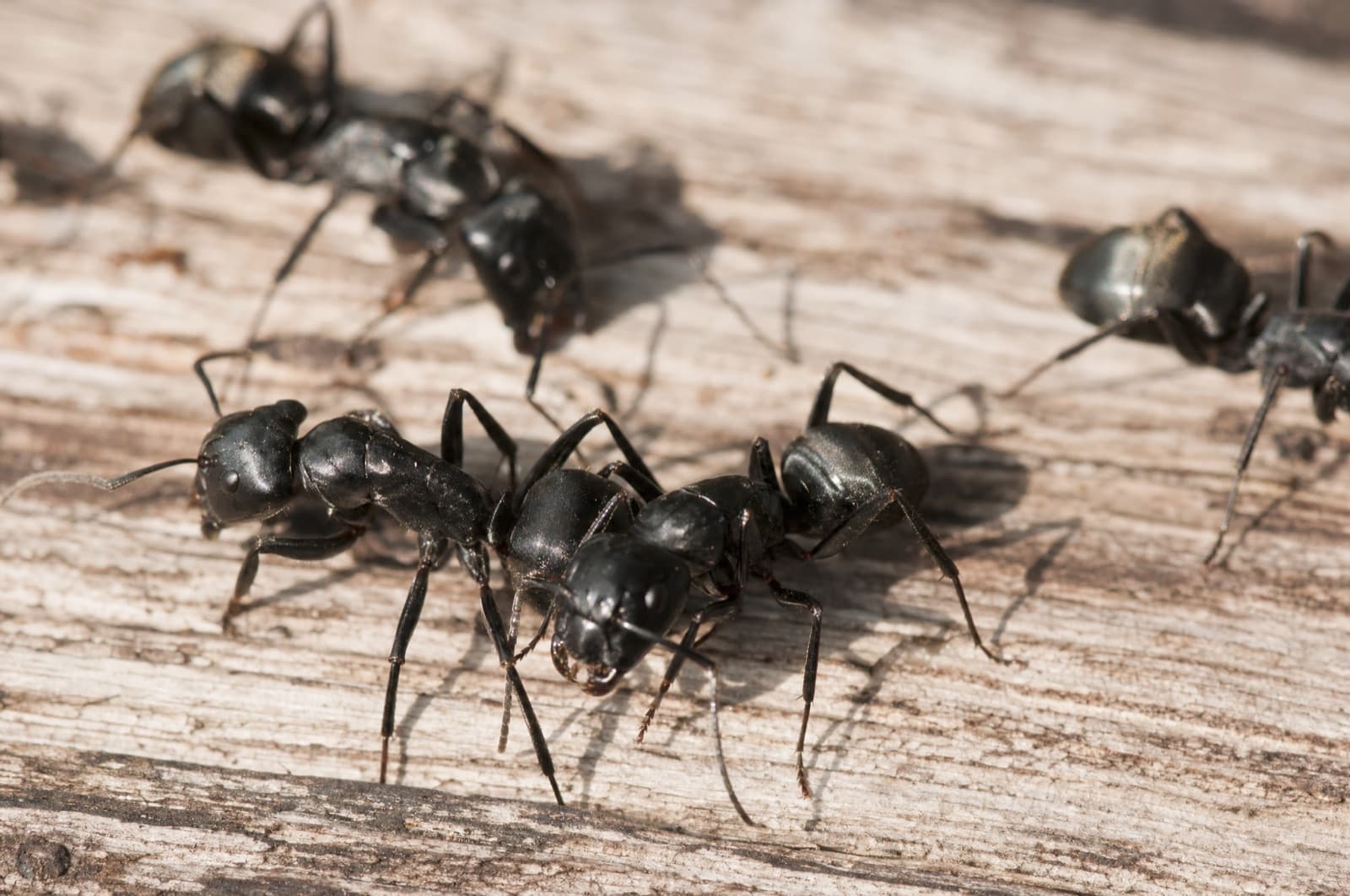
Camponotus pennsylvanicus — Eastern Black Carpenter Ant

Anatomical DiagramSide view, labeled
Elbowed antennaeHeart-shaped headEvenly rounded thoraxSINGLE-NODE petiole(termites have NO node)Gaster (abdomen)6 segmented legs0mm4mm8mm12mm16mm20mmACTUAL SIZE SCALE
Body Size

613 mm

Roughly the length of a grain of long rice; major workers (10–13 mm) are among the largest ants in NH and are easily visible without magnification

0510152025mm
Color

Uniformly matte black across head, thorax, and gaster; dense pale-yellow pubescence on gaster creates a faint sheen in sunlight

Diagnostic Features
  • 1Single-node petiole between thorax and gaster — the definitive field diagnostic separating Camponotus from two-noded pavement ants, pharaoh ants, and all Myrmicinae
  • 2Triangular mandibles with 5–7 teeth on the masticatory margin — powerful enough to excavate sound dry softwood, but structured for cutting and scraping, not digestion
  • 3Geniculate (elbowed) 12-segment antennae with a long scape — contrasts with termite straight bead-like antennae and confirms ant identity in 2 seconds
  • 4Evenly rounded thoracic dorsum in lateral profile (smooth single arch) — no notches, humps, or propodeal spines that would indicate a different NH ant genus
Key Statistics

Do Carpenter Ants Eat Wood? (No — Here's What They Actually Do) — The Numbers

0%

Cellulose they digest

5–7

Teeth on carpenter ant mandibles

>15%

Wood moisture needed to nest

55%

DIY bait field success rate (Hansen 2008)

Side-by-Side Comparison

Carpenter Ant vs. Subterranean Termite

The eat-vs-excavate distinction is the most consequential biological difference between carpenter ants and termites. It determines gallery appearance, frass presence, moisture dependency, and the entire treatment strategy.

Subject A

Carpenter Ant

Camponotus pennsylvanicus — excavates, does not eat

Wood interaction
Excavate only — mechanically cut and remove wood with triangular mandibles; wood provides zero nutrition
Cellulose digestion
None — lack gut enzymes; workers cannot extract calories from wood regardless of species or wood type
Frass output
Coarse fibrous frass ejected through kickout slits — pencil-shaving texture with visible insect body parts; accumulates in cone-shaped piles below openings
Gallery wall texture
Smooth, polished, sanded — 'sandpapered' appearance with clean empty interior; workers actively maintain wall hygiene
Gallery direction
Crosses wood grain freely — follows softer springwood but passes through summerwood to extend chamber network
Moisture dependency
>15% wood moisture content needed for practical excavation — moisture softens wood, making mechanical cutting easier (not more nutritious)
What they actually eat
Honeydew from tended aphids (primary), insect protein (during larval-rearing), household sweets and fats
Treatment vector
Sugar or protein bait ingested via trophallaxis — cannot be poisoned via wood; wood-impregnated insecticides only contact ants traversing the gallery, not via ingestion
NH prevalence
#1 wood-destroying insect in NH — abundant statewide with 5 Camponotus species (UNH Extension Fact Sheet 62, Eaton & Maccini 2016)
Treatment cost (NH 2026)
$250–$500 one-time; $480–$840/year quarterly plan

Bottom line — The fastest field test: look for frass piles below slit-shaped holes (carpenter ants) or mud shelter tubes on the foundation (termites). If you see frass, the ants excavated wood they couldn't eat. If you see mud tubes, termites consumed wood they were eating. The two signatures never overlap.

Deep Dive

The Full Picture

Carpenter ants do not eat wood. This is not a caveat or a qualification — it is a complete biological fact confirmed by UNH Cooperative Extension (Eaton & Maccini 2016), the National Park Service, and the foundational carpenter ant monograph Hansen & Klotz (2005) 12. They excavate wood to build galleries and nest chambers, but the wood provides them zero nutrition because they lack the cellulose-digesting enzymes that termites and wood-boring beetles possess 14. Understanding this single distinction explains frass piles, gallery texture, moisture dependency, and the entire treatment strategy for carpenter ants in NH homes.
01

The Biology: Why Carpenter Ants Cannot Eat Wood

Digesting plant cellulose requires specialized gut enzymes or symbiotic microorganisms.
Read moreSubterranean termites host protozoa and bacteria in their hindgut that break down cellulose into absorbable sugars — wood is literally their food source 3. Carpenter ants have no such enzymatic capability. Their digestive system processes proteins, sugars, and fats from animal and plant sources, but the polymer chains of wood cellulose pass through undigested. UNH Extension Fact Sheet 62 states this explicitly: carpenter ants 'do not consume the wood they excavate' (Eaton & Maccini 2016) 1. The practical implication: every bit of wood that was in a carpenter ant gallery had to be physically removed and ejected, which is precisely where frass comes from.
01
02

The Mandibles: Built for Cutting, Not Digestion

Carpenter ant mandibles are triangular with 5–7 teeth on the masticatory margin — powerful enough to excavate sound dry softwood, but structured for mechanical cutting and scraping rather than for breaking down food 24.
Read moreMajor workers (*Camponotus pennsylvanicus* majors reaching 10–13 mm) have proportionally larger, squared heads with heavier mandibles suited for excavation tasks. This morphology is the anatomical signature of excavation behavior: the mandibles cut, the workers carry, and the ejection point (kickout slit) expels. No step involves digestion of the wood matrix. Compare this to wood-boring beetle larvae, which genuinely chew and partially digest wood as they create their tunnels — their frass is finer and more decomposed-looking precisely because digestion is occurring 3.
02
03

What Carpenter Ants Actually Eat

The dietary hierarchy of *Camponotus pennsylvanicus* is documented in Hansen & Klotz (2005) and reflects the colony's seasonal energy demands 2.
Read moreFirst priority is honeydew — the sugar-rich excretion of aphids and scale insects that workers tend on plants, shrubs, and trees. Honeydew is the primary energy source during spring and summer foraging 2. Second priority is insect protein — live and dead arthropods, especially during brood-rearing season when larvae require amino acids for growth. Third is household sweets, fats, meats, and processed foods encountered indoors. This dietary reality drives treatment logic: sugar or protein baits ingested by foragers and shared via trophallaxis (mouth-to-mouth feeding among nestmates) are the correct treatment vector. Wood-impregnated insecticides work only if an ant physically traverses the treated surface — the ants never consume the wood and cannot be killed by poison embedded in it 6.
03
04

Why Moisture-Softened Wood Is Chosen

Carpenter ants select wood at moisture content above 15% for one reason: it is mechanically easier to excavate, not more nutritious 24.
Read moreMoisture from fungal colonization (brown rot, white rot) progressively softens the wood fiber, reducing the mandibular work required to cut galleries. This is why every carpenter ant infestation is downstream of a moisture defect — a roof leak, ice dam, plumbing failure, gutter overflow, or condensation problem 12. In NH, ice-dam-driven eave and rafter moisture is the single most common proximate cause of interior carpenter ant infestations 3. The moisture is the real root cause; the ants are a biological consequence. Fix the moisture source and the colony's preferred substrate disappears 26.
04
05

The Frass Proof: Why Piles Exist at All

Frass piles exist precisely because carpenter ants cannot eat the wood they remove.
Read moreEvery cubic centimeter of gallery volume had to be physically excavated and ejected — that material piles up below the kickout slit as coarse, fibrous frass 2. The frass contains the excavated wood shavings plus insect body parts (dead nestmates, prey remains, pupal-casing fragments) that were also removed during nest hygiene activities 24. If carpenter ants ate the wood, there would be no frass — the material would be digested inside the ant. The presence of a frass pile is therefore not just a diagnostic sign of carpenter ants; it is a direct proof of excavation-not-eating behavior. Termites, which eat wood, produce no external frass 13.
05
06

Gallery Texture Confirms the Biology

Smooth, polished, sanded gallery walls — consistently described across all authoritative sources including UNH Extension, Hansen & Klotz (2005), and NC State Extension — are the physical consequence of excavation without consumption 124.
Read moreIf wood were being chewed and digested, gallery walls would show partially consumed, rough, irregular texture. Instead, workers mechanically scrape and clean the gallery surface, producing the smooth, 'sandpapered' appearance that field inspectors use as a primary diagnostic. UNH Extension's verbatim guidance: 'Unlike termite galleries that are packed with a mud-like deposit, carpenter ant galleries are clean with smooth walls' (Eaton & Maccini 2016) 1. This sentence is the anatomical verdict: the gallery is clean because nothing is being consumed inside it.
06
07

Treatment Implications: What This Means for Control

The eat-vs-excavate distinction drives three critical treatment decisions 6.
Read moreFirst: do not use wood-impregnated insecticides as primary treatments — ants do not ingest the wood matrix and are only affected on contact, missing the 85–90% of the colony inside the nest. Second: use non-repellent baits (indoxacarb gel, abamectin granules) matched to the seasonal feeding phase — protein matrix in spring, sugar matrix in late summer — because trophallaxis will carry the active ingredient through the colony. Third: eliminate the moisture source before or simultaneously with treatment, because the colony's choice of nesting site is driven by moisture-softened wood availability, not by food location 26. Treatment that ignores the moisture source fails reliably — the colony expands into the next wet section of structural wood.
07
08

Foam Insulation: The Non-Wood Confirmation

Perhaps the clearest demonstration that carpenter ants excavate rather than eat comes from their well-documented ability to tunnel through foam insulation (polyisocyanurate, EPS, XPS rigid foam, and spray foam) 2.
Read moreFoam provides no caloric value whatsoever — it is pure polymer with zero carbohydrate, protein, or fat content. Yet carpenter ants excavate it routinely, especially exterior foundation foam and unprotected sheathing foam (Hansen & Klotz 2005; WSU Extension EB0818; Maine DACF) 2. The galleries in foam are identical in structure to those in wood — smooth-walled, cross-grain-equivalent in foam terms, with ejected foam-shaving piles below exit points. This unambiguously confirms that excavation is a nesting behavior, not a feeding behavior, in any substrate that can be mechanically cut.
08

Bottom line — Carpenter ants excavate wood for shelter — they get zero nutrition from it. Their diet is honeydew, insect protein, and sweets. This biological reality drives everything: why frass piles exist, why galleries are clean, why moisture is the root cause, and why bait (not wood-treatment) is the correct control vector.

Visual Identification

Visual Evidence of Excavation (Not Eating)

Each of these three images demonstrates a specific aspect of carpenter ant excavation biology — why the wood is removed, where it goes, and what the ants actually consume instead.

Sign 1

Smooth, Clean Gallery Wall — No Chewing Residue

The interior of a carpenter ant gallery is polished and clean — no mud packing, no fecal residue, no partially chewed wood fiber. Workers actively maintain this cleanliness by removing all material as frass. The wall texture is smooth to the touch, 'sandpapered' in appearance. This cleanliness is direct evidence of excavation-not-eating: if ants were consuming the wood, the gallery would be full of digestive byproducts, like a termite tunnel.

Sign 2

Coarse Fibrous Frass Pile With Insect Parts

This is the ejected material from gallery excavation — coarse, fibrous wood shavings mixed with insect body parts (legs, head capsules, pupal-casing fragments). Under a 10× lens, the biological debris is immediately visible as dark specks within the pale wood shavings. The pile exists because the excavated wood has to go somewhere — it provides the ants zero nutrition. Frass is the clearest proof that wood is being removed, not consumed.

Sign 3

Kickout Slit — The Ejection Point

The slit-like 2–3 mm kickout opening is where workers eject excavated material. Its irregular, slit shape distinguishes it from round beetle exit holes and from termite kickout holes (which are round and smaller). The opening is just large enough for major workers to pass through carrying frass. If this opening were for eating rather than ejecting, there would be no pile below it — the wood would disappear into the ant, not onto the floor.

Sign 4

What Carpenter Ants Actually Eat

Carpenter ants forage extensively for honeydew from aphids, for dead and live insects, and for household sweets and fats — not for wood. Workers tending aphid colonies on plant stems represent their primary foraging activity during spring and summer. This dietary reality explains why sugar and protein baits (not wood-impregnated insecticides) are the correct treatment vector: ants ingest and share bait via trophallaxis, carrying the active ingredient back to the queen.

Treatment Effectiveness

How long does each method actually last?

Wood-impregnated 'ant killer' sprays applied to galleries

$8–$20 · DIY

Contact kill only, no colony effect

Carpenter ants cannot ingest treated wood — they do not eat it. Contact kill reaches only the ants that traverse the treated surface; 85–90% of the colony remains in the nest. This approach cannot eliminate a colony and may scatter it.

DIY sugar bait (sodium tetraborate / borax 5.4%)

$8–$15 per 6-pack · DIY

1–2 weeks for sugar-feeding species; minimal effect on carpenter ants outside sweet-feeding phase

Works only during carpenter ant sweet-feeding window (late summer). Carpenter ants shift to protein-seeking in spring during brood-rearing — sweet baits are ignored. Not a reliable primary tool for carpenter ants.

DIY indoxacarb gel (0.05%) — protein or sweet matrix

$30–$45 per tube · DIY

7–14 days to colony reduction if accepted

Best DIY bait choice — non-repellent, trophallactically transferred (ants share it through feeding). Hansen (2008) ICUP: 55% field colony-elimination success vs. >95% lab. Match bait matrix to season: protein in spring, sugar in late summer.

DIY abamectin protein granule (Advance 375A, 0.011%)

$25–$95 · DIY

2–3 weeks to colony collapse; reapply every 30–60 days

Protein-corn-grit matrix matches carpenter ant spring feeding preference. Colony elimination in 2–3 weeks per manufacturer data consistent with Hansen (2008). Ants ingest the granules, share via trophallaxis — the correct treatment vector since ants eat protein, not wood.

Professional non-repellent perimeter — fipronil 0.06%

$250–$500 one-time (NH 2026) · Professional

90-day residual; transfer effect via trophallaxis eliminates colony

Ants cannot detect fipronil, contact it, and carry the active ingredient back to the nest via grooming and trophallaxis — the same feeding-and-sharing behavior that makes baits work. BASF documents colony collapse within 90 days. Non-repellent chemistry does not scatter the colony.

Prevention Playbook

How to stop carpenter ants from coming back

1

Eliminate the moisture source that made the wood excavatable: repair roof leaks, extend downspouts, fix gutters, and address plumbing drips — because carpenter ants select wood at >15% moisture content for mechanical ease of excavation, not for nutrition, removing moisture makes the wood non-viable for nesting even if ants are present.

2

Store firewood off the ground and away from the house — workers that establish foraging trails to a woodpile adjacent to the foundation will explore entry points and, if moisture-damaged wood exists indoors, found satellite nests, even though the firewood itself is not 'food.'

3

Seal all utility penetrations, foundation cracks, and gaps around window/door frames with silicone or polyurethane caulk — ants exploring for nesting sites follow structural edges and vapor gradients, not food odors, through the exterior envelope.

4

Trim all vegetation to maintain an 18-inch gap from the structure — branches provide a bridge that bypasses exterior perimeter treatment and connects outdoor parent colonies (often in decaying maple, beech, or hemlock) to interior wall voids.

5

Remove tree stumps within 30 m of the house — a decay-class 2–3 stump is the preferred queen-establishment substrate; colonies founded in stumps routinely found indoor satellite nests via foraging trails within two seasons.

6

If you find carpenter ants, avoid repellent perimeter sprays as your first response — repellent pyrethroids scatter workers and can cause satellite nests to multiply within the structure, worsening the long-term problem; use non-repellent baits or hire a professional who uses non-repellent perimeter products (fipronil 0.06%).

Common Questions

Frequently Asked

Southern NH • Free Inspection

Stop the Excavation — Not Just the Ants You See

85–90% of a carpenter ant colony is inside the nest — not visible on your walls. Our licensed inspectors locate the parent colony and treat through the correct biological pathway: bait and non-repellent perimeter, not ineffective surface sprays.

NH License #782664 — fully licensed and insured Family-owned since 2017, Manchester-based Free inspection — no obligation 30-day follow-up included with every treatment