
Skip to content
APS
Anchor Pest Services Field Team · NH-Licensed Pest Control Operators (License #782664)
Reviewed by Tim Boyle

How to Get Rid of Carpenter Ants in NH: The Complete 2026 Treatment Guide

Solvable — but only ~55% of DIY attempts succeed

Getting rid of carpenter ants requires 4 steps: confirm the species (large black ant, 6–13 mm, single-node petiole), eliminate the moisture source feeding the nest, apply non-repellent bait — indoxacarb gel or abamectin granules are the only DIY products with peer-reviewed colony-elimination data for carpenter ants. Do NOT spray repellent pyrethroids; they kill only the 10–15% of foragers you can see while scattering the 85–90% inside the nest into new satellite locations. If you see ants indoors in winter, find swarmers inside, hear wall sounds, or trails persist past 14 days, call a licensed professional. UNH Cooperative Extension explicitly recommends a pro for winter indoor activity. NH one-time pro treatment: $250–$500 for a moderate infestation.

At a Glance

  • Short Answer: DIY with non-repellent bait works in ~55% of field cases; pro fipronil non-repellent treatment succeeds in 80–95%
  • Key Fact: Hansen (2008) documented a 55% field colony-elimination rate across 72 DIY-bait sites — versus >95% in lab trials — because 85–90% of the colony never leaves the nest to contact surface treatments
  • NH Relevance: UNH Cooperative Extension states explicitly that winter indoor sightings of large black ants mean you have an indoor nest and should hire a professional
  • Action Needed: Locate the nest, fix the moisture source, apply indoxacarb gel or abamectin granules along trails, and escalate to a pro if any of the 10 DIY-failure indicators are present
Key Statistics

How to Get Rid of Carpenter Ants in NH: The Complete 2026 Treatment Guide — The Numbers

55%

DIY field success (Hansen 2008)

10–15%

Of workers ever leave the nest

$250–$500

Moderate NH pro treatment (2026)

8–23×

ROI on Year-1 intervention vs Year-5

Deep Dive

The Full Picture

Getting rid of carpenter ants permanently requires working through a 4-rung treatment ladder that matches intervention to infestation stage. The critical biological reality: only 10–15% of the colony's workers are outside the nest foraging at any time 4 — meaning DIY contact sprays, however thorough, kill at most 10–15% of the colony while leaving 85–90% untouched in the nest. The only treatments that eliminate colonies are those that transfer a slow-acting toxicant to the queen via trophallaxis (the food-sharing behavior all ants use), or that directly inject the nest. This changes the treatment calculus entirely.
01

Step 1: Confirm the species before doing anything

Carpenter ant treatment fails when the wrong ant is treated.
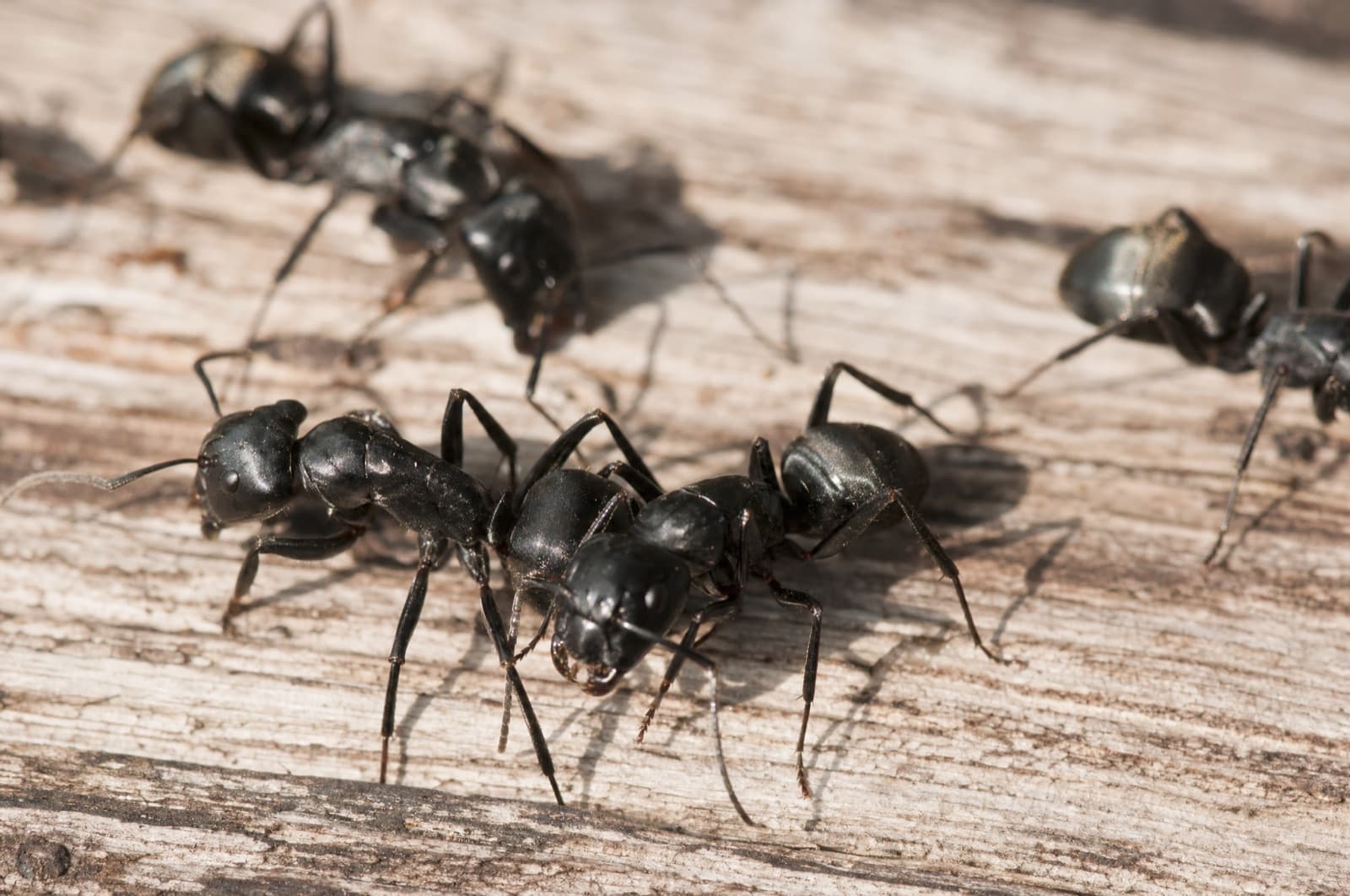
Read moreCapture an ant in a clear jar against white paper. Carpenter ant = single-node petiole (one bump between thorax and abdomen) + evenly rounded thorax in lateral view + 6–13 mm length. If the ant is pale yellow or amber, under 2 mm, and has two visible nodes, it is likely a pharaoh ant — stop all spray activity immediately and call a professional. Per Feng, Choe & Lee (2025), DIY spray treatments against pharaoh ants trigger budding (colony fission), making the infestation categorically worse 8. The single-node petiole test resolves 90% of identification calls without magnification.
01
02

Step 2: Find and fix the moisture source

UNH Cooperative Extension (Eaton & Maccini, Pest Fact Sheet 62) states verbatim: 'A single winged female carpenter ant begins a colony by shedding her wings and selecting a desirable nesting site, generally moist wood that has weathered and begun to decay' 1.
Read moreWood below 15% moisture content is essentially carpenter-ant-proof. Conduct a moisture audit of gutters, downspout extensions, attic venting, bathroom fan discharge, plumbing penetrations through sill plates, ice-dam history at eaves, and foundation grading. Insecticide applied without fixing the moisture source will not produce durable results — the colony will either survive in place or a new colony will colonize the same moisture-damaged wood 5.
02
03

Step 3: Locate both the parent and satellite nests

Hansen & Klotz (2005) identify nest location as the single biggest predictor of treatment success 5.
Read moreParent nests (containing the queen, eggs, and youngest larvae) require wood moisture >15% — they are most often outdoors in stumps, logs, or wet structural wood within 100 meters of the home. Satellite nests (workers, older larvae, pupae — no queen) tolerate drier conditions and are typically indoors in wall voids, attic top plates, and hollow doors. A mature colony operates with one parent nest plus up to 20 satellites 5. Killing only the satellite nest is insufficient — the parent colony replenishes it within a season. Locate nests by: tracing frass piles upward to their kickout holes, tapping walls with a screwdriver handle to hear hollow vs. solid wood, inspecting at night with a flashlight (carpenter ants are crepuscular), and following foraging trails outdoors.
03
04

Step 4: Choose the right bait — NOT repellent spray

Only two DIY products have peer-reviewed colony-elimination data for carpenter ants: indoxacarb gel (0.05%) and abamectin protein granule (0.011%) 2.
Read moreHansen's 2008 ICUP field trial of 7 commercial baits across 72 sites achieved a 55% colony-elimination rate in field conditions — versus >95% in lab trials. The gap exists because field conditions introduce seasonal acceptance shifts (Tripp et al. 2000 showed bait acceptance in *C. pennsylvanicus* drops sharply in fall when ants shift to sugar-seeking), inaccessible parent nests, and competing food sources 3. For gel: place 3–4 pea-sized dots every 12 inches along active trails; replace every 2 weeks during foraging season. For granules: apply 0.4 oz per 1,000 sq ft in a band around the foundation; 1.5–2.1 oz per nest or mound. Keep all repellent products and cleaning agents away from bait placements — they kill uptake.
04
05

Step 5: Do NOT spray repellent insecticides on visible trails

Repellent pyrethroids (bifenthrin, lambda-cyhalothrin, deltamethrin, permethrin) are detected by carpenter ants and cause colony scatter rather than colony kill.
Read morePer Illinois Department of Public Health: 'Typically, only 10 percent to 15 percent of the workers are outside the nest searching for food' 4. A repellent spray kills those foragers — 5–10% of the colony at most — while signaling the remaining 85–90% to relocate and form new satellite nests. This is the most common DIY failure mode and the reason ants 'reappear in a different spot' after spraying. Wiltz et al. (2014) demonstrated that repellent lambda-cyhalothrin produces colony scatter in structural ant pests 9. If you've already sprayed and seen the rebound pattern, switch to non-repellent bait immediately and give it 14 days before evaluating.
05
06

The 4-rung treatment ladder

Rung 0 — Monitor ($0): Single isolated forager in summer, no frass, no night activity, no winter history.
Read moreInspect the nearest tree stump and foundation for moisture. Recheck in 2 weeks. Rung 1 — DIY non-repellent bait ($30–$95 retail): Species confirmed, nest suspected but no frass, trails in one area, summer sightings only. Apply indoxacarb gel or abamectin granules. Expect colony collapse in 2–3 weeks if bait is accepted. No spray, no essential oils. Rung 2 — Pro one-time treatment ($250–$500 moderate, $800–$1,200+ severe): Any DIY-failure indicator present, OR infestation past Rung 1 threshold. Protocol includes free inspection, nest location, fipronil non-repellent 0.06% perimeter, drill-and-dust or foam injection at nest sites, 30-day follow-up. Rung 3 — Pro quarterly plan ($480–$840/yr): Pre-1985 housing, prior moisture event, forest-edge property, history of carpenter ant activity. 4 visits plus free re-service between visits. Drops 12-month re-infestation rate from 10–20% to under 5% by industry estimate 10.
06
07

The 10 DIY-failure indicators (escalation triggers)

Any one of these signals requires professional treatment, per the clinical escalation criteria in p4 §8: (1) large black ants indoors in January or February — UNH Extension Pest Fact Sheet 62 verbatim: 'Winter activity typically means you have a nest inside your home.
Read moreIf that's the case, the UNH Cooperative Extension recommends you hire a professional' 1; (2) ant trails persisting more than 14 days after starting baits — effective baits collapse colonies in 2–3 weeks per Hansen (2008) 2; (3) winged swarmers emerging indoors — indicates a mature colony 3–5 years old already producing reproductives 6; (4) rustling or crinkling sounds inside walls at night — active satellite nest in a wall void beyond bait-trail reach; (5) fresh frass piles below baseboards — active gallery excavation 1; (6) ants in multiple rooms or floors — Illinois DPH 10–15% rule means 85–90% hidden in multiple nests 4; (7) DIY spray 'works' then ants reappear in a new spot — colony scatter from repellent exposure 9; (8) known moisture problem plus large ants — UNH Extension moisture-decay link, insecticide alone will not hold 1; (9) smooth galleries found when probing suspect wood — structural damage already accruing; (10) repeat infestation within 12 months — queen was never reached; operational definition of DIY failure.
07
08

Professional treatment: what fipronil non-repellent actually does

The professional gold standard is fipronil 9.1% concentrate diluted to 0.06% — a non-repellent formulation — applied as a perimeter band (18 inches up the foundation, 18 inches outward) plus targeted crack-and-crevice and nest-injection treatments 7.
Read moreFipronil at this concentration is non-repellent: carpenter ants walk through treated zones, contact the insecticide, and carry it back to nestmates via trophallaxis. BASF's technical literature claims 100% colony control at 0.06% with documented transfer effect 7. The residual ant-control window is 30–90 days; the label permits only two applications per calendar year at 0.06% for general ant control. For wall-void satellite nests, professionals drill small access ports and inject insecticidal dust (deltamethrin 0.05%, silica gel) or foam (fipronil 0.005%) directly into the gallery. 80–95% colony elimination in a single visit when the parent nest is correctly located 7. The 30-day follow-up inspection verifies elimination before the colony can regenerate from surviving brood.
08
09

The cost-of-delay math: why Year 1 treatment is the highest-ROI decision

A homeowner who treats a carpenter ant infestation in Year 1 typically spends $250–$600 total (treatment + minor repairs).
Read moreWaiting until Year 3 — a typical detection-to-treatment delay in NH — costs $1,600–$4,000 (treatment + window frames and insulation). Year 5+ costs $4,000–$11,500+ when structural framing is involved 11. That is an 8× to 23× return on Year-1 intervention 11. Structural wood repair is not covered by standard homeowners insurance — it is treated as preventable maintenance. Hansen & Klotz (2005) note that satellite nests at Year 3 are often inaccessible without drywall removal 5; Carpenter Ant Guide documents repair bills exceeding $10,000 in NH homes with 5+ years of undetected activity 11. The quarterly plan at $480–$840/yr costs approximately the same over 5 years ($2,400–$4,200) as a single Year-3 reactive treatment plus repair — but prevents the infestation entirely.
09
10

Why essential oils, soapy water, and indoor DE don't work against carpenter ants

Essential oils (peppermint, clove, cinnamon, tea tree) have zero peer-reviewed colony-elimination data for carpenter ants 4.
Read moreA 2017 IJBB small-plot study found clove oil 88% effective at direct-contact application — but did not test colony elimination, and the effect lasted 2–4 hours before evaporating. Soapy water kills only directly sprayed foragers — per Illinois DPH, 85–90% of the colony never surfaces 4. Indoor diatomaceous earth is completely inactivated by humidity — the exact condition carpenter ants prefer in their nest substrate 4. These products are acceptable for deterrence at a picnic table or window screen; they are not treatments for a structural infestation and should not be used in place of evidence-based bait while a colony continues to grow and excavate.
10

Bottom line — The two decisions that determine treatment outcome are: (1) bait or spray — always bait, non-repellent, matched to the season; and (2) DIY or pro — use the 10 DIY-failure indicators as a hard escalation trigger, not a suggestion. Early professional treatment at $250–$500 prevents $4,000–$11,500+ in Year-5 costs. In NH, free inspections are standard — the incremental cost of calling a pro is zero until treatment is authorized.

Self-Assessment Tool

How urgent is your situation?

Three questions map your situation onto the 4-rung treatment ladder. Answer honestly — the result tells you whether to treat yourself, escalate now, or call a pro today.

1

Have you seen large black ants indoors in January–February, OR winged ants emerging inside the home in spring?

2

Have you found frass piles (sawdust with tiny insect parts) OR heard rustling/crinkling sounds inside walls at night?

3

Have you tried any DIY treatment? If yes, what happened?

NH Carpenter Ant Species

Carpenter ants aren't one species — they're four

NH hosts four established Camponotus species, each with slightly different treatment implications. Species ID is Step 1 before any bait selection — Tripp et al. (2000) showed bait acceptance shifts between protein-seeking and sugar-seeking phases vary by species and season.

Species 1

Black Carpenter Ant

Camponotus pennsylvanicus

Size
6–13 mm
Color
Uniformly matte black with pale yellow hairs on gaster
Nest
Moist structural wood (>15% MC), dead hardwoods, stumps
Aggression
NH Prevalence

Distinguishing feature

The dominant NH carpenter ant — responsible for 80%+ of structural cases. Treats well with abamectin granule in spring (protein phase) or indoxacarb gel summer through fall. Winter sighting = indoor nest; call a pro.

Species 2

New York Carpenter Ant

Camponotus novaeboracensis

Size
6–11 mm
Color
Bright red-orange mesosoma, black head and gaster
Nest
Rotting logs, stumps, dead hardwood branches
Aggression
NH Prevalence

Distinguishing feature

Bicolored body distinguishes it instantly from pennsylvanicus. Less likely to nest inside structures but does so when wood is wet enough. Same treatment approach as pennsylvanicus — non-repellent bait first.

Species 3

Hercules Carpenter Ant

Camponotus herculeanus

Size
6–14 mm
Color
Dark wine-red mesosoma restricted to dorsum, black head and gaster
Nest
Coniferous wood specialist — spruce, fir, pine stumps; boreal forests
Aggression
NH Prevalence

Distinguishing feature

Primarily in NH's White Mountains and North Country; uncommon near structures in southern NH. Darker, less extensive red than novaeboracensis. Responds to same non-repellent bait strategy.

Species 4

Smaller Carpenter Ant

Camponotus nearcticus

Size
3.5–7.5 mm
Color
Dark brown to black; shiny, mostly hairless gaster
Nest
Arboreal — dead twigs, branches, hollow stems; occasionally eaves or attic siding
Aggression
NH Prevalence

Distinguishing feature

Smaller than pennsylvanicus — can be confused with pavement ants, but check for single-node petiole and smooth thoracic arch. Easier to treat; colonies are smaller and more accessible. Low aggression, low structural damage risk.

NH Risk Heat Map

Carpenter ant pressure by NH county

Carpenter ant pressure varies significantly by county — driven by housing age, forest cover, and proximity to water. NH's 84% forest cover and ~22% pre-1950 housing stock make it the highest-risk northeastern state for structural carpenter ant damage.

HillsboroughExtreme riskRockinghamExtreme riskMerrimackHigh riskStraffordHigh riskCheshireHigh riskManchester HQ
Low
Moderate
High
Extreme

Hillsborough County

Extreme

Highest absolute case volume in the state. Manchester's pre-1940 mill-era housing (West Side, North End) and Nashua's pre-1960 stock combine with forest-edge properties in Bedford, Goffstown, and Amherst. Median home construction year 1979 — most pre-dates modern moisture barriers and ice-shield requirements.

Rockingham County

Extreme

Portsmouth's pre-1900 clapboard housing on tidal moisture is the oldest dense stock in the state. Salem, Derry, and Londonderry suburbs carry high pressure. The Atlantic Coast strip (Zone 6b) has the longest annual carpenter ant foraging window in NH — first foragers emerge up to 2 weeks earlier than inland counties.

Merrimack County

High

Concord's downtown pre-1940 wood-frame stock plus extensive rural forest-edge properties in Henniker, Warner, and Andover. Median construction year 1979. Carpenter ant colonies from Merrimack River-adjacent wetlands regularly seed indoor satellites in Concord's South End.

Strafford County

High

Dover and Rochester both carry substantial pre-1940 stock, and Strafford County has 22% pre-1950 housing — matching the statewide rate. UNH-Durham rental housing and mill-era buildings in Dover and Somersworth see elevated complaint volume in spring and early summer.

Cheshire County

High

The oldest housing stock of any service county — 27.3% built before 1940, median construction year 1973. Keene and its surrounding rural towns have heavy forest interface with the Monadnock region. Monadnock Pest & Wildlife publicly identifies carpenter ants as the most prolific household pest in Cheshire County.

Bottom line — If you live in Hillsborough or Rockingham County and your home was built before 1985, assume active carpenter ant pressure within 100 meters of your foundation — the question is whether they've found a moisture entry point. In Cheshire County, 27.3% pre-1940 housing means balloon-frame construction with long vertical stud cavities that are among the hardest to treat without professional drilling.

Visual Identification

What to look for before treating

These 6 visual indicators — frass, kickout holes, smooth galleries, foraging workers, swarmers, and damaged wood — each trigger a different treatment response. Identifying which ones are present determines whether DIY bait or professional injection is appropriate.

Sign 1

Frass piles

Piles of coarse wood shavings mixed with tiny insect-part fragments (legs, antennae, pupal casings) below baseboards, window sills, or in basement corners. Frass piles directly below a surface indicate an active kickout hole above. Fresh frass = active excavation = nest is reachable via bait from this location.

Sign 2

Kickout holes

Slit-like, irregular openings 2–3 mm in diameter that workers use to eject gallery debris. Look in basement sill plates, around window trim, and inside cabinet toe-kicks. Kickout holes are the map to the gallery — probe outward from the hole with a screwdriver handle to hear where wood is hollow.

Sign 3

Smooth galleries

When suspect wood is probed or cut open, carpenter ant galleries look polished — almost sanded, with a clean finished surface. This distinguishes them from subterranean termite galleries (rough, mud-packed) and from wood rot (soft and discolored throughout). The smooth gallery surface is the definitive structural confirmation.

Sign 4

Foraging workers

Large (6–13 mm) black ants moving in single-file lines, most active after sundown. Trails follow the same routes nightly — along baseboards, up wall corners, under cabinet edges. Tracking a trail with a flashlight 15 minutes after sundown often leads directly to the kickout hole or the moisture source feeding the nest.

Sign 5

Swarmers (alates) indoors

Winged reproductives emerging indoors between February and June are the single strongest indicator of an active nest inside the structure. Discarded wings on windowsills in May are nearly diagnostic. If swarmers emerge in February or March inside a heated NH home, the colony has been present 3–5 years and is mature enough to produce reproductives.

Sign 6

Structural wood damage

Wood that sounds hollow when tapped, visible staining or dark streaking along the grain, flexing or soft spots in sill plates and rim joists, and cracks revealing dark gallery openings. Year-5 damage in NH wood-frame homes can extend through multiple studs, requiring carpentry repair in coordination with pest treatment.

Decision Tree

Should you call a pro?

Four questions route you to the correct rung of the treatment ladder. Each branch reflects published DIY-failure criteria from p4 §8 and UNH Extension guidance.

Did you see large black ants (6+ mm) indoors between December and March?

Transparent Cost Calculator

What carpenter ant treatment actually costs

No NH pest control company publishes pricing on their website — a trust gap we fill here. These ranges are calibrated against Homeyou Manchester data (n=1,653 completed projects through 07/14/2026), Angi 2026, HomeAdvisor, and direct NH operator quotes. Multiply base × home size × severity to estimate your range.

Home size

Infestation severity

Treatment type

Estimated cost

$191$383

One-time carpenter ant treatment

Includes free inspection, nest location, fipronil non-repellent perimeter + targeted bait or nest injection. Standard for confirmed single-nest infestations.

Estimates reflect 2026 southern NH market rates for Manchester, Bedford, Nashua, Derry, and surrounding communities. Northeast pricing runs 30–40% above national average. Your exact quote requires a free on-site inspection — final price varies by nest accessibility, wall-void drilling required, and property size. Repair costs for structural wood damage ($200–$10,000+) are separate from pest control fees and are not covered by standard homeowners insurance.

Treatment Effectiveness

How long does each method actually last?

Essential oils / soapy water / indoor DE

$5–$20 · DIY

2–4 hours (repellent only)

Zero peer-reviewed colony-elimination data for carpenter ants. Soapy water kills only directly sprayed foragers — Illinois DPH 10–15% rule means 85–90% of colony never exposed. Essential oils (peppermint, clove, cinnamon) repel for 2–4 hours and scatter colony to new entry points. Diatomaceous earth is completely inactivated by humidity — exactly the conditions carpenter ants prefer. Do not use as a primary treatment.

Repellent pyrethroid spray (bifenthrin, permethrin)

$15–$35 · DIY

30–90 days residual (forager knockdown only)

Ants detect and avoid repellent insecticides, which kills only the 10–15% of foragers currently outside the nest. Carpenter ants scatter and form new satellite nests when colonies detect repellents — the dominant DIY failure mode. Not appropriate as primary treatment; may be used as a supplement to non-repellent baiting at exterior entry points only.

Indoxacarb gel (0.05%)

$30–$45 per tube · DIY

7–21 days to colony collapse

One of only two DIY products with peer-reviewed carpenter ant colony-elimination data (Hansen 2008). Pro-insecticide metabolized to DCJW inside the ant; delayed kill + trophallaxis transfer to queen. 82% mortality by Day 8 against odorous house ants in 15-structure field trial (DuPont/Bayer, Pest Control Technology April 2012). Place 3–4 pea-sized dots every 12 inches along trails. Best in summer when matched to protein-feeding preference.

Abamectin protein granule (0.011%)

$25–$95 · DIY

2–3 weeks to colony collapse

The second DIY product with peer-reviewed colony-elimination data for carpenter ants (Hansen 2008 ICUP Proc., 55% field success). GABA-receptor antagonist halts egg production by queen via colony transfer. Protein-corn-grit matrix matches carpenter ant spring-protein feeding preference. Apply 0.4 oz per 1,000 sq ft in outdoor perimeter band; 1.5–2.1 oz per individual nest or mound. Reapply every 30–60 days outdoors. Inactivated by direct rain — apply to dry soil.

Pro fipronil non-repellent perimeter (0.06%) — one-time

$250–$500 (moderate NH infestation) · Professional

30–90 days residual ant control

Professional gold standard. Fipronil 9.1% concentrate diluted to 0.06% (non-repellent perimeter formulation). Ants cannot detect the treatment, contact and ingest it, and transfer it to the queen via trophallaxis. BASF claims 100% colony control at 0.06% with documented transfer effect. 80–95% colony elimination in single visit when parent nest correctly located. NH Division of Pesticide Control licensed application only. Label permits two applications per calendar year at this concentration.

Pro quarterly prevention plan (whole-home IPM)

$480–$840/yr in NH · Professional

Year-round continuous coverage

4 visits per year (spring, summer, fall, winter) plus free re-service between visits. Combines fipronil perimeter, targeted nest injection, exterior bait stations, and moisture/vegetation guidance. Industry-operator estimate: drops 12-month re-infestation rate from 10–20% (one-time only) to under 5%. Best for pre-1985 housing, forest-edge properties, or prior carpenter ant history. 90% of US pest professionals endorse IPM as most effective approach (NPMA Ant Survey, Hansen 2012).

Prevention Playbook

How to stop carpenter ants from coming back

1

Eliminate moisture sources first — repair leaks in gutters, roof valleys, plumbing penetrations, and under-sill areas. UNH Extension: queens seek 'moist wood that has weathered and begun to decay.' Wood below 15% moisture content is essentially carpenter-ant-proof and is the single most effective prevention measure [1].

2

Caulk and seal all utility penetrations, foundation cracks, gaps around window and door frames, and openings where utility lines enter. Workers travel up to 100 meters from the nest and use any gap larger than 1 mm as an entry point [5].

3

Trim all tree branches, shrubs, vines, and vegetation so nothing touches the house. Each branch contact is a direct highway bypassing any perimeter insecticide treatment. UNH Extension: 'Keeping trees and bushes from touching the house will reduce the chances of foraging ants coming indoors' [1].

4

Store firewood off the ground on a concrete pad or metal rack, ideally 20+ feet from the foundation and only in quantities you'll use within one heating season. Firewood is one of the most common parent-colony origin sites in New England; UNH Extension explicitly lists it as a harborage to eliminate [1].

5

Remove tree stumps and dead branches within 100 feet of the foundation — UNH Extension explicitly lists stump removal as a preventive measure, and stumps are the most common outdoor parent-colony site seeding indoor satellites [1][5].

6

Schedule an annual professional inspection in spring (mid-April to May in southern NH) before the primary swarm window. NH operators (Modern, JP, Colonial, Fox, Anchor) include inspections free for quarterly subscribers. Inspections catch satellite nests at Year 1–2, when treatment is $250–$600 total, versus Year 5, when structural repairs alone can exceed $10,000 [1][11].

Local Context

Why carpenter ants are NH's #1 structural pest — and why treatment is urgent here

UNH Cooperative Extension (Eaton & Maccini, Pest Fact Sheet 62, 2016) designates carpenter ants, alongside termites, as 'the most troublesome structural pest in New Hampshire.' NH's combination of 84% forest cover (the second-highest in the U.S.), ~44 inches of annual precipitation with chronic ice-dam moisture loading, and a median home build year of 1982 creates near-ideal conditions for satellite-nest colonization. NH temperatures have risen 3°F since 1901, directly lengthening the carpenter ant foraging season and increasing overwintering survival in marginally-heated wall voids.

Key Local Data

Carpenter ants are the most-treated ant species nationally (66% of all PMPs treated them in 2011, per NPMA), a figure that tracks closely with NH operator reports — and in NH the species is dominant from April through October in all five southern service counties.

Common Questions

Frequently Asked

Sources & References

Where this data comes from

  1. [1]
  2. [2]
  3. [3]
  4. [4]
  5. [5]
  6. [6]
  7. [7]
  8. [8]
  9. [9]
  10. [10]
  11. [11]
  12. [12]
Family-owned since 2017 · Manchester, NH

Year-1 treatment costs $250–$500. Year-5 costs $4,000–$11,500+.

The math is brutal: an 8–23× return on early intervention, and homeowners insurance does not cover carpenter ant structural damage. Free inspection, written plan, 30-day follow-up included.

NH-Licensed pest control operators (#782664) Free inspection — no obligation, no pressure 30-day follow-up included in every carpenter ant treatment Serving Manchester, Nashua, Bedford, Derry, Concord, and all of southern NH since 2017