
Pest Control in Milford: What's Actually Different Here?
Is Milford pest control actually different?
The verdict on Milford
something real, and documented
a real but minor factor
pests don't read town lines
Milford's downtown Colonials and newer subdivisions differ from each other — but not from the same houses in any other NH town.
The honest town profile
Census housing age, density and geography — the fields that genuinely predict pest pressure. Only documented facts appear.
Hillsborough
A pre-1940 downtown core around the Oval and River Park alongside a much larger ring of post-war and 1970s-era suburban development.
The Souhegan River runs through downtown on a high water table, with periodic spring flooding on low-lying ground; granite bedrock underlies much of the town.
The pre-1940 downtown core carries the same rodent and moisture-pest risk that any older NH building carries; the newer ring carries the same lower structural risk that newer stock carries anywhere. Riverside floodplain homes see more moisture pressure than homes further from the water. None of it is unique to Milford.
Town of Milford official site, milford.nh.gov · US Census Bureau QuickFacts — Milford CDP, NH
The pests actually here
The real Southern-NH species picture — we name them and link the full profiles rather than re-teach identification, and we correct the ones that don't live here at all.
This is the southern New Hampshire picture, not a Milford picture. The split between an older downtown and a newer suburban ring is itself the regional pattern, not a Milford trait.
- Carpenter ants and moisture pestsOlder, riverside homes near the Souhegan's high water table see more of both, the same as any NH river-mill town.Related guide
- House mouse and Norway ratPre-1940 downtown buildings have the same leaky-envelope entry points found in any older NH structure.Related guide
- Blacklegged tickRegional distribution, present the same as in every town in this hub.Related guide
- MosquitoesThe Souhegan River and its floodplain support them for homes close to the water.Related guide
- Brown marmorated stink bug and other fall invadersConfirmed trapped in Milford in 2014 (UNH Extension) — part of the same regional fall push seen statewide, not a Milford-specific population.Related guide
Our service area — including when it's not us
About 25 to 30 minutes southwest of Manchester — core service area.
Moisture-pest and rodent exclusion for the older downtown core, general structural pest control for the newer suburban ring, and the same range of services we provide throughout the region.
Service Area Map
Southern New Hampshire
The answer
Why 'old downtown, newer ring, river through the middle' isn't a difference
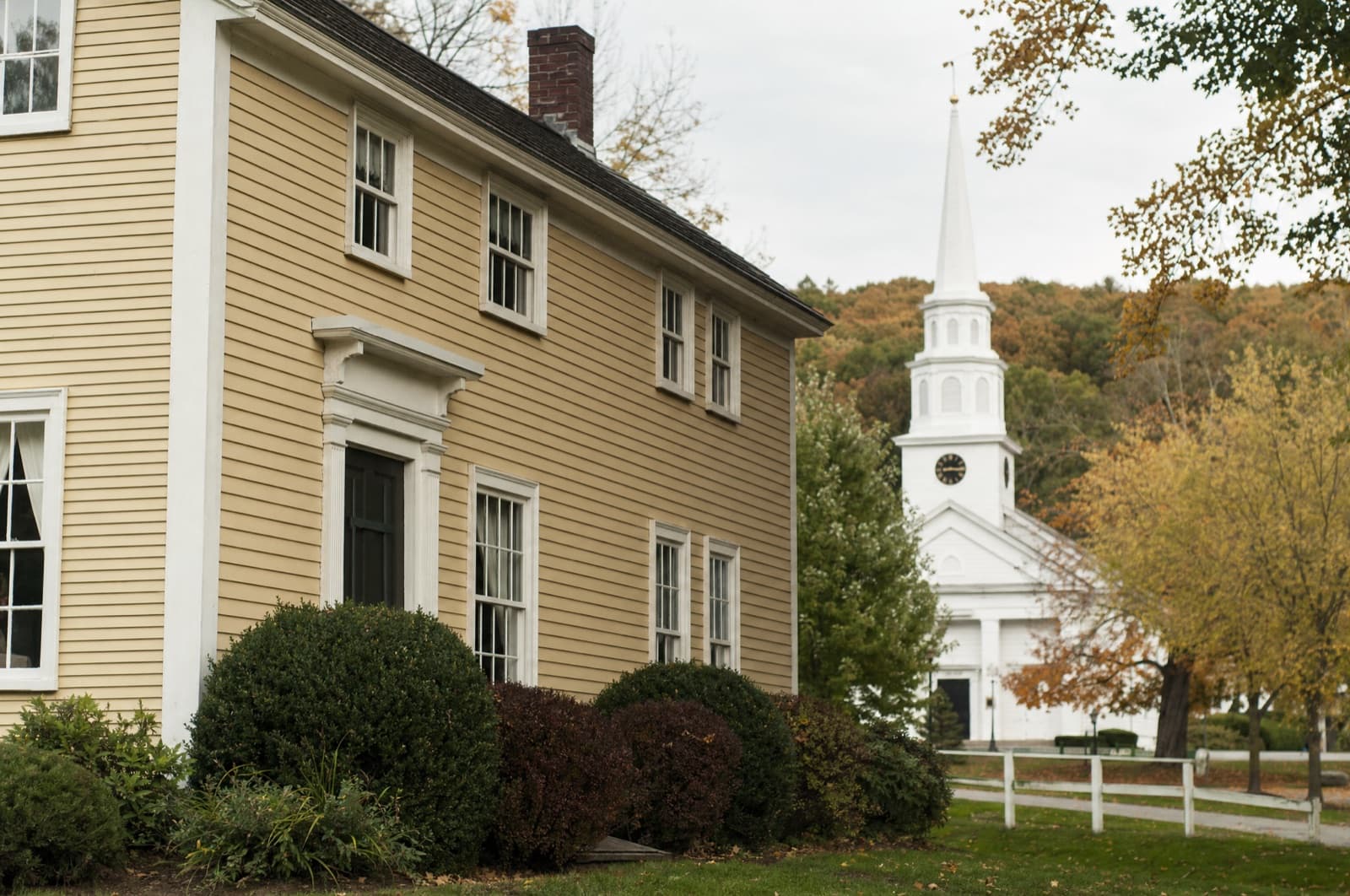
Milford's downtown could be sold as a distinct historic-mill-town pest identity — pre-1940 Colonials around the Oval, granite construction, the Souhegan River running right through the middle. It's a real place with real character, but the pest picture underneath it is the regional average. Split-age housing with an older walkable core and a newer suburban ring, next to a river with a high water table, describes several towns in this hub, not just Milford. No sourced factor sets Milford's pest pressure apart from a town like Litchfield or Hudson with the same combination.
What actually drives your risk here
The real predictors are the same ones that apply everywhere: if you're in one of the pre-1940 homes near the Oval or River Park, your building's age is the relevant factor, the same as it would be in any NH town's historic core. If you're on lower ground near the Souhegan, water adjacency is your factor, the same as it would be along the Merrimack in Hudson or Litchfield. If you're in the newer post-war ring, you have the lower structural risk that comes with newer stock, wherever it's built. None of that is a Milford story — it's a house story.
Key takeaways
- Milford's split-age housing and downtown river frontage are the regional norm, shared with several other towns in this hub.
- Building age (downtown core) and water adjacency (Souhegan riverside) are the real predictors — both property-level, not town-wide.
- Brown marmorated stink bug was confirmed trapped in Milford in 2014, part of a statewide pattern, not a local population unique to the town.
Milford's pests are the region's pests.
Whether you're in a pre-1940 Colonial near the Oval or a newer subdivision, the driver is your house — its age and its distance from the river — not Milford itself.
Frequently asked
Sources & further reading(3)
- [1]Town of Milford official site
Milford's mill-town history and downtown/suburban housing pattern
govverified 2026-07-16 - [2]US Census Bureau QuickFacts — Milford CDP, NH
General population and housing context for Milford
censusverified 2026-07-16 - [3]UNH Cooperative Extension — Brown Marmorated Stink Bug (BMSB)
BMSB confirmed in NH in 2010 (Portsmouth) and trapped in Milford in 2014
extensionverified 2026-07-16
Written & reviewed by
VerifiedDaniel Brady
NH-Licensed Pesticide Applicator · License #782664 (NHDAMF, RSA 430)
Daniel Brady is the New Hampshire–licensed applicator behind Anchor Pest Services, a family-owned pest control company serving the Manchester area since 2017.
Last updated July 2026
Compare a neighbor
Same honest instrument, town by town — most read “not different,” and that's the point.
Honest pest help for New Hampshire homes
Milford's Character Is Real. Its Pest Story Isn't Unique.
Milford's split-age housing and Souhegan River frontage describe several towns in this hub, not just Milford. What predicts your risk is your building's age and its distance from the water. Family-owned since 2017, NH license #782664, based at 700 Harvey Rd in Manchester.
- We'll tell you when your town isn't the deciding factor
- NH-licensed applicators (#782664) — free inspection, same-day service
- Serving Milford and all of southern New Hampshire since 2017
NH License #782664 · No obligation · We answer in person
Your next step
- Book a NH pro
Pest Control Services
Licensed, family-owned pest control across southern NH.
Book now - What to do next
Brown Marmorated Stink Bug in New Hampshire — ID & Control
Read the answer - Also relevant
How to Get Rid of Brown Marmorated Stink Bugs
Read the answer - Related guide
Pest Control in Hudson: What's Actually Different Here?
Read the answer