
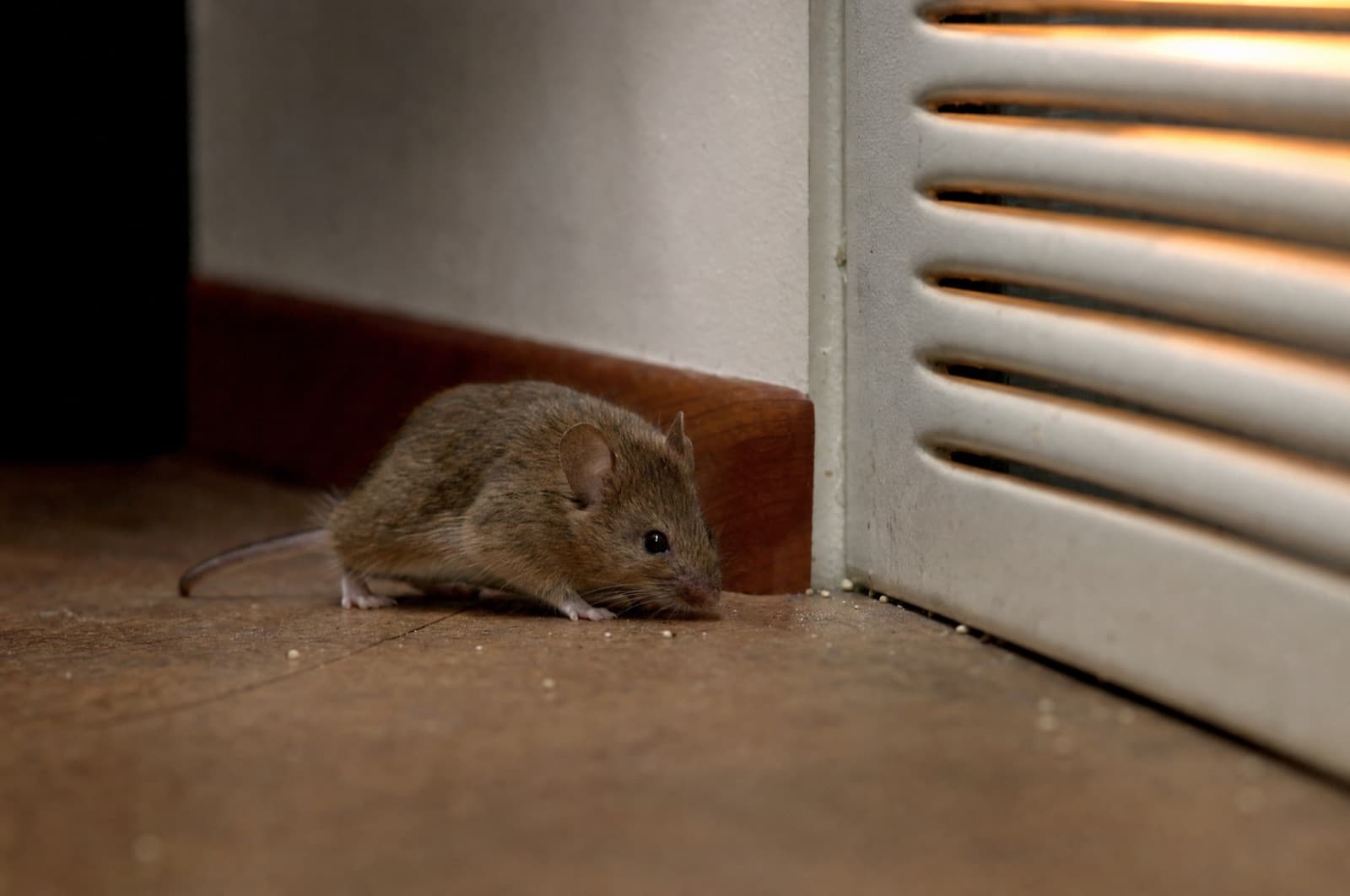
How Do Rodents Access Warm Areas Near Heaters?
Rodents travel along walls and pipes to reach the warmest microhabitats in a house — beside a radiator, above a furnace, along a heat duct — because those spots sit inside their preferred temperature range and standard room temperature doesn't.
This explains where you find them, not a danger in itself. It's a location pattern, not an emergency.
At a glance
- The mechanism: Heat draws them in
- Who fixes it: A licensed pest pro
- The rest lives at: Where do mice usually hide indoors?
Rodents travel along walls and pipes to reach the warmest microhabitats in a house — beside a radiator, above a furnace, along a heat duct — because those spots sit inside their preferred temperature range and standard room temperature doesn't.
This explains where you find them, not a danger in itself. It's a location pattern, not an emergency.
Heat doesn't spawn pests — it changes what you notice
The season and the building set the stage before the thermostat ever comes on. Here's the honest chain of events, spelled out.
What's really happening
A mouse already inside a structure thermoregulates behaviorally by moving toward warmth, because room temperature typically falls below its thermoneutral zone of about 26-34°C. Warm microhabitats — behind or beside radiators, near furnace and boiler cabinets, along heat ducts, in wall voids warmed by heating pipes — become its preferred resting and nesting sites. It reaches them by traveling along walls and pipes, a navigation style called thigmotaxis, or edge-following. Peer-reviewed thermotaxis research confirms mice leave a spot the moment it cools and immediately search for the next warm one.
Source:eLife— ThermoMaze study — mice search for and settle on warm spots (26-29°C) via thermotaxis; leave immediately when the spot cools
Is this an HVAC problem or a pest problem?
Who actually fixes it
A licensed pest pro
Locating nests in warm harborage areas and controlling or excluding the rodents is professional work that requires inspecting spaces most homeowners can't safely or easily access, like behind a furnace cabinet.
Nesting is found inside or directly against heating equipment — a furnace cabinet, an air handler, inside duct runs — coordinate with an HVAC technician before disturbing the nest or the equipment.
This hub owns the heating-system angle
General winter behavior, rodent control, and equipment-damage severity live in siblings that already earn them. Here's exactly where.
This page owns the heat-microhabitat angle — why warm equipment zones are rodent magnets. General rodent control and exclusion strategy belong to our mice & rats FAQ.
How this calibrates for NH
Because New Hampshire winters keep heating equipment running for months at a stretch, the warm microclimate beside a boiler or along basement heat lines stays stable and continuous for the entire season — a reliable, unbroken draw rather than the brief warm spell a milder climate might offer.
NH-licensed applicator #782664 (NHDAMF, RSA 430) · NEPMA member · family-owned since 2017.
Frequently asked
Sources(3)
- [1]eLife
ThermoMaze study — thermotaxis toward 26-29°C; thermoneutral zone 26-34°C; mice leave cooled spots
- [2]PLOS One (Gaskill et al.)
"Heat or Insulation: Behavioral Titration of Mouse Preference for Warmth" — mice prefer around 30°C
- [3]Internet Center for Wildlife Damage Management
Norway Rat Biology — thigmotaxis/edge-following travel
Written & reviewed by
VerifiedDaniel Brady
NH-Licensed Pesticide Applicator · License #782664 (NHDAMF, RSA 430)
Daniel Brady is the New Hampshire–licensed applicator behind Anchor Pest Services, a family-owned pest control company serving the Manchester area since 2017.
Anchor Pest Services
Worth a professional pest inspection?
We've protected Southern New Hampshire homes since 2017. Free inspection, same-day service — we tell you what's actually there before we treat anything.
- NH-licensed applicator
- Same-day service
- Pet & family-conscious
NH License #782664 · No obligation · We answer in person