
Where Do Mice Usually Hide Indoors?
At a Glance
- Short answer: Wall voids, behind appliances, cabinets/pantries, attics, basements, and cluttered storage.
- Key fact: Mice rarely travel more than 10–30 feet from their nest and food source.
- NH relevance: Warm appliance backs and insulated attics are especially attractive during NH winters after the fall entry period (~Oct 19 frost).
- Action needed: Concentrate inspection and trapping within about 30 feet of where you find droppings, not the whole house.
The short of it
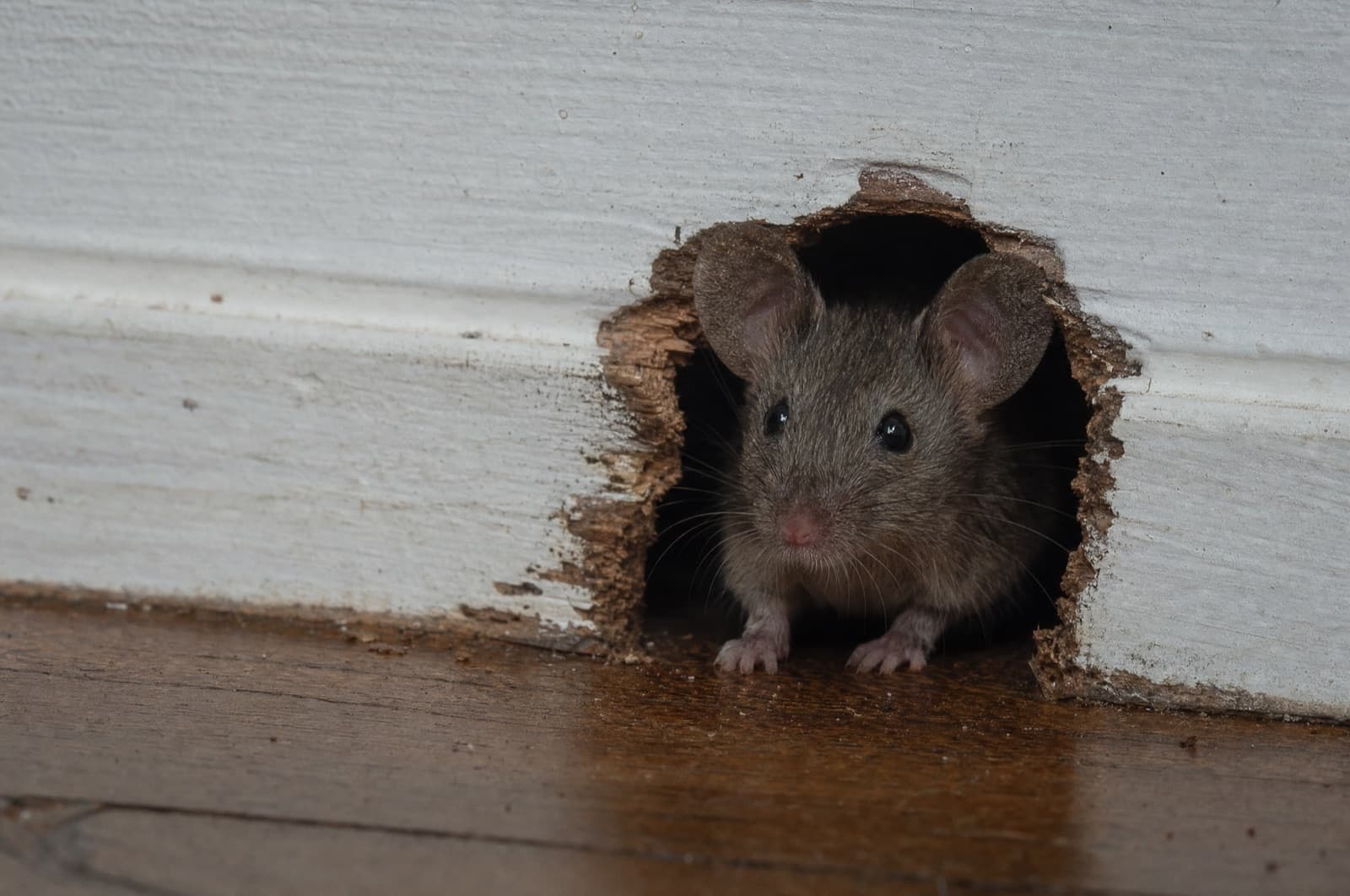
Mice hide in warm, concealed spots close to food: wall voids, behind and under large appliances, inside kitchen cabinets and pantries, attics, basements, and cluttered storage. Extension research shows a house mouse normally travels only about 10 to 30 feet from its nest and food source — sometimes just a few feet where food is abundant — so wherever you find droppings, the nest is usually nearby, not somewhere across the house.
Where Do Mice Usually Hide Indoors — By the Numbers
10–30 ft
Typical range a mouse travels from its nest
Few ft
Range when food is abundant nearby
Multiple
A single home can host several independent nests
Shredded material
Typical nest-building material
The full picture
Why mice stay close to home
Extension sources establish that a house mouse normally travels within an area only about 10 to 30 feet in diameter and "seldom" ranges farther for food or water; where food and shelter are abundant, the foraging range may shrink to just a few feet. That short range is the key practical insight: droppings, gnaw marks, or rub marks mark the neighborhood of the nest, which is usually within a wall void or concealed cavity nearby, not somewhere across the house.
Typical hiding and nesting spots
Common indoor harborage includes wall voids, spaces behind and beneath refrigerators and stoves (which give off warmth), the backs of base cabinets and pantries, attic and crawl-space insulation, basements, and cluttered storage boxes. Nests are built in sheltered locations from finely shredded paper or fibrous material. Because mice prefer to travel tight against walls and edges, runways — and the traps you place — should follow baseboards and vertical surfaces rather than open floor.
Why a house can have more than one nest
A single home can host several independent nests in different rooms, since each mouse or family group stays close to its own local food source. That's why droppings in the kitchen and droppings in a bathroom cabinet across the house don't necessarily mean one mouse traveling widely — they more likely mean two separate populations.
Bottom line — Find droppings in a kitchen and the nest is likely in that room or an adjacent wall void — concentrate inspection and trapping within roughly 30 feet rather than searching the whole house randomly.
Found droppings in one spot?
The nest is probably within 30 feet. Anchor's licensed NH technicians pinpoint it, trap it, and seal how mice are getting in.
Why this matters in New Hampshire
Warm appliance backs and insulated attics are especially attractive hiding spots in NH winters, once mice have moved indoors during the fall entry period around Manchester's first hard frost — about October 19 (50%) to October 29 (80%), NOAA 1991–2020.
Key local data
Deer mice (Peromyscus) are the hantavirus-relevant species in NH; NH DHHS reports no confirmed case acquired in-state to date.
- NH-licensed applicator · #782664
- Same-day service
- Family-owned since 2017
Service Area Map
Southern New Hampshire
Frequently asked
Written & reviewed by
VerifiedDaniel Brady
NH-Licensed Pesticide Applicator · License #782664 (NHDAMF, RSA 430)
Daniel Brady is the New Hampshire–licensed applicator behind Anchor Pest Services, a family-owned pest control company serving the Manchester area since 2017.
Professional Rodent Control
Mice Don't Roam — They Hide Close to Home
A short foraging range means the evidence you find points almost directly at the nest. Anchor Pest Services uses that to target inspection and trapping precisely, instead of guessing across the whole house. Family-owned since 2017, NH license #782664.
- Same-day service across southern NH
- NH-licensed applicators (#782664)
- Free inspection — no flat-price guesswork
NH License #782664 · No obligation · We answer in person
Your next step
- Book a NH pro
Rodent Control
Book now - Next step
Where Do Mice Go in the Winter? NH Mouse Timing Guide
Read the answer - Related guide
Can Mice Climb Walls and Furniture?
Read the answer - Related guide
What Are the Signs of a Mouse Infestation?
Read the answer - Related guide
How Do I Get Rid of Mice in Walls?
Read the answer - Related guide
How Long Can Mice Live Inside a House?
Read the answer