
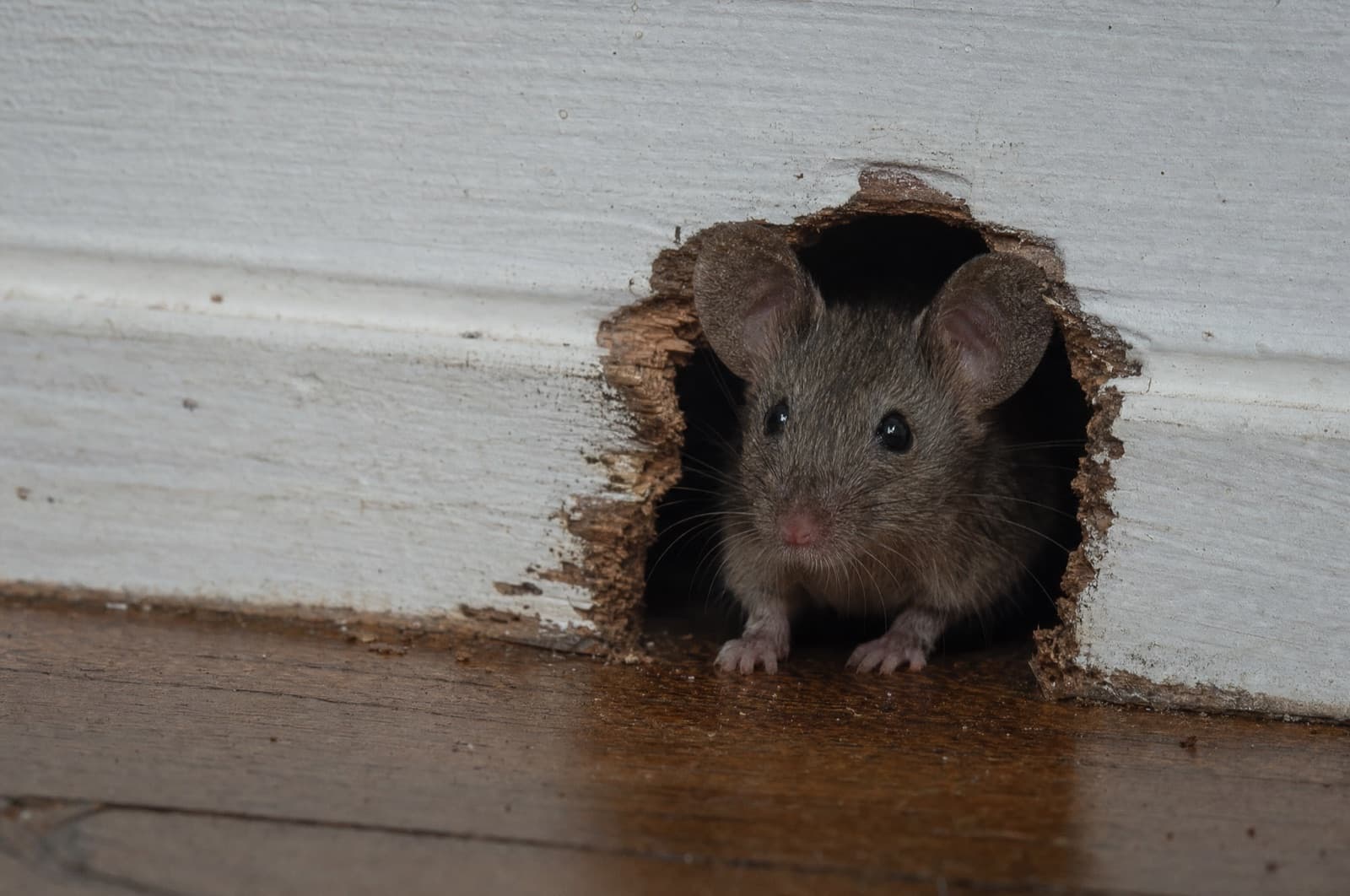
Can Mice Climb Walls and Furniture?
At a Glance
- Short answer: Yes — mice climb rough vertical surfaces, wires, and pipes, and jump up to 12 inches.
- Key fact: Mice squeeze through gaps as small as ¼ inch, so climbing ability opens up entry points at any height.
- NH relevance: Entry surges each fall as nighttime temperatures drop before Manchester's first hard frost (~Oct 19) — check the whole building envelope, not just the foundation.
- Action needed: Inspect rooflines, soffits, and utility penetrations, not just ground-level gaps.
The short of it
House mice run up rough vertical surfaces like wood, brick, stucco, and drywall, travel horizontally along wires and pipes, and jump up to 12 inches from the floor onto a flat surface, per UC IPM's Pest Notes. Combined with their ability to squeeze through gaps only slightly larger than ¼ inch, that means entry points exist at any height on a building — not just at the foundation. An inspection that only checks floor-level gaps will miss how most mice actually get in.
Can Mice Climb Walls and Furniture — By the Numbers
12 in
Vertical jump onto a flat surface
¼ in
Smallest gap a mouse can squeeze through
3 in
Max pipe diameter mice can climb the outside of
Any height
Mice climb rough walls, brick, wires, and pipes at any level
The full picture
How mice climb
UC IPM's Pest Notes: House Mouse states plainly that house mice "are excellent climbers and can run up any rough vertical surface. They will run horizontally along wire cables or ropes and can jump up to 12 inches from the floor onto a flat surface." Their light weight and flexible skeleton let them exploit textures that look smooth to people — painted drywall, brick mortar joints, and rough-sawn timber all provide enough grip. University of Nebraska rodent-proofing guidance adds that rats and mice "climb almost any rough vertical surface" and can climb the outside of pipes up to about 3 inches in diameter.
Why this matters for entry points
Because a mouse can climb an exterior wall and enter at a soffit, roof vent, or utility penetration near the roofline, an inspection that only checks floor-level gaps will miss real entry points. Mice can also pass through openings only slightly larger than ¼ inch — UC IPM's July 2025 Pest Notes specifies mice "can squeeze under gaps ¼ inch tall, and through openings 3⁄8 inch wide" — so a climbable route plus a coin-sized gap anywhere on the building envelope is enough.
Where climbing shows up as evidence
If you find droppings or gnaw marks on upper shelves, countertops, or in an attic, assume mice are using vertical routes to get there, not just crossing open floor. Consumer barrier products exist for specific gaps, but effective exclusion has to cover the whole building envelope — foundation to roofline — not just one point.
Bottom line — Mice climb rough walls, wires, and pipes and can jump a foot onto a flat surface, so entry points exist at every height. Combine that with their ¼-inch squeeze-through ability, and a full building-envelope inspection — not just the foundation — is the only reliable check.
Finding droppings somewhere unexpected?
If mice are climbing to reach counters, shelves, or attics, floor-level fixes alone won't stop them. Anchor inspects the full building envelope, not just the foundation.
Why this matters in New Hampshire
Outdoor mouse populations push indoors as nighttime temperatures fall, and in Manchester that pressure builds toward the first hard frost — about October 19 (50%) to October 29 (80%), NOAA 1991–2020. Deer mice and white-footed mice, the region's hantavirus-relevant species, climb and enter structures from fall through spring as well, so a fall exclusion check should include rooflines and upper-wall penetrations, not just the foundation.
Key local data
NH DHHS: no confirmed hantavirus case acquired in New Hampshire to date; the deer mouse (Peromyscus) is the regional reservoir species.
- NH-licensed applicator · #782664
- Same-day service
- Family-owned since 2017
Service Area Map
Southern New Hampshire
Frequently asked
Sources (3)
- [1]
- [2]
- [3]
Written & reviewed by
VerifiedDaniel Brady
NH-Licensed Pesticide Applicator · License #782664 (NHDAMF, RSA 430)
Daniel Brady is the New Hampshire–licensed applicator behind Anchor Pest Services, a family-owned pest control company serving the Manchester area since 2017.
Professional Rodent Control
Mice Don't Stay Low — Your Inspection Shouldn't Either
A mouse that can climb a rough wall or a wire can enter at the roofline just as easily as the foundation. Anchor Pest Services checks the whole envelope, seals what's found, and traps what's already inside. Family-owned since 2017, NH license #782664.
- Same-day service across southern NH
- NH-licensed applicators (#782664)
- Free inspection — no flat-price guesswork
NH License #782664 · No obligation · We answer in person
Your next step
- Book a NH pro
Rodent Control
Book now - Next step
Where Do Mice Go in the Winter? NH Mouse Timing Guide
Read the answer - Related guide
How Small of a Hole Can a Mouse Get Through?
Read the answer - Related guide
Where Do Mice Usually Hide Indoors?
Read the answer - Related guide
Does Steel Wool Stop Mice From Entering?
Read the answer - Also relevant
Can Ticks Climb Walls or Furniture?
Read the answer