
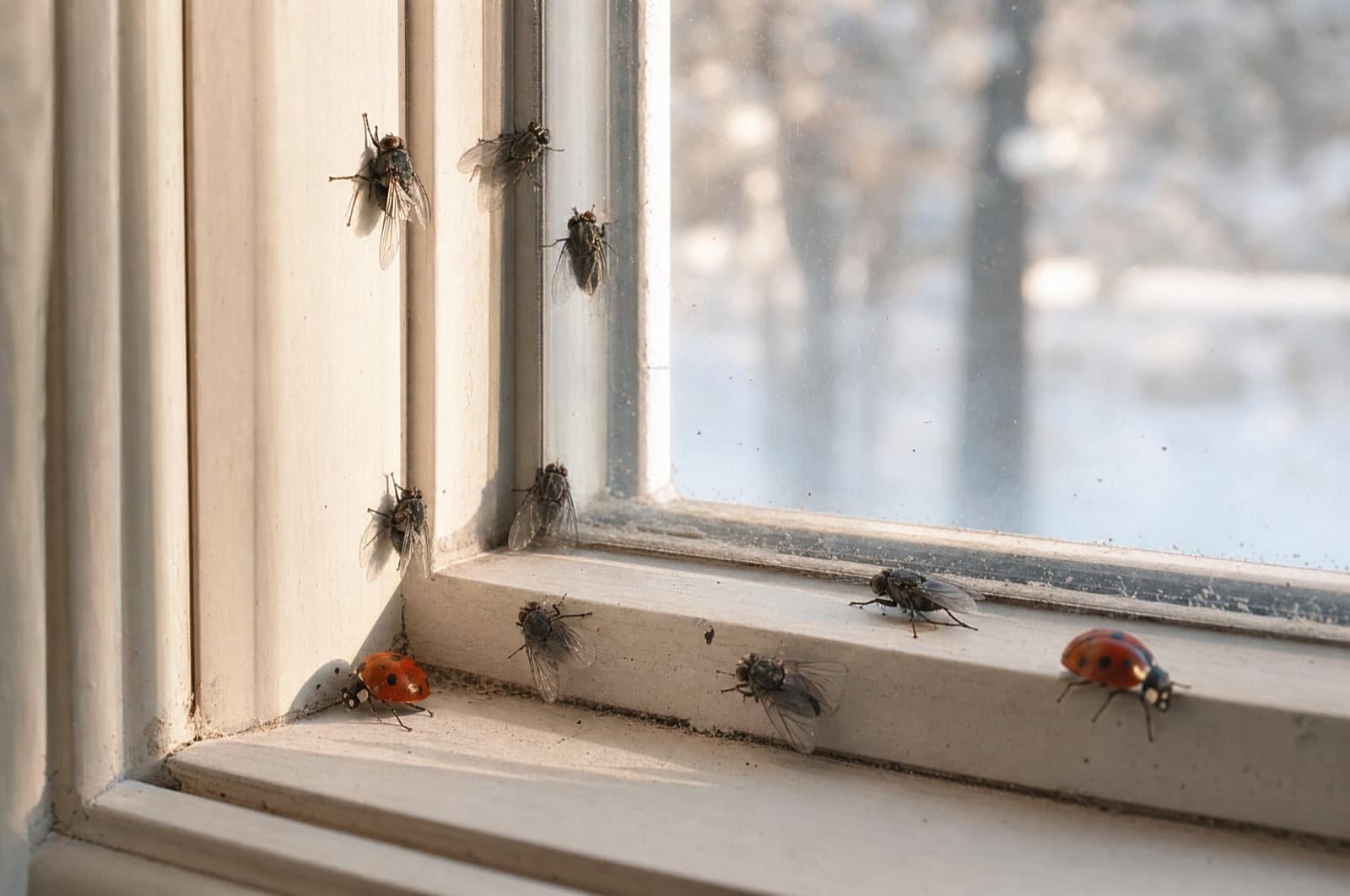
Why Do Pests Appear When I Turn On the Heating?
Flipping the thermostat does two things at once: warmth breaks dormancy in overwintering insects already inside so they start moving, and the now-warm, quiet house makes their movement — and any rodent activity — easier to see and hear.
Nuisance-level for the insects, which don't bite, breed indoors, or damage the house. If what you're hearing is scratching in the walls, that's rodents already present being revealed, which is worth investigating rather than panicking over.
At a glance
- The mechanism: Heat wakes them up
- Who fixes it: You
- The rest lives at: How do cold snaps trigger pest invasions inside homes?
Flipping the thermostat does two things at once: warmth breaks dormancy in overwintering insects already inside so they start moving, and the now-warm, quiet house makes their movement — and any rodent activity — easier to see and hear.
Nuisance-level for the insects, which don't bite, breed indoors, or damage the house. If what you're hearing is scratching in the walls, that's rodents already present being revealed, which is worth investigating rather than panicking over.
Heat doesn't spawn pests — it changes what you notice
The season and the building set the stage before the thermostat ever comes on. Here's the honest chain of events, spelled out.
What's really happening
The heat comes on, which warms the harborage where overwintering insects have been dormant since fall — cluster flies, lady beetles, boxelder bugs, and stink bugs wake up and move toward light and warmth, appearing in rooms. At the same time, the warm, quiet house makes existing rodent scratching and movement newly audible. University of Minnesota Extension notes that brown marmorated stink bugs already inside a home 'on warm days or when we turn up the thermostat… sometimes can be seen' — the insects and rodents predate the thermostat change; the heat just reveals and activates what was already there.
Source:University of Minnesota Extension— Brown Marmorated Stink Bug — become visible on warm days or when the thermostat is turned up
Is this an HVAC problem or a pest problem?
Who actually fixes it
You
Visible overwintering insects are a homeowner cleanup job — vacuum or sweep them up, no chemicals needed.
You hear rodents in the walls or see recurring activity — that's a pest professional's job. If the scratching localizes near ducts or wiring, or you suspect gnawing, bring in an HVAC technician, or a licensed electrician for any active electrical concern.
This hub owns the heating-system angle
General winter behavior, rodent control, and equipment-damage severity live in siblings that already earn them. Here's exactly where.
This page owns the 'when I turn on the heat' timing question. General winter pest appearance belongs to our winter pests FAQ, and what rodent sounds in the walls mean for control belongs to our mice & rats FAQ.
How this calibrates for NH
The New Hampshire ritual of turning on heat at the first hard cold, often October through November, coincides with peak fall rodent migration and the tail end of the fall insect invasion — which is exactly why 'I turned on the heat and suddenly saw pests' is such a common report across the state.
NH-licensed applicator #782664 (NHDAMF, RSA 430) · NEPMA member · family-owned since 2017.
Frequently asked
Sources(3)
- [1]University of Minnesota Extension
Brown Marmorated Stink Bug — visible on warm days or when the thermostat is turned up
- [2]UNH Cooperative Extension
Cluster Flies fact sheet — particularly noticeable on warm winter days when they become active
- [3]University of Kentucky Entomology
ENTFACT-617, "Control of Mice" — noticed in winter following fall migration indoors
Written & reviewed by
VerifiedDaniel Brady
NH-Licensed Pesticide Applicator · License #782664 (NHDAMF, RSA 430)
Daniel Brady is the New Hampshire–licensed applicator behind Anchor Pest Services, a family-owned pest control company serving the Manchester area since 2017.
Anchor Pest Services
Have a different pest question?
This one may be an HVAC call, not a pest job — but if you're facing something that is, we serve Southern New Hampshire with a free inspection and same-day service.
- NH-licensed applicator
- Same-day service
- Pet & family-conscious
NH License #782664 · No obligation · We answer in person