
How to Use CB-80 Aerosol Insecticide by FMC
At a glance
- Efficacy: Situational
- Best job: Instant knockdown and flushing pests out of harborage — including in food-handling areas where a lasting chemical residue isn't wanted
- Format: Professional pressurized aerosol with dual spray-action (mist and crack-and-crevice straw) — no mixing; the manufacturer states plainly it has no residual effect
- Technique: Moderate technique
Does this product actually work?
A real, fast knockdown-and-flushing tool for a narrow job — situational because it deliberately offers zero lasting control.
Pyrethrins deliver a fast, natural flushing and knockdown action, which is exactly why professionals use CB-80 as a diagnostic tool — it drives roaches and other pests out of hiding so you can find and treat the actual harborage. But the same fast-degrading chemistry that makes it safe for food-handling sites means it leaves nothing behind: the population it doesn't directly hit rebounds on its own schedule. Grade it honestly as a situational specialty tool — genuinely useful for knockdown and flushing, genuinely the wrong tool if you're expecting a lasting barrier.
Best for
Fast knockdown of exposed insects and flushing pests out of cracks and harborage so you can see and target where they're hiding, including in food-handling or sensitive areas where you don't want a lasting residue.
Skip it for
Anyone wanting ongoing protection between treatments, or expecting one application to solve a population — it has no residual effect by design.
What it is — and what it's really for
The label is the law. Here's the honest read on the format, the one job it does well, and the job people wrongly buy it for.
The technique walkthrough
Where DIY succeeds or fails is in the placement, patience, and the small pro moves the label never mentions. Follow the label; these are the technique details on top of it.
The correct technique depends on which job you're using it for — a sealed-room space treatment or a targeted crack-and-crevice flush — and either way, a follow-up plan is what separates a useful application from a one-time knockdown with no lasting effect.
Decide: space treatment or crack-and-crevice flush
For a space treatment, close windows, doors, and shut off HVAC/fans in the room; for crack-and-crevice flushing, skip sealing the room and go straight to targeted application with the straw.
Common mistakeSpraying into open air in an unsealed room expecting a space-treatment effect — the plume dissipates before it can knock anything down.For space treatment: apply in a sweeping motion per label timing
With the room sealed, apply in the sweeping pattern and duration the label specifies, then leave the space closed briefly before ventilating.
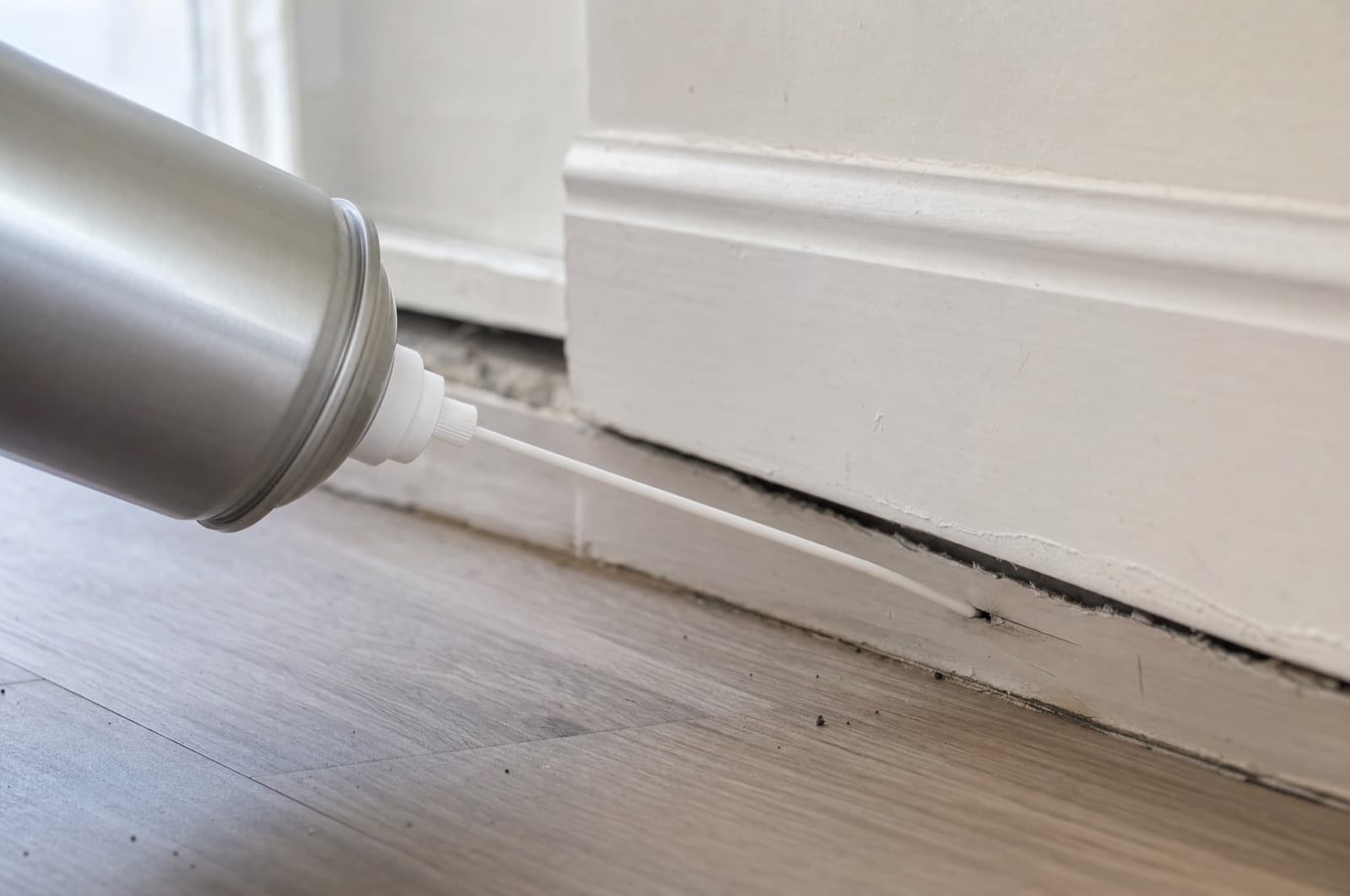
For crack-and-crevice flushing: direct the straw into harborage
Aim the spray into cracks, behind sinks and cabinets, along baseboards, and around drains and plumbing to drive hidden insects into the open where you can see and target the actual harborage.
Pro moveUse CB-80 as a diagnostic flush — it drives hidden roaches out so you can locate exactly where they're harboring, then treat those specific spots with a residual product.Ventilate thoroughly and sweep up
After the labeled wait time, ventilate the space completely before re-entry and sweep or vacuum up fallen insects.
CautionExit the area during a space treatment and keep kids and pets out until it's fully ventilated.Follow up with a residual product or bait
Because CB-80 leaves nothing behind, treat harborage you identified during the flush with a residual insecticide or an appropriate bait for lasting control.
Common mistakeTreating CB-80 as a stand-alone solution — with zero residual, it kills what's present now and does nothing for what shows up tomorrow.
Do & don't
- Use it for fast knockdown or to flush pests out of harborage you can then target.
- Seal the room for a space treatment; skip sealing for a crack-and-crevice flush.
- Ventilate thoroughly and sweep up fallen insects afterward.
- Follow up with a residual product or bait for any lasting control.
- Don't expect any lasting protection — there is none by design.
- Don't rely on it alone for an ongoing pest problem.
- Don't spray into open air in an unsealed room and expect a space-treatment result.
- Don't skip ventilation before re-entry.
Where it works vs. where it fails
No product fixes everything. This is the honest boundary — the situations it genuinely handles, and the ones it simply won't.
Where it works
- You need fast knockdown of exposed flying or crawling insects right now
- You want to flush hidden roaches or other pests out of harborage to locate the actual problem area
- You're in a food-handling or other sensitive area where a lasting chemical residue isn't wanted
- You're doing a pre-inspection flush before deciding where to place a residual treatment or bait
Where it fails
- You want lasting protection between applications — there is none
- The population is established and reproducing somewhere the flush doesn't reach
- You're using it as a stand-alone fix instead of pairing it with a residual product or bait
- You expect a single treatment to solve an ongoing infestation
Mistakes that waste the product
Expecting residual protection
There is none — the manufacturer states this plainly, and treating it like a residual barrier means you'll be surprised when pests reappear almost immediately.
Spraying into the air in an unsealed room
Without a closed space, the plume dissipates before it achieves meaningful knockdown, wasting product for a poor result.
Skipping the follow-up treatment
A flush without a plan just relocates the problem temporarily — the population that wasn't directly hit rebounds on its own schedule.
What to expect — and when
This is a knockdown-now, nothing-later tool — judge it purely on what it kills in the moment, never on how long protection lasts.
Seconds to minutes
Fast knockdown of exposed insects; flushed pests emerge from cracks and harborage into the open.
Same day
Once ventilated, the treated space has no meaningful residual left — this is by design, not a flaw.
Days after, without a follow-up
Without a residual product or bait applied to the harborage you identified, sightings return on the population's own schedule.
When to stop DIY & call a pro
A zero-residual flush is a specialty tool, not a solution — these are the honest signals you need more than a can:
You're reaching for a knockdown flush repeatedly for the same recurring activity
Repeated flushing without lasting control means the underlying population needs a residual product, bait, or an integrated professional program.
Roach sightings continue after flushing and treating identified harborage with a residual product
That points to an established population beyond what consumer-grade tools can finish.
You're using it in a food-handling or commercial setting with an ongoing pest problem
Sensitive-site pest programs typically need a licensed, integrated approach beyond a single knockdown aerosol.
Any suspected termite, carpenter-ant, or stinging-insect nest activity
A knockdown flush can't verify or eliminate a structural nest or colony — that needs professional inspection and treatment.
When knockdown and flushing aren't enough on their own, Anchor's licensed NH technicians build the residual and bait follow-through that actually finishes the job. Free inspection, same-day service across southern and central New Hampshire.
Flushed them out but they keep coming back?
Is it safe for pets & kids?
The short version lives here; the full per-species verdict lives on this product's pet-safety page.
This is a petroleum-distillate pyrethrin/PBO aerosol used as a space or crack-and-crevice treatment — exit during a space treatment, keep kids and pets out, and ventilate thoroughly before re-entry. Never treat a suspected exposure at home.
Re-entry: Keep everyone off treated surfaces until dry and out of a space-treated room until it's fully ventilated per the label's wait time.
A flush tool, not a season-long fix, in NH homes
In southern and central New Hampshire, CB-80's genuine niche is diagnostic: flushing roaches, spiders, or occasional invaders out of a basement or kitchen so you can see exactly where the harborage is before committing to a residual treatment or bait. It won't hold the line through a full NH pest season the way a barrier or residual crack-and-crevice product will, and it isn't the right tool for carpenter ants or termites in structural wood — NH's most troublesome structural pests. Anchor Pest Services builds the residual, bait, and follow-through that actually finishes a job across Manchester, Nashua, Concord, and the surrounding towns.
Service area
Southern New Hampshire
Anchor Pest Services · NH license #782664 · NEPMA member · family-owned since 2017.
Frequently asked
Sources & further reading(4)
- [1]EPA Registered Product Label — CB-80 for Insect Control (Reg. No. 279-3393)
Verified actives (pyrethrins 0.50%, PBO 4.00%), listed target pests, space/crack-and-crevice directions, food-handling site labeling
epa_labelverified 2026-07-14 - [2]Envu — CB-80 Insecticide product page
No-residual design, dual spray-action format, labeled use sites including food-handling establishments (facts only, not the efficacy verdict)
manufacturerverified 2026-07-14 - [3]NPIC — Piperonyl Butoxide General Fact Sheet
PBO as a synergist (not itself an insecticide) that enhances pyrethrin knockdown
npicverified 2026-07-14 - [4]UC IPM — Cockroaches (Home & Landscape)
Knockdown sprays without a residual/bait follow-up will not eliminate an established population
extensionverified 2026-07-14
Written & reviewed by
VerifiedDaniel Brady
NH-Licensed Pesticide Applicator · License #782664 (NHDAMF, RSA 430)
Daniel Brady is the New Hampshire–licensed applicator behind Anchor Pest Services, a family-owned pest control company serving the Manchester area since 2017.
Last updated July 2026
Related products in this category
Same shelf, different jobs — the dot shows each product's honest efficacy verdict at a glance.
Professional Pest Control
When a Flush Isn't a Fix
CB-80 finds where pests hide; it can't keep them from coming back on its own. Anchor Pest Services builds the residual and bait follow-through that actually finishes the job across southern and central New Hampshire. Family-owned since 2017, NH license #782664.
- Targeted, lasting source treatment
- NH-licensed applicators (#782664)
- Free inspection — same-day service across southern NH
NH License #782664 · No obligation · We answer in person
Your next step
- Book a NH pro
Pest Control Services
Licensed, family-owned pest control across southern NH.
Book now - What to do next
Is CB-80 Aerosol Insecticide Safe for Pets?
Read the answer - What to do next
Is D-Force Insecticide Aerosol Spray Safe for Pets?
Read the answer - Also relevant
Is CB-80 Aerosol Insecticide Safe for Pets?
Read the answer - Also relevant
Chemical Control for Roaches, Silverfish, Crickets & Termites
Read the answer - Related guide
How to Use Cy-Kick Aerosol Insecticide Spray by BASF
Read the answer