
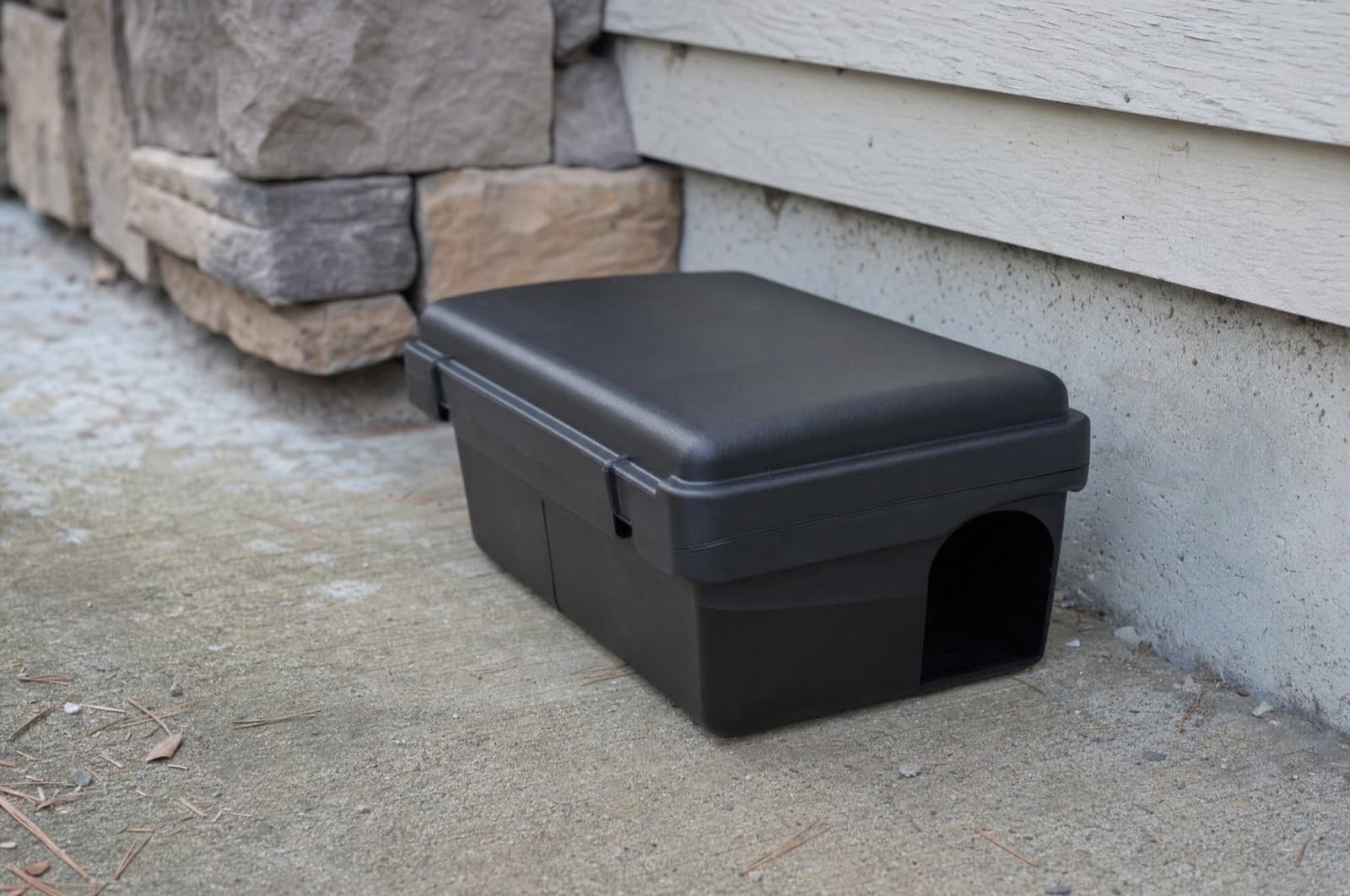
How to Use the d-CON Refillable Mouse Bait Station
At a glance
- Efficacy: Situational
- Best job: Housing a child/pet-resistant bait for light-to-moderate mouse pressure in a home where loose bait is unacceptable
- Format: Reusable, tamper-resistant plastic bait station with a see-through inspection window that holds a replaceable cholecalciferol bait block or soft bait; labeled for house mice
- Technique: Easy technique
Does this product actually work?
A legitimate, tamper-resistant option for light mouse pressure — not a fix for rats or an infestation that's already established.
Placed flush against the wall on real runway evidence and deployed in multiples rather than one station for a whole house, the current d-CON Refillable Bait Station is a legitimate, tamper-resistant way to reduce a light mouse population using cholecalciferol (Vitamin D3) — not the legacy anticoagulant many people still assume it contains. But bait is slower and carries more collateral handling risk than a well-placed snap trap for a handful of mice, and the station does nothing about the entry point. Without sealing gaps and removing competing food, new mice simply replace the ones that feed.
Best for
A homeowner who wants a child/pet-resistant, low-mess bait station for a few mice and won't handle snap traps.
Skip it for
Rats, or any established/recurring infestation — a station alone doesn't address why mice keep getting in.
What it is — and what it's really for
The label is the law. Here's the honest read on the format, the one job it does well, and the job people wrongly buy it for.
The technique walkthrough
Where DIY succeeds or fails is in the placement, patience, and the small pro moves the label never mentions. Follow the label; these are the technique details on top of it.
This is an easy device to set out and a slightly less obvious one to place correctly — the whole result hinges on evidence-based placement and patience, not on how much bait you load.
Inspect before you place anything
Walk the interior perimeter and look for droppings, gnaw marks, and greasy rub marks along walls — these mark the actual runways mice use, not where you'd guess.
Pro moveCheck behind and under large appliances (stove, fridge, washer/dryer) first — they're the most common indoor harborage/runway junctions.Set the station flush against the wall
Place the station with its entry holes parallel to the baseboard, tight against the wall, in the dark corners where you found evidence.
Common mistakePlacing it in the middle of a room or open floor space — mice rarely cross open floor, so an out-of-runway station sees little to no traffic regardless of the bait inside.Use several stations, not one
Because house mice rarely range more than a few feet from their nest or food source, deploy multiple stations spaced along the runways you identified rather than expecting one station to cover the whole house.
Pro moveSpace stations roughly 6-12 feet apart along active runways rather than clustering them in one spot.Don't move it once mice are feeding
Once you see chew marks through the inspection window, leave the station exactly where it is — relocating it resets the mice's acceptance of it.
Common mistakeMoving the station after a few days of no visible activity, before mice have had a real chance to encounter it.Refill and monitor
Wearing gloves, replace the bait block or soft bait when it's consumed. Use the see-through window to confirm actual feeding rather than assuming the station is working.
CautionWear gloves when handling bait and never touch it with bare hands.Seal entry points alongside baiting
Locate and close the gaps mice are using to get in — a station controls mice already inside, it doesn't stop the next one from entering.
Pro moveMice can enter through openings about the size of a dime (roughly 1/4 inch); check foundation gaps, utility penetrations, and door sweeps.
Do & don't
- Place flush against walls, entry holes parallel to the baseboard.
- Deploy several stations along evidence-based runways, not one for the whole house.
- Verify feeding through the inspection window before assuming it's working.
- Wear gloves when refilling.
- Pair baiting with sanitation and exclusion.
- Don't set it in the open middle of a room.
- Don't move it repeatedly once mice are feeding.
- Don't rely on it for rats — it's a mouse-labeled product.
- Don't expect overnight results — cholecalciferol works over days.
- Don't leave competing food (pet food, spilled birdseed) out nearby.
Where it works vs. where it fails
No product fixes everything. This is the honest boundary — the situations it genuinely handles, and the ones it simply won't.
Where it works
- Mouse activity is light and recent, with evidence you can trace to specific runways
- The household wants a child/pet-resistant station instead of loose bait or a snap trap
- You're willing to also seal entry points and remove competing food alongside baiting
- The population is small enough that a handful of stations, correctly placed, is realistic to monitor
Where it fails
- Rats are present — this is a mouse-specific format and won't control them
- The infestation is established or recurring — a station reduces the mice present but won't fix the entry point letting new ones in
- An ongoing food source (pet food, birdseed spillage, unsecured garbage) keeps competing with the bait
- The station is placed in the open or moved before mice have accepted it
Mistakes that waste the product
Placing the station in open floor space
Mice travel along edges and rarely cross open floor, so the station never gets encountered regardless of bait quality.
Leaving competing food out
Easier, unsecured food sources beat any bait, so mice ignore the station entirely.
Using one station for the whole house
House mice have tiny home ranges, so a single station misses most of the runways where they're actually active.
Skipping exclusion work
Without sealing entry points, new mice keep replacing the ones the bait removes, and activity never fully stops.
What to expect — and when
Cholecalciferol works over days, not hours — judge this product on a declining trend in sign, not an immediate stop.
First few days
Mice locate and begin feeding on the station if it's placed correctly on an active runway; check the inspection window for chew marks.
Several days to about a week
Visible decline in droppings, gnawing, and sightings as feeding mice are removed from the population.
Ongoing
Activity should taper off and stay down if entry points are sealed and competing food is removed.
When to stop DIY & call a pro
A refillable station suppresses feeding mice while it stays stocked, yet an unsealed house keeps replacing them faster than bait can keep up. These are the signals the job has outgrown a DIY station:
Rodent sign continues after 2-3 weeks of correctly placed, well-monitored stations
Persistent activity despite correct placement usually means the population or the entry-point problem is bigger than homeowner-scale baiting can match.
You hear or see evidence of activity inside wall voids or other inaccessible spaces
A station can't reach rodents living in a void, and dead rodents in a wall create an odor problem beyond DIY reach.
Rats are present, not just mice
This is a mouse-labeled product; rats need a different tool and typically a professional-grade program.
Sign spans multiple rooms or floors
That pattern points to an established colony rather than a single incursion — homeowner-scale placement density and inspection depth genuinely can't match a professional program.
When bait stations alone aren't holding the line, Anchor's licensed NH technicians combine inspection, professional-grade placement density, and exclusion work to close the actual entry points — not just reduce the mice already inside. Free inspection, same-day service across southern and central New Hampshire.
Still seeing mice despite correct baiting?
Is it safe for pets & kids?
The short version lives here; the full per-species verdict lives on this product's pet-safety page.
Cholecalciferol has no simple antidote, so primary ingestion by a pet or child is the main hazard here — keep the tamper-resistant station out of reach and never pry bait loose by hand. Secondary poisoning (a pet eating a dead or dying rodent) appears lower-risk than with second-generation anticoagulant baits, but it isn't zero, so treat any dead rodent you find as a hazard too.
Re-entry: Keep the station's bait compartment closed and out of reach of children and pets at all times, not just during application.
Mouse pressure timing in New Hampshire
In southern and central New Hampshire, house mice overwinter indoors rather than perishing in the cold, so a home that fed one mouse in autumn will keep feeding more until the gaps are closed. Placing refillable stations along evidence-based runways and pairing them with fall exclusion work gets ahead of that cycle instead of chasing it after mice are established. Anchor Pest Services treats both the population and the entry points across Manchester, Nashua, Concord, and the surrounding towns.
Service area
Southern New Hampshire
Anchor Pest Services · NH license #782664 · NEPMA member · family-owned since 2017.
Frequently asked
Sources & further reading(7)
- [1]EPA — Restrictions on Rodenticide Products
EPA's 2008 risk-mitigation decision moving consumer rodenticides off second-generation anticoagulants by 2015
govverified 2026-07-14 - [2]EPA — Mouse and Rat Poisons in Pellet Form Being Voluntarily Cancelled
Consumer rodenticide reformulation context following EPA action
govverified 2026-07-14 - [3]Pet Poison Helpline — d-CON Rodenticide Ingredient Changes to Vitamin D3
Confirmation that current consumer d-CON uses cholecalciferol (Vitamin D3), not a legacy anticoagulant
independentverified 2026-07-14 - [4]Purdue University Veterinary Teaching Hospital — Rodenticide Revolution
Cholecalciferol mechanism (calcium metabolism disruption) and lack of a simple antidote versus anticoagulants
academicverified 2026-07-14 - [5]d-CON Products — Refillable Bait Station
Product format, reusability, and station design facts (facts only, not the efficacy verdict)
manufacturerverified 2026-07-14 - [6]University of Missouri Extension — Controlling House Mice (G9444)
House mouse home-range/runway behavior and correct trap/station placement principles
extensionverified 2026-07-14 - [7]CDC — Seal Up! Rodent Control Guidance
Exclusion as the long-term fix alongside bait/trap population reduction
govverified 2026-07-14
Written & reviewed by
VerifiedDaniel Brady
NH-Licensed Pesticide Applicator · License #782664 (NHDAMF, RSA 430)
Daniel Brady is the New Hampshire–licensed applicator behind Anchor Pest Services, a family-owned pest control company serving the Manchester area since 2017.
Last updated July 2026
Related products in this category
Same shelf, different jobs — the dot shows each product's honest efficacy verdict at a glance.
Professional Pest Control
When Bait Stations Alone Aren't Enough
A bait station reduces the mice already inside, but it can't seal the gap letting the next ones in. Anchor Pest Services combines inspection, professional placement density, and exclusion to close the source across southern and central New Hampshire. Family-owned since 2017, NH license #782664.
- Inspection + exclusion, not just bait placement
- NH-licensed applicators (#782664)
- Free inspection — same-day service across southern NH
NH License #782664 · No obligation · We answer in person
Your next step
- Book a NH pro
Rodent Control in New Hampshire
Mice and rats move indoors every fall. We trap, seal entry points and keep them out.
Book now - Book a NH pro
Pest Control Services
Licensed, family-owned pest control across southern NH.
Book now - What to do next
Is d-CON Refillable Mouse Bait Station Safe for Pets?
Read the answer - What to do next
Is d-CON Corner Fit Mouse Poison Bait Station Safe for Pets?
Read the answer - Also relevant
Is d-CON Refillable Mouse Bait Station Safe for Pets?
Read the answer - Also relevant
Chemical Rodent Control: Rodenticides, Risks & the Rules
Read the answer