
How to Use Gold Roach Spray by Bengal
At a glance
- Efficacy: Workhorse
- Best job: Injecting a dry, non-wetting knockdown-plus-IGR combination deep into cracks and voids behind walls, where wet sprays can't travel as far
- Format: Ready-to-use dry-propellant aerosol with an extension tube — no mixing, doesn't wet surfaces
- Technique: Moderate technique
Does this product actually work?
A genuine workhorse for dry crack-and-crevice knockdown plus long-tail IGR suppression — not a standalone cure for an infestation already established.
The dry propellant is a real technique advantage — it penetrates cracks and travels behind walls without wetting the surface, and the pyriproxyfen IGR meaningfully suppresses reproduction over months, a genuine edge over a plain contact aerosol. But permethrin is still a repellent pyrethroid: heavy or careless application scatters roaches and can undercut a bait program, and university IPM guidance is consistent that sprays alone won't eliminate an established cockroach population.
Best for
Injecting a dry, no-wetting insecticide-plus-IGR combo deep into cracks, voids, and harborage around plumbing, cabinets, and baseboards.
Skip it for
Expecting the can alone to end a heavy German-roach infestation without sanitation and, ideally, a gel-bait program running alongside it.
What it is — and what it's really for
The label is the law. Here's the honest read on the format, the one job it does well, and the job people wrongly buy it for.
The technique walkthrough
Where DIY succeeds or fails is in the placement, patience, and the small pro moves the label never mentions. Follow the label; these are the technique details on top of it.
This can rewards patience and precision — inject into the crack, don't fog the surface, and let the dry propellant do the work of reaching deep behind the wall.
Locate the harborage, not just the roach
Find where roaches actually hide — under and behind sinks (especially where pipes enter the wall), beneath appliances, and behind cabinets — before you spray anything.
Pro moveCheck damp, dark areas near a water source first — that's where German roaches concentrate.Common mistakeSpraying only where you saw a roach cross open floor — that's not harborage.Insert the extension tube into the crack
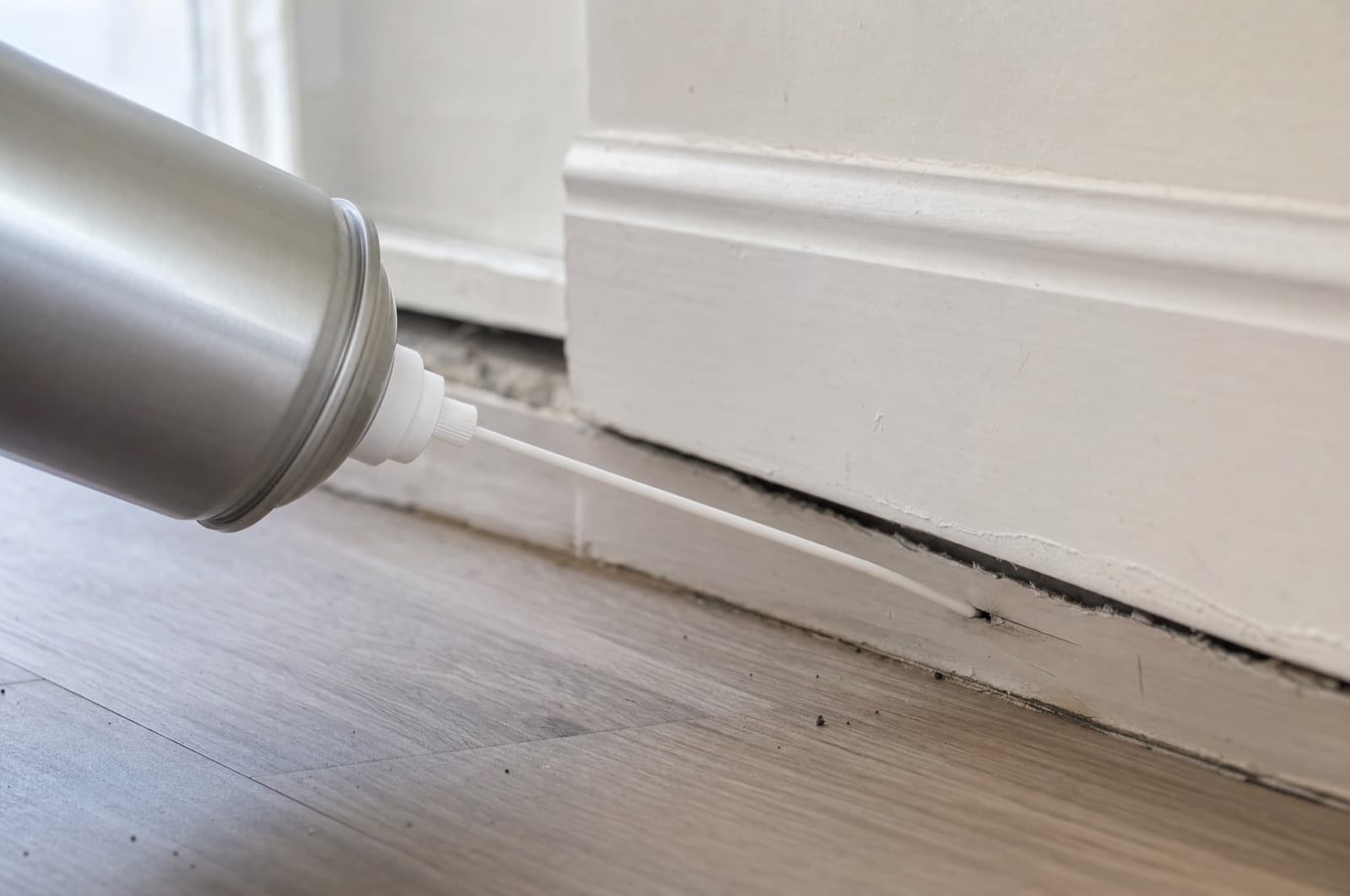
Fit the tube into the crack or crevice you're targeting so the dry spray discharges inside the void, not on the open surface.
Inject, don't fog
Trigger a short burst so the dry propellant carries the active ingredient back into the void and behind the wall — this is the technique advantage a dry-propellant can gives you over a wet spray.
Pro moveExploit the dry propellant: aim into cracks around pipe penetrations and let it travel where a wet spray physically can't reach.Common mistakeFogging open surfaces or over-applying — permethrin's repellency scatters roaches and wastes the IGR's slower-acting benefit.Keep it out of bait zones
If you're also using a gel or liquid bait for roaches or ants, treat spray zones and bait zones as separate territory.
CautionNever spray this can over or near a bait placement — the repellent residue drives roaches away from the bait.Let it dry and be patient with the IGR
Allow treated cracks to dry undisturbed. The permethrin's knockdown is fast, but the pyriproxyfen IGR needs weeks-to-months of contact with the population to fully suppress reproduction.
CautionKeep kids and pets out until dry and vapors clear; Bengal advises extra caution around cats.
Do & don't
- Inject into cracks, crevices, and voids with the extension tube
- Target harborage near moisture and pipe penetrations
- Pair with sanitation to remove competing food sources
- Let the IGR work over weeks — don't judge it on day one
- Don't fog open surfaces or broadcast-spray
- Don't spray over or near a gel or liquid bait
- Don't over-apply chasing instant results
- Don't treat food-prep surfaces
Where it works vs. where it fails
No product fixes everything. This is the honest boundary — the situations it genuinely handles, and the ones it simply won't.
Where it works
- Roach harborage sits in dry cracks, voids, and pipe penetrations the extension tube can reach
- You want reproduction suppression alongside contact knockdown (the IGR advantage)
- A handful of visible roaches or ants need fast knockdown
- Entry cracks around plumbing need targeted treatment
Where it fails
- A heavy, established German-roach population needs to be eliminated by the can alone, without sanitation or baiting
- Harborage is damp or gets disturbed (both the dry residual and the IGR work best undisturbed)
- It's used as a broadcast spray expecting a surface barrier
- The population has already outlasted diligent crack-and-crevice treatment
Mistakes that waste the product
Over-spraying or fogging open surfaces
Permethrin's repellency scatters roaches away from the treated area and wastes the IGR's slower, more valuable reproduction-suppressing effect.
Spraying near a gel or liquid bait
The repellent residue drives roaches away from bait they'd otherwise carry back to the colony, undercutting the bait's colony-level kill.
Skipping sanitation
Roaches keep breeding on available food and water even while the IGR is suppressing some reproduction — sanitation removes the competition.
Judging the product after a few days
The IGR's reproduction-suppression effect builds over weeks to months, not overnight — early impatience leads to unnecessary re-treatment.
What to expect — and when
This is a two-speed product: fast contact knockdown today, slow reproduction suppression over the following months — judge each on its own timeline.
Minutes after application
Direct contact knocks down roaches and other listed insects quickly.
First 1-2 weeks
Fewer visible roaches as the residual in treated cracks keeps working and the IGR begins affecting the developing population.
Weeks to months
The pyriproxyfen IGR continues suppressing reproduction in treated voids — full population decline is gradual, not overnight, and depends on thorough harborage coverage.
When to stop DIY & call a pro
The dry spray plus IGR combination is one of this hub's stronger aerosols, but it still has a ceiling. These are the honest signals it's been reached:
Roaches persist after diligent, harborage-focused crack-and-crevice treatment
An established German-roach population combines behavioral and physiological resistance that a consumer aerosol, even with an IGR, can't reliably overcome alone.
You're seeing roaches during the day
Daytime sightings typically mean the hidden population has grown large enough to push individuals out of harborage — a sign of an infestation beyond spot treatment.
The problem is in a multi-unit building
Roaches migrate between shared walls and units; individual treatment can't control a building-wide population.
You see large black ants indoors or moisture-damaged wood
Those point to carpenter ants nesting in structural wood — a wood-destroying pest that needs professional inspection, not a spot spray.
When crack-and-crevice treatment isn't holding the line, Anchor's licensed NH technicians identify and treat the actual harborage and colony with targeted professional methods. Free inspection, same-day service across southern and central New Hampshire.
Roaches still active after careful crack treatment?
Is it safe for pets & kids?
The short version lives here; the full per-species verdict lives on this product's pet-safety page.
This is a dry-propellant pyrethroid-plus-IGR aerosol; remove pets and people before spraying and keep them out until it's dry and vapors have cleared. Bengal specifically advises extra caution around cats.
Re-entry: Keep children and pets out of the treated area until fully dry and the space is ventilated.
German roaches in New Hampshire homes
German cockroaches can't survive a New Hampshire winter outside a heated structure, so an indoor sighting almost always means an established harborage inside the building, not an occasional outdoor invader. Gold Roach Spray's dry, crack-and-crevice technique suits the pipe penetrations and cabinet voids where NH roach populations concentrate, but a population that's outlasted careful treatment usually needs baiting or professional help. Anchor Pest Services treats the source across Manchester, Nashua, Concord, and the surrounding towns.
Service area
Southern New Hampshire
Anchor Pest Services · NH license #782664 · NEPMA member · family-owned since 2017.
Frequently asked
Sources & further reading(5)
- [1]US EPA, Pesticide Product Label — Bengal Dry Roach Spray (Reg. No. 68543-20)
Verified actives (permethrin, pyriproxyfen), dry aerosol format, target pest list
epa_labelverified 2026-07-14 - [2]Bengal Gold Roach Spray — Safety Data Sheet
Confirmed concentrations (permethrin 2.0%, pyriproxyfen/Nylar 0.05%), dry-propellant format facts
manufacturerverified 2026-07-14 - [3]UC IPM — Cockroaches (Home & Landscape)
Insecticide sprays alone will not eliminate an established cockroach population
extensionverified 2026-07-14 - [4]NC State Extension — Tips for Effective Ant Baiting
Spraying near or over bait contaminates and repels foragers from the bait
extensionverified 2026-07-14 - [5]NPIC — Permethrin General Fact Sheet
Permethrin pyrethroid class and contact-kill behavior
npicverified 2026-07-14
Written & reviewed by
VerifiedDaniel Brady
NH-Licensed Pesticide Applicator · License #782664 (NHDAMF, RSA 430)
Daniel Brady is the New Hampshire–licensed applicator behind Anchor Pest Services, a family-owned pest control company serving the Manchester area since 2017.
Last updated July 2026
Related products in this category
Same shelf, different jobs — the dot shows each product's honest efficacy verdict at a glance.
Professional Pest Control
When a Can Isn't Enough
A dry-spray-plus-IGR aerosol is a genuine step up from a plain contact can, but it still can't finish an established German-roach infestation. Anchor Pest Services treats the actual source with targeted, licensed methods across southern and central New Hampshire. Family-owned since 2017, NH license #782664.
- Targeted source treatment, not just spot spraying
- NH-licensed applicators (#782664)
- Free inspection — same-day service across southern NH
NH License #782664 · No obligation · We answer in person
Your next step
- Book a NH pro
Cockroach Control
Book now - Book a NH pro
Pest Control Services
Licensed, family-owned pest control across southern NH.
Book now - What to do next
Is Gold Roach Spray by Bengal Safe for Pets?
Read the answer - What to do next
Is Raid Ant & Roach Killer Spray Safe for Pets?
Read the answer - Also relevant
Is Gold Roach Spray by Bengal Safe for Pets?
Read the answer - Also relevant
Chemical Control for Roaches, Silverfish, Crickets & Termites
Read the answer