
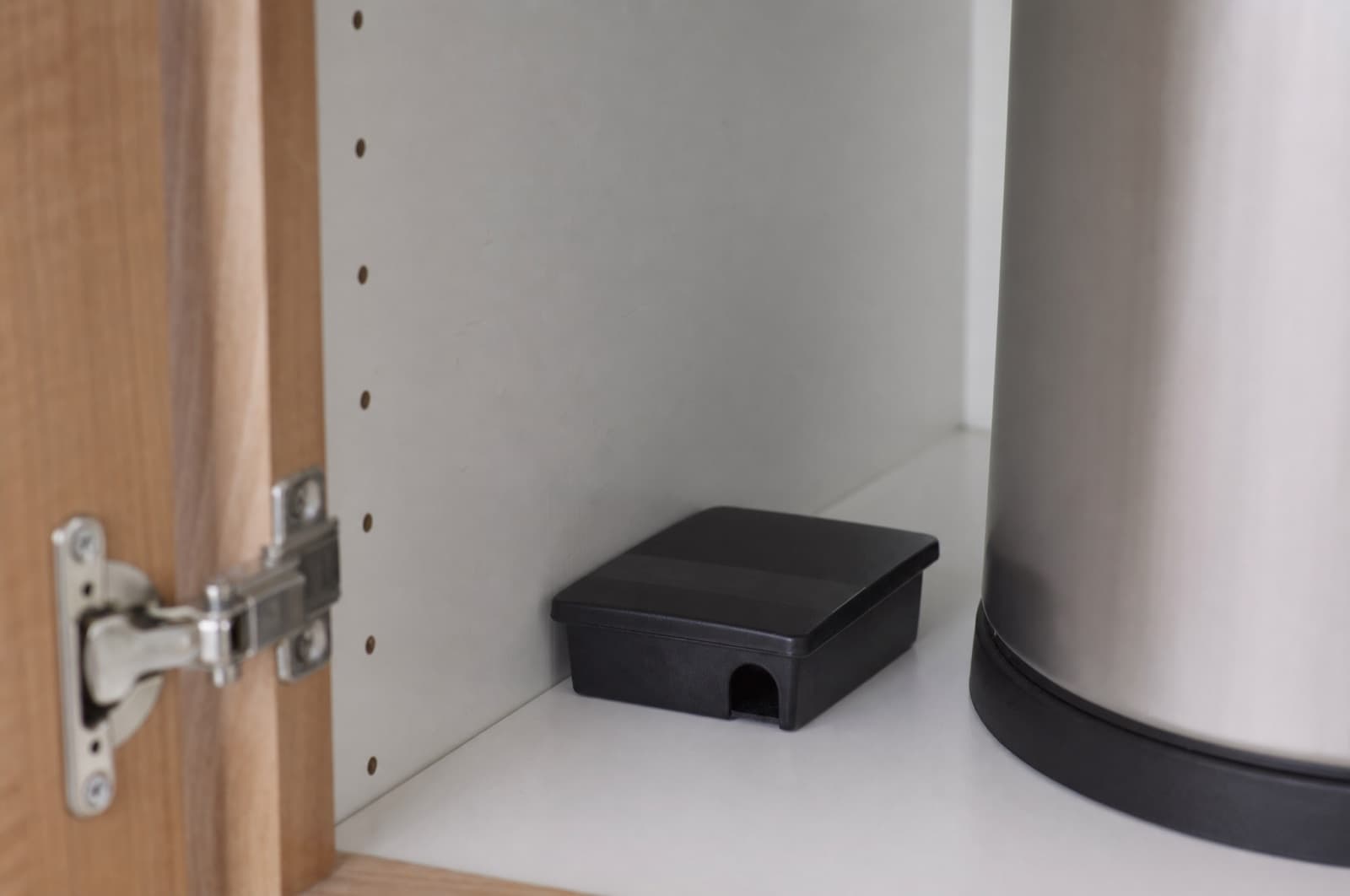
How to Use MaxAttrax Roach Bait by Hot Shot
At a glance
- Efficacy: Workhorse
- Best job: Colony-level reduction of light-to-moderate small-roach activity when many stations are deployed at confirmed harborage
- Format: Enclosed roach bait station (break-apart multi-pack) with stick-up tape for vertical placement
- Technique: Easy technique
Does this product actually work?
A workhorse for light-to-moderate roach pressure — the ceiling is placement density, not the chemistry.
Baiting is the approach university IPM actually recommends over sprays for roaches — UC IPM states plainly that 'insecticide sprays alone will not eliminate cockroaches.' Indoxacarb is bioactivated once inside the insect and transfers through the population as roaches consume contaminated feces and carcasses, the same secondary-kill mechanism that makes bait formats outperform surface sprays. Deployed correctly — many stations clustered tight to harborage, kept away from any spray or fogger — this earns the workhorse grade for light-to-moderate activity. It won't out-breed a dense, established German-roach population on its own, and a couple of stations for a whole kitchen will underperform no matter how good the chemistry is.
Best for
Knocking down light-to-moderate small/German-roach activity when many stations are deployed tight to confirmed harborage.
Skip it for
A heavy, established German-roach infestation, or large roaches (American/waterbugs) — a different pest this product isn't matched to.
What it is — and what it's really for
The label is the law. Here's the honest read on the format, the one job it does well, and the job people wrongly buy it for.
The technique walkthrough
Where DIY succeeds or fails is in the placement, patience, and the small pro moves the label never mentions. Follow the label; these are the technique details on top of it.
Density at confirmed harborage is the entire game with this bait — a couple of stations for a whole kitchen is the most common way people conclude it 'doesn't work' when the real issue is placement.
Open the pouch and use many stations
Break the stations apart and deploy a high count in the kitchen, with additional stations in bathrooms, per the label — not just a couple.
Common mistakePlacing only a station or two for an entire kitchen, which most foragers never encounter.Place at confirmed harborage
Set stations near walls, inside cabinets, under sinks and refrigerators, and in closets — anywhere roaches actually hide, not just where you've seen one cross the floor.
Pro moveCluster stations tight to confirmed harborage rather than spreading them evenly across clean rooms.Use the stick-up tape for vertical placement
Behind appliances and inside cabinets, use the included tape to fix stations vertically where roaches travel edges and undersides.
Keep sprays and foggers away
Do not use insecticide sprays or foggers near the stations — contamination repels roaches from feeding on bait they'd otherwise carry back to harborage.
CautionBait and repellent chemistry work against each other; combining them typically performs worse than baiting alone.Replace on schedule
Replace stations per the label interval, or sooner if activity is heavy or a station looks dried out, dirty, or empty.
Do & don't
- Use many stations — a high count in the kitchen, more in bathrooms.
- Cluster stations tight to confirmed harborage.
- Use the stick-up tape for vertical placement behind appliances.
- Keep sprays and foggers away from stations.
- Replace per the label interval or sooner if activity is heavy.
- Don't rely on just two or three stations for a whole kitchen.
- Don't spray insecticide near or on the stations.
- Don't place in open floor away from harborage.
- Don't leave crumbs or grease out competing with the bait.
- Don't expect it to fix a heavy, established infestation alone.
Where it works vs. where it fails
No product fixes everything. This is the honest boundary — the situations it genuinely handles, and the ones it simply won't.
Where it works
- Roach pressure is light-to-moderate and many stations are deployed tight to confirmed harborage
- Stations touch walls, corners, and vertical surfaces where roaches actually travel
- No sprays or foggers are being used nearby to contaminate the bait
- Used as prevention after a professional knockdown, or in hard-to-reach cracks and voids
Where it fails
- The infestation is dense or established — consumer baiting density can't outpace the breeding rate
- Only a couple of stations are deployed against real activity
- Sanitation is poor and competing food (crumbs, grease) beats the bait
- The roaches are actually large species (American/waterbugs) entering from outside, not small/German roaches
- Spray or fogger use nearby is contaminating or repelling the bait
Mistakes that waste the product
A couple of stations for a whole kitchen
Foragers rarely encounter a sparse deployment, so most of the harborage goes untreated while the colony keeps breeding.
Spraying insecticide near the stations
Contamination and repellent residue keep roaches from feeding on bait they'd otherwise carry back to harborage, wasting the product.
Leaving crumbs, grease, or food out
Competing food sources beat the bait for attractiveness, so roaches feed on your kitchen instead of the station.
What to expect — and when
This bait works on a colony-transfer timeline — judge it over one to two weeks, not the first evening.
Hours to a few days
Kills begin as roaches feed directly at stations placed at harborage.
Days 3-14
Meaningful population decline as secondary transfer — roaches feeding on contaminated feces and carcasses — spreads the effect through the colony.
After 2-3 weeks
Activity should be markedly reduced; persistent or unchanged activity at this point signals a population beyond what consumer baiting density can finish.
When to stop DIY & call a pro
Indoxacarb baiting relies on secondary transfer among roaches, and that chain breaks down once a German-roach population outnumbers the bait you can realistically deploy. These are the honest triggers:
Roaches are seen in daylight
German roaches are largely nocturnal; daytime sightings usually mean the harborage is overcrowded enough that individuals are being pushed into the open — a sign of an established population.
You find egg cases (oothecae) around the home
Visible egg cases point to active breeding outpacing whatever control has been applied, not a population that's declining.
Activity persists or rebounds after 2-3 weeks of correct, dense baiting
That's enough time for indoxacarb's colony-transfer effect to show; continued activity means the infestation has exceeded what consumer-density baiting can finish.
You're seeing large roaches (American/waterbugs), not small German roaches
This product targets small roaches — a different species mix often points to an outdoor entry source worth a professional inspection.
When correct, dense baiting still isn't closing the gap, Anchor's licensed NH technicians combine professional-grade baiting with harborage inspection to finish what a consumer pack can't. Free inspection, same-day service across southern and central New Hampshire.
Roaches still active after correct, dense baiting?
Is it safe for pets & kids?
The short version lives here; the full per-species verdict lives on this product's pet-safety page.
The enclosed stations keep the bait away from casual contact, but should still be kept out of reach of children and pets — the bait inside is a genuine pesticide even in a small dose.
Re-entry: No general re-entry wait is required for the enclosed stations themselves, but keep children and pets from handling, chewing, or prying one open.
Roaches in southern & central New Hampshire
German cockroaches cannot survive New Hampshire's cold outdoors — they're strictly an indoor, heat-dependent problem here, so any activity you find is coming from inside the structure rather than a seasonal outdoor population reinvading. That makes a dense, full-pack deployment of this bait especially effective in NH homes, since there's no outdoor reservoir constantly reintroducing roaches. If activity persists after correct, dense baiting, Anchor Pest Services serves Manchester, Nashua, Concord, and the surrounding towns with licensed roach treatment that reaches harborage a consumer bait pack can't fully cover.
Service area
Southern New Hampshire
Anchor Pest Services · NH license #782664 · NEPMA member · family-owned since 2017.
Frequently asked
Sources & further reading(3)
- [1]Hot Shot MaxAttrax Roach Bait — Safety Data Sheet (indoxacarb 0.10%)
Verified active (indoxacarb 0.10%), EPA registration number, and product format facts (facts only, not the efficacy verdict)
manufacturerverified 2026-07-14 - [2]UC IPM — Cockroaches (Home & Landscape)
Insecticide sprays alone will not eliminate cockroaches; baits are the university-endorsed primary control tool
extensionverified 2026-07-14 - [3]DeVries et al., BMC Public Health (2019) — cockroach bait vs. fogger field trial
Field-trial evidence that transferable bait formats substantially outperform surface sprays/foggers against German cockroaches (fipronil gel bait tested; supports the bait-mechanism reasoning generally applicable to transferable roach baits)
academicverified 2026-07-14
Written & reviewed by
VerifiedDaniel Brady
NH-Licensed Pesticide Applicator · License #782664 (NHDAMF, RSA 430)
Daniel Brady is the New Hampshire–licensed applicator behind Anchor Pest Services, a family-owned pest control company serving the Manchester area since 2017.
Last updated July 2026
Related products in this category
Same shelf, different jobs — the dot shows each product's honest efficacy verdict at a glance.
Professional Pest Control
When Consumer Bait Density Hits Its Ceiling
Indoxacarb bait stations genuinely work, but a retail pack has a density limit a heavy infestation can outgrow. Anchor Pest Services treats the harborage a consumer bait pack can't fully reach, across southern and central New Hampshire. Family-owned since 2017, NH license #782664.
- Professional-density baiting plus harborage inspection
- NH-licensed applicators (#782664)
- Free inspection — same-day service across southern NH
NH License #782664 · No obligation · We answer in person
Your next step
- Book a NH pro
Cockroach Control
Book now - Book a NH pro
Pest Control Services
Licensed, family-owned pest control across southern NH.
Book now - What to do next
Is MaxAttrax Roach Bait by Hot Shot Safe for Pets?
Read the answer - What to do next
Is Hot Shot Ultra Liquid Roach Bait Safe for Pets?
Read the answer - What to do next
Is Hot Shot Ant & Roach Plus Germ Killer Spray Safe for Pets?
Read the answer - Also relevant
Is MaxAttrax Roach Bait by Hot Shot Safe for Pets?
Read the answer