
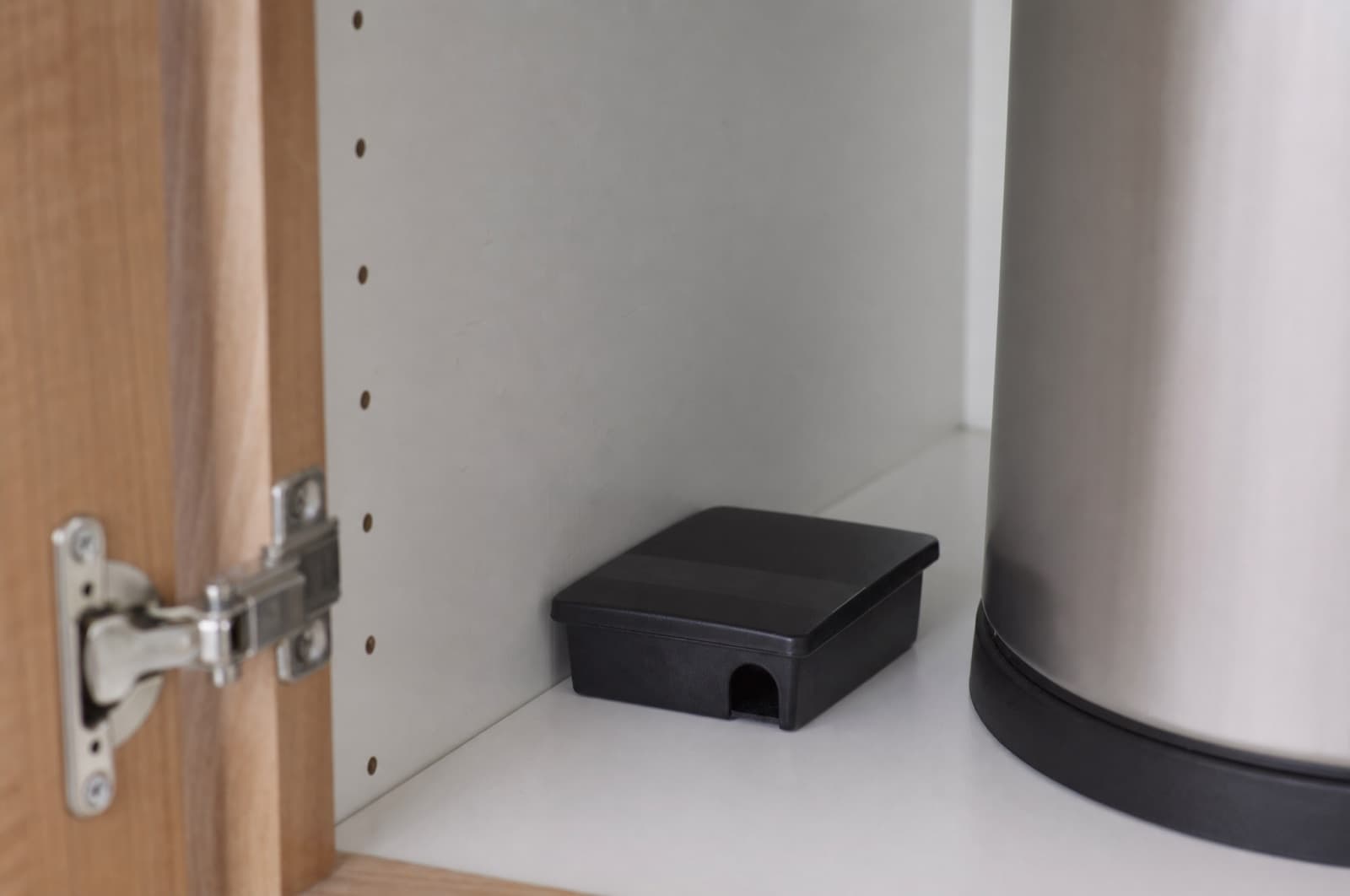
How to Use the Roach Motel Trap by Black Flag
At a glance
- Efficacy: Situational
- Best job: Detecting whether roaches are present and mapping which rooms/corners have activity
- Format: Glue monitor trap — a folded cardboard housing with a lure and adhesive interior; no pesticide
- Technique: Easy technique
Does this product actually work?
A genuinely useful detection tool that a lot of buyers mistake for a control product — it is neither.
The Roach Motel is a glue monitor, not an insecticide — the manufacturer itself says it contains no pesticide. University IPM programs use sticky traps strictly for detection and monitoring, and peer-reviewed testing shows even the best-performing glue traps vary enormously in capture rate. Used honestly — as a diagnostic tool placed in numbers along walls and corners — it earns its keep. Bought expecting it to 'solve' roaches, it will disappoint every time; that expectation gap is why we grade it situational, not weak: it's excellent at the one job it's actually built for.
Best for
Confirming whether roaches are present, finding out which corners they travel, and measuring whether a real treatment is working.
Skip it for
Eliminating an active roach infestation on its own — it removes a few foragers while the breeding population in the wall void or under the sink keeps growing.
What it is — and what it's really for
The label is the law. Here's the honest read on the format, the one job it does well, and the job people wrongly buy it for.
The technique walkthrough
Where DIY succeeds or fails is in the placement, patience, and the small pro moves the label never mentions. Follow the label; these are the technique details on top of it.
This is one of the easiest products in the hub to place and one of the most misunderstood — the technique isn't complicated, but the expectation almost always is.
Unwrap and set flat where roaches travel
Remove the trap from its wrapper and set it flat along walls, in corners, under sinks, in cabinets, and behind the refrigerator and stove — anywhere you suspect roach activity.
Pro moveRoaches hug edges and corners, not open floor — a trap in the middle of a room will sit empty even in an infested kitchen.Common mistakePlacing a single trap in an open, visible spot because that's where the roach was seen — set it at the edges instead.Place several, not one
Spread multiple traps across every suspected area — kitchen, bathroom, basement — to find the actual hot zones rather than guessing from one data point.
Pro moveDate each trap with a marker when you set it so you can track whether counts are rising or falling over time.Give it 3-4 days before judging
Let the trap sit undisturbed for three to four days. If it stays empty, move it to a new location rather than assuming there's no activity nearby.
Common mistakeChecking after one day and concluding 'no roaches' — light activity takes longer to register.Read the catch as a map, not a cure
Treat the fullest traps as pointing to the harborage that needs real treatment — that's where you concentrate gel or station baiting.
CautionA full trap means 'problem located,' not 'problem solved.'Replace and keep monitoring
Flip or discard a full trap and set a fresh one in the same spot. Keep replacing over time to track whether your baiting or professional treatment is actually reducing counts.
Common mistakeRemoving all traps once you start a real treatment — keep a few running so you can measure the change.
Do & don't
- Place several traps, not one, across every suspected area.
- Set them flat against walls, corners, and under appliances — not open floor.
- Give an empty trap 3-4 days before relocating it.
- Use traps before and after a real treatment to measure change.
- Keep them away from children and pets.
- Don't expect a trap to cure an infestation — it has no active ingredient.
- Don't spray insecticide onto or beside a trap — it can gum up the adhesive and won't add control.
- Don't handle the sticky interior with bare hands.
- Don't treat a full trap as 'problem solved' and stop there.
- Don't rely on traps as your only tactic against an active infestation.
Where it works vs. where it fails
No product fixes everything. This is the honest boundary — the situations it genuinely handles, and the ones it simply won't.
Where it works
- You want to confirm whether roaches are actually present before buying a treatment
- You're mapping which rooms or corners have the most activity
- You want a before/after read on whether gel baiting or a professional treatment is working
- You want zero-chemistry capture in a sensitive space (nursery, food-prep area) alongside real baiting elsewhere
Where it fails
- You're treating it as your only tool against an established German-roach population
- The infestation is dense enough that breeding outpaces the handful of roaches a trap can catch
- Roaches are hiding in a wall void or other harborage the trap can't reach
- Dust or humidity has degraded the glue's tack and it's no longer catching anything
Mistakes that waste the product
Setting one trap in the middle of the floor
Roaches travel edges and corners; an open-floor trap sits empty even in an infested room, giving you a false 'no activity' read.
Treating a full trap as a control plan
Capture rate is nowhere near breeding rate for an established colony — the population behind the wall keeps growing while a few individuals get caught.
Ignoring an empty trap for weeks
An empty trap in the wrong spot just means you're not seeing the activity that's actually there.
What to expect — and when
Judge this product on what it tells you, not on how many roaches disappear — that's the honest way to read it.
First 3-4 days
Initial captures if roaches are actively traveling that spot; an empty trap after this window is a signal to relocate it, not proof of a clean home.
Ongoing weeks
A rising or steady catch count across traps means the source is active or growing; a falling count after you start real baiting means the treatment is working.
Any point
Capture will plateau at 'a few individuals per check' regardless of infestation size — the trap never removes the breeding population, so plateauing catch is not the same as a resolved problem.
When to stop DIY & call a pro
Because this product only monitors, the call-a-pro signal comes from what the traps reveal, not from the traps failing:
Traps fill quickly and refill fast after replacement
Rapid, repeated catches point to an established, breeding population in harborage a trap can't reach — that needs baiting and likely professional treatment.
You see roaches in daylight
German roaches are largely nocturnal; daytime sightings usually mean the population is dense enough that individuals are being pushed out of overcrowded harborage.
Catch counts climb across successive checks
A growing trend means the colony is outpacing whatever control you've tried — monitoring data confirming an infestation, not fixing it.
You can't find or reach the harborage the traps are pointing to
An in-wall or void harborage is beyond what any consumer bait or trap can access, which is exactly the gap professional treatment closes.
When the traps do their job and show a real infestation, Anchor's licensed NH technicians find and treat the actual harborage — not just the roaches you can see. Free inspection, same-day service across southern and central New Hampshire.
Traps filling up faster than you'd like?
Is it safe for pets & kids?
The short version lives here; the full per-species verdict lives on this product's pet-safety page.
This is a non-toxic glue trap with no pesticide, so the main precaution is the adhesive itself: it's extremely sticky and traps hold dead insects, so keep it out of reach of children and pets. If fur or skin contacts the glue, work it free gently with vegetable oil rather than pulling.
Re-entry: No re-entry restriction — there's no chemical in this product, only an adhesive that should stay out of reach of curious kids and pets.
Roaches in southern & central New Hampshire
German cockroaches can't survive New Hampshire winters outdoors — they're a heat-dependent, indoor-only problem here, which means any activity you catch on a Roach Motel almost always points to an indoor harborage, not an outdoor population reinvading seasonally. That makes the trap especially useful as a year-round check: if a apartment or kitchen has been treated before, a few traps left running are a cheap early-warning system for a new introduction. If your traps keep filling, Anchor Pest Services serves Manchester, Nashua, Concord, and the surrounding towns with licensed roach treatment that finds the harborage a glue trap only points to.
Service area
Southern New Hampshire
Anchor Pest Services · NH license #782664 · NEPMA member · family-owned since 2017.
Frequently asked
Sources & further reading(4)
- [1]Black Flag — Roach Motel product page
Format (glue lure trap, no pesticide), listed target pests
manufacturerverified 2026-07-14 - [2]UC IPM — Cockroaches (Home & Landscape)
Sticky traps/glue boards are a detection and monitoring tool, not a control method
extensionverified 2026-07-14 - [3]Wang & Bennett, Environmental Entomology 35(3):765-770 (2006)
Wide variance in glue-trap capture rate (up to 78-fold) between products in choice tests
academicverified 2026-07-14 - [4]Home Depot — Black Flag Roach Motel Insect Glue Traps (HG-11020)
Placement directions, product format
manufacturerverified 2026-07-14
Written & reviewed by
VerifiedDaniel Brady
NH-Licensed Pesticide Applicator · License #782664 (NHDAMF, RSA 430)
Daniel Brady is the New Hampshire–licensed applicator behind Anchor Pest Services, a family-owned pest control company serving the Manchester area since 2017.
Last updated July 2026
Related products in this category
Same shelf, different jobs — the dot shows each product's honest efficacy verdict at a glance.
Professional Pest Control
When Monitoring Confirms a Real Infestation
A glue trap is a detection tool, not a cure — it will tell you roaches are there but can't reach the harborage where they breed. Anchor Pest Services treats the actual source with targeted, licensed methods across southern and central New Hampshire. Family-owned since 2017, NH license #782664.
- Targeted harborage treatment, not just monitoring
- NH-licensed applicators (#782664)
- Free inspection — same-day service across southern NH
NH License #782664 · No obligation · We answer in person
Your next step
- Book a NH pro
Cockroach Control
Book now - Book a NH pro
Pest Control Services
Licensed, family-owned pest control across southern NH.
Book now - What to do next
Is the Roach Motel Trap by Black Flag Safe for Pets?
Read the answer - Also relevant
Is the Roach Motel Trap by Black Flag Safe for Pets?
Read the answer - Also relevant
Chemical Control for Roaches, Silverfish, Crickets & Termites
Read the answer - Related guide
How to Use Ant & Roach Killer Spray by Black Flag
Read the answer