
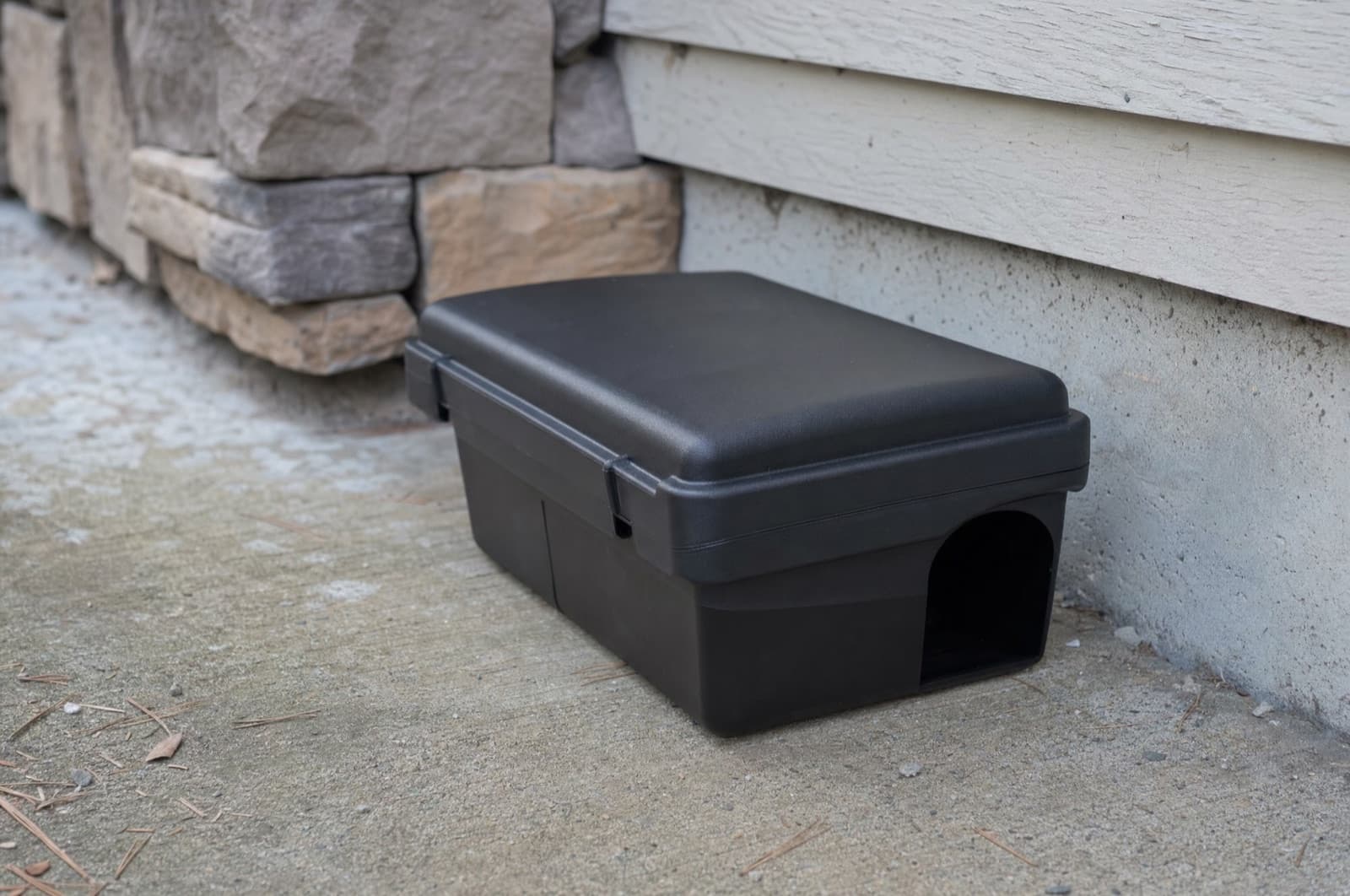
How to Use the Protecta LP Rat Bait Station
At a glance
- Efficacy: Workhorse
- Best job: Safely and legally housing rodenticide bait along rat runways, indoors or outdoors, protecting it from weather, pets, and non-target animals
- Format: Empty, triangular, low-profile tamper-resistant rat bait station with internal securing rods and a two-prong locking key — designed to hold rodenticide bait BLOX, place packs, or tracking powder (bait sold separately); it is a delivery system, not a toxicant
- Technique: Moderate technique
Does this product actually work?
A genuine workhorse — but only as a delivery system. The station itself has no active ingredient; its entire job is to house bait safely, legally, and where rats will actually feed.
A properly anchored, tamper-resistant station is the correct, label-compliant way to deploy rodenticide bait around a household with pets or children — that part of the job the Protecta LP does well. But it ships empty: the station contributes nothing until it's loaded with an appropriate bait product, secured on the interior rod so rats can't carry it off, anchored so it can't be tipped or dragged away, and placed on evidence of actual rat travel. Skip any one of those steps and the station is just an unused triangular box.
Best for
Housing a rodenticide bait block or place pack in a tamper-resistant, anchored container along rat runways, protecting non-targets and complying with label requirements.
Skip it for
Anyone expecting the empty box to kill rats by itself — it's a container. Efficacy depends entirely on what's loaded inside, how well it's anchored, and where it's placed.
What it is — and what it's really for
The label is the law. Here's the honest read on the format, the one job it does well, and the job people wrongly buy it for.
The technique walkthrough
Where DIY succeeds or fails is in the placement, patience, and the small pro moves the label never mentions. Follow the label; these are the technique details on top of it.
This is a moderate product to use well — the mechanism (anchor, secure, place) is simple, but skipping any one part is why an empty or poorly placed station 'does nothing.'
Choose and secure the bait first
Select a rodenticide bait product appropriate for the site (bait BLOX, place packs, or tracking powder) and secure it on the station's interior rod per that bait's own label — the station is only as effective as what's loaded inside it.
Common mistakeAssuming the empty station itself will do something — it's a delivery system with no active ingredient of its own.Place it flush into corners and along walls
Set the low-profile triangular unit flush into corners and along wall lines where rat sign — droppings, gnaw marks, grease rub — shows real travel; the low profile also fits under pallets and other tight spots.
Common mistakeSetting it in open floor space away from an edge — rats travel along walls and rarely cross open areas.Anchor the station
Stake or affix the station so rats can't tip or drag it off and non-target animals can't displace it — this is a label requirement, not an optional step.
Pro moveThe securing rod defeats hoarding behavior — rats that would otherwise cart off loose bait now have to feed on site, which also reduces how much bait ends up scattered where non-targets could reach it.Give rats time to accept it
Rats are strongly neophobic and will often avoid a new station in their runway for several days before feeding confidently.
Pro moveWhere feasible, pre-bait with a non-toxic bait first to build acceptance before loading the toxicant, especially in tough or wary populations.Monitor through the lock, don't open casually
Check stations regularly using the two-prong key, confirm feeding, and refill or replace bait as it's consumed — an empty or fouled station stops contributing exactly like an unloaded one.
CautionWear gloves any time you handle bait or a station that's held bait.Pair it with sanitation and exclusion
Remove competing food sources and identify how rats are entering — the station controls rats already present, not the supply line bringing new ones in.
Do & don't
- Load an appropriate bait product before expecting any result — the station is empty out of the box.
- Anchor the station so it can't be tipped, dragged, or displaced.
- Place flush into corners and along walls on real rat-runway evidence.
- Secure bait on the interior rod so rats can't carry it off.
- Give rats several days to overcome neophobia before judging the station.
- Don't expect the empty box alone to control rats.
- Don't leave it unanchored — an unsecured station can be tipped, moved, or accessed by non-targets.
- Don't place it in open floor space away from a wall or corner.
- Don't let bait run out or go stale — an empty station stops working.
- Don't skip sanitation and exclusion.
Where it works vs. where it fails
No product fixes everything. This is the honest boundary — the situations it genuinely handles, and the ones it simply won't.
Where it works
- It's loaded with an appropriate, secured bait product and anchored on real rat-runway evidence
- Multiple stations are placed at intervals along the evidence trail rather than relying on one
- The household needs a tamper-resistant, label-compliant way to deploy bait around pets, kids, or non-target wildlife
- It's paired with sanitation and an active exclusion effort
Where it fails
- It's left empty or the bait inside has run out or gone stale
- It's unanchored and gets tipped, dragged off, or displaced
- It's placed in open floor space instead of on an actual rat runway
- Rat activity is large, established, or spans multiple areas — a few stations can't outpace an established population without exclusion
Mistakes that waste the product
Treating the empty station as a finished solution
The station has no active ingredient — an unloaded unit does nothing regardless of how well it's placed or anchored.
Leaving the station unanchored
An unsecured station can be tipped, dragged off, or accessed in ways that defeat the entire point of a tamper-resistant design.
Placing it in open floor space
Rats travel along walls and corners; an open placement sees little to no traffic regardless of the bait quality.
Skipping exclusion
A station controls the rats already present, not the ones still able to get in — without sealing entry points, activity keeps recurring.
What to expect — and when
Because the station has no active ingredient of its own, its timeline is entirely borrowed from whatever bait is loaded inside — judge the station on placement and anchoring, and the bait on its own feeding timeline.
First several days
Rats often show caution around a newly placed, anchored station before feeding confidently — this is normal neophobia, not a station or bait failure.
Once feeding begins
Results track the loaded bait's own timeline (commonly first deaths around 4-5 days for many anticoagulant baits, faster for some acute actives) — the station itself doesn't accelerate or slow this.
Ongoing
Feeding sign should decline as the local population is controlled; continued or renewed activity signals new rats entering or a station running low on bait.
When to stop DIY & call a pro
Rat activity carries one of the lowest DIY ceilings in this hub. These are the signals a stationed program has reached its limit:
Rat activity in the structure at all
Confirmed rats inside a building are widely treated as a strong call-a-pro signal — rats reproduce quickly and often occupy spaces a homeowner can't fully inspect or reach.
Feeding sign continues after correct, well-anchored, well-supplied placement
Sustained activity despite proper technique points to a population or access problem beyond homeowner-scale station density.
Sign appears in multiple rooms, floors, or both indoors and outside
That spread signals an established colony and access points beyond what a few consumer-placed stations can cover.
You can't identify or seal the entry point
Without exclusion, new rats keep replacing the ones the station controls — professional inspection finds gaps homeowners often miss.
Rat activity is one of the clearest DIY ceilings Anchor sees — our licensed NH technicians run a full stationed baiting program alongside the exclusion work that actually stops the cycle. Free inspection, same-day service across southern and central New Hampshire.
Rat sign around your foundation even with stations placed?
Is it safe for pets & kids?
The short version lives here; the full per-species verdict lives on this product's pet-safety page.
The station itself ships with no active ingredient — its entire purpose is safety: keeping whatever bait you load inside it locked away from pets, kids, and non-target wildlife. Once loaded, the safety profile depends on the bait product you choose; anticoagulant baits carry secondary-poisoning risk to pets and predators that scavenge poisoned rodents.
Re-entry: Keep the station locked and anchored, out of reach, at all times, and wear gloves whenever handling bait or a station that has held bait.
Rat baiting stations in New Hampshire
Rat activity in southern and central New Hampshire tends to cluster around older foundations, farms, and dense urban blocks in Manchester and Nashua, and picks up as cooler weather pushes rats toward structures. Because the Protecta LP does nothing without the correct bait, anchoring, and placement — and because confirmed rat activity is one of this hub's strongest call-a-pro signals — Anchor Pest Services runs full stationed rat-baiting programs paired with exclusion inspections across Manchester, Nashua, Concord, and the surrounding towns.
Service area
Southern New Hampshire
Anchor Pest Services · NH license #782664 · NEPMA member · family-owned since 2017.
Frequently asked
Sources & further reading(4)
- [1]Bell Laboratories — Protecta LP product page
Triangular low-profile tamper-resistant format, internal securing rods, two-prong locking key (facts only)
manufacturerverified 2026-07-14 - [2]DoMyOwn — Protecta LP Rat Bait Station product listing
Station specifications and compatible bait formats
independentverified 2026-07-14 - [3]PMP Magazine — How to Optimize Bait Station Efficiency
Professional guidance on anchoring, placement, and monitoring practice for bait stations
independentverified 2026-07-14 - [4]Colonial Pest Control — Rats Are Neophobic
Rat neophobia and the acceptance delay for new stations
independentverified 2026-07-14
Written & reviewed by
VerifiedDaniel Brady
NH-Licensed Pesticide Applicator · License #782664 (NHDAMF, RSA 430)
Daniel Brady is the New Hampshire–licensed applicator behind Anchor Pest Services, a family-owned pest control company serving the Manchester area since 2017.
Last updated July 2026
Related products in this category
Same shelf, different jobs — the dot shows each product's honest efficacy verdict at a glance.
Professional Pest Control
When Rat Activity Needs More Than a Few Stations
A well-loaded, anchored station is the right way to deploy bait safely, but rats inside or around a structure often signal a population and entry-point problem beyond homeowner-scale placement. Anchor Pest Services runs full stationed rat programs and exclusion work across southern and central New Hampshire. Family-owned since 2017, NH license #782664.
- Professional-scale stationed rat programs
- NH-licensed applicators (#782664)
- Free inspection — same-day service across southern NH
NH License #782664 · No obligation · We answer in person
Your next step
- Book a NH pro
Rodent Control in New Hampshire
Mice and rats move indoors every fall. We trap, seal entry points and keep them out.
Book now - Book a NH pro
Pest Control Services
Licensed, family-owned pest control across southern NH.
Book now - What to do next
Is Protecta LP Rat Bait Station by Bell Laboratories Safe for Pets?
Read the answer - What to do next
Is Tomcat Refillable Bait Station for Rats Safe for Pets?
Read the answer - Also relevant
Is Protecta LP Rat Bait Station by Bell Laboratories Safe for Pets?
Read the answer - Also relevant
Chemical Rodent Control: Rodenticides, Risks & the Rules
Read the answer