
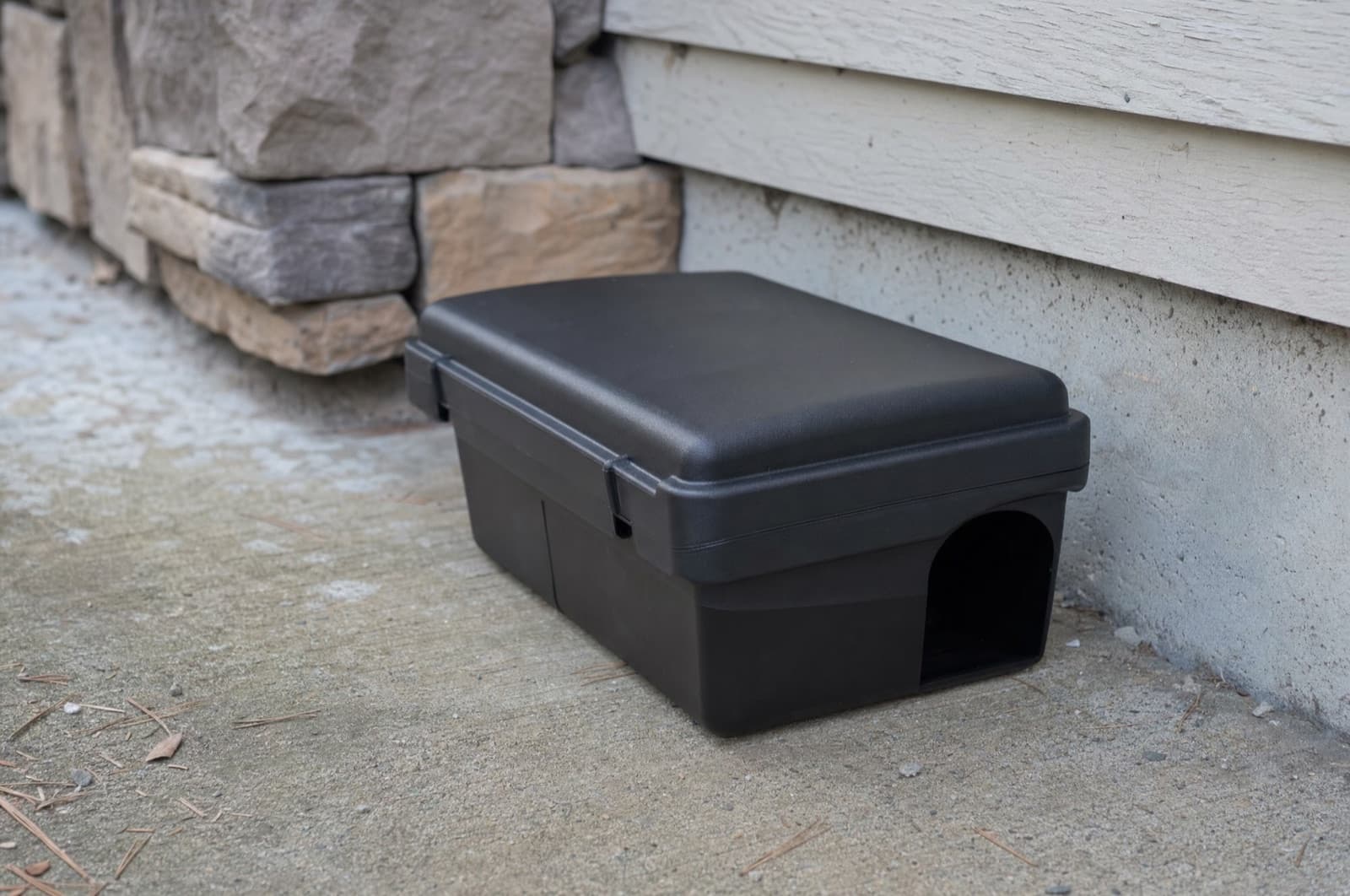
How to Use the Victor Tin Cat Live Mouse Trap
At a glance
- Efficacy: Situational
- Best job: Catching multiple mice alive without poison or a kill mechanism, for households that want the lowest-collateral mouse option available
- Format: Multi-catch live (no-kill) metal mouse trap (model M310S) — a curiosity-driven, one-way entry mechanism that can hold several mice per set; no bait strictly required, though a small dab helps
- Technique: Easy technique
Does this product actually work?
A genuinely low-collateral option for mice — but its value depends entirely on how often you're willing to check it, and what you plan to do with a live mouse afterward.
The Tin Cat exploits real mouse curiosity — its one-way entry can capture several mice per set with no bait strictly required, and it's arguably the lowest-handling-risk format in this cluster since there's no poison and no kill bar. But a live trap is only as humane as how often it's checked: a mouse left inside can die of stress or dehydration within a day or two, and New Hampshire regulates the relocation of wildlife, so releasing a captured mouse elsewhere isn't automatically a simple or legal fix. It's a real, honest alternative to poison and snap traps, not a superior one — it trades mechanism-related risk for a welfare and follow-through commitment.
Best for
Catch-and-monitor mouse capture in homes that specifically want to avoid poison and a kill mechanism, and that will check the trap at least daily.
Skip it for
Rats, an established or large infestation, and anyone who can't commit to frequent checks or hasn't confirmed current relocation guidance.
What it is — and what it's really for
The label is the law. Here's the honest read on the format, the one job it does well, and the job people wrongly buy it for.
The technique walkthrough
Where DIY succeeds or fails is in the placement, patience, and the small pro moves the label never mentions. Follow the label; these are the technique details on top of it.
This is an easy trap to set out and a genuinely different one to use responsibly — the mechanism takes no skill, but the welfare and follow-up commitment is the whole story.
Place it flush against the wall, entrance parallel
Set the trap flush against the wall with the entrance running parallel to the baseboard, directly on an active runway marked by droppings, gnaw marks, or grease rub.
Common mistakePlacing it perpendicular or away from the wall — mice follow edges, and an out-of-runway or misoriented trap sees little traffic.Add a small dab of bait (optional)
The trap works on mouse curiosity and doesn't strictly require bait, but a pea-sized dab of peanut butter in the well can improve catch rates.
Use multiples along the runway
Because house mice have small home ranges, place more than one unit along the evidence trail rather than relying on a single trap to cover the whole house.
Check it very frequently
Check the trap at least once a day, and more often if possible — this is the single non-negotiable rule for using a live trap responsibly.
Pro moveCheck first thing in the morning and again in the evening if the household schedule allows; a captured mouse's welfare depends on it.Common mistakeLeaving it unchecked for more than a day — a trapped mouse can die of stress or dehydration surprisingly quickly, which defeats the purpose of choosing a live trap at all.Know your release plan before you catch anything
Decide in advance what you'll do with a captured mouse — New Hampshire regulates the relocation of wildlife, so simply releasing it elsewhere isn't automatically a legal or humane default without checking current state guidance.
CautionConfirm current NH Fish and Game guidance on relocating trapped wildlife before you rely on release as your plan.Pair it with sanitation and exclusion
Clean up competing food sources and identify entry points — a live trap catches mice already inside, not the ones still able to get in.
Do & don't
- Place flush against the wall with the entrance parallel to the baseboard.
- Check it at least once daily — more often is better for the animal's welfare.
- Use multiples along the same runway.
- Confirm your release plan and current NH wildlife-relocation guidance before you catch anything.
- Pair it with sanitation and exclusion.
- Don't leave it unchecked for more than a day — captured mice can die of stress or dehydration quickly.
- Don't use it for rats — it's built and sized for mice.
- Don't assume releasing a captured mouse elsewhere is automatically simple or legal in New Hampshire.
- Don't place it in open floor space away from an actual runway.
- Don't treat it as a fix for a large or established infestation.
Where it works vs. where it fails
No product fixes everything. This is the honest boundary — the situations it genuinely handles, and the ones it simply won't.
Where it works
- You specifically want to avoid both poison and a kill mechanism
- You can commit to checking the trap at least daily, ideally more often
- The activity is a handful of mice on an identifiable runway
- You've thought through (and confirmed) what happens to a captured mouse before you set it
Where it fails
- Checks are infrequent — a neglected live trap causes real animal suffering and defeats the humane premise
- Rats, not mice, are the problem — it's not built or rated for them
- The infestation is large or established across multiple areas — a live trap doesn't scale well
- You don't have a confirmed, compliant plan for the captured mouse
Mistakes that waste the product
Placing the trap away from the wall or perpendicular to it
Mice follow edges and walls; a trap in the open or facing the wrong direction rarely intercepts a runway.
Checking infrequently
A captured mouse can die of stress or dehydration within a day or two, undermining the entire reason to choose a live trap.
Assuming release is a simple, unregulated fix
New Hampshire regulates the relocation of wildlife, and releasing a mouse far from home doesn't guarantee it survives or that the practice is compliant.
Skipping sanitation and exclusion
The trap only catches mice already inside; an open entry point or easy food source keeps replacing them.
What to expect — and when
This is a curiosity-driven capture tool with no fixed timeline — judge it by whether activity along the runway declines, not by a single overnight result.
First few days
Captures depend on mouse curiosity and traffic along the runway; some mice enter within a day, others take longer even with bait.
First week
With correct flush-to-wall placement and daily checks, a localized handful of mice is often captured over this window.
Ongoing
Captures should taper off; continued activity signals a larger population or an open entry point still letting mice in.
When to stop DIY & call a pro
A multi-catch live box collects mice already inside but is only as useful as the exclusion work that stops the next ones — and NH relocation rules limit what you can do with a catch. These are the signals to bring in a professional:
Activity keeps returning despite correct, daily-checked placement
Persistent activity signals a population or entry point beyond what a single live trap, however well-managed, can resolve.
There's evidence of rats rather than mice
This trap is sized and built for mice — rat activity needs a different tool and typically professional-scale placement.
You can't reliably commit to frequent checks
A live trap that isn't checked often enough causes real animal suffering — a professional program uses methods that don't carry that same welfare dependency.
You're unsure of current, compliant relocation options
A licensed technician can advise on and execute a compliant removal approach rather than leaving you to guess at wildlife-relocation rules.
When a live-catch approach isn't practical — whether because of scale, checking frequency, or relocation questions — Anchor's licensed NH technicians offer trapping and exclusion methods that don't carry the same welfare timeline. Free inspection, same-day service across southern and central New Hampshire.
Mice keep coming back no matter how often you check the trap?
Is it safe for pets & kids?
The short version lives here; the full per-species verdict lives on this product's pet-safety page.
This is a mechanical, non-toxic device with no kill mechanism — there's no poisoning or pinch-injury risk to worry about. The real consideration here is animal welfare: a live trap is only humane if it's checked very frequently, since a captured mouse can suffer and die quickly if left too long.
Re-entry: Check the trap at least once daily, ideally more, and have a confirmed release or disposal plan before you catch anything.
Live-trapping and relocation rules in New Hampshire
House mice head indoors across southern and central New Hampshire as fall cover and food disappear, which is when a multi-catch live box like the Tin Cat sees the most use. Before you treat relocation as the plan, check current NH Fish and Game guidance — wildlife relocation is regulated in the state, and responsibility for a trapped animal generally rests with whoever set the trap. Anchor Pest Services handles both compliant removal and the exclusion work that keeps mice from returning, across Manchester, Nashua, Concord, and the surrounding towns.
Service area
Southern New Hampshire
Anchor Pest Services · NH license #782664 · NEPMA member · family-owned since 2017.
Frequently asked
Sources & further reading(4)
- [1]Victor Pest — Tin Cat Mouse Trap product page
Multi-catch, curiosity-driven, no-bait-required mechanism and format (facts only)
manufacturerverified 2026-07-14 - [2]University of Kentucky Entomology — House Mice (EF617)
General mouse trapping and runway-placement guidance
extensionverified 2026-07-14 - [3]New Hampshire Fish and Game — Cage-Trapping Wildlife
New Hampshire's regulation of live-trapping and relocation of wildlife
govverified 2026-07-14 - [4]Animal of Things — Nuisance Wildlife Laws in New Hampshire
Overview context on NH nuisance-wildlife handling and relocation considerations
independentverified 2026-07-14
Written & reviewed by
VerifiedDaniel Brady
NH-Licensed Pesticide Applicator · License #782664 (NHDAMF, RSA 430)
Daniel Brady is the New Hampshire–licensed applicator behind Anchor Pest Services, a family-owned pest control company serving the Manchester area since 2017.
Last updated July 2026
Related products in this category
Same shelf, different jobs — the dot shows each product's honest efficacy verdict at a glance.
Professional Pest Control
When Catch-and-Release Isn't Practical
A live trap works for a handful of mice if you can check it constantly and have a compliant release plan — but an ongoing or larger population needs exclusion work most households can't complete alone. Anchor Pest Services handles humane removal and the entry-point work across southern and central New Hampshire. Family-owned since 2017, NH license #782664.
- Removal methods that don't depend on constant checking
- NH-licensed applicators (#782664)
- Free inspection — same-day service across southern NH
NH License #782664 · No obligation · We answer in person
Your next step
- Book a NH pro
Rodent Control
Book now - Book a NH pro
Pest Control Services
Licensed, family-owned pest control across southern NH.
Book now - What to do next
Is the Tin Cat Live Mouse Trap by Victor Safe for Pets?
Read the answer - What to do next
Is the Quick-Kill Mouse Trap by Victor Safe for Pets?
Read the answer - Also relevant
Is the Tin Cat Live Mouse Trap by Victor Safe for Pets?
Read the answer - Also relevant
Mechanical Rodent Control: Snap Traps + Exclusion That Works
Read the answer