
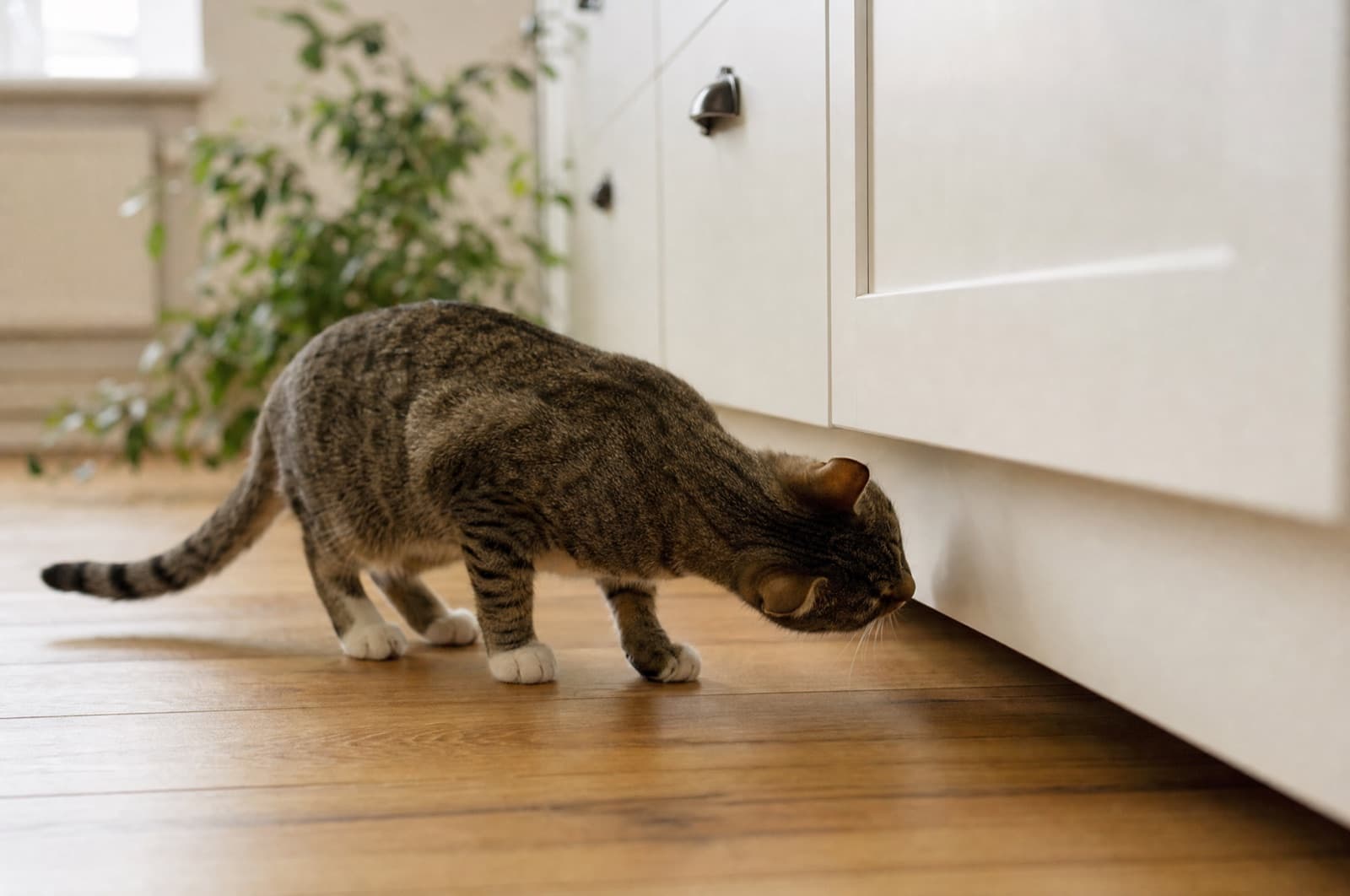
Is the Quick-Kill Mouse Trap by Victor Safe for Pets?
At a Glance
- Product: Quick-Kill Mouse Trap by Victor · Victor
- Active ingredient: No chemical toxicant
- Re-entry: Not applicable.
- Cat owners: Cats differ — read the cat card below
The short, honest answer
The score rolls up every per-species verdict below, weighted by the honest exposure that matters — a chewed-open tube, not a hidden dab — and is checked against the EPA label and veterinary toxicology.
No poison in this trap — the real risk is a pinched nose or paw from the spring bar.
The Victor Quick-Kill is a standard spring-loaded plastic snap trap with no chemical toxicant of any kind — there's no drooling, tremors, or poisoning scenario to grade. The honest risk is entirely physical: a curious dog or cat investigating the bait can trigger the bar and get a nose, paw, or tongue pinched. Place it where pets genuinely can't reach — inside cabinets, behind appliances, or in a covered trap station — and the risk drops close to zero.
General information, not veterinary advice. For a suspected exposure, contact your veterinarian or a pet-poison hotline. Verdict checked 2026-07-13 against the EPA label and veterinary toxicology.
It's not one answer — it's one per animal
Cats, birds, and fish routinely differ sharply from dogs. That contrast is the whole point of this scorecard, and no manufacturer page draws it.
- DogsCaution
- CatsCaution
- Small mammalsCaution
- BirdsSafe
- FishSafe
No poison — the risk is a pinched nose or paw
There's no toxicant in this trap. The spring-loaded bar can pinch a dog's nose, paw, or tongue if it noses the bait and triggers the mechanism; smaller breeds and puppies are most at risk. Placement out of reach is the entire safety strategy.
Victor manufacturer trap resources
A pawing cat can trigger and be pinched
No chemical hazard exists here. Cats investigate with a paw more than a nose, and a triggered bar can pinch a paw pad or toe. Keep the trap somewhere a cat doesn't roam or use a covered station.
Victor manufacturer trap resources
Keep away from loose pet rodents
A pet mouse, hamster, or rat is exactly the body size this trap is built to catch. There's no poisoning risk, but physical injury or death is possible if a loose pet rodent reaches it — keep it well outside their enclosure and any free-roam area.
General mechanical-trap safety guidance
Minimal realistic indoor interaction
A pet bird has little practical reason or ability to contact a floor-level snap trap indoors, and there's no chemical component to be concerned about.
General mechanical-trap safety guidance
No exposure route
There's no chemical toxicant and no plausible interaction pathway for an aquarium fish.
General mechanical-trap safety guidance
What's in it — and what it does to pets
This is a purely mechanical spring-loaded snap trap — there is no insecticide, rodenticide, or other chemical for a pet to ingest or absorb. The only pet-safety concern is physical: the spring bar snaps down with enough force to pinch or bruise a nose, paw, or tongue if a curious pet triggers it. That's an injury risk, not a toxicology one.
Victor manufacturer trap resources
How to use it safely around pets
Because there's no chemical involved, safe use is entirely about where you place the trap and how you handle a triggered one — not drying time or ventilation.
Set it where pets can't reach
Place the trap inside cabinets, behind appliances, in closed utility spaces, or wherever mice travel but pets don't roam.
Use a covered trap station for open areas
If the trap has to sit somewhere a pet could realistically wander, use a tamper-resistant covered snap-trap station so a pet can't reach the bar at all.
Position the pedal toward the wall
Setting the trap with the trigger pedal facing the wall (the way mice naturally travel) reduces the chance of an accidental head-on pet trigger.
Check and dispose of it without direct contact
Check traps regularly and dispose of a triggered trap and any catch without letting a pet investigate it first.
No drying or off-gassing wait applies — there's no chemical in this trap.
Not applicable.
The only ongoing precaution is placement: keep the set trap somewhere your pet cannot physically reach.
Not sure your trap placement is really pet-proof?
Anchor's licensed NH technicians place and monitor traps with pet-aware siting so you don't have to guess.
Symptoms to watch for
A sign, its urgency, and what to do — never a diagnosis. When in doubt, the emergency panel below is one tap away.
- Moderate
Yelping or sudden distress at the moment of contact
Often the first sign an owner notices
- Moderate
Pinched, bruised, or swollen nose or paw
- Moderate
Limping or reluctance to put weight on a paw
- Moderate
Visible swelling at the contact point
- Serious
Broken skin or bleeding
Warrants a same-day veterinary check
- Mild
Persistent licking or guarding of the affected area
A sign your pet is favoring an injury
Act now — call a vet or a pet-poison line
Do not induce vomiting unless told to
This trap has no chemical toxicant, so there's no poisoning scenario — if your pet is caught or injured by the trap, act calmly and check for physical injury. This page is general information, not veterinary advice — if your pet is injured or you suspect exposure, contact your veterinarian or ASPCA Animal Poison Control (888-426-4435) right away.
What each situation calls for
Your pet's nose or paw was pinched in the trap
Calmly free your pet from the trap, check for broken skin, swelling, or bleeding, and keep them still. This is a physical injury, not a poisoning — no hotline call is needed unless you also suspect they chewed on bait or trap material.
Your pet is limping or won't bear weight after a triggered trap
Contact your veterinarian for an exam — a strong pinch can bruise tissue or, rarely, cause a small fracture, and it's worth ruling out.
In the next 60 seconds
- Calmly release your pet from the trap if it's still attached.
- Check the nose, paw, or mouth for bleeding, swelling, or broken skin.
- Keep your pet calm and limit movement if you suspect a paw injury.
- Call your veterinarian if there's bleeding, swelling, or persistent limping.
- If your pet also chewed on bait or trap plastic, watch for GI upset and call your vet.
ASPCA Animal Poison Control
(888) 426-4435
24/7; a consultation fee may apply — for suspected ingestion of trap components or bait, not for physical injury
Pet Poison Helpline
(855) 764-7661
24/7; a per-incident fee applies
Northern New England Poison Center
(800) 222-1222
24/7 human poison control — for household/child exposure context; call your vet directly for any pet trap injury
Safer pet-friendly alternatives
Honest options that reduce or remove pet-toxicity — no affiliate hype, real caveats included.
Victor Tin Cat Live Mouse Trap
SaferLive-catch, no toxicant, no snap mechanism
Fully enclosed live-catch design with no spring bar and no poison — the safest rodent-control format for homes with pets.
Requires checking and releasing captured mice promptly for animal welfare.
Victor Electronic Mouse Trap
SaferEnclosed electronic kill trap
The kill mechanism sits inside a chamber a typical dog or cat's nose or paw can't reach, removing the exposed-spring pinch risk of an open snap trap.
Still keep it away from very small pets, which are close to the target size.
Covered snap-trap station
SaferMechanical, tamper-resistant housing
Encloses a standard snap trap so a pet can't physically reach the bar while still allowing effective mouse control.
Adds cost and setup versus a bare trap; still keep out of a determined pet's reach.
Professional rodent control (Anchor Pest Services)
SaferLicensed professional service
A licensed technician places and monitors traps with pet-aware siting, reducing the guesswork of DIY placement.
A service, not a product — ask about pet-safe trap placement specifically.
Pet-safe mouse control in New Hampshire
Mice push indoors across southern and central New Hampshire as the first hard frosts arrive each fall, typically from October onward, and a well-placed snap trap is an effective chemical-free response. Placement is everything in a home with pets. Homeowners can trap freely, but pest control for hire in NH must be done by an applicator licensed under RSA 430 through the NH Department of Agriculture, Markets & Food. Anchor Pest Services (#782664) provides pet-conscious rodent control across Manchester, Nashua, Concord, and surrounding towns if you'd rather not manage placement yourself.
NH-licensed applicator #782664 (NHDAMF, RSA 430) · NEPMA member · family-owned since 2017.
Service Area Map
Southern New Hampshire
Frequently asked questions
Sources(3)
- [1]Victor Pest — Trap Resources & FAQ
Mechanical snap-trap design and mechanism, no chemical component
manufacturerverified 2026-07-13 - [2]Anchor Pest Services — Quick-Kill Mouse Trap Pet-Safety Guidance
Placement and pet-injury framing for open snap traps
manufacturerverified 2026-07-13 - [3]Pest Control California — Snap Trap in Bait Station Guidance
Covered trap-station placement advice to reduce pet contact
manufacturerverified 2026-07-13
Written & reviewed by
VerifiedDaniel Brady
NH-Licensed Pesticide Applicator · License #782664 (NHDAMF, RSA 430)
Daniel Brady is the New Hampshire–licensed applicator behind Anchor Pest Services, a family-owned pest control company serving the Manchester area since 2017.
Last updated 2026-07-13
Pet-Safe Professional Pest Control
Mouse Control Without the Guesswork
DIY trap placement puts the pet-safety burden on you. Anchor Pest Services handles mouse control with pet-aware methods across southern and central New Hampshire. Family-owned since 2017, NH license #782664.
- Pet-conscious trap placement
- NH-licensed applicators (#782664)
- Free inspection — same-day service across southern NH
NH License #782664 · No obligation · We answer in person
Your next step
- Book a NH pro
Rodent Control
Book now - Book a NH pro
Pest Control Services
Licensed, family-owned pest control across southern NH.
Book now - Next step
How can I protect my attic from mice and rats during winter?
Read the answer - What to do next
How to Use the Victor Quick-Kill Mouse Trap
Read the answer - Also relevant
Mechanical Rodent Control: Snap Traps + Exclusion That Works
Read the answer - Also relevant
House Mouse in New Hampshire — ID, Signs & Control
Read the answer