
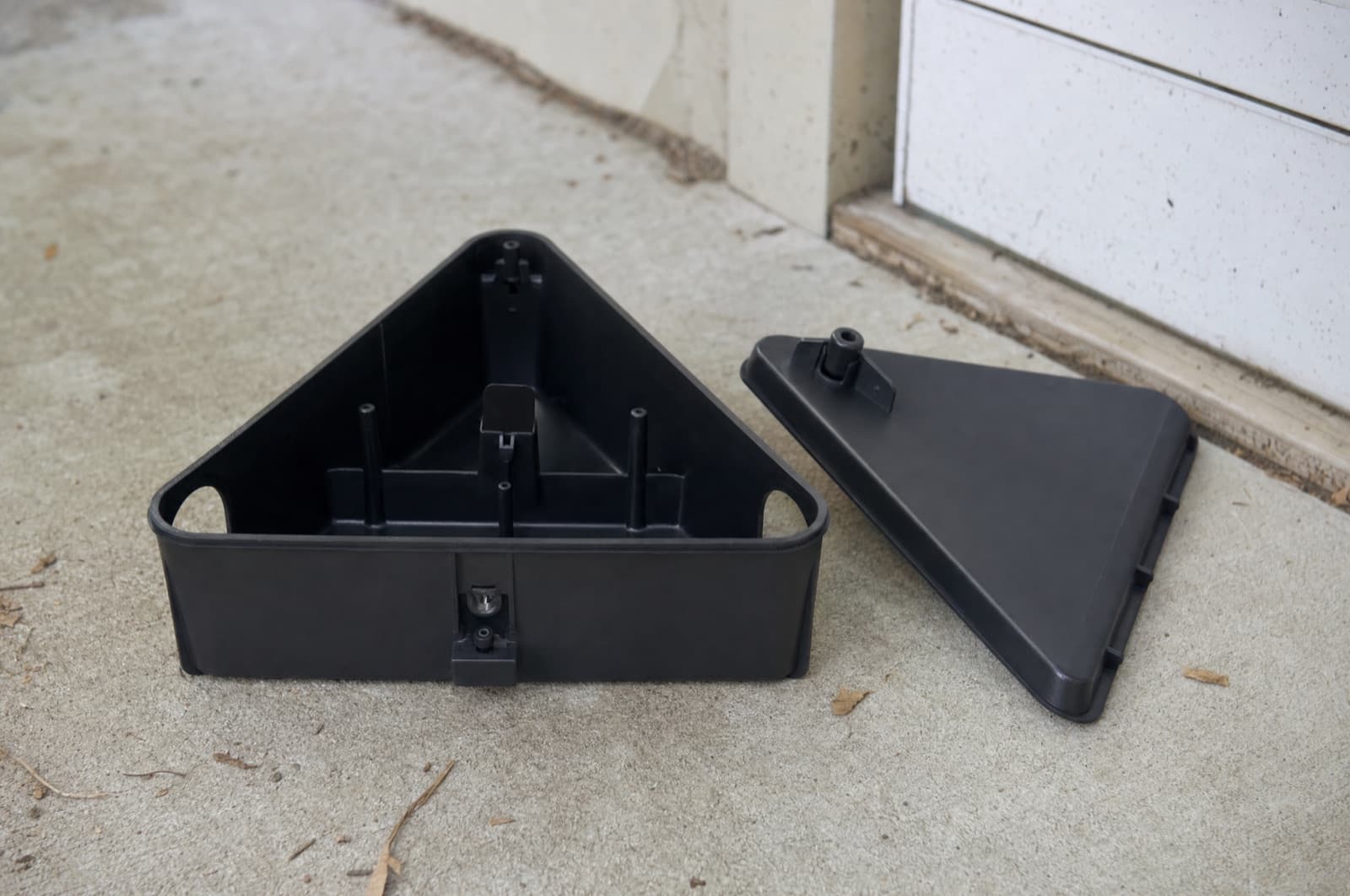
How to Use the Tomcat Refillable Bait Station for Mice
At a glance
- Efficacy: Situational
- Best job: Delivering a mouse bait block along a confirmed wall runway while keeping it away from children, pets, and non-target curiosity
- Format: Empty, tamper-resistant refillable rodent bait station — a reusable plastic housing sold WITHOUT bait; you load a separate mouse bait block (commonly bromethalin or a first-generation anticoagulant such as diphacinone — check the block you buy)
- Technique: Moderate technique
Does this product actually work?
A well-built delivery vehicle that does nothing on its own — efficacy lives entirely in the bait you load and the runway you put it on.
Buyers frequently assume 'bait station' means pre-loaded and ready to go — it isn't. This is a tamper-resistant housing you load with a separate bait block, and every part of its real-world performance rides on that block's active ingredient plus whether you anchored the station on an actual mouse runway. Done right — flush against the wall, blocks secured, several stations rather than one, paired with sealing entry points — it's a genuinely good way to deliver rodenticide safely. Done as a lone, unloaded, or open-floor placement, it accomplishes nothing, which is why we grade it situational rather than a blanket workhorse.
Best for
Protecting a loaded mouse bait block from kids, dogs, and cats while delivering it along a wall or runway mice actually use.
Skip it for
An established indoor mouse infestation you're hoping one or two stations will solve, or any household expecting the empty box itself to do something.
What it is — and what it's really for
The label is the law. Here's the honest read on the format, the one job it does well, and the job people wrongly buy it for.
The technique walkthrough
Where DIY succeeds or fails is in the placement, patience, and the small pro moves the label never mentions. Follow the label; these are the technique details on top of it.
The technique that matters here happens before you ever open the bait bag — find the runway, then load and anchor correctly.
Identify real runways first
Mice hug walls — look for droppings, dark rub marks along baseboards, and gnaw marks to find the paths they actually use before placing anything.
Common mistakeGuessing at placement instead of confirming activity — a station off the runway will sit untouched no matter how good the bait is.Choose and load a bait block
Buy a mouse bait block separately and load it into the station — the housing has no effect on its own. Wear gloves when handling bait.
CautionDifferent bait blocks use different active ingredients (commonly bromethalin, an acute non-anticoagulant, or a first-generation anticoagulant like diphacinone) — read that product's own label for its specific use and safety directions.Secure the block on the interior rod
Push the bait block fully onto the internal securing rod so a mouse can feed but cannot drag the block out of the station.
Common mistakeLeaving the block loose inside the housing — a mouse (or a curious pet if the station tips) can pull it free, defeating the tamper-resistant design.Anchor the station flush against the wall
Set the station tight to the wall with its entry holes aligned to the runway, in corners and behind appliances where you found droppings or rub marks.
Pro moveSpace multiple stations at short, close intervals — mice travel only short distances, so a lone station in the middle of a long wall run will miss most activity.Common mistakePlacing the station in the open middle of a room, where mice simply won't go.Maintain, monitor, and exclude
Check the clear lid every few days, keep bait stocked while feeding continues, and pair every station with sealing the entry points (steel wool, caulk) mice are using to get in.
Pro moveBaiting without exclusion just feeds an endless supply of newcomers — sealing gaps is what actually ends the problem.
Do & don't
- Load and secure a bait block before expecting any result — the housing alone does nothing.
- Anchor stations flush against walls on a confirmed runway.
- Use several stations spaced closely, not one.
- Pair baiting with sealing entry points.
- Wear gloves handling bait or any rodent carcass.
- Don't set it in the open middle of a room.
- Don't leave the bait block loose and unsecured on the rod.
- Don't assume the station is pre-loaded — it ships empty.
- Don't skip exclusion and expect baiting alone to end the problem.
- Don't place where a child or pet could tip or reach inside.
Where it works vs. where it fails
No product fixes everything. This is the honest boundary — the situations it genuinely handles, and the ones it simply won't.
Where it works
- It's loaded with an appropriate bait block and anchored on a confirmed wall runway
- You're protecting perimeter, garage, or basement rodent pressure from pets and kids
- You're dealing with light, ongoing mouse activity rather than an established infestation
- It's paired with sealing the entry points mice are using
Where it fails
- The station is empty or the block is loose — it delivers nothing
- It's placed in open floor space instead of a wall/runway
- You're facing a heavy indoor infestation a couple of stations can't out-pace
- Entry points stay unsealed, so new mice keep replacing the ones the bait removes
- A mouse dies in a wall void or other hidden space, which the station itself can't prevent
Mistakes that waste the product
Buying the station expecting it to be pre-loaded
The housing ships empty; without a bait block loaded inside, it's just a plastic box that does nothing.
Placing the station in the open middle of a room
Mice avoid open space and hug walls — an off-runway station goes untouched regardless of bait quality.
Baiting without sealing entry points
New mice keep entering through the same gaps, so the population never actually shrinks even as the station keeps 'working.'
What to expect — and when
Judge results by feeding activity and entry-point control together — the station is only half the equation.
First few days
If the station is on a true runway and properly loaded, feeding activity typically begins within days — check the clear lid for consumption.
Following week
First mortality from feeding can follow within about a week depending on the bait's active ingredient; some active/odor issues can arise if a mouse dies in a hidden space.
Ongoing
Activity should decline as the local population is reduced — if it plateaus or rebounds, unsealed entry points are usually letting new mice in.
When to stop DIY & call a pro
A loaded, correctly placed station handles light pressure. These signals mean the job has outgrown it:
Droppings show up in multiple rooms, not just near the station
Widespread droppings point to an established population that a couple of stations can't out-reproduce without broader intervention.
You hear activity inside walls or ceilings
In-wall activity is often inaccessible to any station placement and frequently means mice are nesting in voids a consumer product can't reach.
Daytime sightings or gnawed food packaging
Both indicate population pressure has outgrown available harborage — a sign of an established infestation, not a stray mouse or two.
Mice keep returning each season despite baiting and sealing
Recurring activity usually points to entry points you haven't found — a licensed inspection can locate and close gaps a homeowner misses.
When baiting and sealing on your own aren't holding the line, Anchor's licensed NH technicians combine professional-grade rodenticide placement with a full exclusion inspection to close the entry points feeding the problem. Free inspection, same-day service across southern and central New Hampshire.
Mice keep coming back despite loaded stations?
Is it safe for pets & kids?
The short version lives here; the full per-species verdict lives on this product's pet-safety page.
The empty housing itself is tamper-resistant and low-risk, but once loaded it holds a genuine rodenticide — harmful if swallowed by a child or pet. Keep loaded stations out of reach and anchored so they can't be tipped open, and wear gloves handling bait blocks or carcasses.
Re-entry: No general re-entry wait for the housing, but keep children and pets away from any loaded station at all times, not just during application.
Mouse pressure in New Hampshire
House mice overwinter inside southern and central New Hampshire homes instead of dying off outdoors, and an unsealed house will keep drawing new ones in all season long. Anchor a few loaded stations along basement and garage walls before cold weather arrives, and pair the baiting with sealing foundation gaps so you're not simply feeding a fresh supply of mice. If activity is reaching living spaces or you're hearing movement in the walls, Anchor Pest Services serves Manchester, Nashua, Concord, and the surrounding towns with licensed rodent control and exclusion work.
Service area
Southern New Hampshire
Anchor Pest Services · NH license #782664 · NEPMA member · family-owned since 2017.
Frequently asked
Sources & further reading(4)
- [1]Tomcat / ScottsMiracle-Gro — Mouse Killer Child-Resistant, Refillable Station
Housing is a refillable, tamper-resistant station sold empty; clear-lid monitoring design
manufacturerverified 2026-07-14 - [2]Motomco — Tomcat with Bromethalin Bait Chunx
Bromethalin as an acute, non-anticoagulant bait-block active used in the Tomcat line (facts only, not the efficacy verdict)
manufacturerverified 2026-07-14 - [3]University of Nebraska-Lincoln Extension — Controlling House Mice (G1646)
Tamper-resistant stations should be placed along walls and runways; exclusion is essential alongside baiting
extensionverified 2026-07-14 - [4]ScottsMiracle-Gro — Tomcat product listing
Product format and retail listing details
manufacturerverified 2026-07-14
Written & reviewed by
VerifiedDaniel Brady
NH-Licensed Pesticide Applicator · License #782664 (NHDAMF, RSA 430)
Daniel Brady is the New Hampshire–licensed applicator behind Anchor Pest Services, a family-owned pest control company serving the Manchester area since 2017.
Last updated July 2026
Related products in this category
Same shelf, different jobs — the dot shows each product's honest efficacy verdict at a glance.
Professional Pest Control
When Baiting Alone Isn't Enough
A refillable station only delivers what you load into it — it can't seal the gaps letting new mice in. Anchor Pest Services combines targeted rodenticide placement with exclusion work across southern and central New Hampshire. Family-owned since 2017, NH license #782664.
- Rodenticide placement plus exclusion, not just bait
- NH-licensed applicators (#782664)
- Free inspection — same-day service across southern NH
NH License #782664 · No obligation · We answer in person
Your next step
- Book a NH pro
Rodent Control in New Hampshire
Mice and rats move indoors every fall. We trap, seal entry points and keep them out.
Book now - Book a NH pro
Pest Control Services
Licensed, family-owned pest control across southern NH.
Book now - What to do next
Is Tomcat Refillable Bait Station for Rats Safe for Pets?
Read the answer - What to do next
Is Tomcat Refillable Bait Station for Mice Safe for Pets?
Read the answer - What to do next
Is d-CON Refillable Mouse Bait Station Safe for Pets?
Read the answer - Also relevant
Is Tomcat Refillable Bait Station for Mice Safe for Pets?
Read the answer