
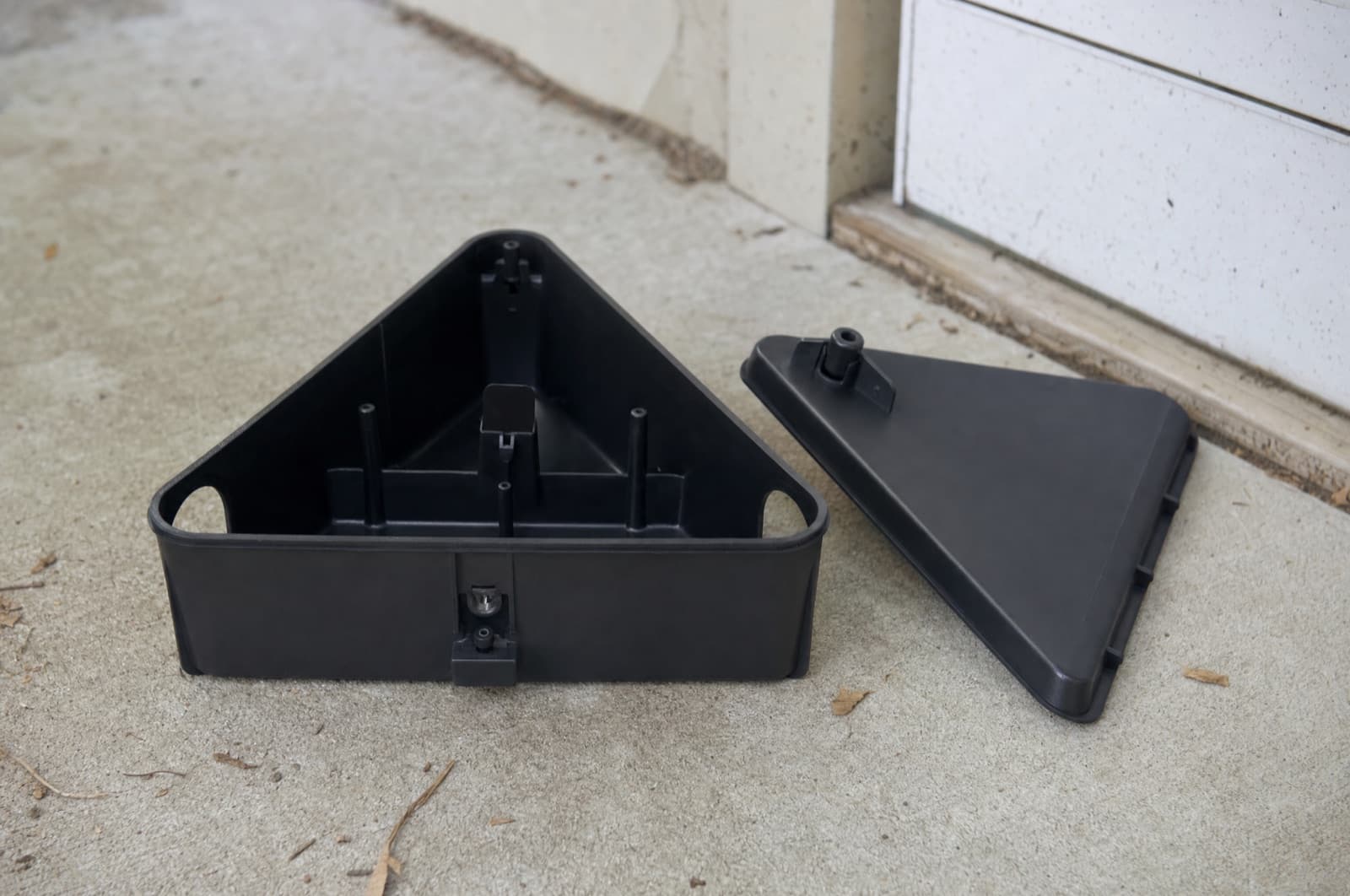
How to Use the Tomcat Refillable Bait Station for Rats
At a glance
- Efficacy: Situational
- Best job: Delivering a rat bait block securely along a confirmed exterior runway or near a burrow while keeping it away from children, pets, and non-target wildlife
- Format: Empty, tamper-resistant refillable RAT bait station — a larger reusable plastic housing sold WITHOUT bait; you load a separate rat bait block (commonly bromethalin or an anticoagulant such as diphacinone — check the block you buy)
- Technique: Moderate technique
Does this product actually work?
A rugged delivery vehicle for rat bait, not a rat-killer on its own — and rats are wary enough that anchoring and patience matter more than they do with mice.
Like its mouse-sized sibling, this ships empty — a tamper-resistant housing you load with a separate rat bait block. Because rats are neophobic (genuinely wary of new objects in their environment), they often ignore a freshly placed station for several days, so anchoring it firmly on a real runway or burrow route and then leaving it undisturbed matters even more than it does with mice. Loaded, anchored, and paired with sealing entry points, it's a legitimate way to deliver rodenticide to an exterior or burrow-adjacent rat population — used alone against an indoor infestation, or left unanchored where a rat can simply drag it off, it will underperform what buyers expect.
Best for
Delivering a loaded rat bait block securely along a confirmed exterior runway or near a burrow, protected from kids, dogs, and non-target wildlife.
Skip it for
An established indoor rat infestation you expect one or two stations to solve, or any household expecting the empty housing itself to do something.
What it is — and what it's really for
The label is the law. Here's the honest read on the format, the one job it does well, and the job people wrongly buy it for.
The technique walkthrough
Where DIY succeeds or fails is in the placement, patience, and the small pro moves the label never mentions. Follow the label; these are the technique details on top of it.
The real skill here is patience and anchoring, not the loading — rats reject anything that looks disturbed or freshly placed, so how you set the station matters as much as what's inside it.
Identify real runways and burrows first
Rats travel established routes — look for droppings, greasy rub marks along walls and foundations, gnaw marks, and active burrow openings before placing anything.
Common mistakeGuessing at placement instead of confirming activity — a station off the runway will sit untouched no matter how good the bait is.Choose and load a bait block
Buy a rat bait block separately and load it into the station — the housing has no effect on its own. Wear gloves when handling bait.
CautionDifferent bait blocks use different active ingredients (commonly bromethalin, an acute non-anticoagulant, or an anticoagulant such as diphacinone) — read that product's own label for its specific use and safety directions.Secure the block on the interior rod
Push the bait block fully onto the internal securing rod so a rat can feed but cannot haul the block out of the station.
Common mistakeLeaving the block loose inside the housing — rats are strong enough to drag a loose block or an unanchored station away entirely.Anchor the station firmly on the runway or near the burrow
Stake or affix the station tight to the wall along the confirmed runway, or beside an active burrow entrance, so it can't be tipped or moved.
Pro moveRats are strong and will drag or flip an unanchored box — stake it down or secure it to a fixed surface so it stays exactly where you placed it.Leave it undisturbed and check the clear lid periodically
Give a wary rat population several days to accept the new object before expecting feeding, then monitor through the clear lid and pair the station with sealing entry points and burrow openings.
Pro moveResist checking constantly — frequent disturbance is one of the fastest ways to spook neophobic rats away from an otherwise correct placement.
Do & don't
- Load and secure a bait block before expecting any result — the housing alone does nothing.
- Anchor or stake the station firmly on a confirmed runway or near a burrow.
- Leave a freshly placed station undisturbed for several days.
- Pair baiting with sealing entry points and burrow openings.
- Wear gloves handling bait or any rodent carcass.
- Don't set an unanchored station where a rat can drag or flip it.
- Don't assume the station is pre-loaded — it ships empty.
- Don't check or move the station constantly.
- Don't expect fast feeding — rat neophobia genuinely slows the first few days.
- Don't place where a child, pet, or non-target wildlife could reach or tip it.
Where it works vs. where it fails
No product fixes everything. This is the honest boundary — the situations it genuinely handles, and the ones it simply won't.
Where it works
- It's loaded with an appropriate bait block and firmly anchored on a confirmed runway or burrow
- You're protecting exterior, perimeter, or garage/basement rat pressure from pets and wildlife
- You're dealing with light, ongoing rat activity rather than an established indoor infestation
- It's paired with sealing the entry points and burrow openings rats are using
Where it fails
- The station is empty, unloaded, or the block is loose — it delivers nothing
- It's left unanchored, so a rat drags or tips it away from the runway
- You're facing a heavy indoor infestation a couple of stations can't out-pace
- Entry points and burrows stay unsealed, so new rats keep replacing the ones the bait removes
- A rat dies in a wall void or other hidden space, which the station itself can't prevent
Mistakes that waste the product
Buying the station expecting it to be pre-loaded
The housing ships empty; without a bait block loaded inside, it's just a heavy-duty plastic box that does nothing.
Leaving the station unanchored
Rats are strong enough to drag, tip, or flip an unsecured station off the runway entirely, defeating the placement.
Checking or moving the station too soon or too often
Rats are neophobic and treat a disturbed object as suspicious, which delays or prevents feeding.
What to expect — and when
Judge results on rat-appropriate timelines and pair them with entry-point control — a single station rarely tells the whole story.
First few days
Wary rats may avoid a freshly placed station entirely — this is normal neophobic behavior, not a failed placement.
Following week
If the station is truly on a runway or burrow route and stayed undisturbed, feeding activity typically begins and first mortality can follow within days after acceptance.
Ongoing
Activity should decline as the local population is reduced — if it plateaus or rebounds, unsealed entry points or burrows are usually letting new rats in.
When to stop DIY & call a pro
A loaded, correctly anchored station handles light exterior rat pressure. These signals mean the job has outgrown it:
Droppings, gnaw damage, or rat sightings show up indoors
Indoor activity usually means rats have already established harborage inside the structure — a job beyond a few exterior stations.
Active burrows are found against the foundation
Burrows next to a structure signal an established colony and often a foundation gap that needs professional inspection to close.
Rats are seen in daylight
Daytime activity from normally nocturnal rats usually indicates population pressure has outgrown available harborage — a sign of an established infestation.
Rats keep returning each season despite correct baiting and sealing
Recurring activity usually points to entry points or conducive conditions a homeowner hasn't found — a licensed inspection can locate and close them.
When exterior baiting and sealing on your own aren't holding the line, Anchor's licensed NH technicians combine professional-grade rodenticide placement with a full exclusion inspection to close the entry points and burrow access feeding the problem. Free inspection, same-day service across southern and central New Hampshire.
Rats keep coming back despite loaded stations?
Is it safe for pets & kids?
The short version lives here; the full per-species verdict lives on this product's pet-safety page.
The empty housing itself is tamper-resistant and low-risk, but once loaded it holds a genuine rodenticide — harmful if swallowed by a child or pet. Keep loaded stations anchored so they can't be tipped or opened, and wear gloves handling bait blocks or carcasses.
Re-entry: No general re-entry wait for the housing, but keep children and pets away from any loaded station at all times, not just during placement.
Rat pressure in New Hampshire
Norway rats in southern and central New Hampshire tend to cluster around structures with reliable food and shelter — dumpsters, woodpiles, foundations, and outbuildings — and push harder toward buildings as cold weather sets in. Anchor a few loaded, well-anchored stations along exterior walls and near suspected burrows before winter, and pair baiting with sealing foundation gaps and utility penetrations, since an unsealed structure will keep feeding new rats through the whole season. If activity is showing up indoors or you're finding burrows against the foundation, Anchor Pest Services serves Manchester, Nashua, Concord, and the surrounding towns with licensed rodent control and exclusion work.
Service area
Southern New Hampshire
Anchor Pest Services · NH license #782664 · NEPMA member · family-owned since 2017.
Frequently asked
Sources & further reading(4)
- [1]Tomcat / ScottsMiracle-Gro — Rat & Mouse Killer Child- and Dog-Resistant, Refillable Station
Housing is a refillable, tamper-resistant rat station sold empty; clear-lid monitoring design
manufacturerverified 2026-07-14 - [2]Motomco — Tomcat with Bromethalin Bait Chunx
Bromethalin as an acute, non-anticoagulant bait-block active used in the Tomcat line (facts only, not the efficacy verdict)
manufacturerverified 2026-07-14 - [3]University of Nebraska-Lincoln Extension — Controlling House Mice and Rats (G1646)
Tamper-resistant stations should be placed along walls, runways, and near burrows; exclusion is essential alongside baiting; rat neophobia
extensionverified 2026-07-14 - [4]The Home Depot — Tomcat Rat and Mouse Killer Child- and Dog-Resistant Refillable Station (product listing)
Retail format and product listing details
manufacturerverified 2026-07-14
Written & reviewed by
VerifiedDaniel Brady
NH-Licensed Pesticide Applicator · License #782664 (NHDAMF, RSA 430)
Daniel Brady is the New Hampshire–licensed applicator behind Anchor Pest Services, a family-owned pest control company serving the Manchester area since 2017.
Last updated July 2026
Related products in this category
Same shelf, different jobs — the dot shows each product's honest efficacy verdict at a glance.
Professional Pest Control
When Exterior Baiting Alone Isn't Enough
A refillable station only delivers what you load into it — it can't seal the burrows and gaps letting new rats in. Anchor Pest Services combines targeted rodenticide placement with exclusion work across southern and central New Hampshire. Family-owned since 2017, NH license #782664.
- Rodenticide placement plus exclusion, not just bait
- NH-licensed applicators (#782664)
- Free inspection — same-day service across southern NH
NH License #782664 · No obligation · We answer in person
Your next step
- Book a NH pro
Rodent Control
Book now - Book a NH pro
Pest Control Services
Licensed, family-owned pest control across southern NH.
Book now - What to do next
Is Tomcat Refillable Bait Station for Rats Safe for Pets?
Read the answer - What to do next
Is Tomcat Refillable Bait Station for Mice Safe for Pets?
Read the answer - What to do next
Is d-CON Refillable Mouse Bait Station Safe for Pets?
Read the answer - Also relevant
Is Tomcat Refillable Bait Station for Rats Safe for Pets?
Read the answer