
Is Ortho Home Defense Insect Killer for Indoor & Perimeter Safe for Pets?
At a Glance
- Product: Home Defense Insect Killer for Indoor & Perimeter by Ortho · Ortho
- Active ingredient: Bifenthrin 0.0500%, Zeta-Cypermethrin 0.0125%
- Re-entry: Re-entry after visibly dry per the Ortho label; the residual film is marketed for up to 12 months of indoor control, so ongoing pet access to the treated band should be minimized, not just the first few hours.
- Cat owners: Cats differ — read the cat card below
The short, honest answer
The score rolls up every per-species verdict below, weighted by the honest exposure that matters — a chewed-open tube, not a hidden dab — and is checked against the EPA label and veterinary toxicology.
Dogs are fine once the barrier dries — cats and any nearby fish need real caution, not just until it's dry.
Home Defense Insect Killer for Indoor & Perimeter is a two-pyrethroid residual barrier (bifenthrin 0.0500% + zeta-cypermethrin 0.0125%, EPA Reg. No. 239-2717). It's built to leave a long-lasting film on treated surfaces, so "wait until dry" is necessary but not the whole story: the dried residue can stay chemically active on non-porous indoor surfaces for months. Dogs generally tolerate it once dry; cats should be kept off treated bands well beyond the initial dry time, and the label is explicit that this product is extremely toxic to fish and aquatic invertebrates.
General information, not veterinary advice. For a suspected exposure, contact your veterinarian or a pet-poison hotline. Verdict checked 2026-07-13 against the EPA label and veterinary toxicology.
It's not one answer — it's one per animal
Cats, birds, and fish routinely differ sharply from dogs. That contrast is the whole point of this scorecard, and no manufacturer page draws it.
- DogsCaution
- CatsAvoid
- Small mammalsCaution
- BirdsCaution
- FishAvoid
Generally tolerated once the barrier is dry
Pyrethroids have a relatively wide safety margin in dogs, and the Ortho label allows people and pets to re-enter once the spray has dried. Any signs are usually minor and self-limiting. A dog that habitually licks or chews baseboards is still at higher relative risk from the residual film.
NPIC Bifenthrin fact sheets; Ortho product label
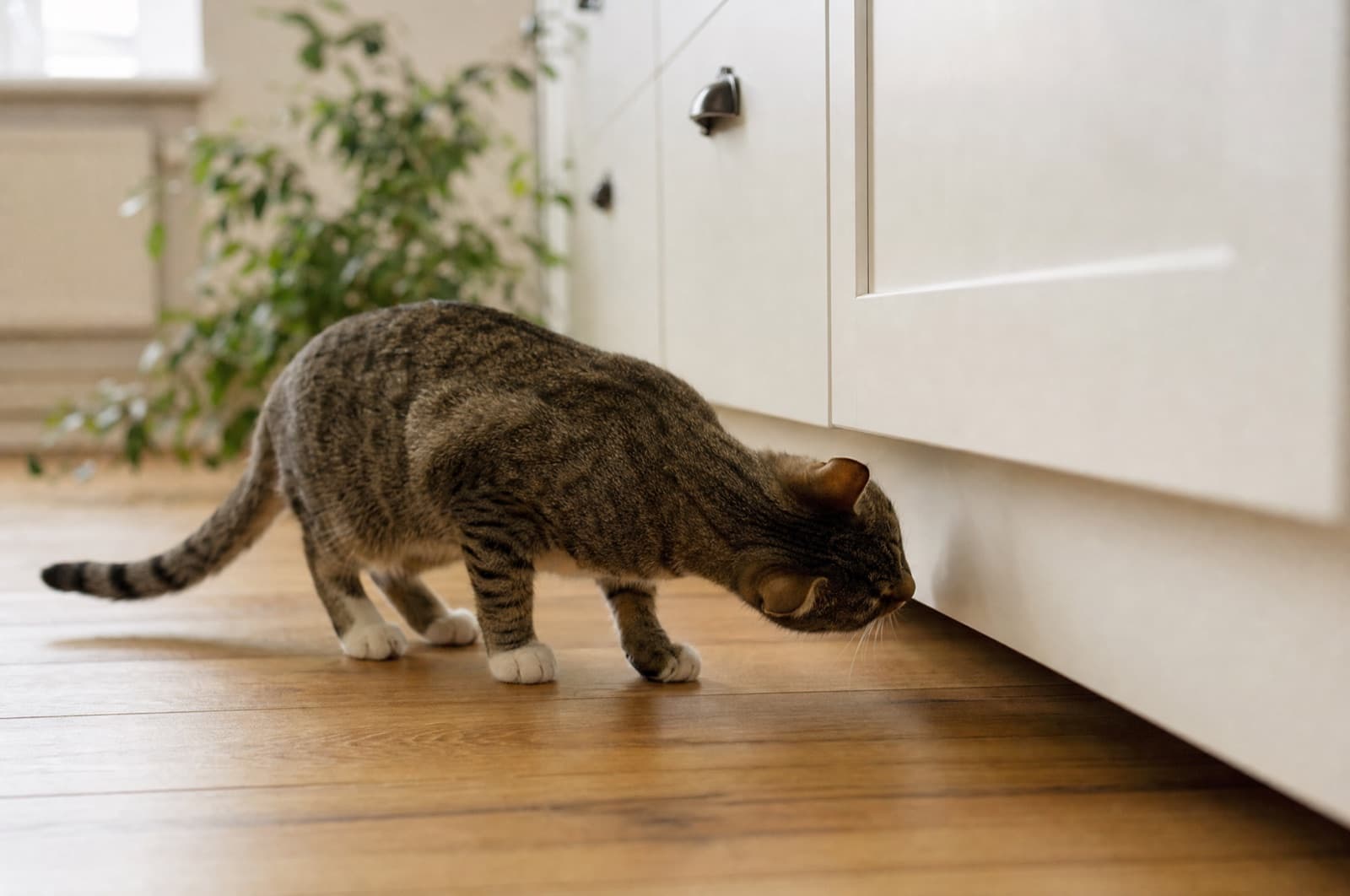
Keep cats off the treated band, not just until dry
Cats poorly metabolize pyrethroids because their livers have limited glucuronidation capacity. Because this is a residual barrier designed to persist on non-porous surfaces for months, the exposure window is longer than a one-time spray — keep cats from repeatedly walking, licking, or resting on treated baseboards and perimeter bands.
Merck Veterinary Manual; MSPCA-Angell pyrethrin toxicity in cats
Keep off the treatment zone until dry and beyond
Rabbits, guinea pigs, and other small-bodied pets are more sensitive per pound of body weight. Keep them and their enclosures out of the treated zone until it's dry, and don't let them repeatedly contact the residual band.
NPIC Bifenthrin General Fact Sheet
Low dietary risk, but keep cages clear of spray mist
NPIC data show bifenthrin has relatively low toxicity to birds when ingested, but the real hazard during application is inhalation of spray mist. Keep caged birds out of the room during application and until the treated surfaces are fully dry and aired out.
NPIC Bifenthrin Technical Fact Sheet
Extremely toxic to fish — cover tanks, shut off pumps
The EPA label states this product is extremely toxic to fish and aquatic invertebrates; NPIC lists bifenthrin 96-hour LC50 values in the parts-per-billion range for trout and bluegill. Cover aquariums and turn off air pumps during and after any nearby application.
EPA label 239-2717 aquatic hazard statement; NPIC Bifenthrin fact sheet
What's in it — and what it does to pets
A Type I pyrethroid that disrupts insect nervous-system function; in mammals it has a wide margin at label concentrations, but cats are the exception due to limited liver glucuronidation. It is very highly toxic to fish and aquatic invertebrates even at trace levels.
NPIC Bifenthrin General Fact Sheet
A Type II pyrethroid added for residual knockdown. Shares the class-level nervous-system mode of action; cats remain the most sensitive common pet, and the compound adds to this product's aquatic-toxicity profile.
NPIC pyrethrins/pyrethroids fact sheet
How to use it safely around pets
This is a residual barrier meant to leave a long-lasting film on treated surfaces — the pet-safety picture has two parts: the initial wet period, and how pets contact the dried residue afterward.
Remove pets before spraying
Move pets, small-mammal enclosures, and any fish tanks that can't be covered out of the treatment area before applying — both for indoor baseboard work and outdoor foundation spraying.
Apply as a targeted band, not a broadcast
Treat baseboards, cracks, entry points, and the foundation perimeter as directed on the label — not open floors, pet bedding, or feeding areas.
Keep pets off until fully dry
The label allows people and pets to re-enter once the spray has dried. Ventilate indoor rooms before pets return.
Limit repeated contact with the dried band
This barrier is designed to remain active on non-porous indoor surfaces for months. Discourage cats and small mammals from repeatedly licking, walking on, or resting against treated baseboards and perimeter lines during that period.
Keep pets off treated surfaces until the spray has fully dried, and limit their repeated contact with the residual band afterward.
Re-entry after visibly dry per the Ortho label; the residual film is marketed for up to 12 months of indoor control, so ongoing pet access to the treated band should be minimized, not just the first few hours.
Cats and small mammals warrant the most caution for repeated long-term contact; fish and aquatic invertebrates must never contact the spray at all.
Rather not manage a residual pyrethroid barrier around pets and cats?
Anchor's licensed NH technicians place targeted barrier treatments precisely where pests travel and pets don't.
Symptoms to watch for
A sign, its urgency, and what to do — never a diagnosis. When in doubt, the emergency panel below is one tap away.
- Moderate
Drooling or hypersalivation
Often the earliest sign in cats
- Moderate
Vomiting or diarrhea
- Moderate
Paw flicking or ear/skin twitching
- Serious
Incoordination
- Serious
Tremors or muscle twitching
- Moderate
Dilated pupils
Act now — call a vet or a pet-poison line
Do not induce vomiting unless told to
If your pet ate, licked, or walked through this product, act now — bring the product label or EPA registration number when you call. This page is general information, not veterinary advice — for a suspected exposure, contact your veterinarian or ASPCA Animal Poison Control (888-426-4435) right away.
What each situation calls for
Your pet walked through or licked a treated baseboard
Wipe residue from paws and fur with a damp cloth to reduce further ingestion via grooming, then call your vet or a pet poison hotline. Do not induce vomiting unless told to.
Your cat is drooling, twitching, or tremoring after contact
Treat as urgent — cats are the most pyrethroid-sensitive common pet. Call your vet or ASPCA Animal Poison Control immediately and bring the product label or EPA registration number.
Spray or overspray reached an aquarium
Do not add anything to the tank; contact your vet or an aquatic specialist and a pet poison hotline right away, since fish are extremely sensitive to this product.
In the next 60 seconds
- Get your pet away from the treated area and any wet product.
- Gently wipe residue off paws and fur to reduce grooming ingestion.
- Do NOT induce vomiting unless a veterinarian or poison expert tells you to.
- Have the product name and EPA registration number ready.
- Call your veterinarian or one of the hotlines below.
ASPCA Animal Poison Control
(888) 426-4435
24/7; a consultation fee may apply
Pet Poison Helpline
(855) 764-7661
24/7; a per-incident fee applies
Northern New England Poison Center
(800) 222-1222
24/7 human poison control — for household/child exposure context; call a vet or the pet lines above for pet guidance
Safer pet-friendly alternatives
Honest options that reduce or remove pet-toxicity — no affiliate hype, real caveats included.
Professional targeted barrier by Anchor Pest Services
SaferLicensed professional service
A licensed applicator places the residual barrier precisely where pests travel and pets don't, instead of a homeowner broadcast application.
A service, not a product — ask for a pet-safety-focused placement plan.
Mechanical exclusion + sealing
SaferNon-chemical
Caulking entry points and sealing gaps removes the pest pressure that drives repeat barrier applications, with zero pet toxicity.
Slower than a spray; works best paired with targeted treatment.
Diatomaceous earth or borate dusts in cracks
SaferMechanical/mineral, out of pet reach
Applied only in cracks and voids pets can't access, avoiding an open residual film on baseboards.
Needs precise, pet-inaccessible placement to stay low-risk.
Enclosed/tamper-resistant bait stations
SaferEnclosed bait
The active is sealed inside a station instead of left as an open surface film, cutting contact and grooming exposure sharply.
Still contains an insecticide — place where pets can't pry them open.
Pet-safe perimeter pest control in New Hampshire
Carpenter ants, spiders, and fall overwintering pests all push toward the foundation of New Hampshire homes as temperatures swing — carpenter ants in particular are the state's most common structural ant. A homeowner may apply a general-use retail barrier product, but pest control performed for hire in New Hampshire must be done by an applicator licensed by the NH Department of Agriculture, Markets & Food Division of Pesticide Control under RSA 430. If you'd rather not manage a residual pyrethroid film around dogs and cats yourself, Anchor's NH-licensed team (#782664) provides pet-conscious perimeter treatment across Manchester, Nashua, Concord, and surrounding towns — targeted placement over broad indoor spraying.
NH-licensed applicator #782664 (NHDAMF, RSA 430) · NEPMA member · family-owned since 2017.
Service Area Map
Southern New Hampshire
Frequently asked questions
Sources(7)
- [1]EPA Registered Product Label — Ortho Home Defense (Reg. No. 239-2717)
Verified actives (bifenthrin 0.05%, zeta-cypermethrin 0.0125%), re-entry after dry, "extremely toxic to fish and aquatic invertebrates" aquatic hazard statement
epa_labelverified 2026-07-13 - [2]Ortho — Home Defense Insect Killer for Indoor & Perimeter product page
Re-entry-after-dry directive (facts only, not the verdict)
manufacturerverified 2026-07-13 - [3]NPIC — Bifenthrin General Fact Sheet
Class toxicity, bird dietary risk, fish LC50 range
npicverified 2026-07-13 - [4]
- [5]VCA Animal Hospitals — Pyrethrin/Pyrethroid Poisoning in Cats
Feline pyrethroid sensitivity and clinical signs
veterinaryverified 2026-07-13 - [6]MSPCA-Angell — Pyrethrin Toxicity in Cats
Feline glucuronidation deficiency mechanism
veterinaryverified 2026-07-13 - [7]Merck Veterinary Manual — Pyrethrin and Pyrethroid Toxicosis
Cross-species pyrethroid toxicosis reference
veterinaryverified 2026-07-13
Written & reviewed by
VerifiedDaniel Brady
NH-Licensed Pesticide Applicator · License #782664 (NHDAMF, RSA 430)
Daniel Brady is the New Hampshire–licensed applicator behind Anchor Pest Services, a family-owned pest control company serving the Manchester area since 2017.
Last updated 2026-07-13
Pet-Safe Professional Pest Control
Skip the Guesswork on Residual Barrier Placement
DIY barrier sprays put months of pet-exposure judgment on you. Anchor Pest Services applies targeted, pet-aware perimeter treatments across southern and central New Hampshire. Family-owned since 2017, NH license #782664.
- Pet-conscious targeted placement
- NH-licensed applicators (#782664)
- Free inspection — same-day service across southern NH
NH License #782664 · No obligation · We answer in person
Your next step
- Book a NH pro
Pest Control Services
Licensed, family-owned pest control across southern NH.
Book now - What to do next
How to Use Ortho Home Defense Insect Killer for Indoor & Perimeter
Read the answer - What to do next
How to Use Ortho Home Defense Ant, Roach & Spider Killer
Read the answer - Also relevant
Chemical Control for Roaches, Silverfish, Crickets & Termites
Read the answer - Also relevant
Chemical Ant Control: Why Bait Beats Spray
Read the answer - Related guide
Is Home Defense Max Indoor Insect Barrier by Ortho Safe for Pets?
Read the answer