
How Do I Get Rid of Mice in Walls?
At a Glance
- Short answer: Trap at exit points along baseboards and pipes; never poison inside the cavity.
- Key fact: A poisoned mouse in a wall decomposes there for weeks — extension guidance says avoid indoor baiting entirely.
- NH relevance: Older NH homes with unsealed baseboards and plumbing chases give mice easy wall-void access.
- Action needed: Seal the exit gap only after trapping confirms activity has stopped.
The short of it
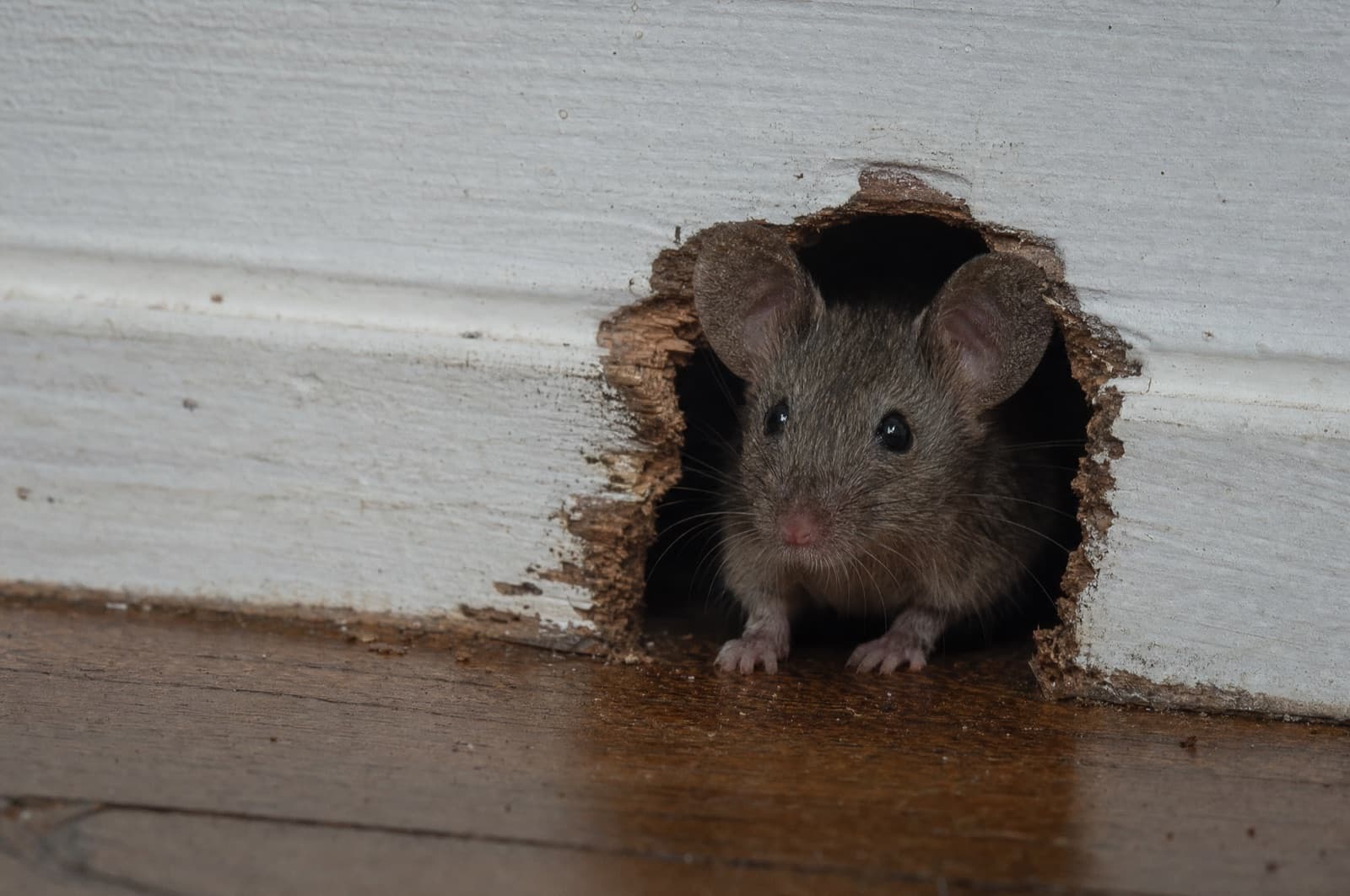
You can't reach a mouse inside a wall cavity directly, so the effective approach targets where it comes out, not the void itself: set snap traps flush against the wall at gnaw holes, baseboard gaps, and pipe penetrations, since mice travel guided by their whiskers along wall lines. Extension guidance is blunt about the one thing to avoid — indoor rodenticide should be 'avoided at all costs' in walls, because poisoned mice retreat into the cavity to die, decomposing for weeks and shedding bacteria and attracting maggots in a spot you can't access.
How Do I Get Rid of Mice in Walls — By the Numbers
¼ in
Smallest gap a mouse can use to enter or exit a wall
0
Poison bait stations recommended inside wall cavities
Weeks
How long a mouse carcass can decay inside an inaccessible wall void
19–21 days
Mouse gestation — why delay lets the population grow
The full picture
Why poison inside a wall is a mistake
University of Nebraska–Lincoln's Dennis Ferraro is direct on this point: indoor baiting should be avoided at all costs, because poisoned mice frequently retreat into the nearest void — often the wall itself — to die. An inaccessible carcass decomposes for weeks, producing a strong odor, attracting flies and maggots, and shedding bacteria into a space you can't clean. A trap you can find and empty avoids that outcome entirely.
Find the exit points, then trap there
Mice navigate largely by touch, running along walls guided by their whiskers rather than crossing open floor space. Follow droppings and grease marks to where mice actually emerge — gnaw holes near baseboards, gaps behind cabinet kick plates, and openings where pipes or utility lines penetrate the wall. Set snap traps flush against the wall right at those points, since that's where activity concentrates.
Seal only after activity stops
Keep trapping until you see no fresh droppings, gnawing, or noise for several days. Then pack the opening tightly with steel or copper wool — materials mice can't chew through — and caulk over it; use galvanized hardware cloth for larger gaps. Sealing before trapping confirms the wall is clear risks trapping a live mouse inside, recreating the exact decay problem poison would have caused.
When it's a job for a pro
Extensive wall-void activity, multiple exit points across several rooms, or noise that persists despite consistent trapping usually means access limitations a homeowner can't work around — behind finished walls, under built-ins, or inside multi-story chases. A pro with wall-access tools and thermal/acoustic inspection can locate activity you can't see from a baseboard gap alone.
Bottom line — Trap mice where they exit the wall — never inside it — and never bait a wall cavity with poison. Seal the openings only once trapping confirms the activity has stopped.
Mice scratching in your walls?
Anchor traps at the exit points and never baits a wall cavity — no odor risk, no guesswork about where they're getting in.
Why this matters in New Hampshire
Many older homes across southern and central New Hampshire have baseboard gaps, uninsulated sill areas, and plumbing chases that give mice easy access to wall voids, and indoor wall activity typically rises as Manchester's first hard frost approaches — about October 19 at 50% probability, October 29 at 80% (NOAA 1991–2020) — when mice push in from outside for warmth. Trapping at exit points before that seasonal push, rather than after mice are already established in the walls, is far more manageable.
Key local data
Much of southern and central NH's older housing stock has fieldstone or rubble foundations and wood sill plates that give rodents ground-level entry (UNH Cooperative Extension exclusion guidance).
- NH-licensed applicator · #782664
- Same-day service
- Family-owned since 2017
Service Area Map
Southern New Hampshire
Frequently asked
Written & reviewed by
VerifiedDaniel Brady
NH-Licensed Pesticide Applicator · License #782664 (NHDAMF, RSA 430)
Daniel Brady is the New Hampshire–licensed applicator behind Anchor Pest Services, a family-owned pest control company serving the Manchester area since 2017.
Professional Rodent Control
Wall-Void Mice, Handled the Safe Way
Anchor Pest Services locates exit points, traps there, and never poisons inside a wall cavity — avoiding weeks of odor from an inaccessible carcass. Family-owned since 2017, NH license #782664.
- Same-day service across southern NH
- NH-licensed applicators (#782664)
- Free inspection — no flat-price guesswork
NH License #782664 · No obligation · We answer in person
Your next step
- Book a NH pro
Rodent Control in New Hampshire
Mice and rats move indoors every fall. We trap, seal entry points and keep them out.
Book now - Next step
Do rodents count as fall invaders too?
Read the answer - What to do next
How to Get Rid of House Mice
Read the answer - Related guide
What Noises Do Mice Make at Night?
Read the answer - Related guide
Where Do Mice Usually Hide Indoors?
Read the answer - Related guide
What Should I Do If I See a Mouse in My Kitchen?
Read the answer