
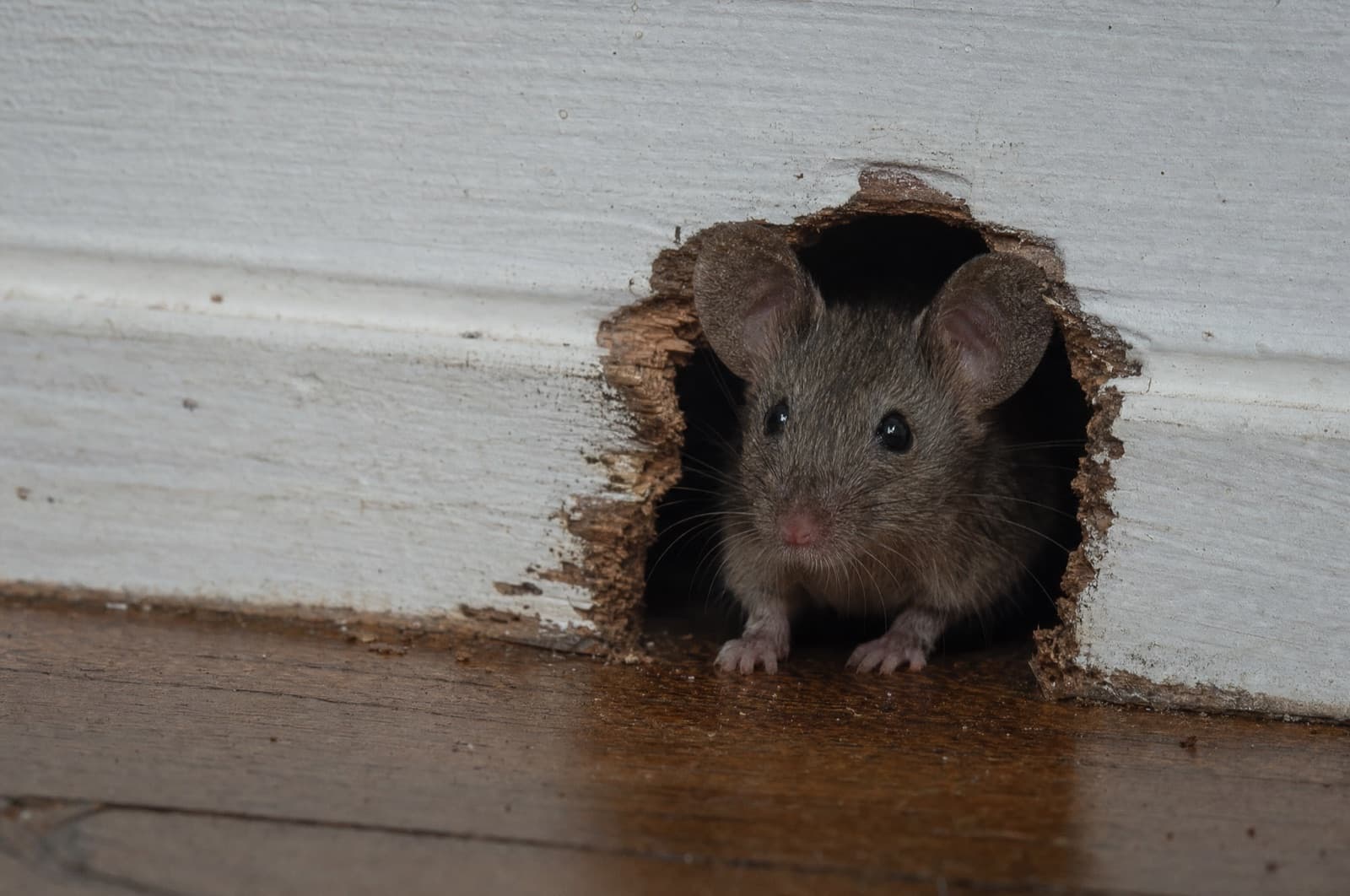
What Cleaning Products Kill Rodent Bacteria and Viruses?
At a Glance
- Short answer: A labeled household disinfectant, or a fresh 1:9 bleach solution — used wet, never dry.
- Key fact: CDC's exact recipe: 1.5 cups household bleach per gallon of water (1 part bleach to 9 parts water), made fresh before each use.
- NH relevance: New Hampshire's deer mice are the regional hantavirus reservoir, which is why the wet-clean rule applies even to small, routine cleanups here.
- Action needed: Air out the space 30 minutes, then wet-clean with one of these two agents — never sweep or vacuum first.
The short of it
The CDC recommends exactly two agents for rodent droppings, urine, and nests: a general-purpose household disinfectant (confirm the word "disinfectant" is on the label) or a fresh bleach solution — 1.5 cups of household bleach per gallon of water, or 1 part bleach to 9 parts water. Neither product works on contact with dry material. The protocol matters as much as the product: air out an enclosed space for 30 minutes first, then spray droppings and urine until very wet, let the solution soak 5 minutes, and wipe up — never dry-sweep or vacuum, which aerosolizes virus-carrying particles.
What Cleaning Products Kill Rodent Bacteria and Viruses — By the Numbers
2
CDC-approved cleanup agents: disinfectant or bleach solution
1:9
Current CDC bleach-to-water ratio (1.5 cups per gallon)
30 min
Air-out time before entering an enclosed space
5 min
Soak time before wiping up sprayed droppings
The CDC rodent-cleanup protocol
CDC's rodent-cleanup protocol is a specific order of operations, not just a product choice. Skipping the air-out step or dry-sweeping first defeats the purpose of using the right cleaning product at all.
Air out the space
For any closed-up room, attic, shed, or camp, open all doors and windows for 30 minutes to ventilate before cleaning, and leave the area during that time.
Do not enter or begin cleaning during the ventilation period.
Glove up and spray
Put on rubber or plastic gloves. Spray droppings, urine, and nesting material with a general-purpose household disinfectant (labeled "disinfectant") or a fresh bleach solution — 1.5 cups bleach per gallon of water (1 part bleach to 9 parts water) — until very wet.
Let it soak
Let the sprayed material soak for 5 minutes, or per the disinfectant label's contact time, so the solution can inactivate bacteria and viruses.
Wipe and dispose
Wipe up with paper towels and discard them in a covered garbage can. Mop or sponge the entire hard surface with disinfectant afterward.
Wash hands
Wash gloved hands with soap and water or disinfectant before removing gloves, then wash bare hands again with soap and warm water.
- Never sweep or vacuum rodent urine, droppings, or nesting materials — this sends virus-carrying droplets into the air.
- Never use a dry cloth or paper towel to wipe droppings before the solution has soaked in.
Calibrated from: Steps and bleach recipe quoted from CDC, "How to Clean Up After Rodents" (last reviewed April 8, 2024).
The full picture
The two CDC-recommended agents
CDC directs the use of a general-purpose household disinfectant — confirm the word "disinfectant" is on the label — or a fresh bleach solution. The current CDC recipe is exact: combine 1.5 cups of household bleach in 1 gallon of water (or 1 part bleach to 9 parts water), and make the solution fresh before each use rather than storing it. EPA also maintains a list of registered disinfectants CDC links to as an alternative to bleach.
Why the protocol matters as much as the product
Neither product works as a quick dry wipe. Spray droppings and urine until very wet, then let the solution soak about 5 minutes (or per the label's contact time) before wiping up with paper towels — that soak time is what inactivates the pathogens. Before any of this, an enclosed space needs 30 minutes of airing out with the room empty, because diseases like hantavirus are mainly spread when people breathe in contaminated air stirred up by disturbing dry droppings.
The one rule that overrides everything else
Do not vacuum or sweep rodent urine, droppings, or nesting materials, dry or otherwise, at any point in this process. CDC is explicit that this can send tiny virus-carrying droplets into the air. If a space was already vacuumed or swept before this guidance was known, go back and wet-clean it properly rather than continuing with dry methods.
Bottom line — Use a labeled household disinfectant or a fresh 1:9 bleach solution (1.5 cups per gallon), air out enclosed spaces 30 minutes first, spray until very wet, soak 5 minutes, then wipe and mop. Never dry-sweep or vacuum rodent droppings at any stage.
Cleanup only removes the risk, not the rodents
If droppings keep reappearing, there's likely an active infestation behind the walls. Anchor's licensed NH technicians handle exclusion and trapping.
Why this matters in New Hampshire
Deer mice (Peromyscus maniculatus) are New Hampshire's hantavirus reservoir species, which is why the wet-clean-not-dry-sweep rule applies even to a small cleanup in an attic, camp, or shed. NH DHHS reports no confirmed hantavirus case acquired in New Hampshire to date, but the wet-clean protocol is the reason that risk stays low — treat every cleanup the same way regardless of how minor it looks.
Key local data
NH DHHS: no confirmed hantavirus case acquired in New Hampshire to date; deer mice are the regional reservoir species.
- NH-licensed applicator · #782664
- Same-day service
- Family-owned since 2017
Service Area Map
Southern New Hampshire
Frequently asked
Sources (3)
- [1]
- [2]CDC — About Hantavirus(2024)
- [3]NH DHHS — Hantavirus(2024)
Written & reviewed by
VerifiedDaniel Brady
NH-Licensed Pesticide Applicator · License #782664 (NHDAMF, RSA 430)
Daniel Brady is the New Hampshire–licensed applicator behind Anchor Pest Services, a family-owned pest control company serving the Manchester area since 2017.
Professional Rodent Control
Cleaned Up the Droppings? Now Stop the Source.
Safe cleanup protects you today, but it doesn't seal the entry points that let rodents back in. Anchor Pest Services finds and closes those gaps and traps the rodents already inside. Family-owned since 2017, NH license #782664.
- Same-day service across southern NH
- NH-licensed applicators (#782664)
- Free inspection — no flat-price guesswork
NH License #782664 · No obligation · We answer in person
Your next step
- Book a NH pro
Rodent Control
Book now - Next step
Rodent Mites After Mice or Rats Are Removed
Read the answer - Related guide
Can I Use Bleach to Clean Rodent Droppings?
Read the answer - Related guide
Can Vacuuming Spread Mouse Droppings?
Read the answer - Related guide
How Do I Clean Up After Mice Safely?
Read the answer - Related guide
Are Mouse Droppings Dangerous to Touch?
Read the answer