
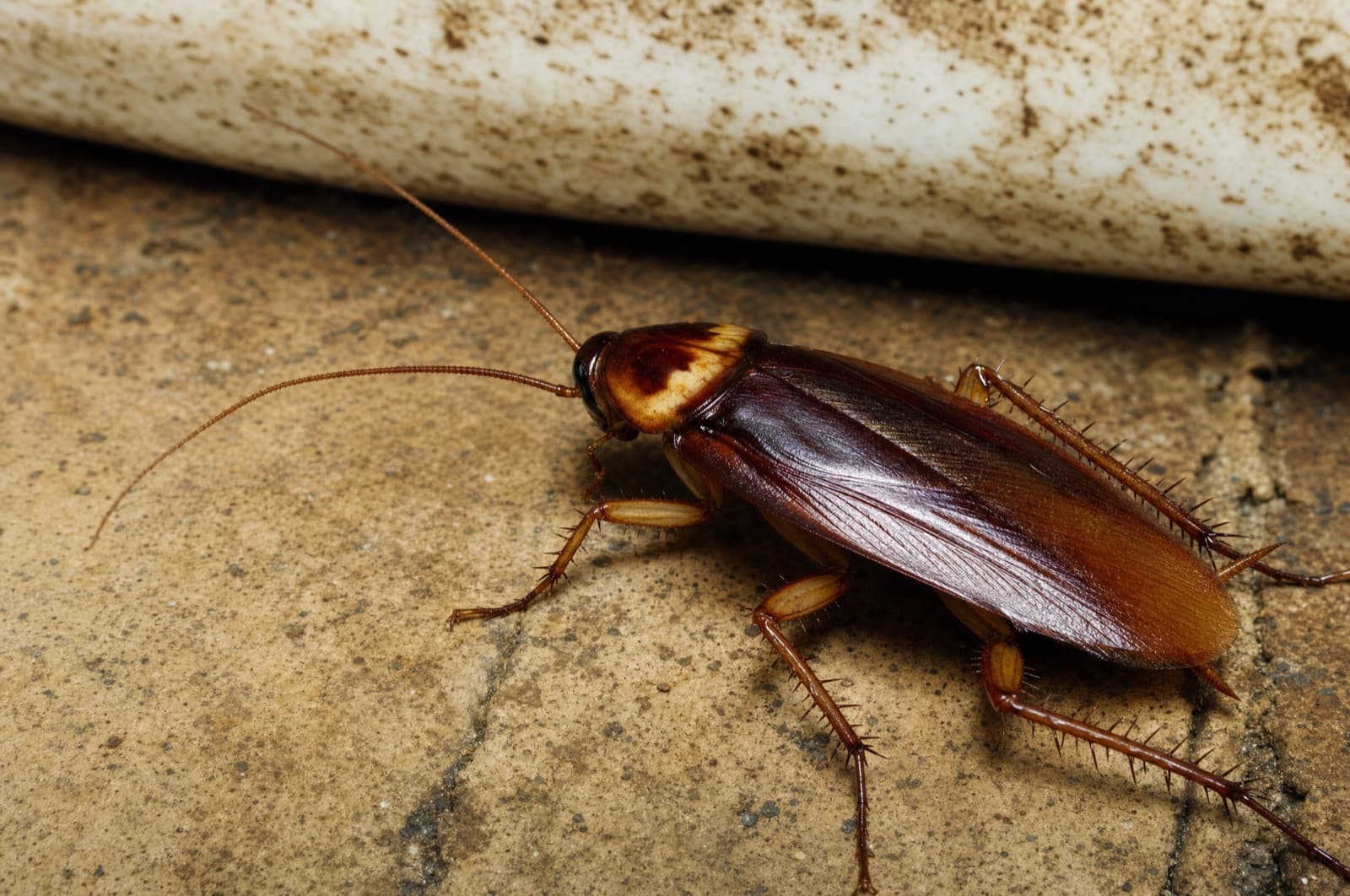
American Cockroach in New Hampshire — ID, Signs & Control
Also called Waterbug · Palmetto bug · Ship cockroach
The American cockroach is the largest common indoor roach in New Hampshire — up to 2 inches, reddish-brown with a pale yellowish figure-8 band on its shield. It's tied to drains, basements, and sewers rather than kitchens, and occasional sightings are usually manageable with sanitation, moisture control, and gel baits. Repeated activity near sumps or drains warrants a pro.
- Adult size
- 1.5–2 in (34–53 mm)
- largest common indoor roach; University of Florida IFAS
- Best visual tell
- Pale figure-8 / halo band on pronotum
- University of Florida IFAS
- Color
- Glossy reddish-brown ('mahogany')
- University of Florida IFAS
- Young per female
- ~150 in a lifetime
- egg-to-adult ~600 days; University of Florida IFAS
- NH status
- Present but uncommon indoors
- UNH Extension: a 'less common' NH roach
- Health angle
- Mechanical bacteria transfer + documented asthma allergen
- CDC/ATSDR environmental asthma triggers
- Where from
- Sewers, drains, steam tunnels, damp foundations
- University of Florida IFAS
The big roach in the basement — what it means for NH homes
The American cockroach is New Hampshire's largest indoor roach — and also one of the least common in your kitchen. Finding one giant, reddish-brown roach near a floor drain or basement sump does not mean your home is infested. American roaches are peridomestic insects: they live primarily in sewers, steam tunnels, and damp utility spaces and wander indoors through drains and foundation gaps, especially in warm weather and during fall migration. A single stray is not proof of a kitchen colony.
The visual give-away is the pale yellowish figure-8 or halo outline on the plate (pronotum) just behind the head — no other NH roach has that badge. The body is glossy reddish-brown and noticeably large, roughly the length of a AA battery.
When American roaches do establish indoors, the fix is a moisture-and-entry-point problem: dehumidify the basement, seal pipe penetrations, clean floor drains, and place gel baits in harborage zones. Avoid total-release foggers — they scatter roaches and leave pesticide residue without reaching the harborage. Repeated sightings, droppings near sumps, or activity in commercial or multi-unit buildings mean it's time for a licensed pro.
How to identify an American cockroach
Three features distinguish the American cockroach from every other NH roach: its large size, reddish-brown color, and the pale yellowish figure-8 or halo outline on the pronotum behind the head. Pair those with a damp-zone location (drain, sump, crawl space, basement) and identification is nearly certain.
American cockroach
- Scientific name
- Periplaneta americana
- Family
- Blattidae
- Size
- ~1.5–2 in (34–53 mm)
- Coloration
- Glossy reddish-brown with a pale yellowish figure-8 / halo band on the pronotum
- Habitat
- Warm, moist areas — basements, crawl spaces, floor drains, sewers, pipe chases, and around bathtubs
- Active season
- Year-round indoors; peaks in warm months; fall migration indoors from sewers and drains
- Diet
- Omnivorous scavenger — decaying organic matter, food scraps, paper, glue, hair
- Reproduction
- Egg case (ootheca) ~0.9 cm holding ~14–16 eggs; female averages 150 young in a lifetime
- Lifespan
- Adults up to ~1 year; full egg-to-adult cycle ~600 days on average
Cosmopolitan; in northern states confined largely to heated commercial/institutional structures, sewers, and steam tunnels
The tells — key ID features
- Pale yellowish figure-8 / halo outline on the pronotum — the single best tell, shared by no other NH roach.
- Large size: 1.5–2 in — the biggest roach found indoors in New Hampshire.
- Glossy reddish-brown ('mahogany') body.
- Fully developed wings; can glide short distances but rarely flies in the North.
- Long whip-like antennae and prominent cerci (tail appendages) at the rear.
Size, to scale
1.5–2 in (34–53 mm)
Roughly the length of a AA battery or a man's thumb
Oriental cockroach
How to tell — Also large and damp-zone-associated, but uniformly near-black and glossy with no figure-8 band; sluggish and slower-moving.
German cockroach
How to tell — Much smaller (~½ in, penny-sized) with two dark parallel stripes behind the head — not the figure-8 halo.
Smokybrown / wood cockroach
How to tell — Similar large size but uniformly colored, lacking the distinctive pale pronotal halo; more common outdoors near woodpiles.
Signs of a problem
American roaches are mostly nocturnal and hidden, so the signs of their presence usually show up before you see a live insect. The dropping shape is the most diagnostic feature — it separates this species from both German roaches and mice.
Large cylindrical droppings with blunt ends and ridged sides (2–3 mm) near drains, sumps, or basement walls
What it means — American-roach activity — the blunt ends distinguish them from pointed mouse droppings.
Dark brown smear marks along walls and moisture sources
What it means — Established harborage route — roaches travel the same paths repeatedly.
Brown, purse-shaped egg cases (oothecae, ~9 mm) in hidden damp spots
What it means — Breeding activity; each case can hold ~14–16 eggs.
Musty, oily odor in basements or utility rooms
What it means — Heavy roach activity producing aggregation pheromones.
Roaches seen in daytime in lighted areas
What it means — Usually a sign of a heavy infestation or a recently disturbed/poisoned population.
The real risks, calibrated
The American cockroach is not a direct health threat — it doesn't bite meaningfully or sting — but it is a documented indirect health concern through mechanical contamination and allergen production.
Mechanical pathogen transfer
ModerateOnset: Ongoing while active indoors
Picks up Salmonella and other bacteria from sewers and decaying matter, then deposits them on food and food-contact surfaces.
Asthma and allergen trigger
ModerateOnset: Chronic exposure
Feces, shed skins, and body parts aerosolize and can trigger asthma and allergic rhinitis, especially in children. Cockroach allergens are a documented indoor asthma trigger (CDC/ATSDR).
Food contamination and odor
Low riskOnset: Ongoing in heavy infestations
Roach secretions taint food flavor and render exposed food unfit for consumption.
Psychological stress
Low riskOnset: Ongoing
Anxiety and embarrassment from sightings, particularly in multi-unit buildings where movement between units is possible.
DIY — what works, what backfires
For occasional American-roach invaders — a single wanderer from the sewer or a minor drain population — DIY is often successful. The approach is moisture control and targeted baiting, not broad spraying.
What actually works
- Fix the moisture problem first: repair leaks, dry out the sump area, and install a basement dehumidifier — these roaches follow dampness.
- Clean and screen floor drains; remove the organic film that serves as food and harbors roaches.
- Seal cracks around pipe penetrations, foundation seams, and utility entry points with caulk or expanding foam.
- Place gel bait stations (e.g., Combat or similar) inside harborage zones — near drains, under the sink, behind the water heater.
- Set sticky traps to monitor activity and confirm locations before and after treatment.
What backfires
- Don't rely on total-release foggers ('bug bombs') — they fail to penetrate harborage, leave indoor pesticide residue, and can disperse roaches to new areas of the home.
- Don't spray repellent insecticide over areas where you've placed gel bait — it renders the bait unpalatable and pushes roaches away from the very traps you set.
- Don't ignore the drainage system — spray alone without addressing moisture and entry points will not produce lasting results.
American cockroaches in New Hampshire homes
UNH Extension lists the American cockroach among New Hampshire's 'less common' roaches. In the Granite State it's most likely encountered in heated commercial kitchens, restaurants, institutional buildings, and damp basements — rarely as a widespread home kitchen breeder. Peak indoor encounters occur in warm months (May–September) and during fall migration when roaches move from outdoor/sewer environments toward warmth. Older homes in Manchester, Nashua, and Concord with damp fieldstone or concrete-block basements, leaky floor drains, and first-floor utility rooms near steam pipes provide the most hospitable conditions.
Peak season
Year-round in heated commercial structures; peaks May–September outdoors; fall migration indoors
You might actually have
- German cockroach (the serious kitchen breeder — small, tan, two dark stripes)
- Oriental cockroach (also large and damp-zone-associated; near-black, no figure-8)
We serve these communities
- NH-licensed applicator · #782664
- Same-day service
- Family-owned since 2017
Service Area Map
Southern New Hampshire
When to call Anchor Pest Services
Occasional wanderers are manageable with DIY, but repeated indoor sightings, droppings near sumps, or activity in commercial or multi-unit buildings signal an established infestation that needs professional inspection and targeted treatment. Anchor's licensed technicians (NH #782664) identify harborage zones you can't see, apply professional gel baits and residual products, and recommend the structural repairs that stop re-entry.
When to call a pro
- Repeated indoor sightings over multiple weeks — not just a single stray.
- Droppings found in basements, utility closets, or around floor drains and sumps.
- Roach activity in a commercial kitchen, restaurant, or multi-unit building.
- DIY baiting hasn't reduced activity after 2–3 weeks.
Keep basement drains clear and dry
Routinely clean floor drains and sump areas; consider a dehumidifier for damp basements — moisture is the primary draw.
Seal the foundation
Caulk gaps around all pipe penetrations, utility entries, and foundation seams; use door sweeps on basement doors.
Manage exterior harborage
Keep firewood off the ground and away from the foundation; remove leaf litter and debris near the house where roaches and moisture accumulate.
Not sure it's a american cockroach?
A licensed NH technician can confirm the species and tell you honestly whether it's a DIY fix or a job for a pro — free inspection, same-day service across Southern New Hampshire.
Frequently asked questions
Sources(6)
- [1]University of Florida IFAS — American Cockroach (IN298)
adult size, color, figure-8 band, reproduction, northern-U.S. range
extensionverified 2026-06-30 - [2]Penn State Extension — American Cockroaches
identification, biology, control
extensionverified 2026-06-30 - [3]University of Maryland Extension — Cockroaches
habitat, indoor migration, control
extensionverified 2026-06-30 - [4]UNH Cooperative Extension — Kitchen Pests Fact Sheet
NH status: 'less common' roach
extensionverified 2026-06-30 - [5]CDC/ATSDR — Environmental Triggers of Asthma
cockroach allergens as documented asthma trigger
govverified 2026-06-30 - [6]Cockroach Care — Cockroach Droppings ID
dropping appearance comparison by species (non-critical visual decoder only)
industryverified 2026-06-30
Written & reviewed by
VerifiedDaniel Brady
NH-Licensed Pesticide Applicator · License #782664 (NHDAMF, RSA 430)
Daniel Brady is the New Hampshire–licensed applicator behind Anchor Pest Services, a family-owned pest control company serving the Manchester area since 2017.
Last updated 2026-06-30

New Hampshire pest control
Dealing with american cockroachs in your home?
Anchor Pest Services identifies and handles american cockroach problems across southern and central New Hampshire. Family-owned since 2017, NH license #782664.
- NH-licensed applicators (#782664)
- Same-day service · free inspection
- Family-owned since 2017
Your next step
- Next step
Is Black Flag Ant & Roach Killer Spray Safe for Pets?
Read the answer - What to do next
How to Get Rid of American Cockroaches
Read the answer - What to do next
What Attracts American Cockroaches to Your House?
Read the answer - What to do next
Are Cockroaches Active at Night? NH Roach Timing Guide
Read the answer - Related guide
Oriental Cockroach in New Hampshire — ID, Signs & Control
Read the answer