
Oriental Cockroach in New Hampshire — ID, Signs & Control
Also called Waterbug · Black beetle · Black cockroach
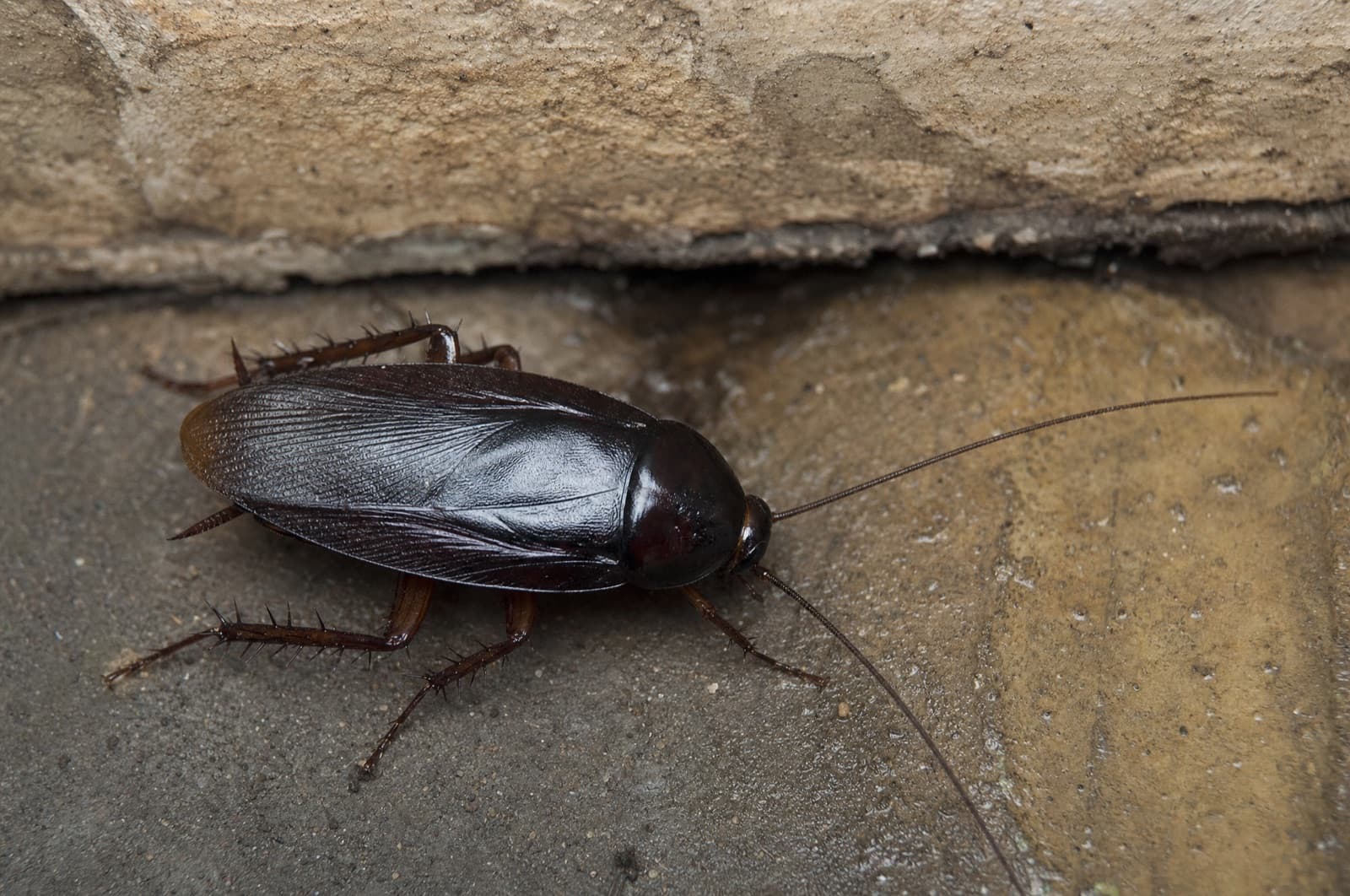
The Oriental cockroach — sometimes called a 'waterbug' or 'black beetle' — is a large (~1 in), sluggish, near-black roach that lives in cool, damp spaces like basements, crawl spaces, and floor drains. It's an occasional invader in New Hampshire, not a kitchen breeder. Finding one signals a moisture problem; fix the dampness and seal entry points, and most homeowners can handle it themselves.
- Adult size
- ~1 in (22–27 mm)
- University of Florida IFAS
- Color
- Glossy dark brown to near-black — no figure-8 band, no stripes
- University of Florida IFAS
- Flight
- Neither males nor females fly
- University of Florida IFAS
- Egg capsules
- ~8 per female, ~16 eggs each
- University of Florida IFAS; Oklahoma State Extension
- Development
- Egg to adult ~1 year through 7 molts
- University of Florida IFAS
- NH status
- Present but 'less common' indoors; tied to damp basements and drains
- UNH Cooperative Extension
- What it signals
- Excess moisture or a drainage problem
- University of Maryland Extension
The 'waterbug' in your basement — what it really is
The Oriental cockroach (*Blatta orientalis*) is frequently called a 'waterbug' or 'black beetle' — two names that capture the two things homeowners notice most about it: its near-black, lacquered appearance and its unmistakable preference for damp, dark places. It is large (~1 inch), broad, and sluggish, which makes it more startling to encounter than the smaller German roach. But it is not a serious kitchen breeder and is far less common indoors in New Hampshire than the German cockroach.
The Oriental roach is a damp-zone specialist: it lives in cool, moist environments — basements, crawl spaces, floor drains, pipe runs, and areas with leaking plumbing. In NH's older homes with damp fieldstone or poured-concrete basements, it occasionally migrates indoors from drains, foundation gaps, and exterior debris — especially after wet weather or during warm-month peak periods. Its presence is best read as a moisture signal: where Oriental roaches appear, there is typically dampness, poor drainage, or decaying organic matter that also raises the risk of mold and structural issues.
The 'waterbug' myth is worth busting: Oriental roaches are not aquatic insects and they don't 'live' inside your plumbing. They travel along pipes and drains and congregate where moisture and organic matter accumulate. Fix the moisture, screen the drains, seal the foundation, and most occasional Oriental roach problems resolve. Recurring basement infestations or roaches climbing into upper floors warrant a professional inspection.
How to identify an Oriental cockroach
The Oriental cockroach is identified by its uniform near-black or very dark brown color, large size, sluggish movement, and strong association with damp environments. It has no figure-8 band (American roach) and no two-stripe pattern (German roach). Think: large, dark, slow, in the basement.
Oriental cockroach
- Scientific name
- Blatta orientalis
- Family
- Blattidae
- Size
- ~1 in (22–27 mm); females slightly broader
- Coloration
- Glossy dark brown to near-black — often described as 'lacquered' or beetle-like
- Habitat
- Cool, damp, dark spaces — basements, crawl spaces, floor drains, around pipe runs and leaking plumbing, beneath debris and leaf litter
- Active season
- Warm months outdoors; year-round in heated but damp basements; peaks after wet weather
- Diet
- Omnivorous scavenger — especially decaying organic matter in drains and damp areas
- Reproduction
- ~8 oothecae per female; each holding ~16 eggs; incubation 42–81 days
- Lifespan
- Developmental period ~1 year through 7 molts; adults live several weeks to months
Cool-climate tolerant; present in the northern and eastern United States; a common pest in parts of the Northwest, Midwest, and New England
The tells — key ID features
- Uniformly glossy, near-black body — no figure-8 band, no stripes — the single most reliable ID feature.
- Large (~1 in) and broad, especially females, which appear almost wingless.
- Males have short wings covering about ¾ of the body; females have only wing pads — neither sex flies.
- Sluggish, slow-moving compared to American or German roaches.
- Strong association with damp, cool environments — almost always found in basements, near drains, or in crawl spaces.
Size, to scale
~1 in (22–27 mm)
About the diameter of a US quarter — large and dark, like a glossy black beetle
American cockroach
How to tell — Similar large size but clearly reddish-brown with a pale figure-8 halo on the pronotum; faster-moving. The American roach never looks black.
Ground beetle (family Carabidae)
How to tell — Also dark and shiny, but beetles have hardened wing covers (elytra) that meet in a straight midline, six short legs, and a very different body shape. Oriental roaches have long, whip-like antennae and the flattened roach profile.
Large dark darkling beetles
How to tell — Similar dark coloration but beetles lack the long antennae and cerci of cockroaches; the body shape is distinctly different once you know what to look for.
Signs of a problem
Oriental cockroaches spend most of their time in inaccessible damp spaces, so the signs of their presence usually appear near floor drains, under sinks, and along basement walls before a live roach is spotted.
Mid-sized, dark, blunt droppings near floor drains, under basement sinks, and in crawl-space corners
What it means — Oriental-roach harborage in the damp zone — droppings are larger than German roach pepper specks but smaller than American roach cylinders.
Large, glossy near-black roaches seen in the basement or crawl space, moving slowly
What it means — Established population in the damp zone; sluggish movement in daylight is typical and distinguishes this species.
Strong, musty or fetid odor in damp areas, basements, or near floor drains
What it means — Heavy roach activity; Oriental roaches are associated with particularly strong odors in dense populations.
Roaches seen climbing water pipes to upper floors, or emerging from sink drains
What it means — Moisture pathway — roaches following pipe runs from lower levels upward; entry points need to be sealed.
Egg capsules in warm, sheltered, damp spots along the floor or basement walls
What it means — Breeding underway; each capsule contains ~16 eggs and incubates for 6–12 weeks.
The real risks, calibrated
Oriental cockroaches are not a direct health threat — they don't bite or sting — but they scavenge in filth and pose an indirect contamination and allergen risk. Their most valuable signal is the moisture problem they indicate.
Mechanical pathogen transfer
ModerateOnset: Ongoing while active
Scavenges in floor drain buildup, decaying matter, and damp debris; transfers bacteria to surfaces they subsequently walk on, including food-prep areas if they migrate upstairs.
Indoor allergen contribution
ModerateOnset: Chronic exposure
Like all cockroaches, shed skins, droppings, and body parts contribute to indoor cockroach allergen loads, which are documented asthma triggers (CDC/ATSDR).
Moisture-problem indicator
ModerateOnset: Ongoing
Oriental roach presence reliably signals excess basement or crawl-space dampness that can also drive mold growth, wood decay, and structural issues — problems that extend well beyond the roach itself.
Odor and nuisance
Low riskOnset: Ongoing in heavy infestations
Oriental roaches produce a distinctive, strong musty odor in high-population areas; significant infestations are unpleasant to inhabit.
DIY — what works, what backfires
Honest verdict: for occasional Oriental roach invaders, DIY is often effective — but the moisture fix must come first. Spraying without addressing dampness and entry points produces only temporary relief. If roaches are recurring or traveling into upper floors, bring in a professional.
What actually works
- Fix the moisture problem first: repair any leaking pipes, improve drainage around the foundation, and run a basement dehumidifier to reduce the humidity that Oriental roaches need.
- Clean and screen floor drains — use drain screens and clean the drain periodically to remove the organic film that feeds roaches.
- Seal foundation cracks and all pipe penetrations where roaches enter from outside or from below.
- Remove exterior harborage: clear leaf litter, wood debris, and mulch piled against the foundation; store firewood elevated and away from the house.
- Use gel bait in harborage zones (under sinks, along drain lines, basement corners) as a targeted supplement to moisture control.
What backfires
- Don't rely on foggers or broad-spray insecticides as the primary approach — without fixing the dampness and sealing entry points, the roaches will return from outdoor and drainage sources within weeks.
- Don't ignore exterior harborage: woodpiles, leaf litter, and debris adjacent to the foundation are a reservoir that continually feeds indoor migration through foundation gaps.
- Don't overlook the crawl space — if you have one, check for standing water, damaged vapor barrier, and unscreened vents that allow easy entry.
Oriental cockroaches in New Hampshire homes
UNH Cooperative Extension lists the Oriental cockroach among New Hampshire's 'less common' indoor roaches. In the Granite State's older housing stock — with damp fieldstone basements, stone-wall foundations, and crawl spaces common in Manchester, Nashua, Concord, and Derry — it is most likely encountered as an occasional invader from floor drains, foundation gaps, and exterior debris piles. Activity peaks in warm months (May–September) and notably increases after wet weather events, when outdoor populations move toward drier indoor spaces through drains and foundation seams.
Peak season
Peak warm months (May–September); year-round in heated damp basements; increased after wet weather
You might actually have
- American cockroach (also a large damp-zone invader; reddish-brown with a pale figure-8 band)
- German cockroach (the serious kitchen breeder; much smaller, tan with two dark stripes)
We serve these communities
- NH-licensed applicator · #782664
- Same-day service
- Family-owned since 2017
Service Area Map
Southern New Hampshire
When to call Anchor Pest Services for Oriental cockroaches
Occasional basement sightings after moisture fixes are usually manageable with DIY. But recurring sightings across multiple seasons, evidence of roaches in drain lines, or roaches migrating to upper floors suggest an entry or harborage problem that needs a professional assessment. Anchor's licensed technicians (NH #782664) can trace the moisture pathways, seal the structural entry points, and apply targeted treatments to the harborage zones that homeowners typically can't reach.
When to call a pro
- Recurring basement or crawl-space sightings after you've dehumidified and addressed obvious leaks.
- Droppings consistently appearing near floor drains or under the basement sink despite cleaning.
- Roaches climbing pipes to reach upper floors or emerging from kitchen or bathroom drains.
- Suspected harborage in a crawl space, utility chase, or buried drain run you can't access.
Dehumidify the basement
Oriental cockroaches require consistent moisture. A basement dehumidifier that keeps relative humidity below 50% eliminates their primary habitat need — and prevents mold to boot.
Screen and maintain floor drains
Install removable drain screens on all basement floor drains; clean and enzyme-treat the drain periodically to eliminate organic buildup that provides food and moisture.
Clear the foundation perimeter
Keep mulch and organic debris at least 12 inches from the foundation, store firewood on a rack away from the house, and rake out leaf litter along foundation walls — especially in fall before NH winters push outdoor populations indoors.
Not sure it's a oriental cockroach?
A licensed NH technician can confirm the species and tell you honestly whether it's a DIY fix or a job for a pro — free inspection, same-day service across Southern New Hampshire.
Frequently asked questions
Sources(6)
- [1]University of Florida IFAS — Oriental Cockroach (IN316)
adult size, coloration, wing development, egg biology, development time
extensionverified 2026-06-30 - [2]
- [3]University of Maryland Extension — Cockroaches
habitat, indoor migration from damp outdoor areas, moisture association
extensionverified 2026-06-30 - [4]UNH Cooperative Extension — Kitchen Pests Fact Sheet
NH status: 'less common' roach
extensionverified 2026-06-30 - [5]CDC/ATSDR — Environmental Triggers of Asthma
cockroach allergens as documented asthma trigger
govverified 2026-06-30 - [6]Cockroach Care — Cockroach Droppings ID
dropping appearance comparison by species (non-critical visual decoder only)
industryverified 2026-06-30
Written & reviewed by
VerifiedDaniel Brady
NH-Licensed Pesticide Applicator · License #782664 (NHDAMF, RSA 430)
Daniel Brady is the New Hampshire–licensed applicator behind Anchor Pest Services, a family-owned pest control company serving the Manchester area since 2017.
Last updated 2026-06-30

New Hampshire pest control
Dealing with oriental cockroachs in your home?
Anchor Pest Services identifies and handles oriental cockroach problems across southern and central New Hampshire. Family-owned since 2017, NH license #782664.
- NH-licensed applicators (#782664)
- Same-day service · free inspection
- Family-owned since 2017
Your next step
- Next step
Is Hot Shot Ultra Liquid Roach Bait Safe for Pets?
Read the answer - What to do next
Are Cockroaches Active at Night? NH Roach Timing Guide
Read the answer - What to do next
How to Get Rid of American Cockroaches
Read the answer - What to do next
Where Do Cockroaches Go In The Winter?
Read the answer - Related guide
American Cockroach in New Hampshire — ID, Signs & Control
Read the answer