
Camel Crickets in New Hampshire — ID, Why They're Inside & Control
Also called Spider cricket · Spricket · Cave cricket · Greenhouse camel cricket
The camel cricket — also called 'spider cricket' or 'spricket' — is a humpbacked, wingless, silent cricket that thrives in damp NH basements, crawl spaces, and garages. It does not bite, does not chirp, and does not damage your home. The jump toward you when surprised is a startle reflex, not an attack. It is a humidity indicator: get relative humidity below 60% and camel crickets leave on their own.
- Body size
- ~9–35 mm body (up to ~1 in), plus very long legs and antennae
- Missouri Dept. of Conservation
- Chirps?
- No — completely wingless and silent
- Missouri Dept. of Conservation
- Bites?
- No
- NC State / PeerJ Epps et al. 2014
- Dominant US-home species
- Invasive Asian Diestrammena asynamora (now Tachycines asynamorus), found by >90% of respondents in 2014 NC State citizen-science study
- Epps, Menninger, LaSala & Dunn, PeerJ 2:e523
- Driver indoors
- Excess moisture — target <60% RH to eliminate them
- Missouri Dept. of Conservation
- NH status
- Present — native Ceuthophilus spp. plus the invasive Asian species
- Regional extension sources
- Lifespan
- ~1–2 years
- General entomological sources
The 'spider cricket' that jumps at you — and why it's harmless
The camel cricket — nicknamed 'spider cricket' or 'spricket' by alarmed homeowners — is one of the most misunderstood insects in New Hampshire basements. It startles people because it is large, humpbacked, spider-like in appearance, and when surprised it jumps toward you. That jump is a startle reflex, not aggression — the camel cricket has no mechanism to bite, sting, or harm you.
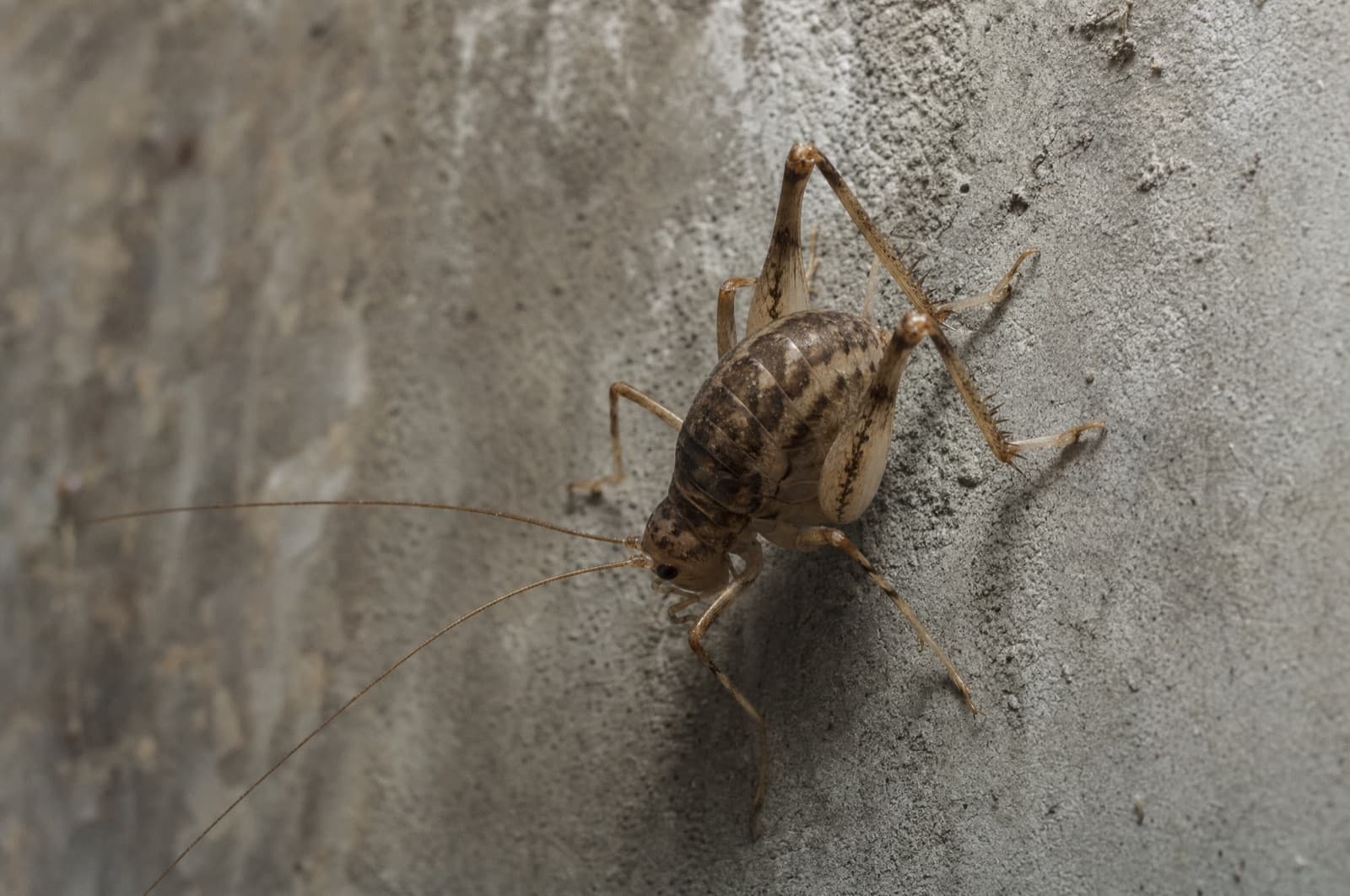
The ID is straightforward once you know the three tells: (1) humpbacked profile like a camel; (2) completely wingless — it cannot fly and it makes no chirping sound (the chirping cricket in your basement is a house cricket, a separate species); (3) six legs and long antennae, confirming it is an insect, not a spider despite its appearance.
Here is what most sites miss: in eastern US homes, the dominant camel cricket species is no longer the native *Ceuthophilus*. A 2014 NC State citizen-science study published in *PeerJ* found that the invasive Asian greenhouse camel cricket (*Diestrammena asynamora*, recently reclassified as *Tachycines asynamorus*) was reported by more than 90% of respondents who found camel crickets in their homes. This invasive species has quietly taken over eastern basements.
The most important NH-specific insight: camel crickets are a humidity indicator. They thrive in damp basements, crawl spaces, and garages with relative humidity above 60%. Get the humidity down and they leave on their own — a dehumidifier does more than any spray.
How to identify a camel cricket
Three features nail the ID: the humped back, the complete absence of wings (and therefore no chirping), and the six legs plus long antennae confirming it is an insect rather than a spider. The extremely long antennae — often longer than the body — and the powerful, disproportionately long hind legs round out the picture. It looks more spider-like than any cricket has a right to.
Camel cricket
- Scientific name
- Diestrammena asynamora (invasive Asian; now Tachycines asynamorus) and Ceuthophilus spp. (native)
- Family
- Rhaphidophoridae (cave and camel crickets)
- Size
- ~9–35 mm body (up to ~1 in), with legs extending well beyond body length
- Coloration
- Tan to dark brown, often with irregular banding or mottling; no distinctive color pattern
- Habitat
- Damp basements, crawl spaces, garages, sheds, under logs and stones; any cool, dark, humid space
- Active season
- Most noticeable late summer through fall; present year-round in climate-controlled damp spaces
- Diet
- Omnivorous scavenger — decaying organic matter, fungi, dead insects, occasional plant material; may nibble cardboard and fabric in large numbers
- Reproduction
- Females have a long blade-like ovipositor used for laying eggs in soil or crevices; it is not a stinger
- Lifespan
- ~1–2 years
Native Ceuthophilus spp. occur throughout New England; the invasive Asian D. asynamora is now the dominant species in eastern US homes including NH/MA, per 2014 NC State PeerJ study
The tells — key ID features
- Humpbacked, arched body — the 'camel' profile that names the insect; the most distinctive visual tell.
- Completely wingless — no wings of any kind, and therefore completely silent (no chirping possible).
- Extremely long, thread-like antennae, often longer than the body.
- Powerful, disproportionately long hind legs; jumps when startled, sometimes toward the disturbance.
- Females have a long, blade-like ovipositor at the rear — harmless, not a stinger.
- Six legs and antennae confirm it is an insect, not a spider (spiders have eight legs and no antennae).
Size, to scale
Body up to ~1 in (35 mm); leg span considerably larger
Body about the size of a large grape; the leg span makes it look as large as a small spider — hence 'spider cricket'
Spiders (most common misidentification)
How to tell — Camel crickets have six legs plus two long antennae — spiders have eight legs and no antennae. Count the legs: six means insect, harmless.
House cricket
How to tell — House crickets are winged, pale yellowish-brown with three dark head bands, and they chirp loudly. Camel crickets are wingless, silent, and humpbacked. If it makes noise, it is a house cricket.
Wolf spider
How to tell — Wolf spiders have eight legs in two rows of four and no antennae. Camel crickets have six legs, two antennae, and a clearly humped thorax.
Signs of a problem
Camel crickets leave a clear signature: they are where the humidity is. Each sign below also identifies the moisture condition driving them.
Humpbacked, jumping insects in the basement or crawl space
What it means — Classic camel cricket — the humidity in that space is above their preferred threshold of ~60% RH. Dehumidify to resolve.
No chirping from the cricket-like insects you're seeing
What it means — Confirms camel cricket (wingless/silent) rather than house cricket (winged/chirps). The silence is diagnostic.
Chewed or nibbled cardboard, paper, or fabric in damp storage areas
What it means — Occasional scavenging by a camel cricket population large enough to be feeding on stored materials — a sign of an established population, not just a stray.
Sightings near the sump pump, floor drain, or damp concrete walls
What it means — Humidity attraction — these are the highest-moisture spots in the basement and the first places camel crickets colonize.
Insects present year-round in the basement (not just fall)
What it means — Climate-controlled basements with sustained moisture provide year-round habitat; the population is established, not seasonal.
The real risks, calibrated
Camel crickets are among the most harmless insects that NH homeowners encounter. The startle factor is real; the actual risk is very low.
Bite
Low riskOnset: Does not bite humans
Camel crickets have chewing mouthparts for scavenging but do not bite people. NC State / PeerJ confirms they are harmless to humans in this regard.
Startle/jump-toward reflex
Low riskOnset: When disturbed
Camel crickets jump toward a perceived threat as a startle defense — not aggression. The jump is surprising but harmless. No venom, no biting, no physical injury.
Scavenging damage to stored items
Low riskOnset: With larger populations over time
Large camel cricket populations in damp storage areas may nibble cardboard boxes, paper, and stored fabric. Minor damage in typical NH household situations.
Moisture indicator — flags humidity and potential mold risk
ModerateOnset: Ongoing presence
The real risk is what camel crickets signal: sustained high humidity in a basement or crawl space is a condition that promotes mold growth and can affect indoor air quality. Treat the crickets as the warning, not the problem.
DIY — what works, what backfires
Camel cricket control is moisture management. A dehumidifier does more than any spray. Address the humidity and the crickets leave — and stay out — on their own.
What actually works
- Dehumidify the basement or crawl space to maintain relative humidity below 60% — this is the single most effective camel cricket control step.
- Fix leaks and improve drainage: check window wells, basement floor drains, and crawl-space moisture barriers.
- Seal foundation cracks, crawl-space access gaps, and voids around pipes and utility lines.
- Remove damp clutter — cardboard boxes, old clothing, and stored items on damp floors provide harborage and food.
- Use sticky traps (glue boards) in corners to monitor population size and reduce numbers.
What backfires
- Don't bother spraying without fixing the moisture — camel crickets will return as long as the humidity is right for them.
- Don't mistake the jump reflex for aggression — they jump toward you because any large silhouette looks threatening to a cricket; they cannot bite.
- Don't ignore a persistent population as a cosmetic issue — it signals sustained high humidity that may be promoting mold or structural moisture damage.
Camel crickets in New Hampshire basements and crawl spaces
Camel crickets are a classic NH stone-foundation basement dweller. Homes across Manchester, Nashua, Concord, and the southern NH communities Anchor serves — particularly those with older fieldstone or block foundations that naturally hold moisture — report camel cricket populations in late summer and fall. They are most noticeable as basement activity increases before the school year and during the late-summer home-inspection season. The invasive Asian species now dominates indoor populations across the Northeast, including NH. A dehumidifier run to maintain relative humidity below 60%, combined with sealing foundation gaps and crawl-space entry points, is the standard recommendation from UNH Extension and regional pest management specialists.
Peak season
Late summer through fall most noticeable; year-round in heated, damp spaces
You might actually have
- House cricket (winged, yellowish-brown, chirps — a completely different pest)
- Silverfish (cool/damp, silvery, eats paper and fabrics — same damp driver)
- Springtail (tiny, jumps from moisture — same damp driver)
We serve these communities
- NH-licensed applicator · #782664
- Same-day service
- Family-owned since 2017
Service Area Map
Southern New Hampshire
When to call Anchor Pest Services for camel crickets
A dehumidifier and foundation sealing resolve most camel cricket situations. Professional help is most useful when populations persist despite moisture control efforts, when a crawl space or foundation moisture issue is suspected but not confirmed, or when a more comprehensive moisture-plus-exclusion assessment would benefit a home with a history of wet basement problems.
When to call a pro
- Persistent basement or crawl-space populations despite running a dehumidifier below 60% RH.
- You suspect a crawl-space vapor barrier failure or foundation moisture problem contributing to sustained high humidity.
- Population is large enough that damage to stored items is occurring.
- You want a combined moisture-assessment and exclusion plan for a home with recurring seasonal populations.
Run a dehumidifier to keep basement RH below 60%
This is the single most important step. NH's high-summer humidity regularly pushes unventilated basements above 70–80% RH. A properly sized dehumidifier cycling continuously in the basement removes the primary condition that sustains camel cricket populations.
Install a crawl-space vapor barrier
NH stone-foundation basements and crawl spaces without a ground-contact vapor barrier allow soil moisture to continuously enter the space. A 6-mil or heavier polyethylene barrier on the crawl-space floor significantly reduces the baseline humidity that supports camel crickets, silverfish, and other moisture pests.
Seal foundation gaps and crawl-space access vents
Camel crickets enter through any gap in the foundation — mortar cracks in fieldstone, unsealed crawl-space vents, gaps around pipe penetrations. Systematic sealing with hydraulic cement or foam before late summer prevents seasonal entry from the outdoor population.
Not sure it's a camel cricket?
A licensed NH technician can confirm the species and tell you honestly whether it's a DIY fix or a job for a pro — free inspection, same-day service across Southern New Hampshire.
Frequently asked questions
Sources(6)
- [1]Missouri Department of Conservation — Camel Crickets / Cave Crickets
Body size up to ~1 in; wingless and silent; dark/damp habitat preference; omnivorous scavenging diet
govverified 2026-06-30 - [2]Epps et al. 2014 — PeerJ 2:e523 (via NC State News)
Invasive Asian D. asynamora found by >90% of respondents in eastern US homes; species dominance in home environments
academicverified 2026-06-30 - [3]NC State News — Camel Cricket Research
Citizen-science study findings; invasive Asian species prevalence in eastern US homes including New England
newsverified 2026-06-30 - [4]iNaturalist — Tachycines asynamorus
Current accepted scientific name reclassification from Diestrammena asynamora
encyclopediaverified 2026-06-30 - [5]UNH Cooperative Extension — Insect & Other Arthropod Identification
NH presence verification; moisture control guidance for seasonal invaders
extensionverified 2026-06-30 - [6]UNH Cooperative Extension — Seasonal Insect Invaders in NH Homes
NH presence; stone-foundation basement habitat; humidity-first management guidance
extensionverified 2026-06-30
Written & reviewed by
VerifiedDaniel Brady
NH-Licensed Pesticide Applicator · License #782664 (NHDAMF, RSA 430)
Daniel Brady is the New Hampshire–licensed applicator behind Anchor Pest Services, a family-owned pest control company serving the Manchester area since 2017.
Last updated 2026-06-30

New Hampshire pest control
Dealing with camel crickets in your home?
Anchor Pest Services identifies and handles camel cricket problems across southern and central New Hampshire. Family-owned since 2017, NH license #782664.
- NH-licensed applicators (#782664)
- Same-day service · free inspection
- Family-owned since 2017
Your next step
- Fall guide
Fall Pest Control in New Hampshire
What matters before frost: the fall invader window, mice at the foundation, and what to seal first.
Read the answer - What to do next
How to Get Rid of Camel Crickets
Read the answer - What to do next
When Do Crickets Come Inside? NH Cricket Timing Guide
Read the answer - What to do next
Are crickets a fall pest concern?
Read the answer - What to do next
How to control indoor crickets in fall?
Read the answer - Related guide
House Crickets in New Hampshire — ID, the Chirp & Control
Read the answer