
House Crickets in New Hampshire — ID, the Chirp & Control
Also called Hearth cricket
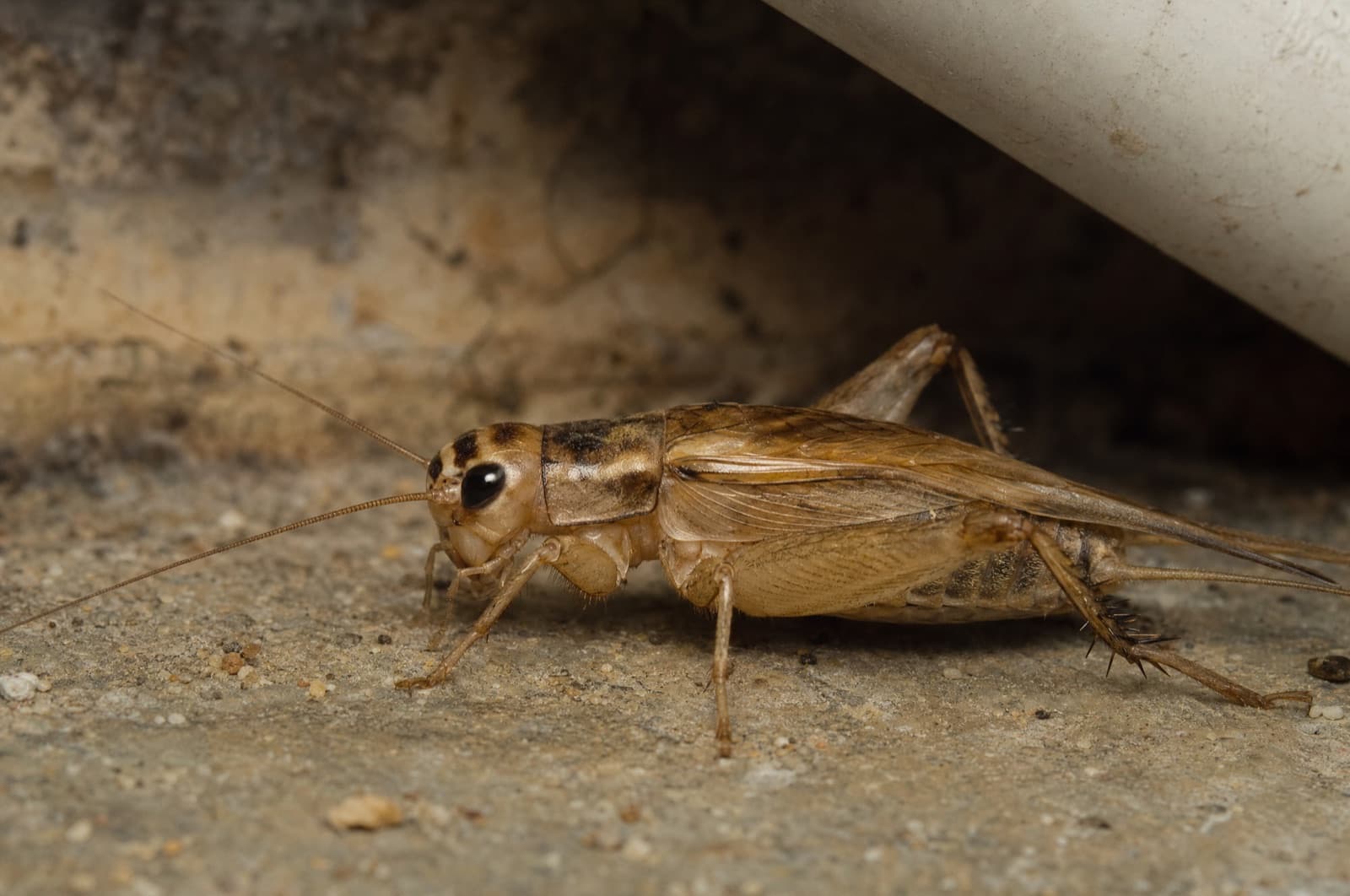
The house cricket is the small yellowish-brown, chirping cricket found in NH basements, utility rooms, and garages each fall. Only males chirp — by rubbing their forewings — and the chirp rate actually tracks air temperature via Dolbear's Law. House crickets are harmless nuisances that may nibble fabric in large numbers but cause no structural or health harm.
- Adult size
- ~¾–1 in (19–25 mm)
- MU Extension
- ID tell
- Three dark bands across the head plus audible chirping
- MU Extension
- Chirp thermometer
- Chirps in 15 seconds + 40 ≈ temperature in °F (Dolbear's Law)
- Dolbear's Law (Dolbear, 1897); naturalist sources
- Who chirps?
- Males only — by stridulating (rubbing) their forewings
- Dolbear's Law sources; MU Extension
- Driver indoors
- Cool fall temperatures; attracted to lights
- MU Extension
- Breeds indoors?
- Yes — unlike most occasional invaders
- MU Extension
- Adult lifespan
- ~2–3 months
- MU Extension
The chirping cricket behind your radiator — and what its song tells you
That rhythmic chirping behind the baseboard heater or in the basement corner is almost certainly a house cricket (*Acheta domesticus*) — the small, pale yellowish-brown cricket with three dark bands across its head. Only males chirp, and they do it by stridulating: rubbing a serrated ridge on one forewing against the other wing's edge.
Here is the genuinely useful hook that most pages skip: the chirp rate tracks temperature. Dolbear's Law, established in 1897 and subsequently validated, states that counting the chirps a cricket makes in 15 seconds and adding 40 gives an approximation of the air temperature in degrees Fahrenheit. So the cricket behind your radiator is a living thermometer.
The NH-seasonal story: cool fall temperatures drive house crickets indoors, where warm basements, utility rooms, and garages provide year-round conditions they like. They are attracted to outdoor lights at night, which concentrates them near exterior doors where they slip inside. Unlike most occasional invaders, house crickets can breed indoors — but a large indoor breeding population is unusual in a typical NH home. Most fall encounters involve one or a few males that wandered in.
The most important NH basement disambiguation: if it chirps, it's a house cricket; if it's silent and humpbacked, it's a camel cricket — and a moisture problem. These two are the most commonly confused basement insects in southern NH.
How to identify a house cricket
The house cricket's ID is built on sound and color: it chirps (which the silent, humped camel cricket does not) and it is pale yellowish-brown with three distinctive dark bands across the head (which field crickets, which are dark brown to black, do not share). Wings are present. At ~¾–1 inch it is larger than most incidental bug visitors and smaller than a large camel cricket.
House cricket
- Scientific name
- Acheta domesticus
- Family
- Gryllidae (true crickets)
- Size
- ~¾–1 in (19–25 mm)
- Coloration
- Light yellowish-brown body; three distinctive dark brown bands across the head; wings present and held flat
- Habitat
- Warm, somewhat dark indoor spots — basements, utility rooms, behind appliances, under sinks; outdoors in warm weather near garbage and refuse piles
- Active season
- Driven indoors by cool fall temperatures; can live in heated buildings year-round; most common fall through winter
- Diet
- Omnivorous — plant matter, paper, fabrics (especially soiled fabric), crumbs, and occasionally other insects
- Reproduction
- Can breed indoors; females lay eggs in moist substrate; lifecycle approximately 60–90 days
- Lifespan
- ~2–3 months as an adult
Native to southwestern Asia; established worldwide; common across all of New Hampshire as a year-round indoor and warm-season outdoor cricket
The tells — key ID features
- Audible chirping by males — the fastest field ID; the silent, humpbacked camel cricket does not chirp at all.
- Three dark brown bands across the head — distinctive on the pale yellowish background.
- Light yellowish-brown body — noticeably paler than the dark field cricket.
- Wings present and held flat along the back (unlike the wingless camel cricket).
- ~¾–1 inch; long antennae and powerful hind legs for jumping.
- Female has a long, needle-like ovipositor extending from the rear (harmless).
Size, to scale
~¾–1 in (19–25 mm)
About the length of a standard paperclip
Camel cricket (most common NH confusion)
How to tell — Camel crickets are wingless, humpbacked, silent, and much longer-legged in proportion to body size. House cricket is pale, winged, and chirps. If it makes noise, it is a house cricket.
Field cricket (Gryllus spp.)
How to tell — Field crickets are dark brown to black — significantly darker than the pale yellowish-brown house cricket. Field crickets also chirp but are mostly outdoor insects that rarely establish indoors.
Grasshopper
How to tell — Grasshoppers are larger, have distinctly short antennae (house crickets have very long antennae), and are outdoor insects that do not enter homes.
Signs of a problem
House crickets announce themselves loudly — here is how to interpret each sign.
Rhythmic nighttime chirping from the basement, utility room, or behind an appliance
What it means — One or more male house crickets calling for a mate; the chirp rate at 15-second intervals + 40 approximates the air temperature in °F (Dolbear's Law).
Cricket activity near exterior lights or doors at night
What it means — House crickets are attracted to outdoor lighting; concentrations near lit doorways signal how they are getting inside.
Small irregular holes or thinning in fabric, especially soiled garments in storage
What it means — Feeding damage from a larger indoor population; house crickets prefer fabrics with organic stains (perspiration, food) over clean fabric.
Sightings in warm, dark corners of the basement or behind the water heater
What it means — Preferred indoor harborage — warm, somewhat dark, and not excessively damp.
The real risks, calibrated
House crickets are a genuine nuisance but not a health or structural risk. Honest assessment: the risks are low.
Nighttime chirping noise
Low riskOnset: As soon as a male begins calling
A single male cricket in a room can make sleep difficult — the chirp is loud and repetitive. This is the primary complaint from NH homeowners and the main quality-of-life impact.
Fabric and paper damage
Low riskOnset: With larger indoor populations over time
House crickets chew small holes in fabric — especially soiled clothing, upholstery, or stored textiles — and will nibble paper and cardboard. Damage is minor with a few crickets but can accumulate with a sustained indoor population.
Biting people
Low riskOnset: Rarely, not of concern
House crickets have chewing mouthparts and can theoretically bite skin, but unprovoked biting of people is extremely rare and not a practical concern in normal indoor encounters.
Health or structural harm
Low riskOnset: Not applicable
House crickets do not transmit disease to people, do not damage wood or structural materials, and do not cause allergic reactions in most people. MU Extension rates them as a low-risk nuisance.
DIY — what works, what backfires
House cricket control combines exclusion (stop new entries), harborage reduction (remove what keeps them comfortable), and trapping or removal of existing individuals. Locating the chirping male is often the fastest resolution.
What actually works
- Seal entry gaps around door frames, foundation sills, utility penetrations, and window wells — especially on the first floor and basement level.
- Replace or adjust door sweeps on exterior doors; even a narrow gap at the bottom of a door is a cricket highway in fall.
- Reduce outdoor lighting near entry doors in fall; switching to amber/yellow LED lights that are less attractive to insects reduces the congregation that leads to indoor entry.
- Locate and remove the chirping male by sound: use a flashlight at night to follow the chirp to its source, then vacuum or hand-capture and release outdoors.
- Use sticky traps (glue boards) along walls in basements or utility areas to capture and monitor populations.
What backfires
- Don't assume the chirping is a camel cricket — camel crickets are completely silent. If it chirps, it is a house cricket.
- Don't leave exterior lights blazing near entry doors at night during September and October — this actively recruits crickets to your doorstep.
- Don't ignore ongoing fabric damage in storage areas — small holes in stored clothing or upholstery signal a cricket population that warrants action.
House crickets in New Hampshire homes
House crickets are common across New Hampshire and enter homes in highest numbers as September and October temperatures drop. Warm basements, utility areas, and heated garages in Manchester, Nashua, Derry, Bedford, and across Hillsborough County are the typical indoor habitats. Unlike camel crickets, which signal a humidity problem, house crickets are primarily a cool-temperature response — they prefer dry, warm spots rather than damp ones. The nighttime chirp is the #1 call driver for this species; a single male behind a baseboard heater can produce substantial sound. Indoor populations that grow large enough to damage fabric require a more systematic exclusion response.
Peak season
Fall and winter indoors as temperatures drop; most enter September–October
You might actually have
- Camel cricket / spider cricket (silent, humpbacked, moisture-driven — not the same)
- Field cricket (darker/black, outdoor species, may also enter in fall)
We serve these communities
- NH-licensed applicator · #782664
- Same-day service
- Family-owned since 2017
Service Area Map
Southern New Hampshire
When to call Anchor Pest Services for house crickets
A single stray cricket that wandered inside is a DIY fix. Persistent populations that chirp night after night, multiple generations breeding indoors, or fabric damage across multiple seasons indicate a more systematic entry-and-harborage problem that benefits from professional exclusion and targeted treatment.
When to call a pro
- Persistent chirping populations that return each fall despite exclusion efforts.
- Evidence of indoor breeding — sightings of different size classes (adults plus juveniles) or egg-laying activity.
- Fabric or paper damage accumulating across a season.
- You cannot locate the entry point(s) driving a recurring population.
Seal the foundation sill in late summer
The foundation sill — where the house frame meets the concrete — is the most common cricket entry point in older NH homes. Inspect and seal this zone with foam or caulk before September to close the main fall entry route.
Switch exterior lights to amber LEDs
Broad-spectrum white and blue-spectrum lights attract insects. Switching porch and garage lights to warm amber LEDs reduces the concentration of crickets and other insects near entry doors in fall.
Reduce basement clutter and damp harborage
House crickets prefer dark, warm, somewhat cluttered areas. Clearing boxes, old fabric, and clutter from basement corners and utility areas removes the preferred harborage and makes it easier to detect and eliminate individual crickets.
Not sure it's a house cricket?
A licensed NH technician can confirm the species and tell you honestly whether it's a DIY fix or a job for a pro — free inspection, same-day service across Southern New Hampshire.
Frequently asked questions
Sources(5)
- [1]MU Extension — House-Invading Crickets
Adult size 19–25 mm; three dark head bands; yellowish-brown color; drives indoors in cool weather; breeds indoors; lifespan ~2–3 months; fabric damage
extensionverified 2026-06-30 - [2]A. E. Dolbear — 'The Cricket as a Thermometer,' The American Naturalist 31(371):970–971 (1897)
Chirps in 15 seconds + 40 ≈ °F (Dolbear's Law); original publication of the formula
peer-reviewedverified 2026-06-30 - [3]Missouri Department of Conservation — True Crickets
Biology and behavior; stridulation; attraction to lights; corroborating life history
govverified 2026-06-30 - [4]UNH Cooperative Extension — Insect & Other Arthropod Identification
NH presence verification; seasonal timing; exclusion guidance
extensionverified 2026-06-30 - [5]Garden.org — NOAA Frost Date Calculator (Manchester, NH)
NH seasonal context for fall cricket invasion; first frost timing
govverified 2026-06-30
Written & reviewed by
VerifiedDaniel Brady
NH-Licensed Pesticide Applicator · License #782664 (NHDAMF, RSA 430)
Daniel Brady is the New Hampshire–licensed applicator behind Anchor Pest Services, a family-owned pest control company serving the Manchester area since 2017.
Last updated 2026-06-30

New Hampshire pest control
Dealing with house crickets in your home?
Anchor Pest Services identifies and handles house cricket problems across southern and central New Hampshire. Family-owned since 2017, NH license #782664.
- NH-licensed applicators (#782664)
- Same-day service · free inspection
- Family-owned since 2017
Your next step
- Fall guide
Fall Pest Control in New Hampshire
What matters before frost: the fall invader window, mice at the foundation, and what to seal first.
Read the answer - What to do next
How to Get Rid of House Crickets
Read the answer - What to do next
When Do Crickets Come Inside? NH Cricket Timing Guide
Read the answer - What to do next
How to Get Rid of Camel Crickets
Read the answer - What to do next
How to control indoor crickets in fall?
Read the answer - Related guide
Camel Crickets in New Hampshire — ID, Why They're Inside & Control
Read the answer