
Chipmunks in New Hampshire — ID, Signs & Control
Also called Chippie · Striped ground squirrel
Eastern chipmunks (Tamias striatus) are burrowing rodents whose 12–30-foot tunnel systems can undermine NH patios, stone steps, and retaining walls — but they almost never threaten house foundations. That 'foundation collapse' fear is greatly exaggerated; most chipmunk damage involves only minimal economic loss. The signature sign is a clean, round, ~2-inch hole with no dirt mound. Removing food attractants (especially spilled bird seed), eliminating ground cover near the foundation, and trapping at active burrow entrances are the most effective control strategies.
- Body size
- 5–6 in body, 3–4 in tail, ~3 oz
- Penn State Extension / ICWDM
- Burrow length
- 12–30 ft of tunnels with a ~2-inch entrance and NO dirt mound
- Penn State Extension; ICWDM — absence of a dirt fan is the signature ID cue
- Typical damage cost
- Minimal in the majority of cases
- ICWDM — 'the majority of chipmunk damage involves minimal economic loss'
- Litters
- 2 per year; April–June and August–October; 2–5 pups each litter
- ICWDM; gestation 31 days
- Rabies risk
- Very rare in small rodents including chipmunks
- NH DHHS — chipmunks listed explicitly among low-risk species
The burrowing neighbor that isn't quite the threat you've heard
The eastern chipmunk is one of the most familiar — and most misrepresented — wildlife problems in New Hampshire. Online forums are full of warnings about chipmunks 'destroying foundations,' but the evidence simply doesn't support that level of alarm. The documented structural damage from chipmunks almost always involves lighter landscape elements: patio slabs, stone steps, wooden retaining walls, and garden borders. The majority of cases result in only minimal economic loss, per the Integrated Crop and Wildlife Damage Management (ICWDM) program.
The real signature of a chipmunk problem is the burrow entrance: a clean, round hole roughly 2 inches in diameter with no dirt mound — because chipmunks carry excavated soil away in their cheek pouches and scatter it far from the opening. That 'tidy hole with no dirt' separates chipmunk burrows from Norway rat holes (similar size but with a soil scatter fan) and groundhog holes (10–12 inches across with a large dirt fan).
Eastern chipmunks (Tamias striatus) are active from roughly April through October in New Hampshire, then enter a light torpor — not true hibernation — returning to cached food stores underground throughout mild winter spells. Populations climb quickly wherever bird feeders, rock piles, and dense foundation plantings combine to offer food, cover, and shelter in the same spot. Removing those attractants is the highest-leverage control step you can take.
This guide covers identification, burrow-hole signature decoding, honest risk assessment, and the most effective DIY and professional control approaches for southern New Hampshire.
How to identify the eastern chipmunk in New Hampshire
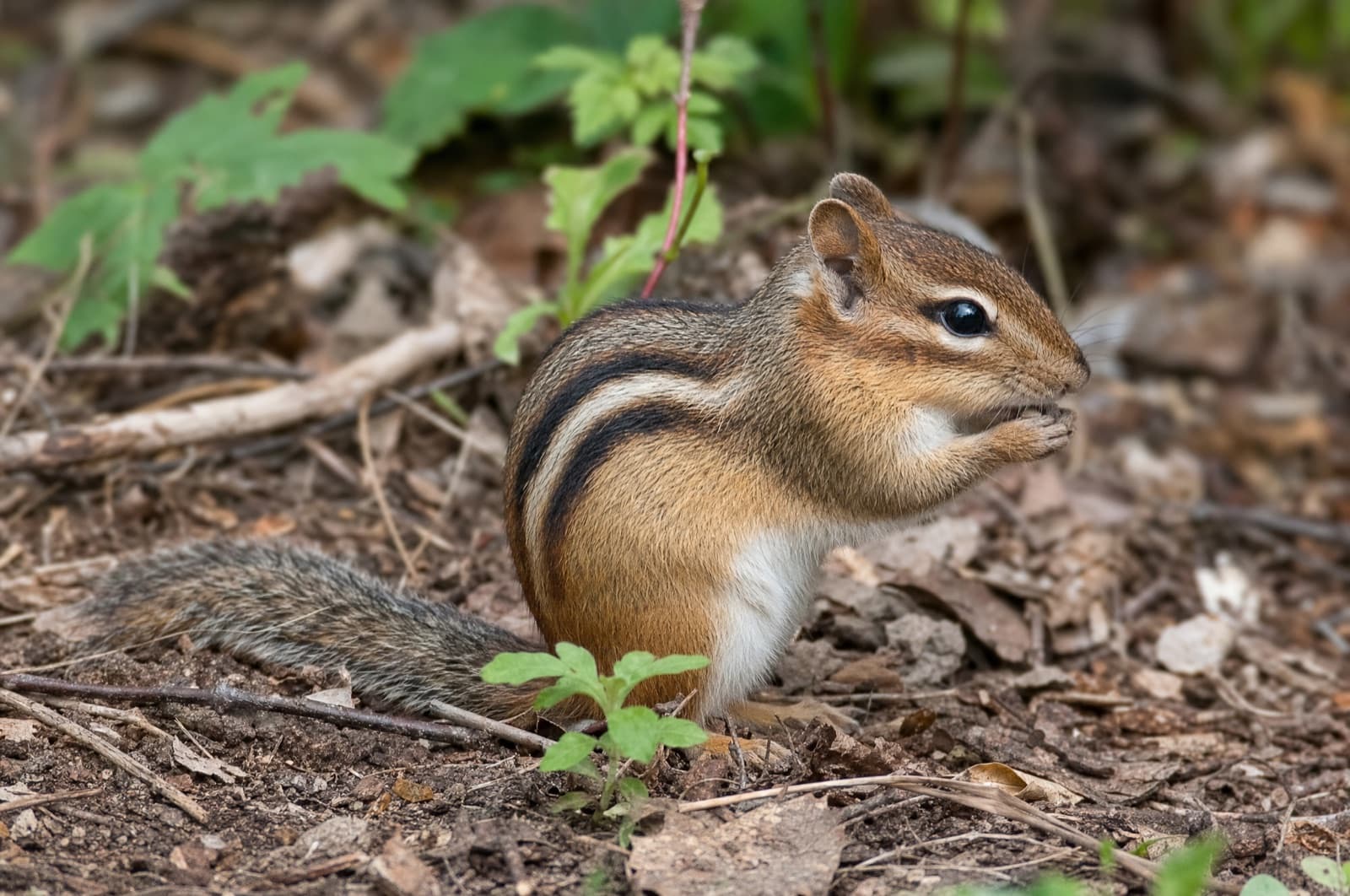
The eastern chipmunk is the only chipmunk species in New Hampshire, so species ID is straightforward once you know the pattern. The challenge is distinguishing chipmunks from voles (similar size, no stripes, runways in lawn), red squirrels (similar size, no stripes, arboreal), and juvenile gray squirrels (larger, no stripes). The five dark and two tan back stripes running from shoulder to rump — plus the facial stripes running through the eye — are definitive. Chipmunks also have cheek pouches visible when foraging, a rusty-red rump contrasting with the brown back, and an upright, flicking tail.
Eastern chipmunk
- Scientific name
- Tamias striatus
- Family
- Sciuridae
- Size
- Body 5–6 in; tail 3–4 in; weight ~3 oz
- Coloration
- Reddish-brown back with five dark brown and two tan/white stripes running shoulder to rump; two facial stripes through the eye; rusty-red rump; white underside
- Habitat
- Ground-dwelling; burrows in well-drained soil under fieldstone walls, patios, steps, dense shrubs, woodpiles, and building foundations. Does not climb to roost; sleeps in burrow.
- Active season
- Active April–October in NH; enters light torpor November–March but emerges on warm winter days to access underground food caches
- Diet
- Seeds, nuts (acorns, beechnuts), berries, fungi, insects, bird eggs, and small vertebrates; caches food in underground tunnels for winter
- Reproduction
- 2 litters per year: first born April–June, second born August–October; 2–5 pups per litter (up to 9); gestation 31 days; pups emerge from burrow at about 6 weeks
- Lifespan
- 2–3 years in the wild; up to 8 years in captivity
Common throughout New Hampshire, from the Seacoast through the White Mountains. Most abundant in edge habitats — woodland margins, residential yards, and stone-wall borders.
The tells — key ID features
- Five dark and two tan back stripes running shoulder to rump — the single most reliable field ID; no other NH ground mammal shares this pattern.
- Two dark facial stripes passing through the eye on each side of the face, visible at close range.
- Rusty-red rump contrasting with the browner back — distinctive even at a distance.
- Rapid, jerky movement on the ground with tail held nearly vertical; freezes and flicks tail when alarmed.
- Cheek pouches visibly bulging when carrying seeds or nuts toward the burrow — often the first time homeowners get a close look.
- Rapid 'chuck-chuck-chuck' alarm call, usually from a perch on a stone wall or stump, when a predator or human approaches.
Size, to scale
Body 5–6 in; tail 3–4 in; ~3 oz
About the length of a hot dog without the bun; weighs roughly as much as four AA batteries
Red squirrel
How to tell — Red squirrels are arboreal — they run up and down trees, not along the ground. They are reddish overall with NO back stripes and a white eye ring. Red squirrels have a sharp, scolding 'churr' call and are highly territorial around their food caches.
Vole / meadow vole
How to tell — Voles are smaller (~4–5 in with a very short tail ~1 in), have no stripes, chubby bodies, small rounded ears, and create surface runways in lawn grass. They do not burrow deeply; their entry holes are smaller and more irregular than chipmunk holes.
Juvenile gray squirrel
How to tell — Juvenile gray squirrels in late summer are similar in size to chipmunks but are gray or brownish-gray overall with no stripes. Their heads are proportionally larger and rounder, and they spend time both on the ground and in trees.
Signs of a problem
The most reliable chipmunk signs are all connected to the burrow system. Learning to read the hole is the fastest way to confirm what you have — and to separate chipmunk activity from groundhog, rat, or vole problems.
Clean, round ~2-inch holes in the ground with no dirt mound or fan
What it means — Classic chipmunk burrow entrance — chipmunks carry excavated soil away in their cheek pouches, leaving a tidy hole. Distinguishes them from groundhogs (10–12 in hole with large dirt fan) and Norway rats (2–3 in hole with loose soil scatter).
Soft spots, settling, or cracks appearing under patio slabs, stone steps, retaining walls, or concrete walkways
What it means — Burrow tunnels running beneath the sub-base have eroded support; NH's freeze-thaw cycles accelerate settling once voids form.
Rapid 'chuck-chuck-chuck' alarm calls coming from brush, stone walls, or foundation plantings
What it means — Established chipmunk territory with active burrows nearby — calling chipmunks are perched near an escape route (usually a burrow entrance).
Piles of seed shells, nut fragments, or mushroom pieces at the base of a log, stump, or foundation planting
What it means — Active feeding station at or very near a burrow entrance — confirms current activity and identifies where to concentrate traps.
Small, rice-shaped droppings (3–5 mm) scattered near foundation plantings, stone steps, or bird feeders
What it means — Active foraging route; droppings are smaller and thinner than squirrel droppings and rounder than vole fecal pellets.
The real risks, calibrated
Chipmunks are not dangerous animals. The risk profile is honest: real but modest structural damage to landscape elements, near-zero rabies concern, and a foundation-collapse fear that is almost entirely myth. Here is an accurate breakdown.
Undermining of patios, walkways, steps, and retaining walls
ModerateOnset: After one or more seasons of burrowing under the same feature
Tunnel systems 12–30 ft long concentrated beneath lighter landscape structures erode sub-base support, causing settling, cracking, or partial collapse of patio slabs, granite step sets, and stacked-stone retaining walls. NH's freeze-thaw cycles worsen settling once voids form.
House foundation collapse — a widespread myth, not a real risk
Low riskOnset: This risk is routinely overstated online and by some pest control companies
Chipmunk burrows are too shallow, too loosely packed, and too small to undermine a poured concrete, concrete block, or fieldstone house foundation. The ICWDM notes that 'the majority of chipmunk damage involves minimal economic loss' — this reflects landscape damage, not structural damage to the home itself. If you have read alarming claims about foundation collapse, discount them.
Garden and bulb damage
Low riskOnset: Spring planting season and fall bulb-planting time
Chipmunks cache bulbs (especially tulips and crocuses) and dig up freshly planted seedlings. Primarily cosmetic and low-cost to address with hardware cloth barriers.
DIY — what works, what backfires
Chipmunk control is mostly habitat management and trapping — neither requires professional help for most NH homeowners. The key is addressing the food and cover attractants first, then removing animals if populations are already established.
What actually works
- Move bird feeders at least 15–30 feet from the house and switch to a baffle-equipped, squirrel-resistant design — spilled seed is the single largest chipmunk attractant in NH yards, and moving the feeder is the highest-leverage step you can take.
- Remove rock piles, brush, woodpiles, and low-growing ground cover within 10 feet of the foundation to eliminate the cover chipmunks use to travel between burrows and feeders safely.
- Bury ¼-inch hardware cloth in an 'L' shape — 12 inches down and 6 inches out horizontally away from the structure — along the base of patio slabs, retaining walls, or steps to block future burrowing under them.
- Set rat-sized snap traps or live traps (Havahart No. 0 or No. 1 size) baited with peanut butter, sunflower seeds, or raisins directly at the burrow entrance or along an active travel path between feeder and burrow.
- After trapping out a burrow, fill it with compacted soil mixed with gravel and monitor for reopening — a previously active burrow site is prime real estate for the next chipmunk if habitat conditions remain favorable.
What backfires
- Don't pour cat litter, mothballs, ammonia-soaked rags, or cayenne pepper into burrows — these approaches carry toxicity or toxoplasmosis risk to children, pets, and raptors, and there is no reliable evidence they work.
- Don't fill a burrow without trapping first — you will just force the chipmunk to dig a new entrance within feet of the old one, and you will lose track of the active system.
- Don't believe claims that chipmunks will collapse your house foundation — the evidence does not support this fear. Focus effort where real damage happens: patio slabs, stone steps, and retaining walls.
- Don't use rodenticide bait stations near foundation plantings where children, dogs, cats, or raptors may encounter poisoned chipmunks — secondary poisoning risk is real and the control benefit of poison is lower than trapping for a surface-dwelling species.
Chipmunks in southern New Hampshire: fieldstone walls, porches, and patios
Eastern chipmunks are abundant in southern New Hampshire wherever second-growth woodland meets residential yards — which describes most of Anchor Pest's service area from Manchester and Nashua to Derry, Bedford, and the Lakes Region fringe. NH's abundance of old fieldstone walls, granite steps, and loose-rubble foundations gives chipmunks ideal burrow cover; densities reliably climb wherever bird seed and ground-level cover are close together.
In NH, chipmunks become active in late March or early April as soil temperatures rise. Two breeding seasons follow (spring and late summer), making populations feel like they 'explode' by late summer when the second cohort of juveniles disperses. By November, chipmunks enter torpor — they are not true hibernators and will emerge on warm late-fall or winter days to access food caches.
The most common NH structural complaint is burrows excavated under concrete patio slabs, bluestone terraces, granite steps, and stacked-stone retaining walls. The sub-base voids can cause surface settling or cracking over time, particularly after NH's freeze-thaw cycles work on the compromised soil. This is real, addressable damage — but it is patio and landscape damage, not house foundation damage.
Peak season
Active April–October in NH; torpor November–March with occasional warm-weather emergence to access food caches
You might actually have
- Red squirrel (Tamiasciurus hudsonicus) — similar size but no back stripes, highly arboreal, aggressive food-cache defender
- Vole / meadow mouse (Microtus pennsylvanicus) — smaller, no stripes, creates surface lawn runways, not deep burrows
- Juvenile gray squirrel — similar size in summer but larger head, no dorsal stripes
We serve these communities
- NH-licensed applicator · #782664
- Same-day service
- Family-owned since 2017
Service Area Map
Southern New Hampshire
When to call a wildlife control operator for chipmunks in NH
Most chipmunk situations in New Hampshire are manageable with habitat modification and targeted trapping. Professional help becomes worthwhile when burrows are actively undermining landscape structures, when population pressure is too high for a homeowner trap-and-release program to keep up, or when you want a thorough attractant audit to break the cycle for good. Anchor Pest Services can assess density, identify the attractants driving high populations, and implement a trapping program across southern NH.
When to call a pro
- Burrows are concentrated under a patio slab, deck, retaining wall, or stone steps and structural settling has already begun.
- You have been trapping consistently for several weeks but new burrow entrances keep appearing, suggesting a large population or ongoing immigration from neighboring properties.
- You want a habitat assessment to identify and correct the root attractants — seed, cover, water, and harborage — that are sustaining the population.
- You would rather not handle or relocate live-trapped animals yourself.
- Chipmunks are accessing interior spaces such as a crawl space, unfinished basement, or garage through foundation gaps.
Manage bird feeders year-round
Move feeders 15–30 ft from the house, use baffled poles, and sweep up spilled seed regularly. Chipmunk populations in NH yards are almost always seed-driven — fix the feeder situation and density drops.
Reduce ground-level harborage near the foundation
Remove woodpiles, debris, and low ground cover from the 10-ft zone around the foundation. Chipmunks need cover to feel safe; removing it pushes them to the perimeter of the yard rather than the base of the house.
Install hardware cloth L-footers at vulnerable landscape features
Bury ¼-inch hardware cloth at a right angle along the base of patios, retaining walls, and steps before problems start. This is far cheaper than repairing settled concrete after the fact.
Seal foundation gaps in fall
Check for gaps at utility penetrations, where sills meet foundation, and at basement window wells. A 2-inch gap is all a chipmunk needs to access a crawl space or unfinished basement.
Not sure it's a eastern chipmunk?
A licensed NH technician can confirm the species and tell you honestly whether it's a DIY fix or a job for a pro — free inspection, same-day service across Southern New Hampshire.
Frequently asked questions
Sources(5)
- [1]Penn State Extension — Chipmunks
body size (5–6 in), burrow dimensions and structure, control methods
extensionverified 2026-06-30 - [2]ICWDM — Chipmunk Biology and Management
burrow length (12–30 ft), litter data, 'majority of damage involves minimal economic loss' statement
academicverified 2026-06-30 - [3]IPM Centers — Chipmunk Resource
burrow entrance characteristics, no-dirt-mound signature, integrated control approaches
academicverified 2026-06-30 - [4]NH DHHS — Zoonotic Diseases / Rabies Fact Sheet
'very rare among rabbits, hares, and small rodents (i.e. squirrels, rats, mice, chipmunks)' rabies risk statement
govverified 2026-06-30 - [5]Colonial Pest — The Secret Underground World of the Chipmunk
burrow anatomy detail, NH regional context on chipmunk structural damage patterns
industryverified 2026-06-30
Written & reviewed by
VerifiedDaniel Brady
NH-Licensed Pesticide Applicator · License #782664 (NHDAMF, RSA 430)
Daniel Brady is the New Hampshire–licensed applicator behind Anchor Pest Services, a family-owned pest control company serving the Manchester area since 2017.
Last updated 2026-06-30

New Hampshire pest control
Dealing with eastern chipmunks in your home?
Anchor Pest Services identifies and handles eastern chipmunk problems across southern and central New Hampshire. Family-owned since 2017, NH license #782664.
- NH-licensed applicators (#782664)
- Same-day service · free inspection
- Family-owned since 2017
Your next step
- Fall guide
Fall Pest Control in New Hampshire
What matters before frost: the fall invader window, mice at the foundation, and what to seal first.
Read the answer - What to do next
How to Get Rid of Chipmunks
Read the answer - What to do next
What Attracts Chipmunks to Your House?
Read the answer - What to do next
Chemical Squirrel & Small-Mammal Control: The Wrong Tool
Read the answer - What to do next
Mechanical Wildlife Control: Exclusion Beats DIY Trapping in NH
Read the answer - Also relevant
Do chipmunks cause damage near foundations?
Read the answer