
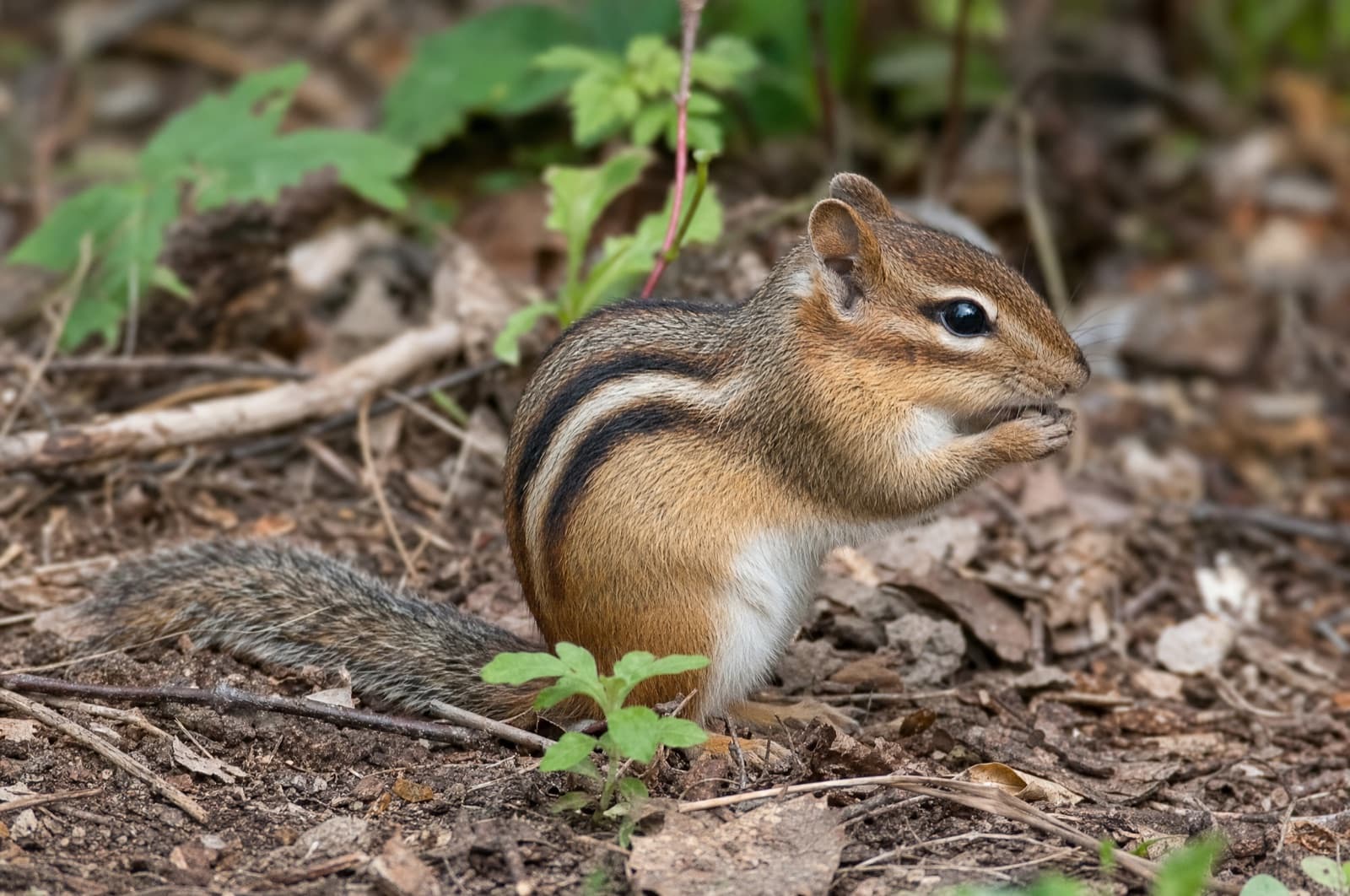
How to Get Rid of Chipmunks
At a glance
- Difficulty: Beginner
- Time: A weekend for habitat cleanup and sealing; ongoing upkeep in gardens
- Cost: Low — hardware cloth, gravel, bulb cages
- Success: Good with consistent habitat modification; harder in yards bordering open woods with continuous immigration
Can you DIY Chipmunk?
The verdict on Chipmunk DIY
A genuinely DIY-friendly nuisance — habitat changes do most of the work.
Eastern chipmunks are primarily a garden and foundation-burrowing nuisance with minimal direct health relevance — NH DHHS notes small rodents are almost never found infected with rabies. Removing ground cover and food sources near the house, combined with sealing foundation gaps, resolves most homeowner complaints without ever needing a trap or a pro.
The 5 DIY methods — honestly graded
Every approach graded for this species, in IPM order — prevention first, chemistry late. Pick a method to see how it works, the steps, and what it actually takes.
Prevention / Exclusion
Works wellThe most effective lever — chipmunks avoid open ground, so removing cover near the foundation does most of the work.
Chipmunks rely on ground cover, brush, and rock walls for protection from predators as they move between burrows and food sources. Removing that cover near the house, and sealing physical gaps, denies both the habitat and the entry points.
Best for: Long-term reduction of chipmunk activity near the house and gardens
Open up the ground near your foundation
Maintain a plant-free gravel border against the foundation — chipmunks avoid crossing open ground where they're exposed to predators.
Seal gaps and protect plantings
Cover crawl-space and weep vents with ¼-inch hardware cloth, seal foundation gaps, and protect bulbs with buried wire mesh cages.
Tools & materials
Why DIY falls short here
Not scare tactics — the specific, proportionate reasons a home attempt can stall for this species.
Open landscape with abundant cover
Yards bordering woods or brush see continuous immigration from adjacent populations, so DIY control needs to be ongoing, not one-and-done.
Extensive burrow systems
Sealing a single visible entrance rarely resolves an established colony — chipmunks maintain multiple connected tunnel openings.
Bird feeders
A nearby, reliable seed source sustains a chipmunk population indefinitely, undercutting any exclusion or trapping effort nearby.
How risky is it, really?
An honest read — most nuisance species are genuinely low risk, and we say so.
Chipmunks are a cosmetic and garden nuisance with minimal direct health relevance to people. The real cost is burrowing and bulb/seedling loss, not disease — this is one of the lowest-risk species in the hub.
- Burrow undermining of walkways or retaining wallsOccasional
Structural nuisance from tunneling near hardscaping, not a safety hazard
UNH Cooperative Extension
- Bulb and seedling lossCommon
A garden-only cost — chipmunks dig up and eat bulbs and seeds
UNH Cooperative Extension
- Disease transmission to peopleRare
Minimal direct health relevance; small rodents are almost never found rabies-infected in NH
NH DHHS
Chipmunk Burrowing Getting Out of Hand?
When burrowing threatens a foundation or hardscaping, Anchor Pest Services offers exclusion and habitat guidance across southern and central New Hampshire. Family-owned since 2017, NH license #782664.
Call a pro when…
- Burrowing that's undermining a foundation, patio, or retaining wall
- A large, persistent population despite your own habitat cleanup
- You want trapping done within current NH Fish & Game rules without researching them yourself
General Pest Control
Most chipmunk situations are entirely DIY. Consider a pro if burrowing is undermining a foundation, patio, or retaining wall, or if a large yard bordering woods has an ongoing population you can't keep pace with alone.
Keep them out
- Keep a gravel, plant-free border against the foundation
- Seal crawl-space and weep vents with ¼-inch hardware cloth
- Clean up spilled birdseed regularly
Chipmunks in New Hampshire
In New Hampshire, chipmunks are most active in spring and fall as they cache food ahead of a period of winter dormancy in their burrows, though they don't fully hibernate and can be seen on mild winter days. Habitat cleanup done before spring planting and again in fall keeps pace with the seasons they're most active.
Peak season
Spring and fall, with reduced activity (not full hibernation) in winter
Make sure it's a Chipmunk
Two quick detours worth taking — confirm the ID, then learn what drew it in so it doesn't come back.
Frequently asked
Sources & further reading(3)
- [1]NH DHHS — Rabies and Animal Bites
Small rodents almost never found rabies-infected
govverified 2026-07-13 - [2]UNH Cooperative Extension — Nuisance Wildlife Around the Home
NH-specific chipmunk habitat and exclusion guidance
extensionverified 2026-07-13 - [3]NH Fish & Game — Nuisance Wildlife / Wildlife Control Operators
Trapping licensing and relocation constraints
govverified 2026-07-13
Written & reviewed by
VerifiedDaniel Brady
NH-Licensed Pesticide Applicator · License #782664 (NHDAMF, RSA 430)
Daniel Brady is the New Hampshire–licensed applicator behind Anchor Pest Services, a family-owned pest control company serving the Manchester area since 2017.
Last updated July 2026
Other species you can tackle
Same category — the dot shows each one's DIY verdict at a glance (green = friendly, amber = doable with care, red = call a pro).
Professional Pest Control
Chipmunk Burrowing Getting Out of Hand?
When burrowing threatens a foundation or hardscaping, Anchor Pest Services offers exclusion and habitat guidance across southern and central New Hampshire. Family-owned since 2017, NH license #782664.
- Humane exclusion and habitat guidance
- NH-licensed technicians (#782664)
- Free inspection — same-day service across southern NH
NH License #782664 · No obligation · We answer in person
Your next step
- What to do next
Chipmunks in New Hampshire — ID, Signs & Control
Read the answer - Also relevant
What Attracts Chipmunks to Your House?
Read the answer - Also relevant
Chemical Squirrel & Small-Mammal Control: The Wrong Tool
Read the answer - Also relevant
Mechanical Wildlife Control: Exclusion Beats DIY Trapping in NH
Read the answer - Related guide
How to Get Rid of Groundhogs
Read the answer