
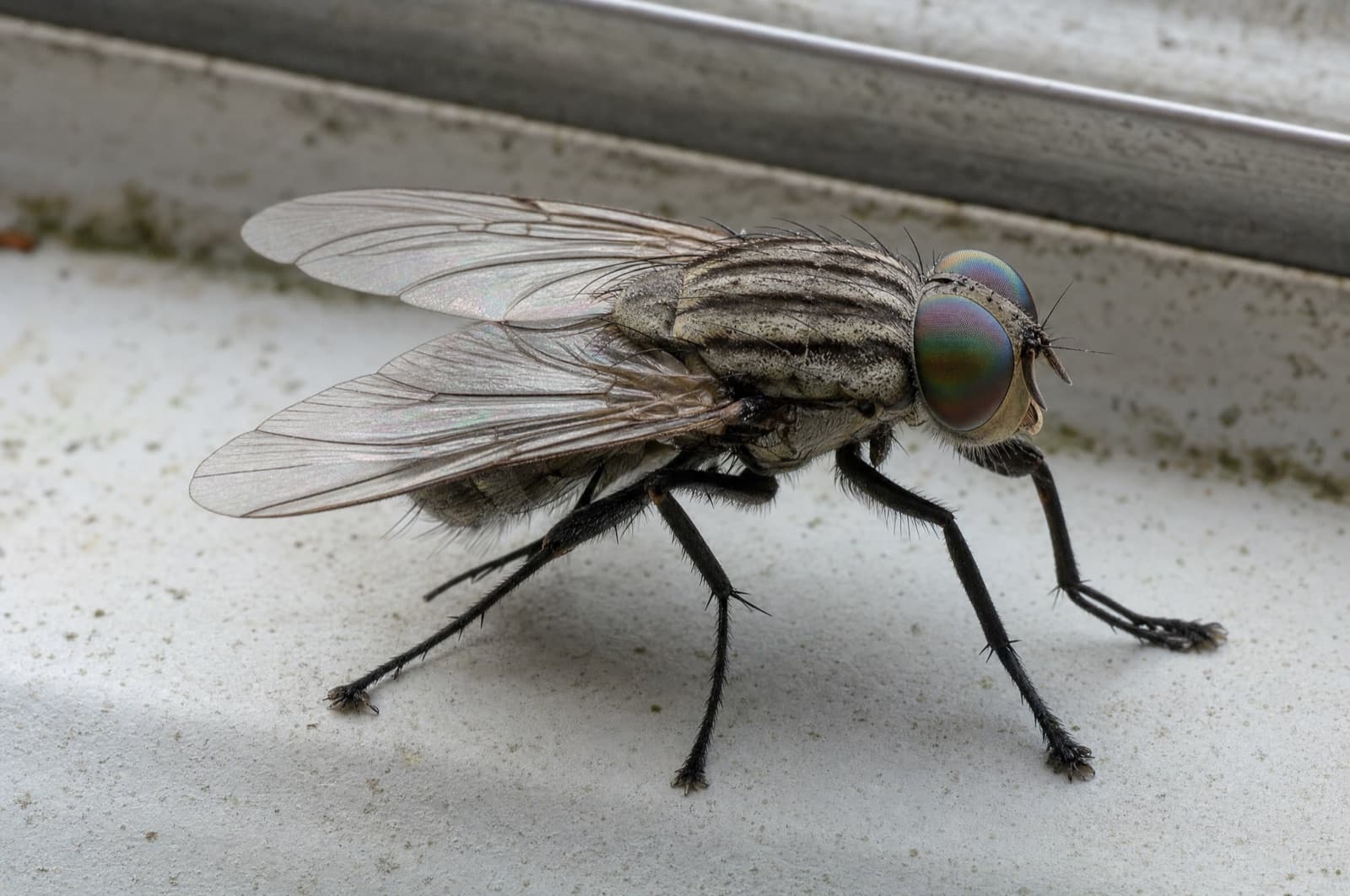
Where Do Flies Go in the Winter? NH Cluster Fly Timing
At a glance
- Peak indoor-entry: Late Aug–OctLast-generation adults seek shelter starting late August, continuing through the fall entry window.
- Winter location: Wall voids, attics, under sidingFlies cluster in the thousands between walls in protected overwintering sites.
- Wake-up trigger: ~Mid-50s°FFurnace heat or sunny days rouse dormant flies toward windows.
- Breeds indoors?: No — larvae parasitize earthworms outdoorsNo feeding, breeding, or health hazard indoors; larvae develop only outdoors.
Peak indoor-entry
Late Aug–Oct
Last-generation adults seek shelter starting late August, continuing through the fall entry window.
Winter location
Wall voids, attics, under siding
Flies cluster in the thousands between walls in protected overwintering sites.
Wake-up trigger
~Mid-50s°F
Furnace heat or sunny days rouse dormant flies toward windows.
Breeds indoors?
No — larvae parasitize earthworms outdoors
No feeding, breeding, or health hazard indoors; larvae develop only outdoors.
The short of it
Cluster flies you see in winter entered your walls last fall and are simply waking on warm days — they don't breed or feed indoors.
When are they active — the whole year at a glance
Cluster flies follow a predictable New Hampshire calendar: entirely outdoors all summer, then a sharp fall entry window before settling into winter dormancy indoors.
Best window to act · Summer through late August — seal cracks around windows, eaves, soffits, siding, and utility lines, and screen vents before flies begin aggregating.
Peaks reflect the fall entry window, anchored to Manchester's first frost (~Oct 19, 50% probability — NOAA 1991–2020 Climate Normals).
Winter behavior
The single most-asked question about these flies is where they go in winter — and the answer is: nowhere. They're already inside.
Hides indoors
Adults overwinter dormant inside wall voids, attics, and false ceilings — mainly on sun-warmed south/west walls — gathering in large, sluggish clusters. They do not die off, breed, or feed indoors.
Move in
Late August through the first frost (~Oct 19), with the heaviest aggregation on sunny walls in September.
Hides indoors
Adults overwinter dormant inside wall voids, attics, and false ceilings — mainly on sun-warmed south/west walls — gathering in large, sluggish clusters. They do not die off, breed, or feed indoors.
Spring exit
On warm days (mid-50s°F or warmer) or with furnace heat, flies crawl to windows and light; survivors leave outdoors in spring to lay eggs in soil near earthworm burrows.
A year in the life
Cluster fly behavior in New Hampshire shifts sharply by season, from entirely outdoor breeding to a hard fall entry and a quiet, dormant winter indoors.
- 01
Spring
Overwintered adults leave the walls and attic, move outdoors, and lay eggs near earthworm burrows in the soil. Homeowners often notice a late-winter or early-spring 'second wave' of sluggish flies at windows — these are the same individuals from fall, not a new hatch.
- 02
Summer
Cluster flies are entirely outdoors. Larvae develop inside earthworms over roughly 27–39 days, completing up to four generations across the warm months with no indoor presence at all.
- 03
Fall
The critical window. Last-generation adults begin entering homes in late August, aggregating heavily on sunny south- and west-facing walls through September and October, then slipping into wall voids and attics ahead of the first frost.
- 04
Winter
Flies sit dormant in walls and attics for months. Warm spells and indoor heating periodically rouse a few, producing the classic sluggish window-crawling that many NH homeowners see on mild January or February afternoons.
Cluster flies in southern New Hampshire
Cluster flies are one of the most common fall home-invaders in Manchester, Nashua, and Concord because NH's mix of lawns, fields, and older wood-frame construction gives them both the earthworm hosts they need in summer and the sun-warmed wall cavities they favor for winter shelter. Once a building is used as an overwintering site, the same flies — via aggregation pheromones — tend to return to it year after year, which is why some homes see heavier clusters annually than their neighbors.
Key local data
Manchester's first hard frost averages October 19 (50% probability) — the tail end of the cluster-fly entry window (NOAA 1991–2020 Climate Normals).
We serve these communities
- NH-licensed applicator · #782664
- Same-day service
- Family-owned since 2017
Service Area Map
Southern New Hampshire
Timing your treatment
Because cluster flies are already sealed inside by the time most homeowners notice them, timing prevention for the following fall is what actually works.
General Pest Control
Free inspection and same-day service across southern New Hampshire. NH-licensed #782664.
Learn more about this pestFrequently asked
Sources & references
- UNH Extension — Cluster Flies Fact Sheet
entry timing, overwintering site, no indoor breeding, don't-fog guidance
- UNH Extension — House Fly Fact Sheet
cluster fly vs. house fly distinction
- UConn Home & Garden — Cluster Flies
mid-50s°F wake trigger, clustering behavior
- University of Kentucky Entomology — EF624
no indoor reproduction, larval biology
- Orkin — Cluster Flies
late-August entry timing corroboration
- University of Illinois Extension — Overwintering Insects
secondary-pest carcass note
- Garden.org — Manchester, NH Frost Dates
~Oct 19 Manchester first-frost anchor (NOAA 1991–2020)
Editorial disclaimer: This content is provided for informational purposes only and does not constitute pest control advice. Every property is unique — consult a licensed professional for guidance specific to your situation. Anchor Pest Services is licensed in New Hampshire (#782664).
Written & reviewed by
VerifiedDaniel Brady
NH-Licensed Pesticide Applicator · License #782664 (NHDAMF, RSA 430)
Daniel Brady is the New Hampshire–licensed applicator behind Anchor Pest Services, a family-owned pest control company serving the Manchester area since 2017.
Last updated Jul 2026
Anchor Pest Services
Whatever the season — we handle the timing for you.
Same-day service across Southern New Hampshire. NH-licensed #782664, family-owned since 2017. We track the local calendar so you don't have to guess the right window.
- NH-licensed applicator
- Same-day service
- Pet & family-conscious
NH License #782664 · No obligation · We answer in person
Your next step
- What to do next
Cluster Flies in New Hampshire — Why They're in Your House in Winter
Read the answer - Related guide
When Are Asian Lady Beetles Active? NH Ladybug Timing
Read the answer - Related guide
Box Elder Bugs in the House in Winter — NH Timing Guide
Read the answer - Related guide
Where Do Moths Go in the Winter? NH Moth Timing Guide
Read the answer - Also relevant
Cluster Flies in New Hampshire — Why They're in Your House in Winter
Read the answer - Also relevant
House Flies in New Hampshire — ID, Disease Risk & Control
Read the answer