
Earwigs in New Hampshire — ID, the Ear Myth & Control
Also called Pincher bug · Forficula
The European earwig is a flat, reddish-brown, nocturnal insect with distinctive rear pincers. The 'crawls in your ear to lay eggs' story is pure folklore — earwigs prefer mulch, moist soil, and damp crevices. If handled, the pincers can deliver a harmless pinch. Indoors, earwigs are a moisture symptom: dry out the perimeter and they disappear.
- Adult size
- ~½ in (12–15 mm)
- UF/IFAS Featured Creatures; peer-reviewed genome sources
- Ear myth
- False — earwigs do not crawl into human ears
- Old Farmer's Almanac
- Pinch
- Harmless; the pincers rarely break skin
- Old Farmer's Almanac; Romex
- First N. America record
- Seattle, Washington, 1907
- UF/IFAS Featured Creatures
- Eggs / maternal care
- Females lay 30–50 eggs and actively guard them — unusual among insects
- Britannica; Romex
- Driver indoors
- Moisture and heat — pushes inside during hot, dry spells seeking humidity
- Romex Pest
The ear myth, debunked — and what earwigs actually want
Let's start with the myth: the European earwig will NOT crawl into your ear to lay eggs. That story is centuries-old folklore, and there is no credible evidence earwigs are attracted to human ears. The Old Farmer's Almanac puts it plainly — the 'earwig' name comes from an old English superstition, not from observed behavior. Earwigs prefer mulch, leaf litter, and damp stone — not human bodies.
The rear pincers (cerci) are the insect's most alarming feature and the source of a second misconception. Those pincers can deliver a harmless pinch if the insect is handled or cornered — male pincers are curved, female pincers straighter — but they rarely break skin and cause no lasting harm. They are defensive tools, not offensive weapons.
The NH-relevant truth: earwigs are moisture-loving outdoor insects that hide under mulch, flowerpots, logs, and in moist soil. They wander indoors during hot, dry summer spells seeking moisture — so indoors they are a perimeter humidity symptom, not a structural pest or a health hazard. The fix is to pull mulch back from the foundation, improve drainage, and seal entry gaps. Whole-house insecticide sprays without addressing the moisture source will give only temporary relief.
How to identify an earwig
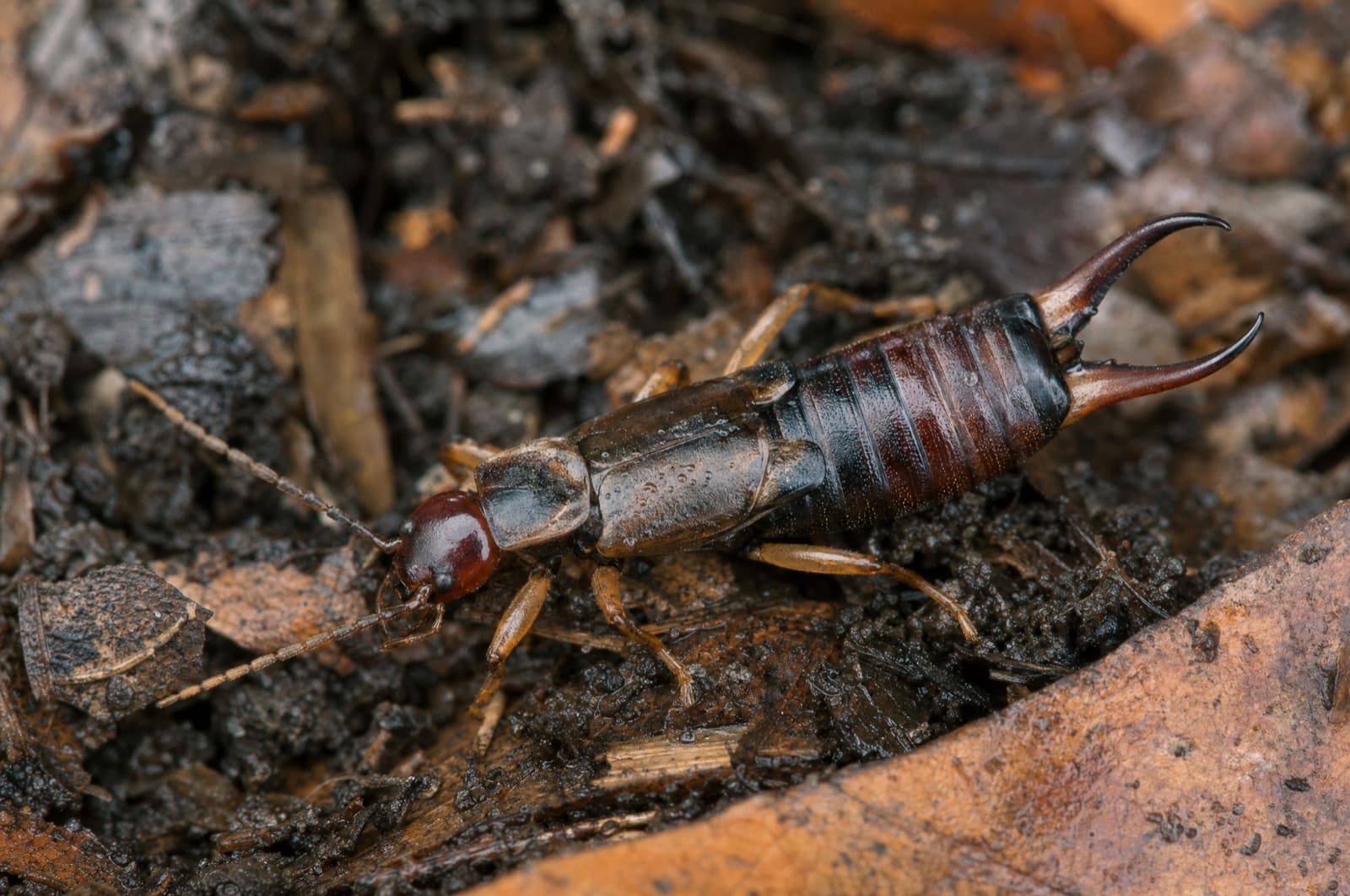
The rear pincers (cerci) make the earwig unmistakable — no other common NH household insect has paired forceps at the rear of the abdomen. The flat, elongate reddish-brown body and the beaded antennae complete the ID. Male pincers are distinctly curved; female pincers are straighter — a useful secondary detail.
European earwig
- Scientific name
- Forficula auricularia
- Family
- Forficulidae (order Dermaptera)
- Size
- ~12–15 mm (~½ in)
- Coloration
- Reddish-brown to dark brown; slender and flattened; slightly paler toward the legs
- Habitat
- Mulch, leaf litter, under flowerpots and doormats, in damp soil crevices; damp basements and bathrooms indoors
- Active season
- Most active spring through fall; greatest indoor movement during hot, dry summer spells
- Diet
- Omnivorous — decaying organic matter, live plants (especially tender seedlings and soft fruit), aphids, and small insects
- Reproduction
- Female lays 30–50 eggs in an underground burrow and actively guards them through hatching — notably unusual maternal behavior among insects
- Lifespan
- ~1 year
Native to Eurasia; first recorded in North America in Seattle, WA in 1907; now widespread across the continent including all of NH
The tells — key ID features
- Rear pincers (cerci) — paired forceps at the tail end are the unmistakable diagnostic feature.
- Flat, elongate reddish-brown body, about ½ inch long.
- Short, leathery forewings covering rarely-used hindwings that fold intricately.
- Slender beaded antennae roughly half the body length.
- Male pincers are distinctly curved; female pincers are nearly straight.
- Six legs; fast, scuttling movement when disturbed.
Size, to scale
12–15 mm (~½ in)
About the length of a pumpkin seed — pincers included
Rove beetle (family Staphylinidae)
How to tell — Rove beetles have short elytra like earwigs but lack the paired cerci at the tail. The earwig's forceps are diagnostic.
Devil's coach horse (Ocypus olens)
How to tell — Similar shape but much larger and all-black; native to Europe but rarely found in NH. Lacks the paired cerci of earwigs.
Silverfish or firebrat
How to tell — Silverfish and firebrats are wingless, have three long tail filaments (not pincers), and are silver or gray. No pincers.
Signs of a problem
Earwigs are nocturnal and secretive by day but leave a clear pattern of signs. Each points to the same underlying issue: perimeter moisture.
Earwigs under flowerpots, doormats, mulch, or boards against the house
What it means — Daytime moisture harborage — these are exactly the moist, dark hiding spots earwigs need during daylight hours.
Clusters of earwigs indoors (basement, bathroom, crawl space) after hot or dry outdoor weather
What it means — They pushed inside seeking cooler, moister conditions — a reliable signal that foundation perimeter moisture needs attention.
Notched or ragged leaf edges and damage to tender seedlings and soft fruit in the garden
What it means — Earwig feeding; most significant in spring when seedlings are vulnerable. Rarely severe enough to threaten established plants.
Earwigs in damp basement corners near the sump pump or floor drain
What it means — Humidity attraction — indoor moisture is high enough to sustain them. Dehumidify and seal entry gaps.
The real risks, calibrated
Earwigs are one of the most over-feared insects in NH homes. The honest risk assessment is very low across every category.
Pinch if handled
Low riskOnset: On contact when cornered or picked up
The cerci can deliver a surprising pinch that rarely breaks skin. It is startling but not medically significant — no venom, no wound beyond a minor skin depression.
Defensive chemical secretion
Low riskOnset: When threatened
Earwigs can release a mild benzoquinone-based defensive secretion (similar to some beetles) that produces a noticeable odor when the insect is crushed. Not a health hazard.
Garden plant feeding
Low riskOnset: Warm growing season, especially spring
Earwigs can notch tender seedlings and soft fruit — most significant in vegetable gardens in spring. Rarely severe enough to destroy established plants or cause economic loss for NH homeowners.
Ear or health danger
Low riskOnset: Not applicable — the ear myth is false
Earwigs pose no documented human health risk. They do not bite in the medical sense, do not sting, do not transmit disease, and do not enter human ears.
DIY — what works, what backfires
Earwig control is perimeter moisture management. Fix the conditions that draw them to the foundation and they stop coming inside. Sprays that skip this step provide only temporary, partial relief.
What actually works
- Pull mulch, leaf litter, and wood piles back at least 12–18 inches from the foundation — this removes the daytime harborage that sustains outdoor earwig populations.
- Fix drainage problems around the foundation: regrade soil to slope away, clean gutters, and extend downspouts at least 4 feet from the foundation.
- Seal gaps under doors (replace door sweeps), around window frames, and at utility penetrations.
- Reduce nighttime outdoor lighting near entry doors — earwigs are attracted to light.
- Trap and monitor: roll up dampened newspaper and leave it near the foundation overnight; earwigs collect inside and can be disposed of in the morning.
What backfires
- Don't let mulch pile against the foundation — it is the single biggest earwig attractor in most NH foundation plantings.
- Don't fear the pincers — they are a harmless self-defense tool and almost never break human skin.
- Don't reach for whole-house sprays before fixing the perimeter moisture — you will keep seeing earwigs until the harborage is gone.
- Don't ignore earwigs as a signal — they are an indicator of a damp, hospitable foundation perimeter that may also be inviting other moisture-loving pests.
Earwigs in southern and central New Hampshire
European earwigs are widespread and common across southern and central NH. They are most active in warm weather and are a consistent late-summer caller at homes with mulched, shaded foundation plantings — a very common landscape feature across Manchester, Nashua, Bedford, and Derry. The hot, dry summers of recent years have increased indoor encounters as earwigs seek cooler, damper conditions inside. Damp basements and first-floor bathrooms are the typical indoor sighting locations. The perimeter fix — pulling mulch back 12–18 inches from the foundation and improving drainage — is the most effective and sustainable control step.
Peak season
Spring through fall outdoors; most indoor encounters during hot, dry summer spells
You might actually have
- Pillbugs (same damp-perimeter driver, roll into a ball)
- Sowbugs (same damp-perimeter driver, two rear tail-points, can't roll)
- Camel crickets (damp basements and crawl spaces — see that page)
We serve these communities
- NH-licensed applicator · #782664
- Same-day service
- Family-owned since 2017
Service Area Map
Southern New Hampshire
When to call Anchor Pest Services for earwigs
Most earwig situations resolve with perimeter moisture reduction and exclusion alone. Professional help adds value when recurring perimeter invasions persist despite DIY landscaping and exclusion, when garden damage is significant across multiple seasons, or when the earwigs are pointing to a larger moisture problem — such as a wet crawl space or poor foundation drainage — that needs a more comprehensive plan.
When to call a pro
- Recurring perimeter invasions each warm season despite pulling mulch back and improving drainage.
- Significant garden or seedling damage across multiple seasons.
- Earwigs are one indicator of a broader moisture problem (wet crawl space, drainage failure) that needs a comprehensive assessment.
- Indoor populations are large enough to be a consistent nuisance in living areas.
Maintain a dry 12-inch foundation border
The single most effective earwig prevention in NH is keeping the 12 inches immediately adjacent to the foundation free of mulch, leaf litter, and dense ground cover. Replace mulch with gravel or leave bare soil in this zone.
Fix gutters and downspout drainage before summer
Clogged gutters and short downspouts deposit water at the foundation — the primary cause of moist-perimeter conditions that attract earwigs, pillbugs, and sowbugs. Clean gutters in April and extend downspouts well away from the foundation.
Seal all first-floor and crawl-space entry points
Door sweeps, window-frame caulk, and crawl-space vent screens prevent earwigs from reaching damp interior areas once they are at the foundation. Combine sealing with perimeter moisture reduction for the most complete defense.
Not sure it's a european earwig?
A licensed NH technician can confirm the species and tell you honestly whether it's a DIY fix or a job for a pro — free inspection, same-day service across Southern New Hampshire.
Frequently asked questions
Sources(5)
- [1]Britannica — Earwig
Forceps-like cerci; reddish-brown body; females lay 30–50 guarded eggs
encyclopediaverified 2026-06-30 - [2]UF/IFAS Featured Creatures — European Earwig
First North America record Seattle 1907; biology; omnivorous diet; adult size 12–15 mm; male vs. female pincer curvature
extensionverified 2026-06-30 - [3]Old Farmer's Almanac — Earwigs
Ear myth debunked; pinch harmless; male vs. female cerci
industryverified 2026-06-30 - [4]Bug of the Week (UMD) — European Earwig
Benzoquinone defensive secretion chemistry; moisture-first control rationale
extensionverified 2026-06-30 - [5]UNH Cooperative Extension — Insect & Other Arthropod Identification
NH presence verification; moisture-management guidance
extensionverified 2026-06-30
Written & reviewed by
VerifiedDaniel Brady
NH-Licensed Pesticide Applicator · License #782664 (NHDAMF, RSA 430)
Daniel Brady is the New Hampshire–licensed applicator behind Anchor Pest Services, a family-owned pest control company serving the Manchester area since 2017.
Last updated 2026-06-30

New Hampshire pest control
Dealing with european earwigs in your home?
Anchor Pest Services identifies and handles european earwig problems across southern and central New Hampshire. Family-owned since 2017, NH license #782664.
- NH-licensed applicators (#782664)
- Same-day service · free inspection
- Family-owned since 2017
Your next step
- Fall guide
Fall Pest Control in New Hampshire
What matters before frost: the fall invader window, mice at the foundation, and what to seal first.
Read the answer - What to do next
How to Get Rid of Earwigs
Read the answer - What to do next
Natural Control for Roaches, Crickets, Earwigs & Termites in NH
Read the answer - Also relevant
Do earwigs damage garden plants or flowers?
Read the answer - Also relevant
What Is That Smell in My Crawl Space? Causes and Solutions
Read the answer