
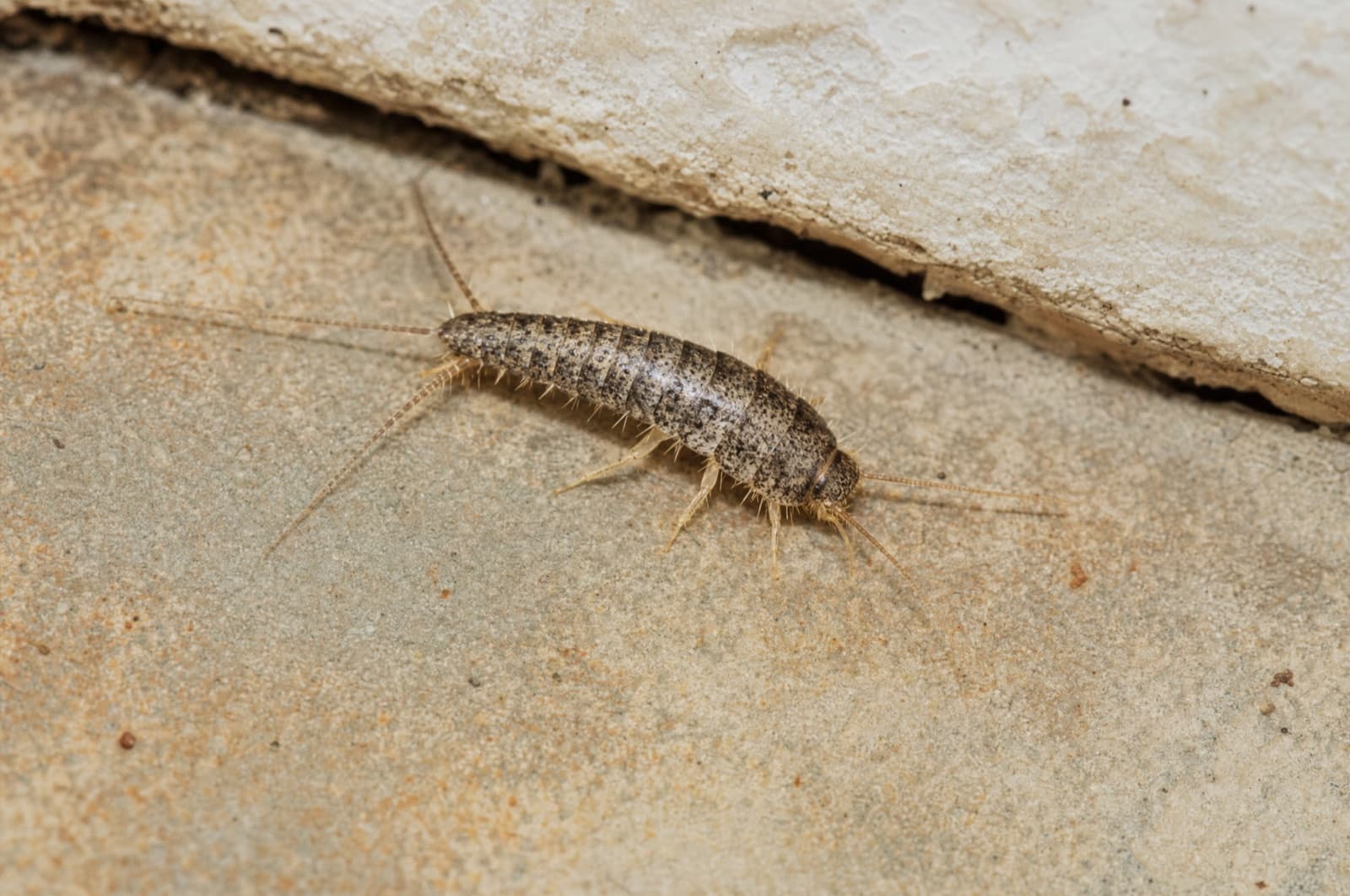
Firebrats in New Hampshire — ID, Heat & Moisture Control
Also called bristletail
The firebrat is a mottled gray-brown, wingless bristletail that thrives in hot, humid pockets near furnaces, water heaters, and hot pipes. Like silverfish it eats starches — paper, glue, cereal — but is harmless to people. Find a firebrat and you've pinpointed a hot, humid microclimate worth ventilating.
- Size
- ~½ in (approx. 12–13 mm)
- Missouri Dept. of Conservation
- Habitat
- Hot, humid (~90–108°F) near heat sources
- UMD Extension; Penn State Extension
- Diet
- Starches — paper, glue, fabric, cereal
- Penn State Extension
- Bites/disease?
- No
- Penn State Extension
- Lifespan
- ~2–4 years
- Penn State Extension
- ID vs silverfish
- Mottled coloring vs uniform silver
- UMD Extension
The silverfish's heat-loving twin
The firebrat is a close relative of the silverfish — a mottled gray-brown, carrot-shaped, wingless bristletail that darts fast and nocturnal across hot, dark surfaces. People who find one near their furnace, boiler, water heater, or oven often mistake it for a silverfish, but the key diagnostic is location: cool damp spots host silverfish; hot, humid pockets host firebrats. Where you find it tells you exactly which microclimate to fix.
Like silverfish, the firebrat is completely harmless to people — no biting, no disease transmission — but it will quietly damage paper, book bindings, wallpaper paste, fabrics, and dry cereal if populations go unaddressed. New Hampshire homes with furnaces, boilers, or older heating equipment in the basement are common habitat, and firebrats are active year-round near the heat source. A firebrat sighting is a diagnostic: it flags a hot, humid, under-ventilated pocket worth improving through better ventilation and pipe insulation.
How to identify a firebrat
Three features distinguish a firebrat from the silverfish it is most commonly confused with: mottled gray-brown coloring (not uniform silver), a location near heat sources rather than cool damp spots, and a slightly stouter build. Both species share three long rear bristle-tails and two long antennae.
Firebrat
- Scientific name
- Thermobia domestica
- Family
- Lepismatidae (order Zygentoma)
- Size
- ~½ in (approx. 12–13 mm)
- Coloration
- Mottled gray/brown with darker spots and bands — contrasts with the uniformly silver silverfish
- Habitat
- Hot, humid spots — furnace rooms, near boilers and water heaters, around hot pipes, hot attics in summer
- Active season
- Year-round near heat sources
- Diet
- Starches and carbohydrates: paper, book glue, wallpaper paste, fabrics, dry cereal
- Reproduction
- Eggs laid in cracks and crevices near heat; females may lay approximately 50 eggs
- Lifespan
- ~2–4 years; molts throughout life
Cosmopolitan worldwide; common in heated buildings throughout New Hampshire year-round.
The tells — key ID features
- Mottled gray-brown with darker spots — the clearest visual tell vs. the uniformly silver silverfish.
- Located near heat sources (furnace, water heater, oven, hot pipes) — not in cool damp basements.
- Three long rear bristle-tails plus two long antennae — shared with silverfish.
- ~½ inch, slightly stouter than silverfish, wingless.
- Fast, darting nocturnal movement when exposed to light.
- Fish-like wriggling motion when running — same order (Zygentoma) as silverfish.
Size, to scale
~½ in (approx. 12–13 mm)
About the length of a sunflower seed — similar to silverfish but found in a hot spot, not under the cool sink.
Silverfish
How to tell — Silverfish are uniformly silver-gray and prefer cool, damp places (basements, under sinks). Firebrats are mottled gray-brown and found near heat. The location is the fastest tell.
Jumping bristletails (outdoors)
How to tell — Outdoor bristletails are humped and jump; firebrats are flattened and dart without jumping, always near indoor heat.
Signs of a problem
Firebrats are nocturnal and fast-moving, so sightings are often the first sign. Look for these clues near heating equipment.
Mottled gray-brown bristletail spotted near the furnace, water heater, or hot pipes
What it means — Classic firebrat microhabitat — it requires the consistent heat these appliances produce.
Irregular holes or notches in paper, book bindings, or cereal boxes near heating equipment
What it means — Starch-feeding damage from firebrats active where food and heat intersect.
Tiny pepper-like scales near pipes or on warm surfaces
What it means — Shed exoskeleton — firebrats molt repeatedly throughout their multi-year life.
Sightings in a hot attic during summer months
What it means — Seasonal migration to any space that reaches their preferred temperature range (~90–108°F).
The real risks, calibrated
Firebrats are harmless to people but can cause minor property damage over time if populations go unaddressed.
Paper and book damage
Low riskOnset: Over weeks to months
Holes, notches, and yellow staining in paper, book bindings, wallpaper paste, and stored documents near heat.
Fabric and textile damage
Low riskOnset: Over time in larger populations
Minor holes and staining in natural fabrics such as cotton, linen, and silk stored near heat sources.
Pantry contamination near heat
Low riskOnset: When exposed dry food is present
Minor contamination of cereals, flour, or starches stored in open packaging near heating equipment.
Indicator of a hot, humid microclimate
Low riskOnset: Ongoing presence
A population signals a poorly ventilated or uninsulated heat-pipe zone — the underlying condition is worth addressing.
DIY — what works, what backfires
Firebrat control is about removing the conditions they need — heat plus humidity — not just spraying. Here is what actually works.
What actually works
- Improve ventilation near furnaces, water heaters, and hot pipes to reduce the humidity build-up firebrats need.
- Insulate hot pipes to lower surface heat and reduce the hot, humid microclimate around them.
- Store all starchy goods (papers, books, cereals, flour) in sealed airtight containers, away from heat zones.
- Use sticky traps near heating equipment to monitor numbers and reduce the population.
- Vacuum and seal cracks in furnace rooms and around hot-pipe penetrations to remove harborage.
What backfires
- Don't confuse it with silverfish — the hot location (not cool damp) tells you which species you have and what microclimate to fix.
- Don't ignore humidity build-up near heat sources; ventilating that pocket is the durable fix, not a spray.
- Don't rely on insecticide sprays alone — populations rebound if the heat-and-humidity conditions remain.
Firebrats in New Hampshire homes
Across Manchester, Nashua, Concord, and the wider southern NH service area, firebrats concentrate in basements with gas or oil heating equipment, near hot-water heaters, and around older boiler systems. They thrive year-round indoors near the heat source — NH's cold winters are irrelevant to their lifecycle. A firebrat sighting near your furnace is a diagnostic clue: it flags a hot, humid, under-ventilated pocket worth improving through ventilation and insulation.
Peak season
Year-round near indoor heat sources
You might actually have
- Silverfish (cool damp — basements, bathrooms, under sinks)
- Camel crickets (cool damp basements — the humpbacked jumper)
We serve these communities
- NH-licensed applicator · #782664
- Same-day service
- Family-owned since 2017
Service Area Map
Southern New Hampshire
When to call a pro for firebrats
If firebrats keep returning near heating equipment despite sealing and ventilation improvements, a licensed technician can treat harborage areas and advise on insulation and airflow fixes that prevent reinfestation more reliably than continued DIY.
When to call a pro
- Recurring firebrat populations near the furnace or water heater despite sealing and ventilation work.
- Damage to irreplaceable books, documents, or stored items near heat zones.
- Unable to locate the primary harborage area within or around heating equipment.
Ventilate hot-pipe zones
Ensure furnace rooms and utility closets have adequate air circulation to prevent the hot, humid microclimates that firebrats need.
Seal cracks near heat sources
Caulk around hot-pipe penetrations and foundation cracks in furnace rooms to eliminate harborage and entry points.
Protect starchy materials from heat zones
Store paper, books, and dry food in sealed bins — never in cardboard boxes near heating equipment.
Not sure it's a firebrat?
A licensed NH technician can confirm the species and tell you honestly whether it's a DIY fix or a job for a pro — free inspection, same-day service across Southern New Hampshire.
Frequently asked questions
Sources(5)
- [1]UMD Extension — Silverfish and Firebrats
identification, habitat preferences, hot vs. cool location tell
extensionverified 2026-06-30 - [2]Penn State Extension — Silverfish and Firebrats
diet, lifespan, control guidance, no health risk
extensionverified 2026-06-30 - [3]MU Extension — Silverfish and Firebrats
biology, wingless nocturnal behavior
extensionverified 2026-06-30 - [4]
- [5]UNH Cooperative Extension — Insect Identification
NH context and sanitation-first guidance
extensionverified 2026-06-30
Written & reviewed by
VerifiedDaniel Brady
NH-Licensed Pesticide Applicator · License #782664 (NHDAMF, RSA 430)
Daniel Brady is the New Hampshire–licensed applicator behind Anchor Pest Services, a family-owned pest control company serving the Manchester area since 2017.
Last updated 2026-06-30

New Hampshire pest control
Dealing with firebrats in your home?
Anchor Pest Services identifies and handles firebrat problems across southern and central New Hampshire. Family-owned since 2017, NH license #782664.
- NH-licensed applicators (#782664)
- Same-day service · free inspection
- Family-owned since 2017