
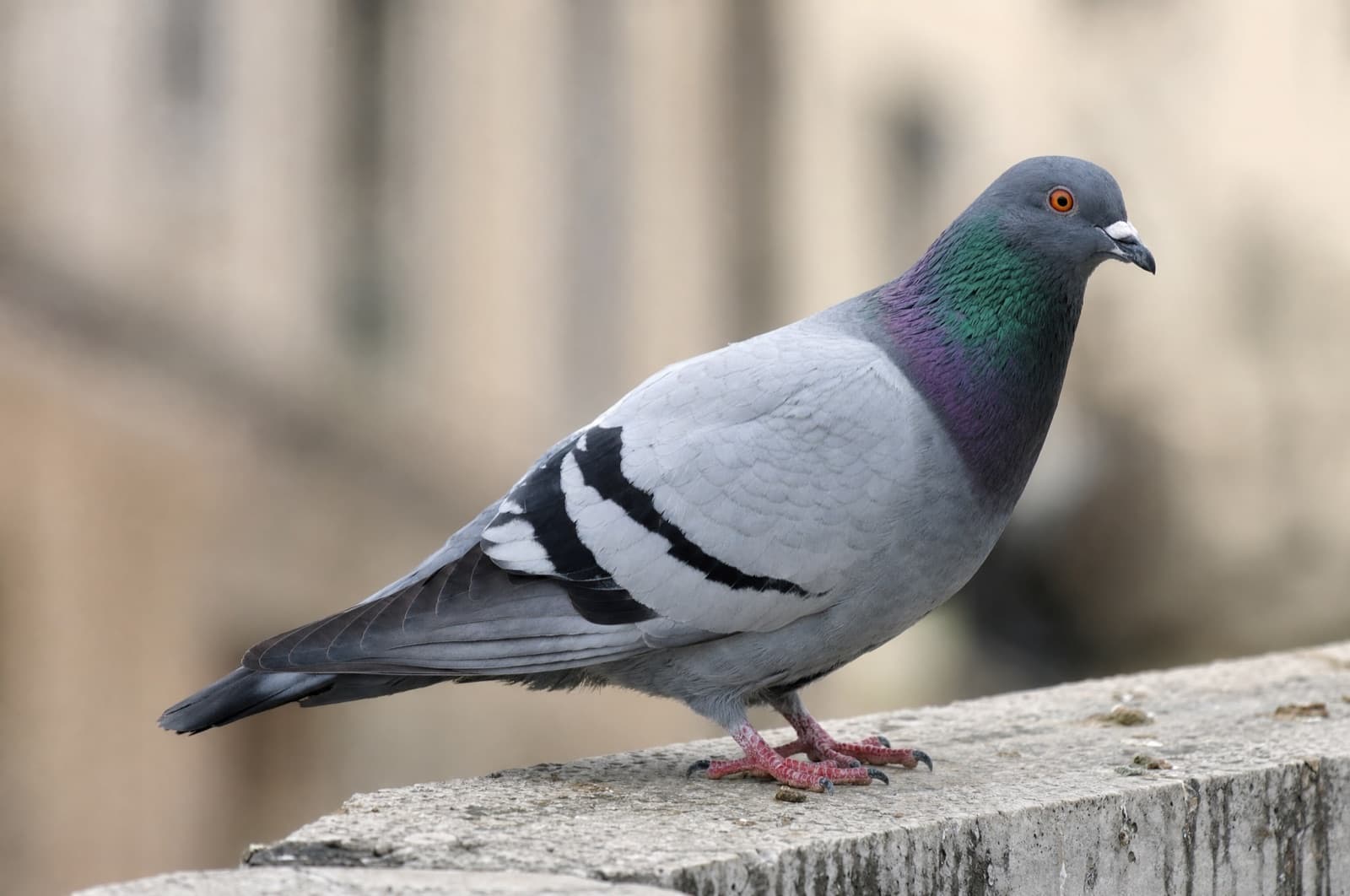
Pigeons in New Hampshire — ID, Droppings & How to Deter Them
Also called Rock dove · Rock pigeon · Feral pigeon
The feral pigeon (rock pigeon) is a non-native bird not protected by the Migratory Bird Treaty Act. It roosts year-round on NH building ledges and produces corrosive, disease-carrying droppings. The right control playbook is exclusion-first — ledge spikes, netting, and wire deny the site permanently. Droppings must be wet-cleaned with PPE; never dry-sweep.
- Size
- 12–14 in; 9–13 oz
- Plump body, small head — the classic pigeon silhouette
- MBTA status
- Not protected
- USFWS 2020 Federal Register — non-native introduced species exempt
- Introduced
- 1606
- First brought to North America by European colonists; now ubiquitous in urban areas
- Dropping hazard
- Histoplasmosis + cryptococcosis
- Both fungal diseases linked to accumulated pigeon droppings; wet-clean with N95 + gloves
- Corrosion
- Uric acid in droppings
- Accelerates deterioration of stone, metal, and paint; slip hazard on walkways
- Broods per year
- Several
- Lays 2 white eggs; year-round breeding; ~31 days egg to fledge (Avian Report)
The ledge roosting pest — exclusion beats everything else
The feral pigeon (Columba livia) — also called the rock dove or rock pigeon — has been part of North American cities since colonists brought the species in 1606. Today it is among the most consequential urban pest birds, not because it is dangerous in the conventional sense, but because of what it leaves behind: droppings that corrode building materials, harbor two distinct fungal pathogens (Histoplasma capsulatum and Cryptococcus neoformans), and pile up fast enough to create structural and safety problems on ledges, rooftop HVAC equipment, and beam-and-rafter spaces.
Feral pigeons are not protected by the Migratory Bird Treaty Act. The USFWS 2020 Federal Register ruling explicitly exempts non-native, human-introduced species, and Columba livia is on that list. This matters practically: ledge exclusion, netting, trapping, and other control measures do not require a federal permit.
The most important thing a New Hampshire property owner can understand about pigeons: exclusion is vastly more durable than any lethal or hazing method. Deny the ledge and the problem ends. Fail to deny the ledge and birds return regardless of how many are removed, because the site conditions remain favorable. Droppings — the primary hazard — must be addressed with proper respiratory protection and wet methods. Never dry-sweep accumulated pigeon droppings.
How to identify a feral pigeon
Pigeons are one of the few birds where the silhouette alone is usually enough for a confident ID — plump body, small head, full rounded tail. Coloration is highly variable in feral populations, but the wild-type gray-blue with iridescent neck and two black wing bars is the most common.
Pigeon
- Scientific name
- Columba livia
- Family
- Columbidae
- Size
- 12–14 inches in length; 9–13 oz
- Coloration
- Wild type: gray-blue body, iridescent green-purple neck, two black wing bars, white rump. Feral populations: extremely variable — white, brown, rust, pied, and combinations. All share the full-body, small-headed pigeon shape.
- Habitat
- Building ledges, bridges, parking garages, barn rafters, loading docks, rooftop HVAC equipment, overpasses.
- Active season
- Year-round; breeds in all seasons when food is available
- Diet
- Entirely vegetarian; picks up seeds and grain whole and swallows without crushing. Thrives on urban food waste, dumpster scraps, and deliberate feeding by the public.
- Reproduction
- Lays 2 white eggs; incubation ~18 days; young fledge ~31–35 days after hatching; multiple broods per year; breeds year-round (Avian Report). Feral pigeons can live at least 10 years.
- Lifespan
- At least 10 years for feral birds (Avian Report); up to 35 years in captivity
Found year-round across all of New Hampshire; densest in Manchester, Nashua, and Concord downtowns and near grain storage or food facilities. Does not migrate.
The tells — key ID features
- Plump, full-bodied silhouette with a small, rounded head — the defining pigeon shape at any distance.
- Wild-type has gray-blue plumage, iridescent green-purple neck feathers, and two black wing bars.
- Short, full, rounded tail — clearly distinct from the mourning dove's long, pointed tail.
- Walks with a head-bobbing strut; does not hop.
- Heavy, whitish dropping accumulations under roost sites — volume and color are characteristic.
- Cooing calls (coo-OO-oo) and wing-clapping at takeoff are distinctive.
Size, to scale
12–14 inches
About the size of a standard 8.5x11 sheet of paper in body length — noticeably larger than a mourning dove or starling
Mourning dove
How to tell — Mourning doves are slimmer, smaller (12 in but much lighter), warm brown in color, and have a long, pointed tail with white outer feathers. They are fully protected under the MBTA. The pointed tail is the instant field mark — feral pigeons have a short, full, rounded tail. Never disturb a mourning dove nest.
Band-tailed pigeon
How to tell — Native band-tailed pigeons are not typical in New Hampshire — they are primarily a western U.S. species. On the rare chance one is present, it has a yellow bill tip, a pale band across the tail tip, and a white crescent on the nape. Protected under MBTA.
Signs of a problem
Pigeon presence is hard to miss — the volume of droppings and the noise from roosting flocks are usually the first complaints.
Heavy white-to-gray dropping accumulations on ledges, window sills, rooftops, and pavement below roost sites
What it means — Active roosting site above; droppings are corrosive, carry histoplasmosis and cryptococcosis, and create slip hazards — wet-clean with PPE.
Cooing calls and wing-clapping from ledges, rooftop equipment, or barn rafters
What it means — Established roost or nesting site; multiple birds likely present.
Flimsy stick-and-debris nests on building beams, ledge recesses, rooftop HVAC units, or windowsill corners
What it means — Nesting in progress; eggs or young may be present — check before physical removal.
Shed feathers accumulating around ledges or in air intakes
What it means — Regular roosting site; feathers in air intakes can contaminate HVAC systems.
Staining and surface pitting on stone, brick, painted metal, or copper below roost sites
What it means — Uric acid in droppings actively corroding the building material; remediation and exclusion needed to stop ongoing damage.
Bird mite complaints from occupants of rooms adjacent to a former roost site
What it means — Pigeons have vacated or been excluded; mites are dispersing into the living space — see bird mite page for treatment.
The real risks, calibrated
Pigeon droppings are the primary hazard — combining disease risk, structural corrosion, and slip hazard into one persistent problem. The birds themselves are not aggressive toward people.
Histoplasmosis from accumulated droppings
HighOnset: Risk increases with accumulation depth and disturbance
Pigeon droppings (along with bat guano) are the classic source of Histoplasma capsulatum in the United States. Disturbance of dried droppings — sweeping, blowing, or demolition — releases spores that can cause histoplasmosis, a lung infection that ranges from subclinical to severe. Large accumulations require professional wet-remediation with N95 or P100 respirator, gloves, and disposable coveralls. Route any health concerns to a physician or NH DHHS.
Cryptococcosis from accumulated droppings
ModerateOnset: Risk primarily to immunocompromised individuals
Cryptococcus neoformans, a fungus that thrives in pigeon droppings, can cause a serious infection including cryptococcal meningitis in immunocompromised individuals (HIV/AIDS, organ transplant recipients, individuals on immunosuppressant medications). The same wet-cleaning PPE protocol that protects against histoplasmosis applies. Route any health concerns to a physician.
Structural corrosion and slip hazard from droppings
ModerateOnset: Ongoing with active roost
Pigeon droppings contain uric acid, which aggressively corrodes stone, metal, paint, and concrete. Heavy accumulations on walkways and parking garage decks are a slip-and-fall hazard. Unaddressed roosts can cause hundreds to thousands of dollars in surface damage annually on commercial properties.
Ectoparasites and pigeon mites entering buildings
ModerateOnset: After birds vacate or are excluded from a roost
Pigeon mites and soft ticks in nest and roost debris can disperse into adjacent living or working spaces when the host birds leave. They bite humans and can cause significant skin irritation. Exclusion must be paired with mite treatment when ectoparasites are suspected.
Nest and dropping blockage of drains, vents, and HVAC intakes
ModerateOnset: Accumulates over one or more nesting seasons
Nest material and droppings accumulating in roof drains, gutters, and air intakes can cause water backup, moisture intrusion, and contamination of building HVAC systems.
DIY — what works, what backfires
The pigeon control playbook is exclusion-first. Remove the ledge, beam, or flat surface the bird can land on and the problem ends. Every other method — hazing, trapping, poisoning — requires ongoing effort and produces diminishing returns without site modification.
What actually works
- Install ledge spikes or wire coil systems on all flat and slightly sloped perching surfaces — the only truly durable deterrent.
- Use heavy-gauge netting to exclude pigeons from open beam-and-rafter spaces in barns and parking garages.
- Apply sloped covers (45-degree or steeper) to wide ledges where spikes alone are insufficient.
- Wet-clean all droppings before installing exclusion hardware — dried droppings continue to attract birds by scent even after the roost is broken up.
- Wear an N95 or P100 respirator, disposable gloves, and old clothing when cleaning pigeon droppings. Wet the material thoroughly with water and disinfectant before disturbing.
- Eliminate food sources — do not feed pigeons; manage dumpsters and outdoor food waste; communicate no-feeding policies to staff or tenants.
What backfires
- Don't dry-sweep, blow dry, or use leaf blowers on heavy pigeon dropping accumulations — this aerosolizes histoplasmosis and cryptococcosis spores. Always wet first.
- Don't use anticoagulant or neurotoxic poisons — they are not registered for pigeon control in most U.S. jurisdictions, are inhumane, create secondary poisoning risk for raptors and scavengers, and do not address the site conditions that attract pigeons in the first place.
- Don't rely on hazing alone (noise, predator decoys) for an established roost — pigeons habituate quickly and return when stimulation stops.
- Don't seal nest sites while eggs or young are present without a plan for humane resolution — check for active nests before installing exclusion hardware.
- Don't feed pigeons — it is the single most effective way to grow a colony and the most avoidable driver of pigeon problems near commercial properties.
Pigeons in New Hampshire — downtown roosts and commercial properties
Pigeons are year-round residents across New Hampshire's urban and suburban centers. Manchester, Nashua, and Concord have established downtown colonies roosting on building ledges, parking garages, bridges, and loading dock overhangs. Barns and outbuildings in more rural NH communities also attract nesting pigeons, particularly on beam-and-rafter structures inside large open buildings. Commercial dropping remediation is a recurring service need, especially for ledges above storefronts, HVAC rooftop units with accumulated droppings, and parking garage decks. Because pigeons do not migrate, the problem is present 12 months per year.
Peak season
Year-round; dropping accumulation concerns worst in late summer after multiple breeding cycles
You might actually have
- Mourning dove (protected MBTA — slimmer, pointed tail, brown coloration; NOT to be confused with feral pigeon)
- European starling (unprotected — co-roosts with pigeons on ledges)
- House sparrow (unprotected — co-roosts at smaller cavities near pigeon sites)
We serve these communities
- NH-licensed applicator · #782664
- Same-day service
- Family-owned since 2017
Service Area Map
Southern New Hampshire
When to call a pro for pigeon control
Pigeon control at any scale beyond a single small ledge benefits significantly from professional work. The combination of dropping remediation (which requires proper PPE and disposal), physical exclusion hardware at height, and mite treatment (if ectoparasites are present) requires equipment, experience, and coordination that most property owners cannot efficiently manage on their own.
When to call a pro
- Dropping accumulations are significant — more than a light coating over a small area — and require wet-remediation with appropriate respiratory and skin protection.
- Exclusion hardware needs to be installed at height on a commercial or multi-story residential building.
- Pigeons are roosting on or in HVAC equipment, air intakes, or rooftop mechanical areas.
- An established colony on a commercial property is causing complaints, staining, or health concerns for tenants or customers.
- Bird mites or pigeon ticks have entered the building after a roost was vacated or excluded.
- A barn or warehouse has an interior pigeon infestation requiring netting installation across a large open space.
Deny the ledge permanently
Ledge spikes and wire systems are a one-time installation with years of effectiveness. Commercial-grade stainless steel spikes on all accessible perching surfaces are the most cost-effective long-term solution for NH commercial buildings.
Manage food access at commercial properties
Dumpster enclosures with secure lids, no-feeding signage, and regular cleaning of outdoor food areas reduce the attractant that sustains downtown pigeon colonies. One consistent feeding point can support dozens of birds.
Inspect rooftop equipment annually
Rooftop HVAC units, condenser pads, and ductwork caps are common nesting and roosting sites. Annual inspection and cleaning prevents accumulation from reaching remediation-scale levels.
Address new roosts quickly
A pair of pigeons that has just discovered a ledge is far easier to deter than an established colony with accumulated droppings (which serve as a scent attractant for additional birds). Early exclusion installation prevents colony formation.
Not sure it's a pigeon?
A licensed NH technician can confirm the species and tell you honestly whether it's a DIY fix or a job for a pro — free inspection, same-day service across Southern New Hampshire.
Frequently asked questions
Sources(5)
- [1]PAWS — Pigeons, Starlings & Sparrows
introduction date, nesting biology, broods, ledge roosting
industryverified 2026-06-30 - [2]Avian Report — Rock Pigeon
egg count, incubation, fledge timing, lifespan, diet
industryverified 2026-06-30 - [3]USFWS Federal Register 2020 — MBTA Applicability
non-native species MBTA exemption
govverified 2026-06-30 - [4]CDC NIOSH — Histoplasmosis and the Environment
histoplasmosis risk from bird droppings, PPE guidance
govverified 2026-06-30 - [5]CCOHS — Histoplasmosis
occupational histoplasmosis risk, droppings as source, PPE requirements
govverified 2026-06-30
Written & reviewed by
VerifiedDaniel Brady
NH-Licensed Pesticide Applicator · License #782664 (NHDAMF, RSA 430)
Daniel Brady is the New Hampshire–licensed applicator behind Anchor Pest Services, a family-owned pest control company serving the Manchester area since 2017.
Last updated 2026-06-30

New Hampshire pest control
Dealing with pigeons in your home?
Anchor Pest Services identifies and handles pigeon problems across southern and central New Hampshire. Family-owned since 2017, NH license #782664.
- NH-licensed applicators (#782664)
- Same-day service · free inspection
- Family-owned since 2017
Your next step
- What to do next
Bird & Bat Prevention: Legal, Humane Exclusion in NH
Read the answer - What to do next
Chemical Bird & Bat Control: Why Poison Isn't Legal Here
Read the answer - Also relevant
Can starlings or pigeons clog vents or drains?
Read the answer - Also relevant
Can pest droppings stain ceilings or walls?
Read the answer - Also relevant
Can Vacuuming Spread Mouse Droppings?
Read the answer