
Skip to content
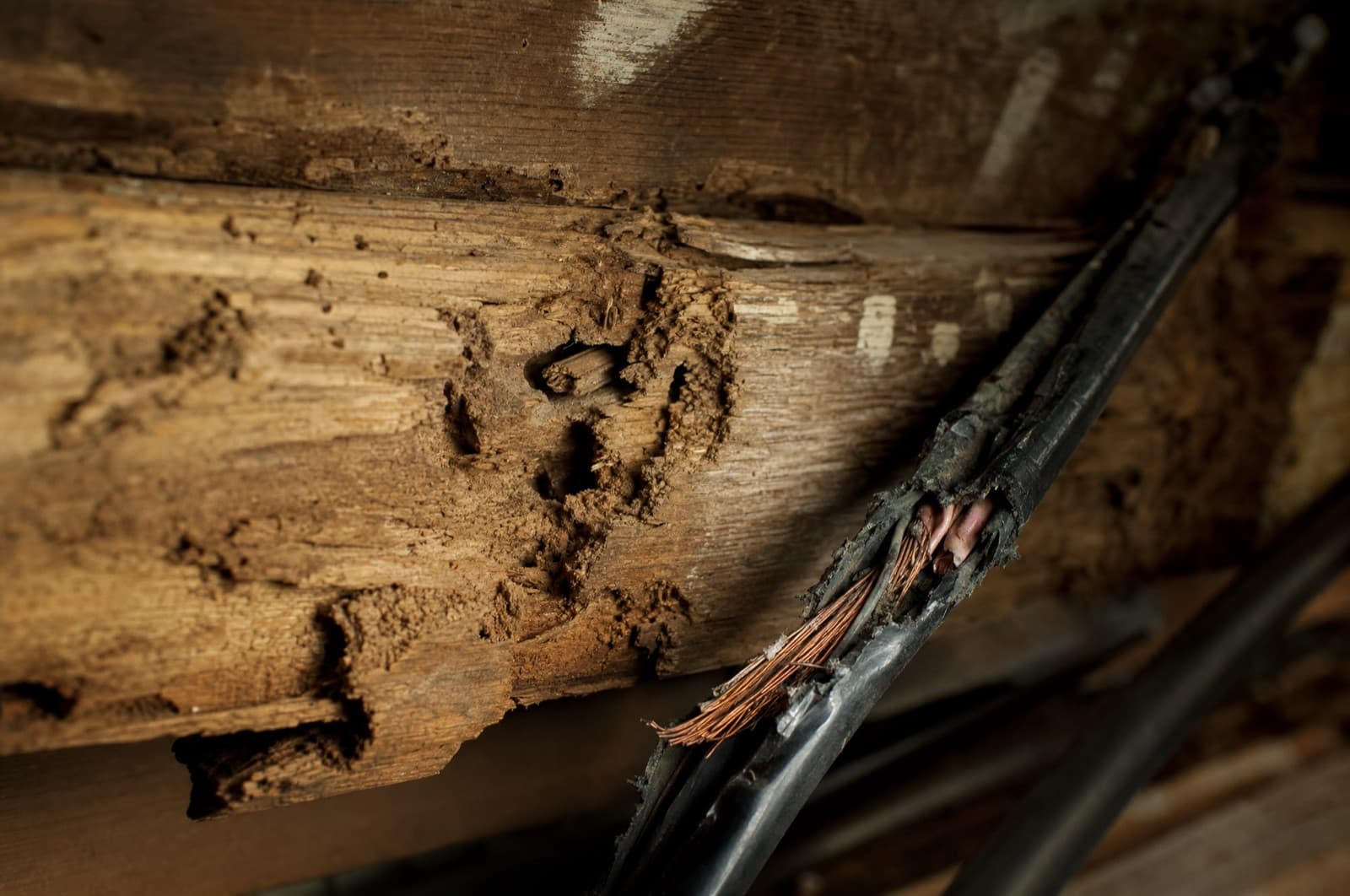
Pest damage evidence — a gnawed structural beam and a chewed electrical wire
Daniel Brady · NH-Licensed Pesticide Applicator · License #782664
Reviewed by Daniel Brady

Can pest droppings stain ceilings or walls?

Cosmetic damage — real, with a genuine health caveat
Yes. Rodent grease and urine marks, roach fecal spotting, fly specks, and bird or bat guano all discolor ceilings and walls, and the stains can be stubborn on unpainted drywall or ceiling tile. For most indoor pests, this staining is surface-level and wipes or repaints away — it does not weaken the material underneath. The one place this claim earns real weight is bird and bat guano, whose dried acids can etch paint and masonry over prolonged contact, and which more importantly carries a histoplasmosis risk that a fecal spot from a mouse or roach does not.

At a glance

  • Can it?: Yes
  • How common: Routine
  • Hype: Overstated
  • Evidence: Well documented
  • pH 2.7 to 4.1

    Acidity of dried bat excrement — acidic enough to attack paint and metal over prolonged contact

    APT Bulletin (Spennemann & Watson) — Bird excreta and architectural decay

The honest answer

The short of it

The verdict
Cosmetic damage — real, with a genuine health caveat

Yes, droppings routinely stain ceilings and walls — but the stain is cosmetic, and where the claim carries real weight is bird and bat guano, where the actual hazard is health, not your drywall.

The correction

What they claim vs. what the evidence supports

One shared severity track, two markers. The span between them is the hype delta — named out loud.

The claim — pest droppings staining, etching, or eating through ceilings and walls

That droppings "eat through" walls, corrode building materials, and contaminate entire homes — often citing bird-dropping acidity as if it works like a chemical solvent on paint, wood, or masonry.

Where the claim comes from: Bird-control vendor marketing, facilities-maintenance blogs, and pest-company pages that borrow corrosion language to make a cleaning problem sound like a structural one.

Severity, 0–100
Hype says75
40Evidence says
Hype delta35point gapWell documented
The evidence

Droppings from rodents, roaches, and flies stain readily but the effect is surface-level pigment and oil deposited on porous paint, plaster, or drywall — a cleaning and repainting job. Dried bird and bat guano is genuinely acidic enough to etch paint and metal finishes over prolonged contact, which is real, but even that etching is a finish-level effect, not a structural one. Interior wall and ceiling stains from rodents, roaches, or flies never weaken the material underneath.

The gap

Droppings do stain, and dried guano really is corrosive to finishes over time — but a fecal spot on your ceiling is a cleaning job, not a structural one. The real reason to take heavy guano seriously is the fungus it can carry, not the paint underneath it.

Damage assessment

What is actually harmed

Damage verdict
Cosmetic damage — real, with a genuine health caveat
CosmeticCan it?Yes
The specimen
Pest
Rodents (mice and rats), cockroaches, flies, and birds or bats where guano accumulates
What is in question
Painted and unpainted drywall, plaster, ceiling tile, wallpaper, and exterior paint or masonry near a roost
How common
Routine
Evidence
Well documented
Mechanism

Pigment, body oils, and organic acids in droppings deposit on and soak into porous surfaces — paint film, unfinished drywall, plaster, and ceiling tile. Dried bird and bat guano is more acidic than fresh guano and can, over long exposure, etch paint and metal finishes. None of these mechanisms reach the structural material underneath the finish.

Actually at risk4
  • Paint film and wallpaper, which absorb pigment and oil from droppings
  • Unfinished or unpainted drywall and plaster, which stain more readily and permanently than sealed surfaces
  • Exterior paint, metal flashing, and masonry near a long-established bird or bat roost, where dried guano acids can etch the finish over time
  • Ceiling tile in commercial-style drop ceilings, which is especially porous and quick to discolor
Not at risk — despite the myth4
  • Framing, studs, and joists — droppings do not weaken any structural wood
  • Poured concrete and masonry integrity — guano etches the surface finish, not the material's strength
  • The building's structural soundness in any scenario involving droppings alone
  • Anything beyond the finish layer, even in the worst realistic guano cases
Worst realistic case
A large, undisturbed bat or bird roost deposits accumulating guano that both stains and etches a surface and becomes a genuine histoplasmosis exposure hazard requiring professional cleanup — a real problem, but one that is about health and cleaning scope, not structural repair.

Assessed from: CDC (NIOSH) histoplasmosis guidance; University of Texas at Austin / Journal of Ornithology (2019); APT Bulletin on bird excreta and architectural decay

The compounding clock

Does it get worse if you ignore it?

Over time
Compounds slowly

A single stain is static — but an active roost or infestation keeps depositing, so accumulation worsens while the source remains.

The timeline
3 stages
  1. WeeksReversible

    Fresh droppings from an active indoor pest or a new roost deposit visible spotting or streaking on a ceiling or wall. At this stage it's usually still a surface stain that hasn't set deeply into the material.

  2. MonthsReversible

    Continued deposits from an ongoing infestation or roost darken and deepen the stain, and for bird or bat guano specifically, dried acids begin etching the paint or finish underneath.

  3. YearsReversible

    A long-undisturbed roost accumulates enough guano to require professional remediation, and the etched finish beneath it may need to be stripped and refinished rather than simply cleaned.

What stops the clock
Excluding or removing the animal causing the deposits, then cleaning the surface. A dried, old stain with no active pest present is already static and simply needs cleaning or repainting whenever convenient.
Repair scope

Who actually fixes this

Scope, not dollars — the honest answer to “how expensive is it,” routed to the right trade.

Who fixes it
You — wipe it up
Effort
An afternoon

Ordinary rodent, roach, or fly staining is a cleaning-and-repainting job you can do yourself — nothing about it requires a trade.

The right order
  1. 1
    Resolve the pest source first — an active infestation or roost keeps re-staining the same spot
  2. 2
    Clean the surface (following standard household cleaning practice) and let it dry
  3. 3
    Prime and repaint stubborn or porous stains that don't lift with cleaning alone
Route by symptom
  • Qualified remediationThe staining comes from a heavy, established bird or bat guano accumulation — that scale of cleanup is a qualified hazardous-cleanup job, not a homeowner task
  • Wildlife / exclusion specialistBats are the source — they are protected in New Hampshire, so removal is exclusion-only and timed around the maternity period, never a kill service
Do not
  • Don't dry-sweep or vacuum dry guano — it aerosolizes spores and is a genuine histoplasmosis risk; route heavy accumulations to remediation instead
  • Don't assume a stain means the wall or ceiling is structurally compromised — it isn't, even when the stain looks severe
Where we help — and where we don't

Anchor handles rodent exclusion and can address the pest source behind ordinary staining. Anchor does not do guano remediation or bat removal — bats are NH-protected and exclusion-only, and heavy guano accumulations route to a qualified remediation firm, not a pest treatment.

Health risk

The health angle

Histoplasmosis — a lung infection caused by a fungus that grows in soil enriched by accumulated bird or bat droppings

Caution
Who is at risk
  • Anyone disturbing a large, long-standing accumulation of bird or bat droppings without protection
  • People with weakened immune systems, who can experience more severe illness if exposed
Precautions
  • Do not dry-sweep, vacuum, or otherwise disturb a heavy droppings accumulation yourself
  • Treat any large or long-standing guano accumulation, especially in an attic or enclosed space, as a job for qualified remediation professionals
  • Wet down or dampen light, fresh droppings before wiping, rather than dry-brushing them
Do not
  • Don't dry-sweep or vacuum dried guano
  • Don't attempt large-scale guano cleanup yourself — route it to remediation
When to seek care

See a doctor if you develop flu-like respiratory symptoms after disturbing an accumulation of bird or bat droppings, particularly after cleaning an attic, barn, or similar space without professional help.

Health guidance from: CDC (NIOSH) — Histoplasma in the Environment

In depth

The full picture

01

What's actually staining your ceiling or wall

Rodent grease trails and urine marks, cockroach fecal spotting, fly specks, and bird or bat guano all deposit pigment, oils, and organic acids onto whatever surface they land on. On porous, unpainted, or unfinished materials — bare drywall, plaster, ceiling tile — those deposits soak in and become genuinely stubborn stains rather than a simple wipe-away mark. On painted or sealed surfaces, the same droppings usually clean off far more easily.

This is the routine, everyday version of the claim, and it's real: if you have an active rodent, roach, or fly presence, staining is a normal and expected side effect, not a rare worst case.

02

The guano exception, and where the corrosion claim actually comes from

The popular claim that bird droppings' uric acid "eats through" building materials is overstated and partly wrong on the chemistry. Nick Crouch, a postdoctoral researcher at the University of Texas at Austin's Jackson School of Geosciences, analyzed excretions from six bird species (published in the Journal of Ornithology, August 2019, with co-authors Julia Clarke and Vincent Lynch) and found there is no uric acid in excreted bird urine — it's likely broken down by gut bacteria before excretion. The commonly cited pH figures for bird droppings trace to trade and auto-detailing sources rather than primary chemistry.

What peer-reviewed work does support is more specific: fresh bat excrement measures a pH of roughly 5.1 to 7.3, but once it dries and solidifies, the pH drops to roughly 2.7 to 4.1 — genuinely acidic enough to attack paint and metal finishes over prolonged contact. So the corrosion mechanism is real for dried guano specifically, just not for the reason usually given, and it's a finish-level effect, not a structural one.

03

Why this stays cosmetic even at its worst

Even in the worst realistic case — a large, long-undisturbed roost with heavy guano accumulation — the physical damage described in the literature is etching of paint, metal flashing, or masonry surfaces, not a weakening of the studs, joists, or concrete underneath. No source in this body of evidence describes droppings of any kind compromising a building's structural integrity. The stain, however severe it looks, sits on top of a sound wall.

That's why the honest verdict here is cosmetic across the board, with the caveat that heavy guano is a genuine cleanup-scale problem rather than a small one — it just isn't a structural problem.

04

The health risk is real, and it's the actual reason to act

The genuine reason to take heavy bird or bat guano seriously isn't the paint underneath it — it's histoplasmosis, a lung infection caused by a fungus that grows in soil enriched by bird and bat droppings. The CDC identifies large or long-standing droppings accumulations as the kind that should be handled by professionals rather than disturbed by a homeowner, because dry-sweeping or vacuuming guano aerosolizes fungal spores.

That's the correction worth internalizing: don't evaluate a guano problem by how bad the stain looks. Evaluate it by how much accumulation there is and route heavy cases to qualified remediation — the stain is the least important part of the picture.

Key takeaways
5 points
  • Yes — droppings from rodents, roaches, flies, and birds or bats all stain ceilings and walls, and the effect can be stubborn on unpainted surfaces.
  • For ordinary indoor pests, this is a cleaning-and-repainting job. It does not weaken drywall, plaster, or framing.
  • Dried bird and bat guano is genuinely acidic enough to etch finishes over time — the popular 'uric acid eats through walls' explanation is not the correct chemistry, but the corrosive effect itself is real.
  • The real reason to treat heavy guano seriously is histoplasmosis, not the stain — large accumulations route to qualified remediation, not DIY cleaning.
  • Bats are protected in New Hampshire — removal is exclusion-only and timed around the maternity period, never extermination.
New Hampshire context

Attics and barns are where this shows up in New Hampshire

Southern and central New Hampshire's older barns, farmhouses, and unfinished attic spaces are the most common places a long-established bird or bat roost goes unnoticed long enough to build up heavy guano staining — spaces people simply don't look at often. As temperatures drop toward Manchester's first hard frost (historically around October 19 to 29, per NOAA), bats seek out exactly these undisturbed, insulated spaces to overwinter, which is when an existing roost's accumulation is likely to be highest.

If you find heavy droppings staining in an attic, barn, or outbuilding, treat it as a call for professional evaluation of both the pest source and the accumulation itself — not a weekend cleaning project.

  • NH-licensed #782664

    Southern New Hampshire

  • Family-owned

    Since 2017

  • Honest routing

    Even when it isn’t us

We serve these communities

ManchesterNashuaConcordDerryBedfordSalemHudsonAmherstAuburnGoffstownHooksettLitchfieldLoudonMilfordBristol

Service Area Map

Southern New Hampshire

BristolPop. 3,200LoudonPop. 5,500ConcordPop. 43,900HooksettPop. 14,800GoffstownPop. 18,000AuburnPop. 5,700ManchesterPop. 115,600BedfordPop. 23,300LitchfieldPop. 8,500AmherstPop. 11,300DerryPop. 34,500MilfordPop. 15,700HudsonPop. 25,600NashuaPop. 91,100SalemPop. 30,000HQCityHover for info

Active rodents or roaches leaving the stains? Anchor stops the source.

We resolve the pest causing ongoing staining. Cleaning and repainting is yours, and any large guano cleanup routes to qualified remediation.

Follow-up questions

Frequently asked

Sources & citations(4)
  1. CDC (NIOSH) — Histoplasma in the Environment

    Histoplasmosis risk from bird and bat droppings; large accumulations routed to professional cleanup

    govverified 2026-07-16
  2. CDC — Reducing Risk for Histoplasmosis

    Guidance that large droppings accumulations should be cleaned by professionals

    govverified 2026-07-16
  3. University of Texas at Austin (Jackson School) / Journal of Ornithology (2019) — Bird Droppings Defy Expectations

    Finding that excreted bird urine contains no uric acid, correcting the popular corrosion explanation

    academicverified 2026-07-16
  4. APT Bulletin (Spennemann & Watson) — Bird excreta and architectural decay

    Uric and phosphoric acids associated with decay of stone, paint, and metal finishes

    academicverified 2026-07-16

Written & reviewed by

Verified

Daniel Brady

NH-Licensed Pesticide Applicator · License #782664 (NHDAMF, RSA 430)

Daniel Brady is the New Hampshire–licensed applicator behind Anchor Pest Services, a family-owned pest control company serving the Manchester area since 2017.

Verify license

Last updated Jul 2026

Honest pest help for New Hampshire homes

We Stop the Pest Behind the Stain. We'll Tell You Who Handles the Rest.

Droppings staining is cosmetic and cleans up with basic household work once the source pest is gone. Anchor Pest Services resolves the rodent, roach, or bird-exclusion issue causing it — we don't do guano remediation or bat removal, and we'll route you to the right specialist for either. Family-owned since 2017, NH license #782664, serving Manchester, Nashua, Concord and nearby towns.

  • Honest advice — we route guano cleanup and bat exclusion to the right specialists
  • NH-licensed applicators (#782664) — free inspection, same-day service
  • Rodent, roach, and bird-exclusion pest control across southern and central New Hampshire

NH License #782664 · No obligation · We answer in person