
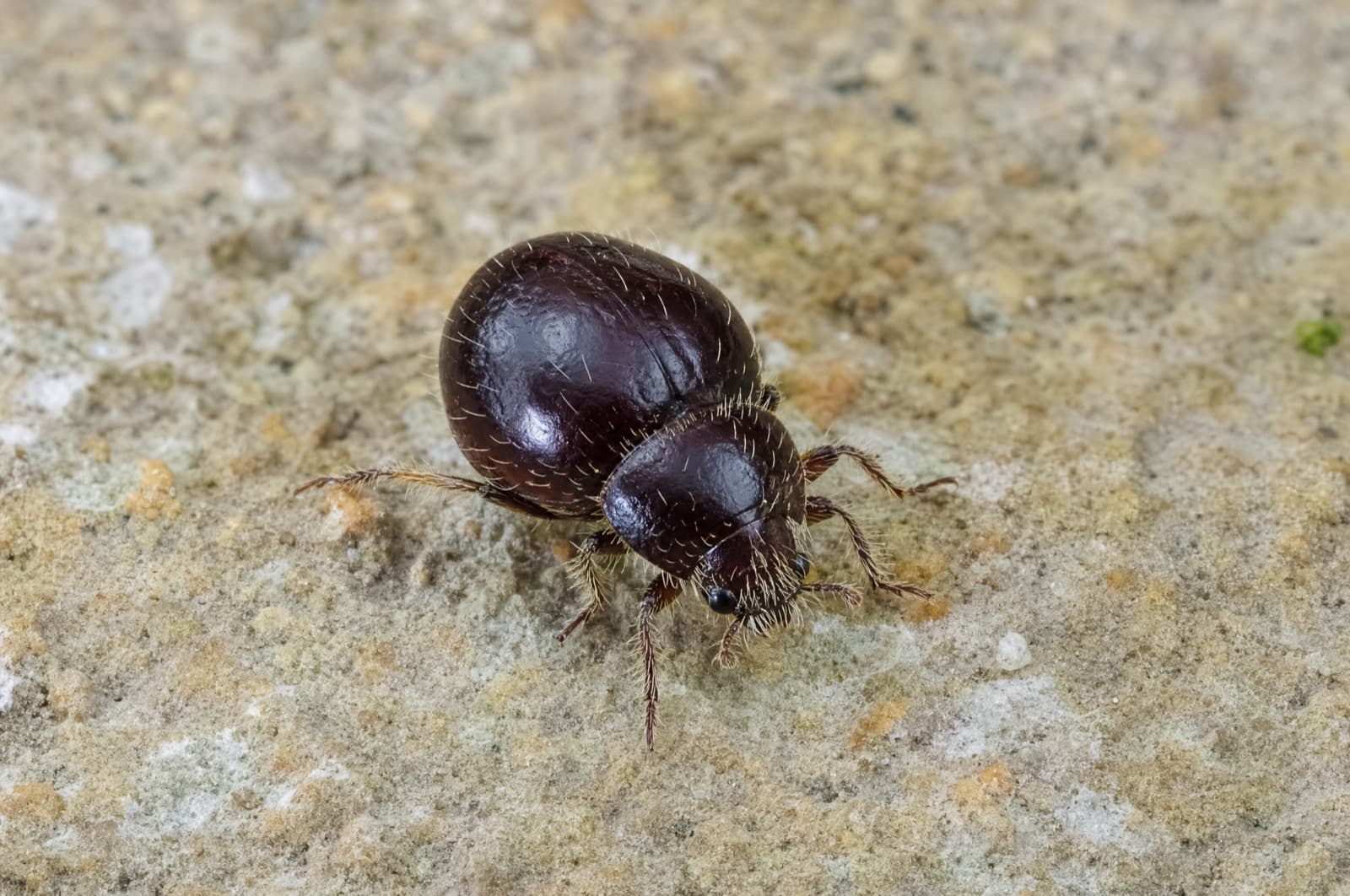
Spider Beetles in New Hampshire: Not a Spider — Here's the Real ID
Also called American spider beetle · Whitemarked spider beetle
Spider beetles are odd little scavengers with long legs and a round, bulbous body that makes them look like tiny spiders, mites, or even engorged ticks — but they're harmless beetles, not spiders. They feed on stored food, crumbs, and debris in dark, damp, often older buildings. Their numbers usually trace to a hidden source: a rodent nest, spilled grain, damp or forgotten package, or wall-void debris. They don't bite, sting, or bore into structural wood.
- Size
- American spider beetle ~1.5–3.5 mm; whitemarked spider beetle ~2–4.3 mm
- Penn State Extension
- Silhouette
- Six legs + antennae; round bulbous abdomen — looks like a spider but is a beetle
- Penn State Extension
- Habitat
- General scavenger in pantries, attics, and areas with rodent/bird/bat droppings
- Penn State Extension
- Life cycle
- Development ~2–3 months; 1–2 generations per year
- Colorado State University Extension; Penn State Extension
- Cold tolerance
- Active even below freezing — unusual among pantry beetles
- Penn State Extension
- Safety
- Does not bite, sting, transmit disease, or bore into structural wood
- UC Riverside Urban Entomology
Is it a spider, a tick, or a beetle? How to tell in three steps
Few pantry pests cause as much alarm as the spider beetle — because at first glance, it isn't obviously a beetle. The round, bulbous abdomen and long, spindly legs produce a silhouette that reads as 'spider' or 'tiny tick' to most people, and the panic that follows often sends them to the wrong solution.
Here's how to distinguish it in three steps: Count the legs. Six legs = insect (a beetle). Eight legs = arachnid (spider or tick). Look for antennae. A pair of antennae = a beetle; spiders and ticks have none. Check the body. A round, shiny, hard-shelled abdomen with hard wing covers = spider beetle.
Spider beetles are harmless. They don't bite, sting, or transmit disease. They're general scavengers that feed on stored food, grain debris, dead insects, feathers, and the organic material in rodent and bird nests. Their presence indoors — especially in damp basements, attics, or older buildings — is more of a sign than a problem in itself: finding them is often a cue to check for excess moisture and rodent activity as much as for infested food.
In New Hampshire, UNH Extension lists spider beetles among the less common pantry pests, but their tolerance of cold means they can stay active in unheated spaces that other pantry pests can't. They fit NH's older housing stock and damp basements well.
Spider beetle ID: the disambiguator for spiders, ticks, and beetles
The spider-beetle identification is essentially a two-step disambiguation. First, confirm it's not a spider or tick: count the legs (six, not eight) and look for antennae (beetles have them, arachnids don't). Second, identify which spider beetle: the American spider beetle (Mezium americanum) has a glossy, near-black globular abdomen with pale cream hairs on the head, thorax, and legs; the whitemarked spider beetle (Ptinus fur) is brownish with patches of light scales that are often worn off on older specimens.
Spider beetle
- Scientific name
- Mezium americanum (American); Ptinus fur (whitemarked)
- Family
- Ptinidae (subfamily Ptininae)
- Size
- ~1.5–4.3 mm (1/16–3/16 inch)
- Coloration
- American: glossy reddish-brown to near-black bulbous abdomen with pale cream hairs on head/legs; whitemarked: brownish with light scale patches (often worn off)
- Habitat
- Damp basements, crawl spaces, pantries, attics with rodent or bird droppings, old wooden buildings
- Active season
- Year-round indoors; active even at temperatures below freezing
- Diet
- Seeds, grain debris, herbs, dried fruit, fungi, feathers, dead insects, rodent-nest refuse
- Reproduction
- Eggs laid singly over weeks; egg-to-adult ~2–3 months; 1–2 generations per year
- Lifespan
- Variable; extended larval/pupal diapause possible (7–8 months)
Cosmopolitan across North America; documented in New Hampshire (UNH Extension)
The tells — key ID features
- Long legs plus a round, bulbous abdomen — a 'spider-like' silhouette, but with six legs and a pair of antennae.
- American spider beetle: glossy, near-black globular abdomen with pale fuzzy head and legs.
- Whitemarked spider beetle: brownish with patches of light scales (often rubbed off in older specimens).
- Nocturnal — forages at night and hides in dark crevices by day.
- C-shaped, dirty-white grub larvae with well-developed legs.
- Associated with damp conditions and older structures — often near rodent activity.
Size, to scale
1.5–4.3 mm
About the size of a pinhead or a small seed bead
Actual spiders
How to tell — Spiders have eight legs, two distinct body regions (cephalothorax + abdomen), no antennae, and often spin webs. Spider beetles have six legs, antennae, and hard wing covers.
Ticks
How to tell — Ticks have eight legs, no antennae, are flattened, and blood-feed on hosts. Spider beetles have six legs, antennae, and are found in pantries and debris — not on people or pets.
Other pantry beetles (flour, sawtoothed)
How to tell — Flour and sawtoothed grain beetles are flat and elongate — very different from the spider beetle's round, bulbous abdomen on long spindly legs.
Signs of a problem
Spider-beetle signs point both to the insect itself and to the underlying conditions — moisture and rodent activity — that sustain it.
Round, long-legged 'tiny spiders' in the pantry, basement, or damp attic
What it means — Likely spider beetles — count legs (six = beetle, eight = spider) before treating as an arachnid problem.
Beetles in damp basements, crawl spaces, or old attics
What it means — Moisture-favored harborage; check for a hidden food or debris source in these areas.
Beetles near areas of rodent activity or near bird/bat roost areas
What it means — Rodent nests, droppings, and spilled grain are a primary spider-beetle source — check for both pests.
Silk, cocoons, or fine debris inside stored food
What it means — Larval activity is contaminating stored goods; the infested package must be discarded.
Small holes or scarring in old cardboard, sacking, or wood surfaces near food
What it means — Pupating larvae forming chambers — not structural wood-boring damage, but confirms beetle activity.
Beetles active on cold nights in an unheated space
What it means — The unusual cold tolerance of spider beetles specifically points to this group versus other pantry pests.
The real risks, calibrated
Spider beetles are a nuisance and contamination pest — and a useful indicator of moisture and rodent problems. The risk level is low.
Food contamination
ModerateOnset: Ongoing while source exists
Dead insects, silk, and cocoons in stored food lower quality and render it unfit for consumption.
Hidden-source persistence
ModerateOnset: Weeks to months
Rodent nests, wall-void debris, and damp grain can sustain a population despite pantry cleanup.
Moisture and rodent indicator
Low riskOnset: Ongoing
Their presence in a damp basement or near rodent activity signals a moisture or pest problem that may exceed the beetle itself.
Incidental surface scarring
Low riskOnset: Over months
Pupating larvae can chew cardboard, sacking, and the surface of old wood to form pupation chambers — they do NOT bore into or weaken structural timber.
Misidentification anxiety
Low riskOnset: Immediate
Mistaken for spiders or ticks, leading to the wrong treatment approach (spider sprays miss the food/debris source).
Biting, stinging, or disease
Low riskOnset: N/A
None — spider beetles don't bite, sting, or transmit disease to people or pets.
DIY — what works, what backfires
Spider-beetle control is a two-part problem: remove the food/debris source AND address the moisture and rodent conditions that attracted them.
What actually works
- Count legs before treating — six legs and antennae = beetle (not a spider); use this ID to target the right source.
- Find and discard infested food, debris, and any rodent nest material; seal in bags and remove from the home.
- Reduce humidity in damp basements and crawl spaces with a dehumidifier — spider beetles favor high-moisture environments.
- Vacuum cracks, corners, and damp areas where organic debris accumulates.
- Address any rodent activity — rodent nests and droppings are a primary harborage for spider beetles.
- Store dry goods in airtight glass or metal containers.
What backfires
- Don't reach for spider sprays — they target arachnids and miss the food or rodent-debris source causing the beetle infestation.
- Don't ignore moisture: damp conditions are a root cause, not just a coincidence.
- Don't overlook attics and wall voids where rodent or bird nest debris can sustain a hidden population for months.
Spider beetles in New Hampshire homes
UNH Cooperative Extension lists spider beetles among New Hampshire's less common pantry pests. Their preference for damp, cool environments and tolerance of temperatures below freezing makes them a fit for NH's older housing stock — particularly damp basements, crawl spaces, and attics. Finding spider beetles is often a cue to inspect for moisture problems and rodent activity (rodent nests and droppings are a primary harborage) as much as for infested food. A licensed NH applicator can assess both the beetle source and any contributing rodent issue.
Peak season
Year-round indoors; active even in cold — can persist in unheated NH spaces
You might actually have
- House mouse and white-footed mouse (whose nests are a primary spider-beetle harborage)
- Sawtoothed grain beetle (flat, elongate, very different silhouette — no bulbous abdomen)
- Drugstore beetle (humpbacked oval, similar pantry pest but different body shape)
We serve these communities
- NH-licensed applicator · #782664
- Same-day service
- Family-owned since 2017
Service Area Map
Southern New Hampshire
When to call a pro for spider beetles
If spider beetles keep appearing despite cleaning, the source is often hidden in a rodent nest, wall-void debris, or damp stored grain in a secondary area. A licensed technician can locate the harborage, address contributing rodent issues, and advise on moisture. Anchor Pest Services (NH #782664, F1) offers General Pest Control with a free quote and same-day service.
When to call a pro
- Beetles keep appearing despite removing all obvious food sources and cleaning the area.
- Beetles are found in wall voids, attics, or crawl spaces suggesting a hidden rodent-nest source.
- A rodent problem likely coexists and requires coordinated pest control.
- Damp basement or crawl space conditions are contributing — a professional can assess both the beetle and the moisture.
Reduce moisture in basements and crawl spaces
Spider beetles favor damp, humid spaces. A dehumidifier or improved crawl-space drainage removes the environmental condition that makes NH basements and crawl spaces attractive harborage.
Exclude rodents and remove their nests
Rodent nests and droppings are a primary spider-beetle source. Seal entry points for mice and remove any nests in attics, wall voids, and crawl spaces — this removes both the rodent and a key beetle harborage.
Store dry goods airtight and clear old debris
Transfer food to airtight rigid containers. Clear old boxes, sacking, forgotten packages, and accumulated debris from pantry shelves and secondary storage areas.
Not sure it's a spider beetle?
A licensed NH technician can confirm the species and tell you honestly whether it's a DIY fix or a job for a pro — free inspection, same-day service across Southern New Hampshire.
Frequently asked questions
Sources(5)
- [1]Penn State Extension — Spider Beetles
size (American and whitemarked), coloration, general-scavenger habitat, damp preference, cold tolerance
extensionverified 2026-06-30 - [2]Colorado State University Extension — Spider Beetles
development 2–3 months, 1–2 generations per year, humidity preference
extensionverified 2026-06-30 - [3]UC Riverside Urban Entomology (Ebeling, Ch. 7)
no bite/sting/disease, food contamination, incidental surface scarring (not structural wood boring)
academicverified 2026-06-30 - [4]UNH Cooperative Extension — Kitchen Pests Fact Sheet
NH presence (less common pantry pest)
extensionverified 2026-06-30 - [5]USDA Forest Service — Treesearch Publication
supplemental stored-product pest context
govverified 2026-06-30
Written & reviewed by
VerifiedDaniel Brady
NH-Licensed Pesticide Applicator · License #782664 (NHDAMF, RSA 430)
Daniel Brady is the New Hampshire–licensed applicator behind Anchor Pest Services, a family-owned pest control company serving the Manchester area since 2017.
Last updated 2026-06-30

New Hampshire pest control
Dealing with spider beetles in your home?
Anchor Pest Services identifies and handles spider beetle problems across southern and central New Hampshire. Family-owned since 2017, NH license #782664.
- NH-licensed applicators (#782664)
- Same-day service · free inspection
- Family-owned since 2017
Your next step
- Next step
Is Home Defense Ant, Roach & Spider Killer by Ortho Safe for Pets?
Read the answer - What to do next
What Attracts Spider Beetles to Your House?
Read the answer - What to do next
Mechanical Spider Control: Web Removal That Actually Works
Read the answer - What to do next
Natural Spider Control: What Actually Works in New Hampshire
Read the answer - Related guide
Cellar Spider (Daddy-Long-Legs) in NH: ID & Control
Read the answer