
Cellar Spider (Daddy-Long-Legs) in NH: ID & Control
Also called Daddy-long-legs spider · Skull spider · Vibrating spider
The cellar spider — the long-legged, ghostly spider in your NH basement — is completely harmless, not known to bite people, and eats other insects and spiders. The famous 'world's most venomous with fangs too short to bite' claim has no scientific basis; it is a myth. Managing cellar spiders is mostly about reducing basement moisture and vacuuming webs.
- Body size
- 6–10 mm (~grain of rice)
- legs ~5–6× body length; Missouri Department of Conservation
- Bite risk
- Not known to bite people
- tiny chelicerae; insectidentification.org
- NH status
- Present statewide indoors
- insectidentification.org
- Diet
- Insects and other spiders
- Penn State Extension
- 'Most venomous' myth
- False — no scientific basis
- Penn State Extension
Harmless, helpful, and absolutely everywhere in NH basements
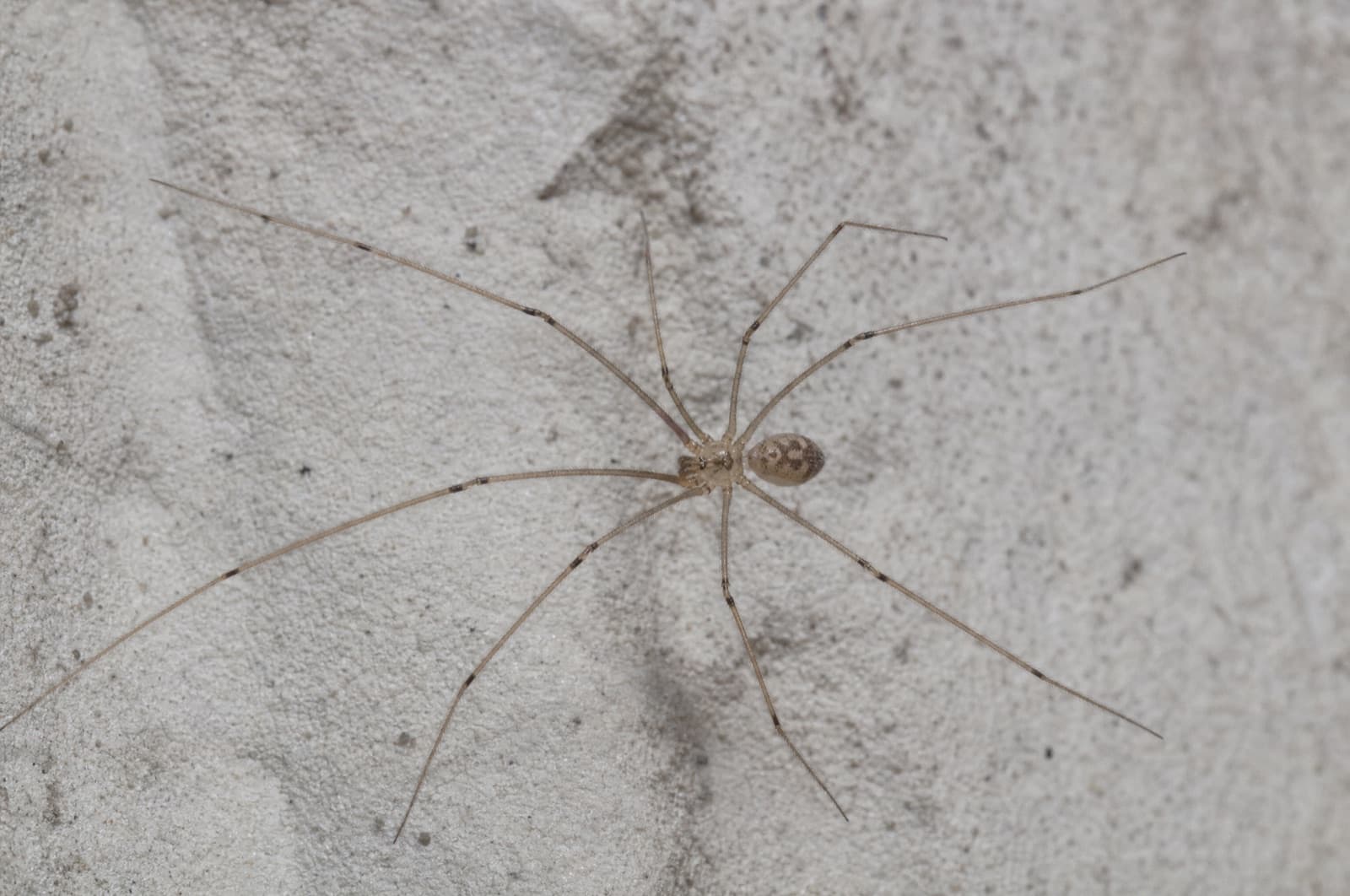
The cellar spider (Pholcus phalangioides) — widely called the daddy-long-legs spider — is one of the most reliably encountered spiders in New Hampshire homes. It is also one of the most misunderstood. Its wispy, almost ghostly appearance, persistent webs in every basement corner, and the famous (and entirely false) claim about being 'the world's most venomous spider' combine to give it a reputation out of all proportion to its actual impact.
The reality: the cellar spider is harmless. It is not known to bite people, its chelicerae are not unusually small, and no scientific study has ever demonstrated unusual venom toxicity. The myth has no published peer-reviewed foundation. The spider's most distinctive feature is its extraordinary leg length — a body the size of a grain of rice suspended on legs that can span the width of a silver dollar — and its habit of vibrating the web rapidly when disturbed.
What the cellar spider is actually doing in your basement is eating other insects and spiders, including other species you would less prefer to have around. For most NH homeowners, the only real question is whether the webs in the corners are tolerable — and if not, how to manage them without overreacting.
How to identify a cellar spider
Two features identify the cellar spider immediately: a body no larger than a grain of rice paired with legs that are disproportionately long and thin — typically five to six times the body length. Nothing else in your NH basement looks quite like it.
Long-bodied Cellar Spider
- Scientific name
- Pholcus phalangioides
- Family
- Pholcidae
- Size
- Body 6–10 mm; legspan up to ~50 mm
- Coloration
- Pale gray, tan, or slightly translucent; small dark markings on cephalothorax; abdomen elongated and pale
- Habitat
- Basements, crawlspaces, garages, utility rooms, and fieldstone foundations — cool, damp, and undisturbed.
- Active season
- Year-round indoors; no seasonal retreat
- Diet
- Insects and other spiders, including spiders larger than itself
- Reproduction
- Female carries egg sac in chelicerae until eggs hatch; several egg masses per season
- Lifespan
- 1–2 years in favorable conditions
Present statewide in New Hampshire; found throughout the US and worldwide wherever suitable indoor habitat exists.
The tells — key ID features
- Tiny pale body (grain-of-rice size) — the single most striking feature when seen in context with the legs.
- Extremely long, thin, fragile-looking legs roughly five to six times the body length.
- Loose, tangled, three-dimensional cobweb in ceiling corners and basement spaces.
- Hangs upside-down in the web at rest.
- Vibrates or whirls rapidly in the web when disturbed — a unique defensive behavior.
- Pale gray or translucent coloration — almost ghostly in appearance.
Size, to scale
Body 6–10 mm; legspan up to ~50 mm
Body roughly the size of a grain of rice; legspan can exceed a silver dollar
Harvestman (Opiliones — 'daddy-long-legs')
How to tell — A harvestman has a single fused body lump (no waist between body segments), cannot spin silk, and builds no web. If it is in a web, it is a cellar spider. If it is wandering the floor on long stalky legs with a tiny round body, it is a harvestman.
Crane fly ('mosquito hawk')
How to tell — A crane fly is a flying insect — it has wings, antennae, and no web-spinning ability. Often mistaken for a giant mosquito. Not an arachnid at all.
Common house spider
How to tell — Rounder, more compact abdomen; shorter, stockier legs; brownish mottled coloration; builds cobwebs at head height or in window frames rather than ceiling corners.
Signs of a problem
Cellar spiders advertise themselves through webs far more than through direct sighting. These are the characteristic signs of a resident cellar spider population.
Loose, three-dimensional cobwebs in upper corners of basements, garages, and crawlspaces
What it means — The irregular, tangled structure in ceiling corners is classic cellar spider construction — not the orb web of a garden spider or the funnel web of a grass spider.
Multiple webs accumulating quickly after cleaning
What it means — Cellar spiders reproduce continuously indoors; fast web recurrence suggests an established population with good food supply and conditions.
A spider that shakes or blurs rapidly when the web is touched
What it means — The vibrating defensive behavior is unique to Pholcus and its relatives — if it shakes rather than fleeing, you have a cellar spider.
The real risks, calibrated
The cellar spider has no medical significance. It is not known to bite people and carries no venom of concern. The popular 'world's most venomous' myth has no scientific support.
Cobweb accumulation (nuisance only)
Low riskOnset: Ongoing while population is active
Persistent webs in basement corners and crawlspaces are the primary nuisance. No health risk is associated with cellar spider webs or presence.
Misidentification alarm
Low riskOnset: Immediate
The 'world's most venomous' myth can cause unnecessary alarm. Cellar spiders are harmless; the myth has no scientific basis and should not drive treatment decisions.
DIY — what works, what backfires
Cellar spider control is mostly mechanical — vacuum webs, reduce moisture, and seal entry points. Chemical treatment is rarely warranted and addresses only the symptom, not the conditions driving the population.
What actually works
- Vacuum webs regularly — this removes eggs, hatchlings, and adult spiders together and is the most effective single step.
- Dehumidify the basement to below 50% relative humidity; cellar spiders thrive in damp conditions and will reduce in population when humidity drops.
- Seal gaps around sill plates, rim joists, and basement windows where spiders enter from the foundation.
- Reduce undisturbed clutter in the basement — open shelving and empty corners have fewer suitable web sites.
What backfires
- Don't fog or panic-spray for cellar spiders — they are harmless, and aerosol treatment without addressing moisture and entry points produces only temporary results.
- Don't mistake a harvestman (a wandering, web-free arachnid with a fused body) for a cellar spider and over-treat.
- Don't assume heavy cobwebs mean a dangerous species — in a NH basement, it almost always means cellar spiders, not anything medically significant.
Cellar spiders in New Hampshire homes year-round
Cellar spiders thrive in virtually every New Hampshire basement and crawlspace because the conditions here are ideal: cool, damp, and undisturbed. Unfinished basements, fieldstone foundations, utility corners, and rim-joist cavities are prime habitat. Unlike many spiders that are seasonal, the cellar spider is active year-round indoors — there is no season during which they retreat outdoors. In southern NH, the same features that make older homes energy-inefficient — gaps around sill plates, uninsulated rim joists, open crawlspaces — also create ideal cellar spider harborage.
Peak season
Year-round indoors; no seasonal retreat
You might actually have
- Common house spider (rounder body, corner webs at head height)
- Wolf spider (large, ground-hunting, no web)
- Harvestman / daddy-long-legs (not a spider — fused single body, no web)
We serve these communities
- NH-licensed applicator · #782664
- Same-day service
- Family-owned since 2017
Service Area Map
Southern New Hampshire
When to call a pro for cellar spiders
A few cellar spiders in a basement corner require no professional intervention. Heavy recurring populations in a finished basement — especially where webs are becoming aesthetically problematic or the moisture issue driving them has not been identified — can benefit from a professional inspection.
When to call a pro
- Heavy recurring cobwebs in a finished basement that return within days of cleaning.
- You want the moisture and entry-point conditions professionally identified and corrected.
- You are unsure of your identification and want confirmation of which spider species you actually have.
Dehumidify to below 50% RH
A dehumidifier in the basement is the single most impactful step — cellar spiders need damp conditions and will naturally reduce when relative humidity drops below 50%.
Seal sill plate and rim-joist gaps
Foam or caulk around the sill plate and rim joist blocks the primary entry paths from the foundation into the basement — this reduces all basement spider species, not just cellar spiders.
Knock down webs on a routine schedule
Without a stable web, cellar spiders relocate. Regular vacuuming of basement corners — even monthly — keeps populations from establishing at high density.
Not sure it's a long-bodied cellar spider?
A licensed NH technician can confirm the species and tell you honestly whether it's a DIY fix or a job for a pro — free inspection, same-day service across Southern New Hampshire.
Frequently asked questions
Sources(3)
- [1]InsectIdentification.org — Long-bodied Cellar Spider
not known to bite people; NH statewide presence
referenceverified 2026-06-30 - [2]Penn State Extension — Long-bodied Cellar Spider
in no way harmful ('most venomous' myth false); diet including other spiders; common in cellars and garages
extensionverified 2026-06-30 - [3]Missouri Department of Conservation — Long-bodied Cellar Spider
habitat; behavior; identification; harmlessness; body size 6–10 mm; leg length ~5–6× body
govverified 2026-06-30
Written & reviewed by
VerifiedDaniel Brady
NH-Licensed Pesticide Applicator · License #782664 (NHDAMF, RSA 430)
Daniel Brady is the New Hampshire–licensed applicator behind Anchor Pest Services, a family-owned pest control company serving the Manchester area since 2017.
Last updated 2026-06-30

New Hampshire pest control
Dealing with long-bodied cellar spiders in your home?
Anchor Pest Services identifies and handles long-bodied cellar spider problems across southern and central New Hampshire. Family-owned since 2017, NH license #782664.
- NH-licensed applicators (#782664)
- Same-day service · free inspection
- Family-owned since 2017
Your next step
- Next step
Is Home Defense Ant, Roach & Spider Killer by Ortho Safe for Pets?
Read the answer - What to do next
How to Get Rid of Cellar Spiders
Read the answer - What to do next
What Attracts Cellar Spiders to Your House?
Read the answer - Related guide
House Spider in New Hampshire: ID, Webs & Control
Read the answer - Related guide
Spider Beetles in New Hampshire: Not a Spider — Here's the Real ID
Read the answer