
How to Prevent Termites in a Shed or Detached Outbuilding
This is a genuine, if low-probability, termite risk — a shed or outbuilding sitting on skids, blocks, or a slab in damp ground is a classic wood-to-soil scenario, and it matters because an infested outbuilding can be an unmonitored feeder colony a short forage away from the house.
Real but manageable: a detached structure at NH's northern range edge is rarely urgent, and the fix — get the wood off the dirt, keep it dry — is inexpensive and mostly one-time work.
At a glance
- What it is: Real termite risk
- The driver: Wood-to-soil contact at the sill and floor framing
- Who fixes it: You can handle this
This is a genuine, if low-probability, termite risk — a shed or outbuilding sitting on skids, blocks, or a slab in damp ground is a classic wood-to-soil scenario, and it matters because an infested outbuilding can be an unmonitored feeder colony a short forage away from the house.
Real but manageable: a detached structure at NH's northern range edge is rarely urgent, and the fix — get the wood off the dirt, keep it dry — is inexpensive and mostly one-time work.
Pull the right lever, not the sprayer
The organism is downstream of one condition. Remove that condition and it has no foothold — which is why prevention here is rarely a pesticide.
The driver
Wood-to-soil contact at the sill and floor framing
Skids, sill plates, and untreated floor framing resting on or near soil let foraging termites reach cellulose under cover of darkness and moisture without ever surfacing. Because a subterranean colony can forage up to roughly 260-300 feet from its nest, an outbuilding within that radius of the house can share the same soil colony.
Source:Rutgers Cooperative Extension— FS338: Termite Prevention and Control (Changlu Wang)
4 levers, honestly ranked
Sorted by what actually moves the driver — primary first, theatre last. Effort is graded so you know what's a five-minute fix and what's a real project.
- Primary — moves the driverWeekend project
Get the sill and floor framing up off the dirt
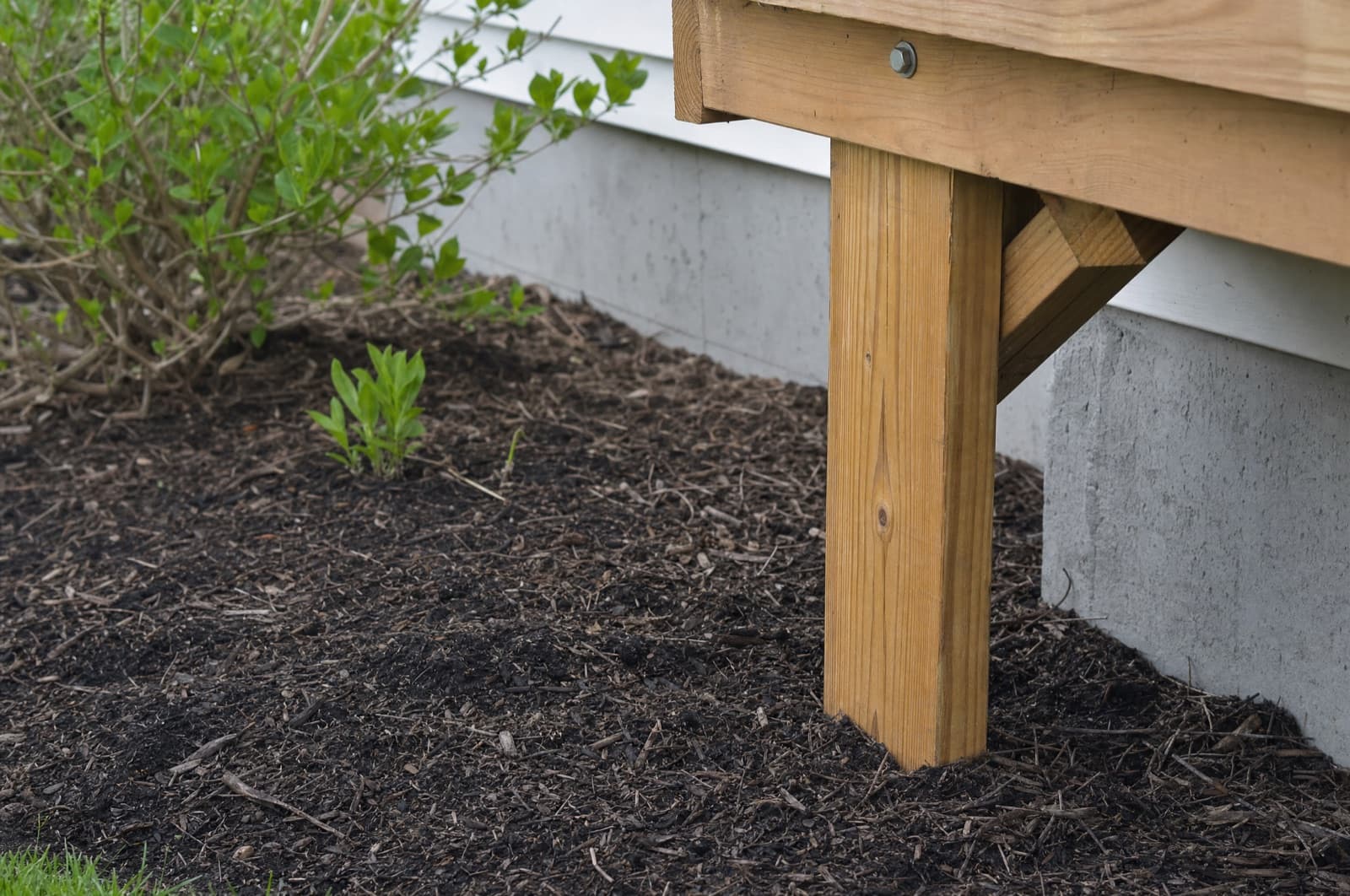
Set the structure on a concrete slab, poured piers, or concrete blocks so no untreated wood touches soil, aiming for at least six inches of clearance between soil and any wood. If the shed already sits on wood skids in ground contact, jack it and shim onto blocks or a gravel pad. This directly removes the enabling condition — the hidden, moist wood-to-soil bridge — rather than masking it, which is why it is the one lever that actually moves the driver.
- Primary — moves the driverWeekend project
Fix the drainage around the shed
Grade soil so it slopes away from the structure, keep any gutters discharging away from the base, and eliminate low spots where water stands after rain. Subterranean termites concentrate where soil stays consistently moist, so drying the perimeter denies them the humidity they need to forage upward and makes any mud tube that does form easier to spot. Keep the base clear of leaf litter and stacked debris that trap dampness against the wood.
- SupportingQuick DIY
Keep a clear inspection band around the base
Maintain a strip of bare soil or gravel around the base so the bottom edge of walls and framing stays visible; pull back mulch, stored lumber, and vegetation. Mud tubes are the single most reliable early sign of activity, and they can only be found if the wood-to-soil junction is exposed to view rather than buried under plantings or piled storage.
- SupportingQuick DIY
Don't store loose cellulose on the shed floor against the ground
Cardboard, scrap lumber, and firewood left directly on the shed floor or against interior walls give foragers an easy first meal and cover close to the wood-to-soil junction. Store these items off the floor and away from walls, on shelving or racks, to reduce what a colony could exploit before anyone notices.
Whose job is this, really?
Who actually fixes it
You can handle this
Drainage, clearance, and housekeeping around a shed are homeowner-level work; re-setting the structure onto a slab or piers is best handled by a building or moisture professional if it's beyond basic carpentry.
You find mud tubes on the foundation or blocks, hollow-sounding or soil-packed galleries in the framing, or swarmers in spring — call a licensed pest professional for an inspection.
How this calibrates for NH
Southern New Hampshire sits in HUD/IRC Termite Infestation Probability Zone 3 ('slight to moderate'), and detached outbuildings are exactly the kind of low-traffic structure where activity can persist unnoticed at the range's northern edge. Peer-reviewed USDA Forest Products Laboratory research places the northern boundary for persistent Eastern subterranean termite populations below 45°N, putting Anchor's service area at the warmer, at-risk fringe rather than the core of the range.
NH-licensed applicator #782664 (NHDAMF, RSA 430) · NEPMA member · family-owned since 2017.
Frequently asked
Sources(4)
- [1]U.S. EPA
Termites: How to Identify and Control Them
- [2]University of Kentucky Entomology
ENT-605: Protecting Your Home Against Termites
- [3]Rutgers Cooperative Extension
FS338: Termite Prevention and Control
- [4]Arango et al. 2024, Environmental Entomology
Seasonal shifts in gut microbiota and cold tolerance in a northern population of Reticulitermes flavipes
Written & reviewed by
VerifiedDaniel Brady
NH-Licensed Pesticide Applicator · License #782664 (NHDAMF, RSA 430)
Daniel Brady is the New Hampshire–licensed applicator behind Anchor Pest Services, a family-owned pest control company serving the Manchester area since 2017.
Your next step
- termite-mite-prevention-guides
Preventing termites when storing firewood near a house
Read the answer - termite-mite-prevention-guides
Preventing termites in a garage with stored lumber and cardboard
Read the answer - termite-mite-prevention-guides
Preventing termites in a crawl space
Read the answer - faq-pest-damage-and-risks
Can termites or ants damage fences or sheds?
Read the answer
Anchor Pest Services
Have a different pest question?
This one may not be a pesticide job — but if you're facing something that is, we serve Southern New Hampshire with a free inspection and same-day service.
- NH-licensed applicator
- Same-day service
- Pet & family-conscious
NH License #782664 · No obligation · We answer in person