
How to Prevent Termites in Porch Columns and Wooden Railings
Porch columns and railings that bear on or near soil, or that stay chronically damp, are legitimate termite targets — Extension guidance lists porch columns among classic structural-pest sites.
Real, and the fix is straightforward: get the wood elevated and dry. New Hampshire porches this age commonly show carpenter-ant or decay damage at the same spot, so the correction pays off either way.
At a glance
- What it is: Real termite risk
- The driver: Columns and railings bearing on or near soil, kept wet
- Who fixes it: A moisture or building pro
Porch columns and railings that bear on or near soil, or that stay chronically damp, are legitimate termite targets — Extension guidance lists porch columns among classic structural-pest sites.
Real, and the fix is straightforward: get the wood elevated and dry. New Hampshire porches this age commonly show carpenter-ant or decay damage at the same spot, so the correction pays off either way.
Pull the right lever, not the sprayer
The organism is downstream of one condition. Remove that condition and it has no foothold — which is why prevention here is rarely a pesticide.
The driver
Columns and railings bearing on or near soil, kept wet
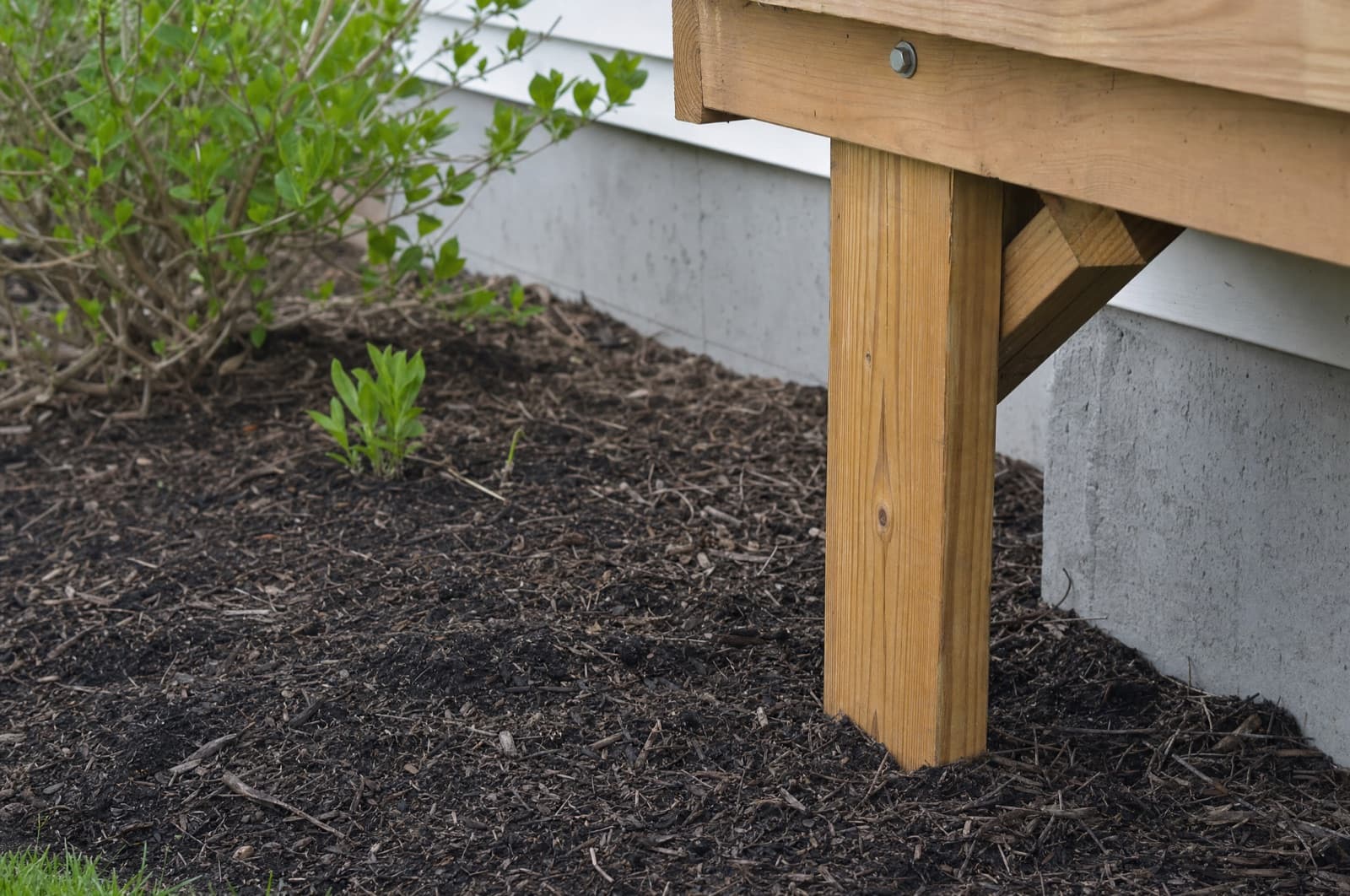
Columns bearing directly on damp concrete or soil, or railing posts set into the ground, give termites both access and moisture in one place. Extension guidance specifically recommends breaking wood-to-soil contact and elevating this kind of wood, the same principle that applies to porch steps and any other near-grade structural member.
Source:University of Kentucky Entomology— ENTFACT-605: Protecting Your Home Against Termites (Potter)
3 levers, honestly ranked
Sorted by what actually moves the driver — primary first, theatre last. Effort is graded so you know what's a five-minute fix and what's a real project.
- Primary — moves the driverHire a pro
Set columns on standoffs or bases and keep railings off grade
Make sure columns bear on metal standoffs or concrete piers rather than directly on soil or standing water, and that railing posts don't run straight into the ground. Elevating and isolating the wood removes both the direct pathway termites use and the wicking moisture that makes column bases vulnerable in the first place, and it also prevents the decay and carpenter-ant damage that's common on New Hampshire porches of this style. Seal and paint the base of each column so it continues shedding water once elevated.
- SupportingWeekend project
Manage water at the porch
Make sure the porch roof and floor shed water away from column and railing bases, and that those bases can actually drain and dry out rather than sitting in a puddle after every rain.
- SupportingQuick DIY
Inspect bases for tubes and softness
Probe column and railing-post bases each spring for a hollow sound or sponginess, and look for mud tubes climbing from the ground toward the base.
Whose job is this, really?
Who actually fixes it
A moisture or building pro
Setting a column onto a proper standoff or base, or resetting a railing post, is carpentry work. A licensed pest professional's role is confirming and addressing any activity actually found at the base.
You find mud tubes at a column or railing base, or wood there is soft and hollow — either is worth a professional inspection.
How this calibrates for NH
UNH Extension specifically lists porch columns and steps among the sites where New Hampshire's structural pests, including carpenter ants, commonly nest, and the same moisture-and-clearance fix that helps with termites addresses that far more common local problem at the same time.
NH-licensed applicator #782664 (NHDAMF, RSA 430) · NEPMA member · family-owned since 2017.
Frequently asked
Sources(3)
- [1]University of Kentucky Entomology
ENTFACT-605: Protecting Your Home Against Termites (Potter)
- [2]UNH Cooperative Extension
Carpenter Ants fact sheet (A.T. Eaton) — NH structural-pest context
- [3]Clemson Cooperative Extension (HGIC)
Subterranean Termite Control
Written & reviewed by
VerifiedDaniel Brady
NH-Licensed Pesticide Applicator · License #782664 (NHDAMF, RSA 430)
Daniel Brady is the New Hampshire–licensed applicator behind Anchor Pest Services, a family-owned pest control company serving the Manchester area since 2017.
Your next step
- termite-mite-prevention-guides
Preventing termites in a home with wood-to-soil contact at porch steps
Read the answer - termite-mite-prevention-guides
Preventing termites in roof eaves and soffits with wood components
Read the answer - faq-pest-damage-and-risks
Can termites or ants damage fences or sheds?
Read the answer
Anchor Pest Services
Have a different pest question?
This one may not be a pesticide job — but if you're facing something that is, we serve Southern New Hampshire with a free inspection and same-day service.
- NH-licensed applicator
- Same-day service
- Pet & family-conscious
NH License #782664 · No obligation · We answer in person