
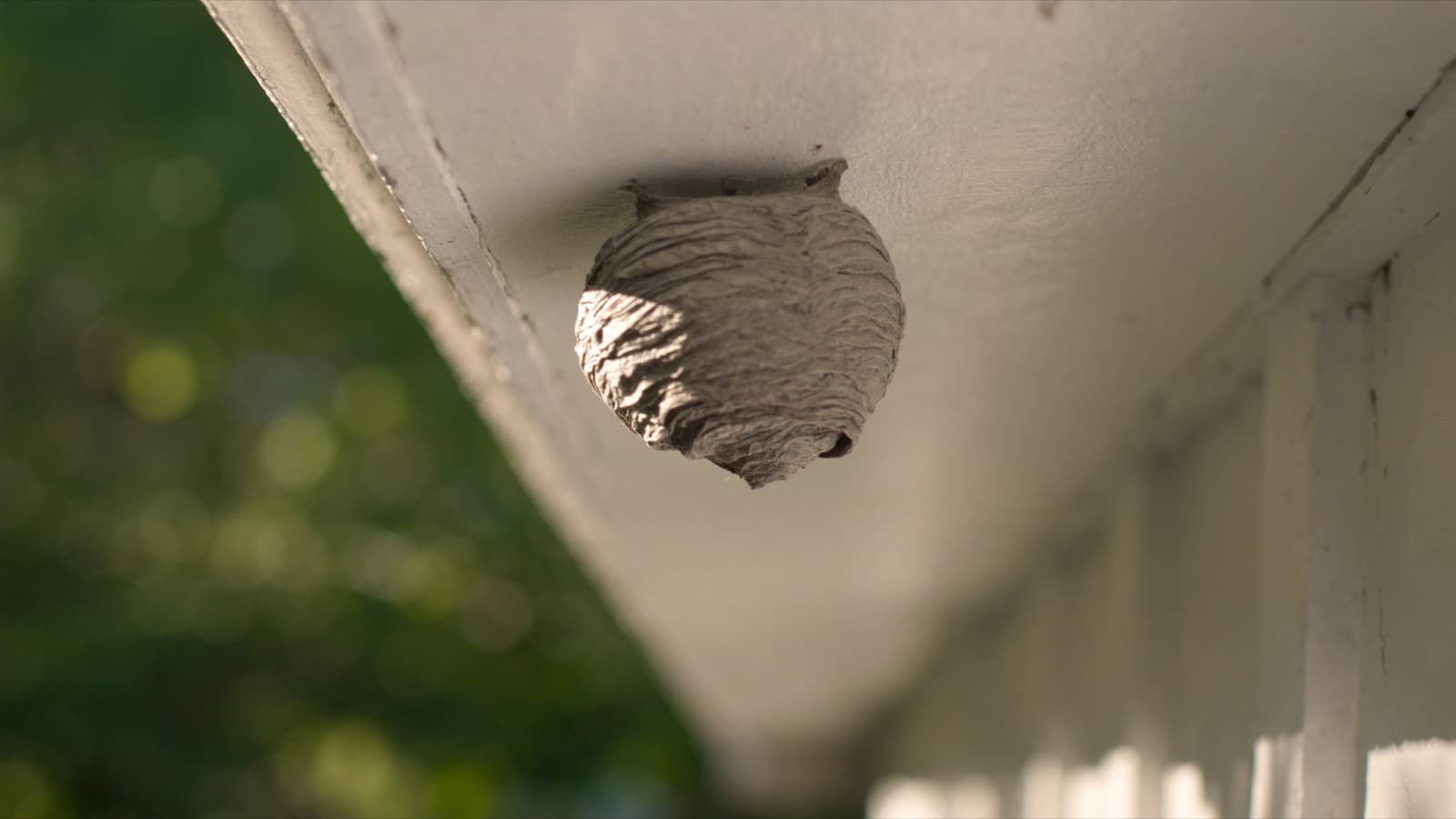
Are Pets at Risk During Nest Removal Efforts?
At a Glance
- The call: Yes. A sting can be dangerous to a pet the same way it can to a person, and pesticide residue adds a second risk gear doesn't remove.
- Your nest: Yellowjacket (aerial, ground, or unknown)
Should you do this? It depends entirely on which nest
The generic question has no generic answer. Your nest is one row below — the others are the argument that this page isn't just selling you a “no.”
One question, six honest answers — one per nest.
- Mud dauber (solitary)
Solitary — no colony to defend, essentially no swarm response. Not on the router's danger end at all.
Go - Paper wasp — small, exposed, early-season nest
Low-to-moderate risk before workers hatch and while the nest is reachable — gear and timing genuinely earn their keep here.
Go with gear - Yellowjacket (aerial, ground, or unknown)Your nest
Large, coordinated colony defense; ground nests add vibration triggers and concealment.
No-go - Bald-faced hornet
Large aerial colony, aggressive when disturbed, often high off the ground.
No-go - European hornet
Concealed cavity nests plus nighttime activity defeat the usual safe-timing rule other species allow.
No-go - Any species, in October
By the time a sustained hard freeze has come through, the colony is already finished and the nest will never be reused.
Do nothing
“Is it safe to remove a wasp nest?” has no answer. “Is it safe to remove THIS nest?” has six.
Derived from: /top-diy-methods per-species verdicts (mud-dauber diy_friendly, paper-wasp doable_with_care, yellowjacket / bald-faced-hornet / European hornet pro_recommended) + /winter-pests-shift/wasps (colony dies at a sustained hard freeze; the nest is never reused).
Why you should doubt us on this
We make money when you call us — so here is a test that doesn't depend on trusting our word.
We make money when you call us for a removal, and a page about protecting pets from that process can read as us building the case for a paid visit rather than a free precaution.
If it's a mud dauber, the sting risk to a curious pet is genuinely low — we say so on our own DIY page, no gear or pro required. The pesticide-residue risk still applies if you use any spray at all, on any nest, and that part has nothing to do with which species is involved.
See the proof on Mud DauberThis page leans no-go mainly because 'nest removal efforts' as asked covers the whole spectrum, including a yellowjacket or hornet colony where an agitated swarm chasing a loose pet is a real, serious risk that gear doesn't remove. A mud dauber knocked down with a broom and no spray carries almost none of that risk — the nest, not the pet, decides the answer.
The full picture
The two separate risks to a pet
A sting to a dog or cat can cause the same range of reactions it can in a person, up to a serious allergic response in an animal that turns out to be sensitive — and a pet can't tell you it's in trouble the way a person can. Separately, most pesticide products used against wasp nests carry label guidance to keep children and pets out of the treated area until it has dried; that's a residue and ingestion concern, not a sting concern, and it applies even to a nest with almost no sting risk at all.
Where the risk is worst, and where it's nearly absent
A pet that blunders into a defended yellowjacket or bald-faced hornet colony — especially an underground nest a dog might dig at or step near — can trigger the same coordinated, multi-sting response a person would face, and a panicked animal running through a yard can end up stung many times before anyone can intervene. A solitary mud dauber poses essentially none of that risk, since there's no colony to defend and no swarm response to trigger. The pesticide-residue risk, though, doesn't scale down the same way — if a spray is used at all, keep pets away regardless of species until it's dry.
What actually protects a pet here
Remove pets from the yard or room entirely before starting any nest work, and keep them out until any spray has fully dried, following the product's own label guidance. That single step covers both risk channels at once and doesn't depend on correctly identifying the species first. If you're not sure what's in the nest, treating the situation as if it carries the higher risk — for the pet's sake as much as your own — is the safer default until you know otherwise.
The honest line — Yes. A sting can be dangerous to a pet the same way it can to a person, and pesticide residue adds a second risk gear doesn't remove.
Key takeaways
- Pets face two separate risks: stings (which can be dangerous the same way they are for people) and pesticide residue.
- Sting risk to a pet scales with the nest — low for a solitary mud dauber, high for a defended colony.
- Pesticide-residue risk applies regardless of species whenever a spray is used at all.
- The simplest protection is removing pets from the area before starting, and keeping them out until any spray is dry.
Where to go next
Identification, sting treatment, per-species DIY viability, and nest-reuse facts each live on the hub that owns them. We route, we don't rebuild.
DIY viability by species
The router's source of truth — which nests are DIY-able.
Go thereIdentify the species
Tell the wasps, hornets, and lookalikes apart.
Go thereSting & allergy treatment
What to do about a sting or a reaction.
Go thereNest reuse & winter
The colony dies at frost; the nest is never reused.
Go there
Not sure if your pet is actually at risk?
It depends on which nest you have. A licensed technician can identify it and handle the removal without putting a pet anywhere near it.
Frequently asked questions
Sources(3)
- [1]UNH Cooperative Extension — Bees, Wasps and Hornetsextensionverified 2026-07-17
- [2]Alabama Cooperative Extension System — Outdoor Stinging Insectsextensionverified 2026-07-17
- [3]CDC/NIOSH — Stinging Insect Safetygovverified 2026-07-17
Written & reviewed by
VerifiedDaniel Brady
NH-Licensed Pesticide Applicator · License #782664 (NHDAMF, RSA 430)
Daniel Brady is the New Hampshire–licensed applicator behind Anchor Pest Services, a family-owned pest control company serving the Manchester area since 2017.
Last updated 2026-07-17
Before you touch it
Keep pets fully out of it — let us confirm what's there
A quick identification tells you whether the risk to your pet is minimal or serious.
- Family-owned since 2017
- NH License #782664, category F1 (RSA 430, NHDAMF)
- Member, NEPMA