
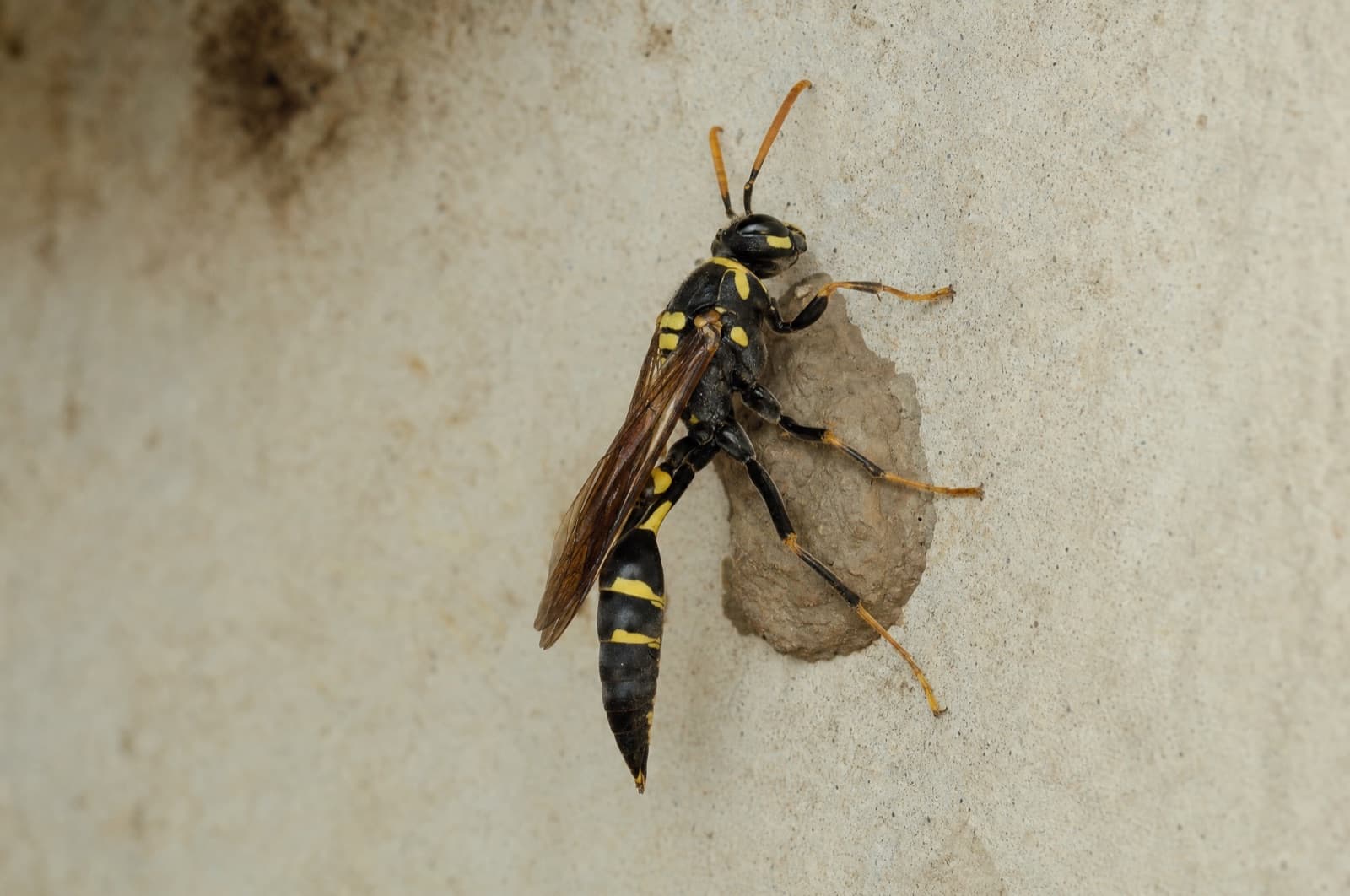
How to Get Rid of Mud Daubers
At a glance
- Difficulty: Beginner
- Time: A few minutes per nest
- Cost: Low — a putty knife and dustpan
- Success: High — nest scraping is simple and effective
Can you DIY Mud Dauber?
The verdict on Mud Dauber DIY
DIY-friendly — and one of the safest stinging-insect jobs in this cluster.
Mud daubers are solitary wasps that build distinctive mud tube nests under eaves, in garages, and in sheds, provisioning each cell with paralyzed spiders (including, notably, black widows) for their larvae. UNH Extension notes they "are not particularly aggressive, and since they nest individually, disturbing a nest doesn't call out a large swarm of defenders." Because there's no colony to defend, simply scraping the mud nest off with a putty knife — usually with no chemical needed — solves the problem safely.
The 5 DIY methods — honestly graded
Every approach graded for this species, in IPM order — prevention first, chemistry late. Pick a method to see how it works, the steps, and what it actually takes.
Prevention / Exclusion
ModerateReducing spider prey and mud sources, plus sealing sheltered nooks, cuts down on new nests.
Mud daubers need both mud (from standing water or damp soil) and spider prey to build and provision nests. Removing standing water sources and sealing sheltered eave and garage nooks makes a structure less attractive for nesting.
Best for: Reducing new nest-building over a season
Eliminate standing water and mud sources
Fix leaky hoses or gutters and address damp soil patches near the foundation that provide nest-building material.
Seal sheltered nooks
Caulk gaps under eaves, in garages, and in sheds where daubers like to attach nests.
Tools & materials
Why DIY falls short here
Not scare tactics — the specific, proportionate reasons a home attempt can stall for this species.
Old nests can be taken over by more aggressive insects
Abandoned mud tubes are sometimes occupied by other, more defensive wasps — leaving old nests up indefinitely invites a new, less predictable tenant.
Recurring mud and prey sources
Reliable mud (standing water, damp soil) and spider prey keep drawing new females to build in the same spot — removal without addressing the source just means scraping again next season.
How risky is it, really?
An honest read — most nuisance species are genuinely low risk, and we say so.
Mud daubers are solitary and non-aggressive. They do not defend their nests the way social wasps do, and disturbing a nest does not summon a swarm — they rarely sting at all, and only if handled or trapped against skin. This is genuinely one of the lowest-risk species in this cluster.
- Sting if directly handled or trapped against skinRare
Mud daubers do not defend nests and are not aggressive; a sting requires direct handling in nearly all cases
UNH Cooperative Extension
- Old nest occupied by a more aggressive speciesOccasional
The main reason to remove an old, vacant nest rather than leave it up indefinitely
Purdue Extension
Confirm Before You Scrape
Mud daubers are one of the safest DIY stinging-insect jobs there is — but if you're unsure of the ID or the nest is out of reach, Anchor Pest Services can help across southern and central New Hampshire. Family-owned since 2017, NH license #782664.
Call a pro when…
- You suspect an old nest has been taken over by a more aggressive wasp species
- The nest is somewhere you can't safely reach without a ladder
- You'd rather not handle nest removal yourself, even though the risk is low
General Pest Control
Almost nobody needs a pro for mud daubers — nest scraping handles nearly every case yourself. Anchor is available if you'd simply rather not do it, or if a nest turns out to be occupied by something more defensive.
Keep them out
- Fix leaky hoses/gutters and damp soil patches near the foundation
- Seal sheltered nooks under eaves and in garages/sheds
- Scrape off old nests once inactive to prevent takeover by other insects
Mud daubers in New Hampshire
In New Hampshire, mud dauber females build and provision nests through summer, when both mud (from damp soil or standing water) and spider prey are available. Activity winds down before the first hard frost, roughly October 19–29 in Manchester (NOAA), and nests found over winter are safe to scrape off at any time since they're inactive.
Peak season
Summer nest-building and provisioning
First-frost anchor
Manchester first hard frost ~Oct 19 (50%) / Oct 29 (80%), NOAA 1991–2020
Make sure it's a Mud Dauber
Two quick detours worth taking — confirm the ID, then learn what drew it in so it doesn't come back.
Frequently asked
Sources & further reading(4)
- [1]UNH Cooperative Extension — Stinging Insects (Resource000532/Rep554)
Non-aggressive, solitary nesting behavior
extensionverified 2026-07-13 - [2]Purdue Extension (E-253) — Mud Dauber Wasps
Nest biology, provisioning behavior
extensionverified 2026-07-13 - [3]UC ANR Green Blog — Why Mud Daubers Are Spider Patrol
Spider-hunting behavior, including black widows
extensionverified 2026-07-13 - [4]PestWorld (NPMA) — Mud Dauber Wasps
General identification and removal guidance
industryverified 2026-07-13
Written & reviewed by
VerifiedDaniel Brady
NH-Licensed Pesticide Applicator · License #782664 (NHDAMF, RSA 430)
Daniel Brady is the New Hampshire–licensed applicator behind Anchor Pest Services, a family-owned pest control company serving the Manchester area since 2017.
Last updated July 2026
Other species you can tackle
Same category — the dot shows each one's DIY verdict at a glance (green = friendly, amber = doable with care, red = call a pro).
Professional Pest Control
Confirm Before You Scrape
Mud daubers are one of the safest DIY stinging-insect jobs there is — but if you're unsure of the ID or the nest is out of reach, Anchor Pest Services can help across southern and central New Hampshire. Family-owned since 2017, NH license #782664.
- Licensed NH applicators (#782664)
- Accurate identification for mud tube nests
- Free inspection — same-day service across southern NH
NH License #782664 · No obligation · We answer in person
Your next step
- Book a NH pro
Pest Control Services
Licensed, family-owned pest control across southern NH.
Book now - What to do next
Mud Dauber — Quick ID for New Hampshire Homeowners
Read the answer - What to do next
Can mud dauber nests stain walls or eaves?
Read the answer - What to do next
Why do pests chew or gnaw on everything?
Read the answer - What to do next
Can Removing a Nest Provoke Multiple Stings From Wasps?
Read the answer - Also relevant
Mud Dauber — Quick ID for New Hampshire Homeowners
Read the answer