
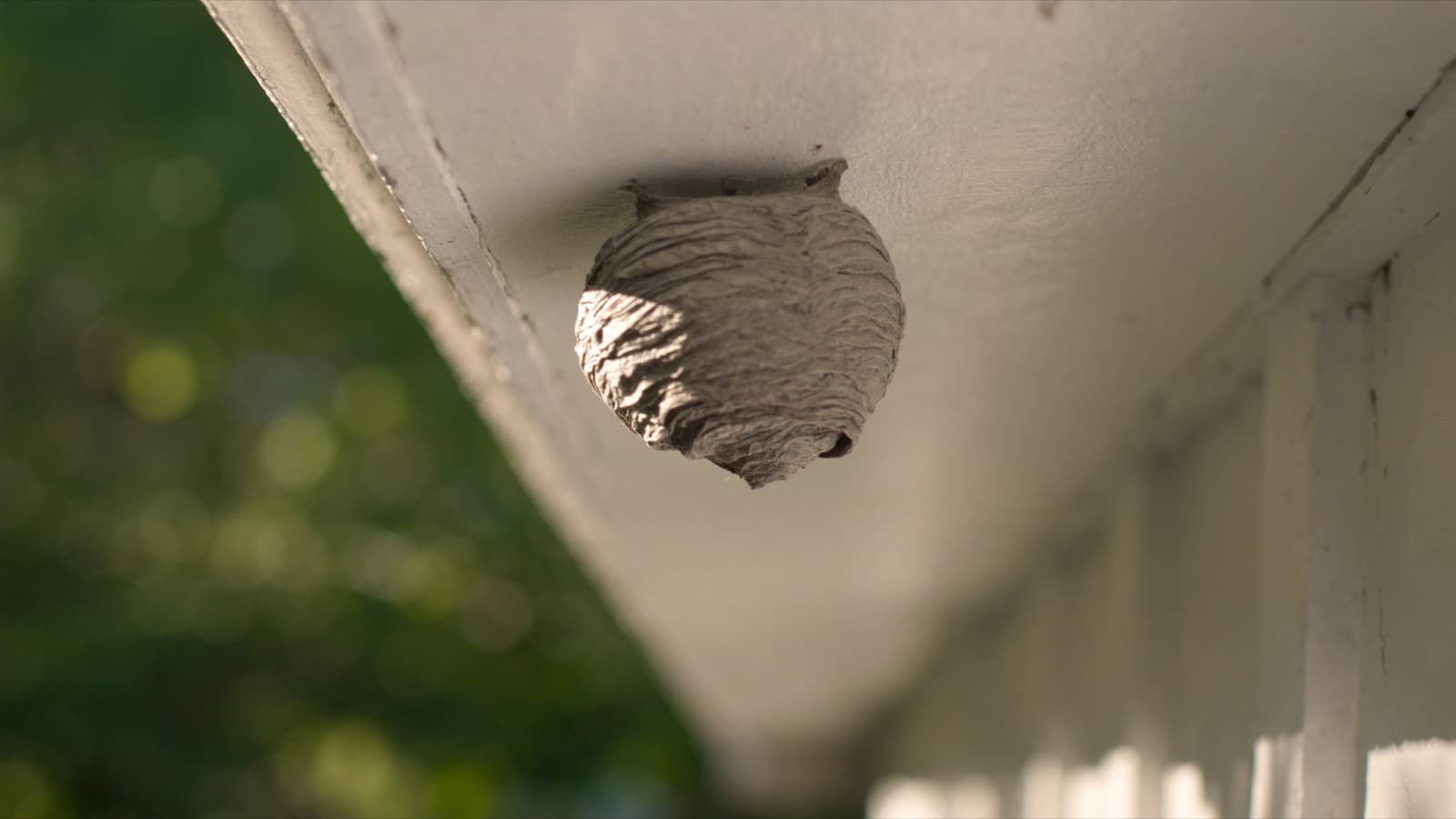
Are Underground Yellowjacket Nests More Hazardous to Tackle?
At a Glance
- The call: Yes, materially. Concealment, vibration triggers, and a colony a surface spray often can't fully reach make underground nests the worst category to tackle.
- Your nest: Yellowjacket (aerial, ground, or unknown)
Should you do this? It depends entirely on which nest
The generic question has no generic answer. Your nest is one row below — the others are the argument that this page isn't just selling you a “no.”
One question, six honest answers — one per nest.
- Mud dauber (solitary)
Solitary — no colony to defend, essentially no swarm response. Not on the router's danger end at all.
Go - Paper wasp — small, exposed, early-season nest
Low-to-moderate risk before workers hatch and while the nest is reachable — gear and timing genuinely earn their keep here.
Go with gear - Yellowjacket (aerial, ground, or unknown)Your nest
Large, coordinated colony defense; ground nests add vibration triggers and concealment.
No-go - Bald-faced hornet
Large aerial colony, aggressive when disturbed, often high off the ground.
No-go - European hornet
Concealed cavity nests plus nighttime activity defeat the usual safe-timing rule other species allow.
No-go - Any species, in October
By the time a sustained hard freeze has come through, the colony is already finished and the nest will never be reused.
Do nothing
“Is it safe to remove a wasp nest?” has no answer. “Is it safe to remove THIS nest?” has six.
Derived from: /top-diy-methods per-species verdicts (mud-dauber diy_friendly, paper-wasp doable_with_care, yellowjacket / bald-faced-hornet / European hornet pro_recommended) + /winter-pests-shift/wasps (colony dies at a sustained hard freeze; the nest is never reused).
Why you should doubt us on this
We make money when you call us — so here is a test that doesn't depend on trusting our word.
We make money when you call us to handle exactly this kind of nest, so a page saying underground yellowjacket colonies are the most hazardous type is also, not coincidentally, an argument for hiring us.
If it's a mud dauber, this entire hazard profile doesn't apply — it's solitary, doesn't defend a nest, and we say it's a fine DIY case on our own page. A small, exposed, early-season paper wasp nest is also a real DIY exception with basic gear. Underground yellowjacket colonies are a different animal from both.
See the proof on Mud DauberThe difference here is concealment plus scale: a ground nest can hold thousands of workers, is triggered by simple vibration, and often can't be fully reached by a surface spray the way an exposed aerial nest can. That combination — not just 'it's a colony' — is what pushes this past what gear and caution can make safe.
The full picture
Why underground specifically raises the risk
Cooperative-extension sources note that ground vibration from something as ordinary as mowing the lawn can provoke an underground yellowjacket colony, which is a trigger an aerial paper-wasp nest simply doesn't share. The entrance itself is often small and easy to miss until it's already been disturbed, so many underground encounters happen by accident rather than during an intentional removal attempt.
Why treatment itself is harder to get right
A ground colony's tunnel system can extend well beyond the visible opening, which means a spray aimed only at the entrance may not reach the full nest — leaving behind an agitated colony that's now only partly treated rather than eliminated. Eastern yellowjacket colonies can hold several thousand workers at peak size, all capable of a coordinated defense once disturbed, which is a very different scale from the handful of cells in a solitary mud dauber's nest.
What this means for the decision
Underground concealment plus colony scale plus a treatment method that may not fully reach the nest is why this specific category — not yellowjackets in general, and certainly not every wasp nest — is the one this hub routes to a professional regardless of gear, timing, or caution. The router above shows where this sits relative to the genuinely lower-risk cases.
The honest line — Yes, materially. Concealment, vibration triggers, and a colony a surface spray often can't fully reach make underground nests the worst category to tackle.
Key takeaways
- Ground vibration from mowing, trimming, or foot traffic can trigger an underground colony by accident.
- Underground entrances are often small and easy to miss until already disturbed.
- A surface spray may not reach the full underground nest, leaving it only partly treated.
- This combination of concealment and scale is why underground yellowjacket nests are a professional job.
Where to go next
Identification, sting treatment, per-species DIY viability, and nest-reuse facts each live on the hub that owns them. We route, we don't rebuild.
DIY viability by species
The router's source of truth — which nests are DIY-able.
Go thereIdentify the species
Tell the wasps, hornets, and lookalikes apart.
Go thereSting & allergy treatment
What to do about a sting or a reaction.
Go thereNest reuse & winter
The colony dies at frost; the nest is never reused.
Go there
Found a hole in the ground with wasps coming and going?
That's exactly the profile our licensed technicians handle — concealed, colony-scale, and hard to fully treat from the surface.
Frequently asked questions
Sources(3)
- [1]Alabama Cooperative Extension System — Outdoor Stinging Insectsextensionverified 2026-07-17
- [2]Ohio State University Extension — Controlling Wasps, Yellowjackets and Bees (HYG-2075)extensionverified 2026-07-17
- [3]Virginia Tech Extension — Yellowjackets, Hornets and Paper Wasps (ENTO-49)extensionverified 2026-07-17
Written & reviewed by
VerifiedDaniel Brady
NH-Licensed Pesticide Applicator · License #782664 (NHDAMF, RSA 430)
Daniel Brady is the New Hampshire–licensed applicator behind Anchor Pest Services, a family-owned pest control company serving the Manchester area since 2017.
Last updated 2026-07-17
Before you touch it
Underground nests are our most common call for a reason
Let a licensed technician confirm what's there and handle it completely, the first time.
- Family-owned since 2017
- NH License #782664, category F1 (RSA 430, NHDAMF)
- Member, NEPMA